
Polymer Modified Bitumen Market Report 2026
Global Outlook – By Product Type (Thermoplastic Polymer, Thermoplastic Elastomer, Plastomers, Styrene Butadiene Styrene Modified Bitumen, Crumb Rubber Modified Bitumen, Other Product Types), By Distribution Channel (Direct Sale, Distributor), By Application (Road Construction, Roofing, Waterproofing, Airport Runways, Pavement Maintenance, Other Applications), By End-User Industry (Construction, Infrastructure, Transportation, Manufacturing) – Market Size, Trends, Strategies, and Forecast to 2030
Polymer Modified Bitumen Market Overview
• Polymer Modified Bitumen market size has reached to $12.15 billion in 2025 • Expected to grow to $16.33 billion in 2030 at a compound annual growth rate (CAGR) of 6% • Growth Driver: Surge In Eco-friendly Road Construction Materials Fueling The Growth Of The Market Due To Sustainability And Cost Efficiency Benefits • Market Trend: Innovative Approaches Enable High Recycled Asphalt Content In Surface Layers • Asia-Pacific was the largest region and fastest growing region.What Is Covered Under Polymer Modified Bitumen Market?
Polymer modified bitumen refers to a bitumen mixture enhanced with polymers such as styrene-butadiene-styrene (SBS) or ethylene-vinyl acetate (EVA) to improve its performance characteristics. It offers superior elasticity, resistance to deformation, and durability compared to conventional bitumen. This makes it ideal for high-stress applications such as highways, airports, and bridges. The main product types of polymer modified bitumen include thermoplastic polymer, thermoplastic elastomer, thermosetting polymer, plastomers, styrene-butadiene-styrene-modified bitumen, crumb rubber-modified bitumen, and others. Thermoplastic polymer refers to a type of plastic that softens when heated and hardens when cooled, allowing it to be reshaped multiple times without altering its chemical structure, and the grades are given as polymer modified bitumen 40, polymer modified bitumen 70, and polymer modified bitumen 120. The distribution channels are direct sales, distributors, and online sales. There are various applications, such as road construction, roofing, waterproofing, airport runways, pavement maintenance, and others, and the key end-user industries are construction, infrastructure, transportation, manufacturing, and oil and gas.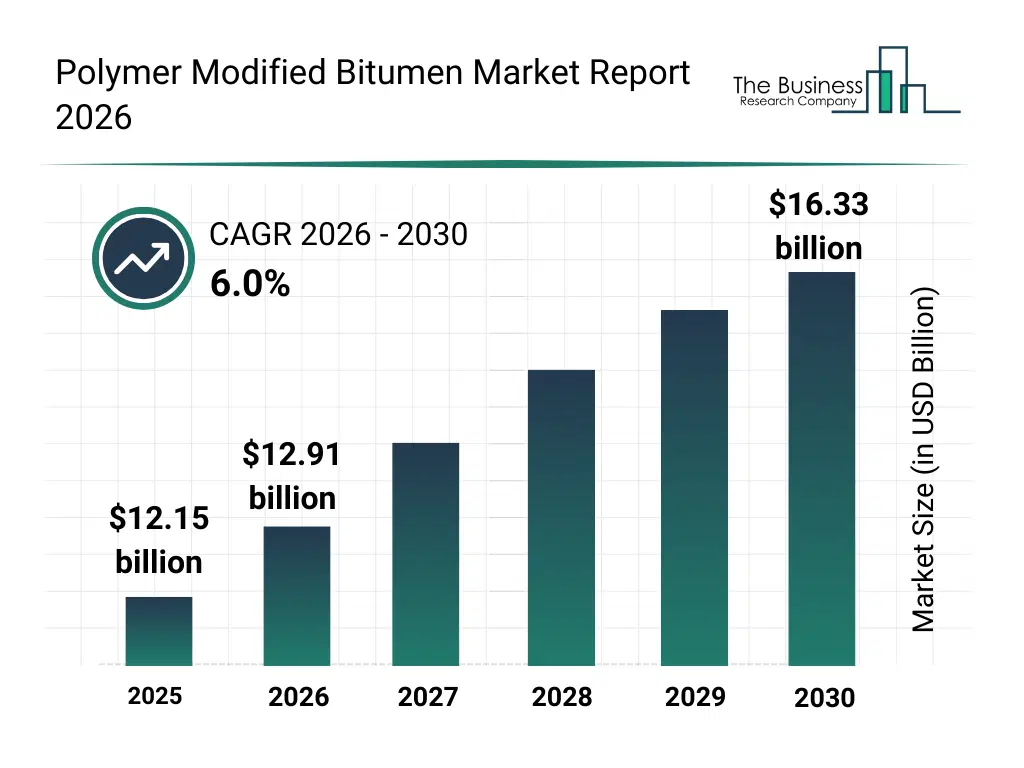
What Is The Polymer Modified Bitumen Market Size and Share 2026?
The polymer modified bitumen market size has grown strongly in recent years. It will grow from $12.15 billion in 2025 to $12.91 billion in 2026 at a compound annual growth rate (CAGR) of 6.3%. The growth in the historic period can be attributed to road infrastructure expansion, bitumen modification technologies, demand for load bearing pavements, urban transportation growth, adoption in roofing applications.What Is The Polymer Modified Bitumen Market Growth Forecast?
The polymer modified bitumen market size is expected to see strong growth in the next few years. It will grow to $16.33 billion in 2030 at a compound annual growth rate (CAGR) of 6.0%. The growth in the forecast period can be attributed to smart road initiatives, increased public infrastructure spending, climate resistant pavements, innovation in polymer additives, airport modernization projects. Major trends in the forecast period include rising demand for durable road surfaces, expansion of highway and airport projects, growing use of SBS modified bitumen, increased adoption in waterproofing systems, focus on long life pavement solutions.
Global Polymer Modified Bitumen Market Segmentation
1) By Product Type: Thermoplastic Polymer, Thermoplastic Elastomer, Plastomers, Styrene Butadiene Styrene Modified Bitumen, Crumb Rubber Modified Bitumen, Other Product Types 2) By Distribution Channel: Direct Sale, Distributor 3) By Application: Road Construction, Roofing, Waterproofing, Airport Runways, Pavement Maintenance, Other Applications 4) By End-User Industry: Construction, Infrastructure, Transportation, Manufacturing Subsegments: 1) By Thermoplastic Polymer: Polyethylene (PE), Polypropylene (PP), Ethylene Vinyl Acetate (EVA) 2) By Thermoplastic Elastomer: Styrene-Butadiene-Styrene (SBS), Styrene-Butadiene Rubber (SBR), Styrene-Isoprene-Styrene (SIS) 3) By Plastomers: Atactic Polypropylene (APP), Polyethylene Vinyl Acetate (PEVA) 4) By Styrene Butadiene Styrene (SBS) Modified Bitumen: Linear Styrene Butadiene Styrene Modified Bitumen, Radial Styrene Butadiene Styrene Modified Bitumen 5) By Crumb Rubber Modified Bitumen: Ambient Process Crumb Rubber, Wet Process Crumb Rubber 6) By Other Product Types: Polyphosphoric Acid (PPA) Modified Bitumen, Ethylene-Vinyl Acetate Modified BitumenWhat Is The Driver Of The Polymer Modified Bitumen Market?
The growing demand for eco-friendly road construction materials is expected to propel the growth of the polymer modified bitumen market going forward. Eco-friendly road construction materials refer to sustainable, recycled, or low-impact materials used to reduce environmental harm in road building. The rise in eco-friendly road construction materials is due to their ability to reduce environmental impact by using recycled content, which conserves natural resources and lowers carbon emissions. Polymer-modified bitumen enhances eco-friendly road construction by improving durability and flexibility, which extends pavement life and reduces the need for frequent repairs, thereby conserving materials and minimizing environmental impact. For instance, in February 2024, according to Transport for NSW, an Australia-based road safety organization, it reduced lives lost and serious injuries reported using 85% recycled asphalt, repurposing 257,700 tonnes of materials, saving over $5 million, cutting emissions, and aiming to replace 35% of traditional cement with alternative materials, surpassing the 30% target. Therefore, the growing demand for eco-friendly road construction materials is driving the growth of the polymer modified bitumen industry.Key Players In The Global Polymer Modified Bitumen Market
Major companies operating in the polymer modified bitumen market are ExxonMobil Corporation, Shell plc, BP plc, Marathon Petroleum Corporation, ENEOS Corporation, Indian Oil Corporation Limited, Hindustan Petroleum Corporation Limited, Repsol S.A., Gazprom Neft, Tipco Asphalt Public Company Limited, CEPSA, TotalEnergies SE, Valero Energy Corporation, Nynas AB, Alma Petroli S.p.A., Büsscher & Hoffmann GmbH, Polyglass S.p.A., Sinopec Group, China National Petroleum Corporation, RAHA Bitumen Inc.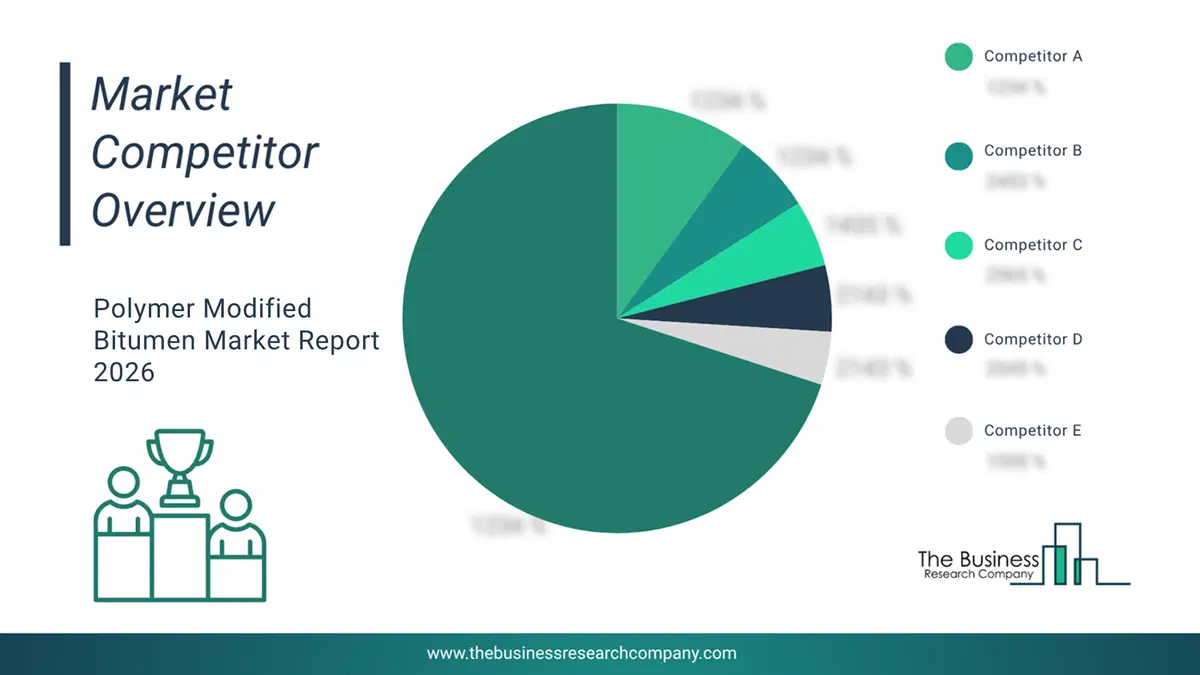
This chart is for illustrative purposes; the full report includes a detailed competitor analysis and comprehensive overview of the top 10 companies in the market.
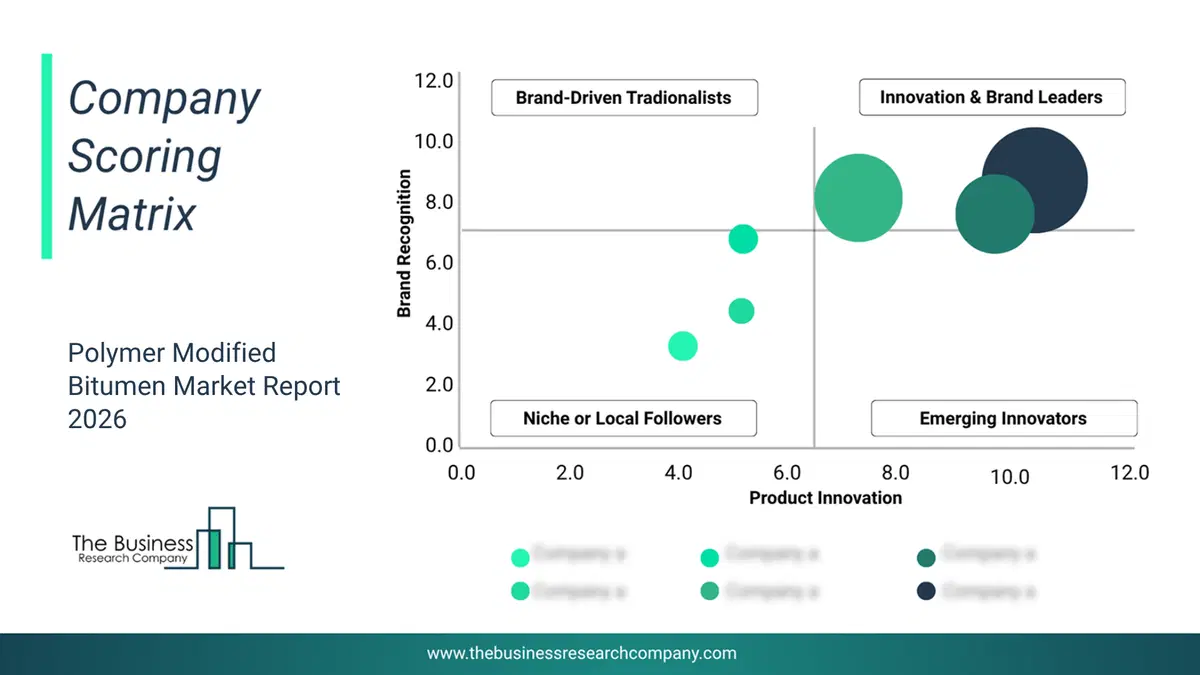
This chart maps companies by product innovation and brand strength, with bubble size indicating relative revenue, helping identify market leaders, challengers, and niche players. This is an illustrative chart; the full report provides a complete and accurate competitive analysis.
Global Polymer Modified Bitumen Market Trends and Insights
Major companies operating in the polymer modified bitumen market are focusing on advanced innovation, such as high reclaimed asphalt content incorporation, enhanced polymer formulations for improved durability, eco-friendly and sustainable product development, compatibility with warm mix asphalt technologies, and digital solutions for optimized pavement performance and lifecycle management. High reclaimed asphalt content refers to the increased use of recycled asphalt materials in new asphalt mixtures to promote sustainability and reduce raw material consumption. For instance, in April 2025, Kraton Corporation, a US-based specialty polymer and bio-based chemical manufacturer, launched the new CirKular+ Paving Circularity Series. This series is designed to address the paving industry's growing demand for sustainable solutions by maximizing reclaimed asphalt usage. It allows for the inclusion of up to 50% or more reclaimed asphalt in surface layer mixes. The innovation improves both the ease of processing and the overall performance of the asphalt. Additionally, it supports efforts to lower greenhouse gas emissions in paving applications.What Are Latest Mergers And Acquisitions In The Polymer Modified Bitumen Market?
In December 2024, Pankas Group, a Netherlands-based industrial solutions company, acquired Ooms Producten B.V. for an undisclosed amount. With this acquisition, Pankas Group aims to expand its product portfolio and strengthen its position in the industrial solutions market by integrating Ooms Producten’s expertise and offerings. Ooms Producten B.V. is a Netherlands-based company that specializes in industrial products and solutions for manufacturing and processing applications.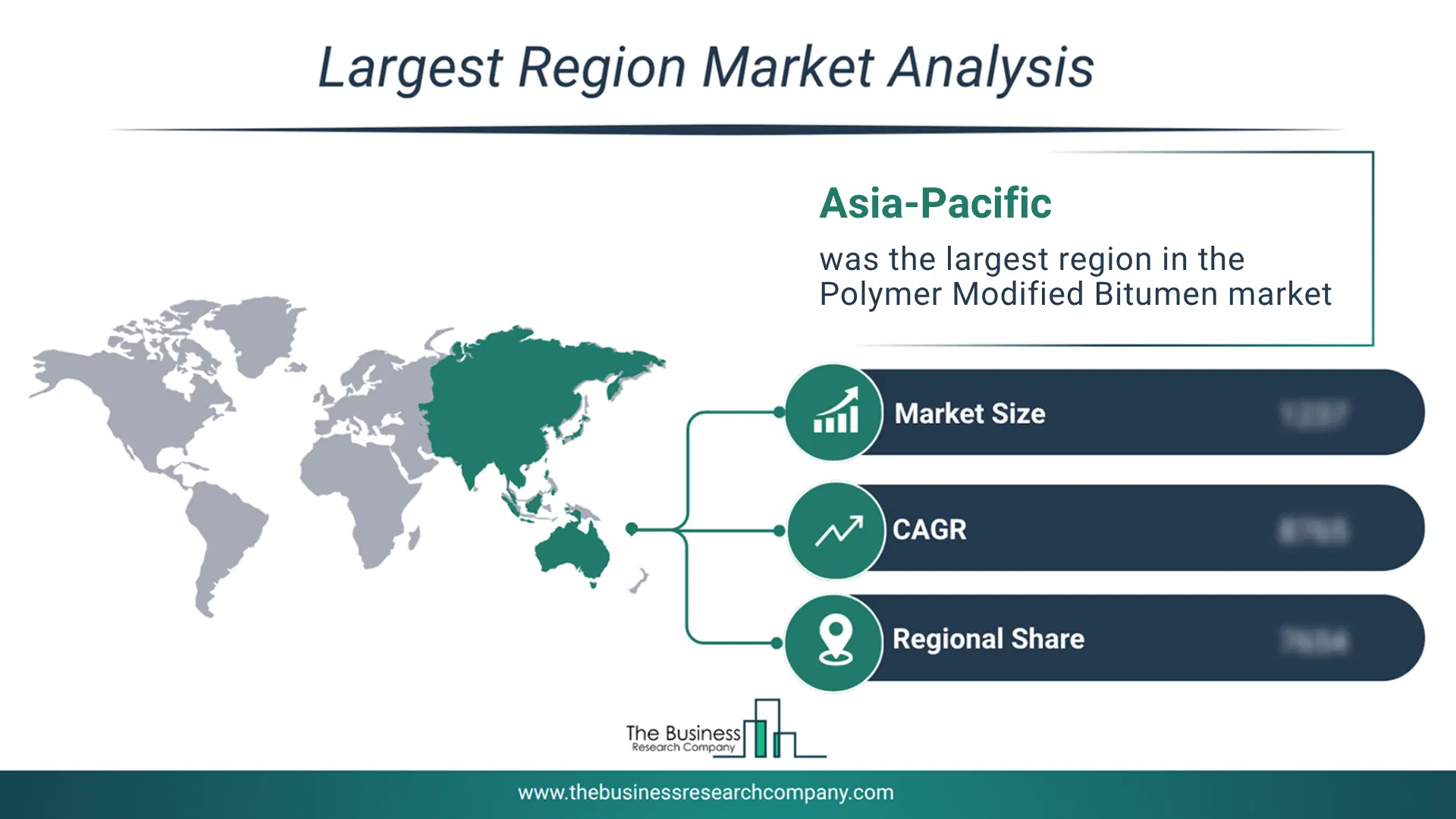
Regional Insights
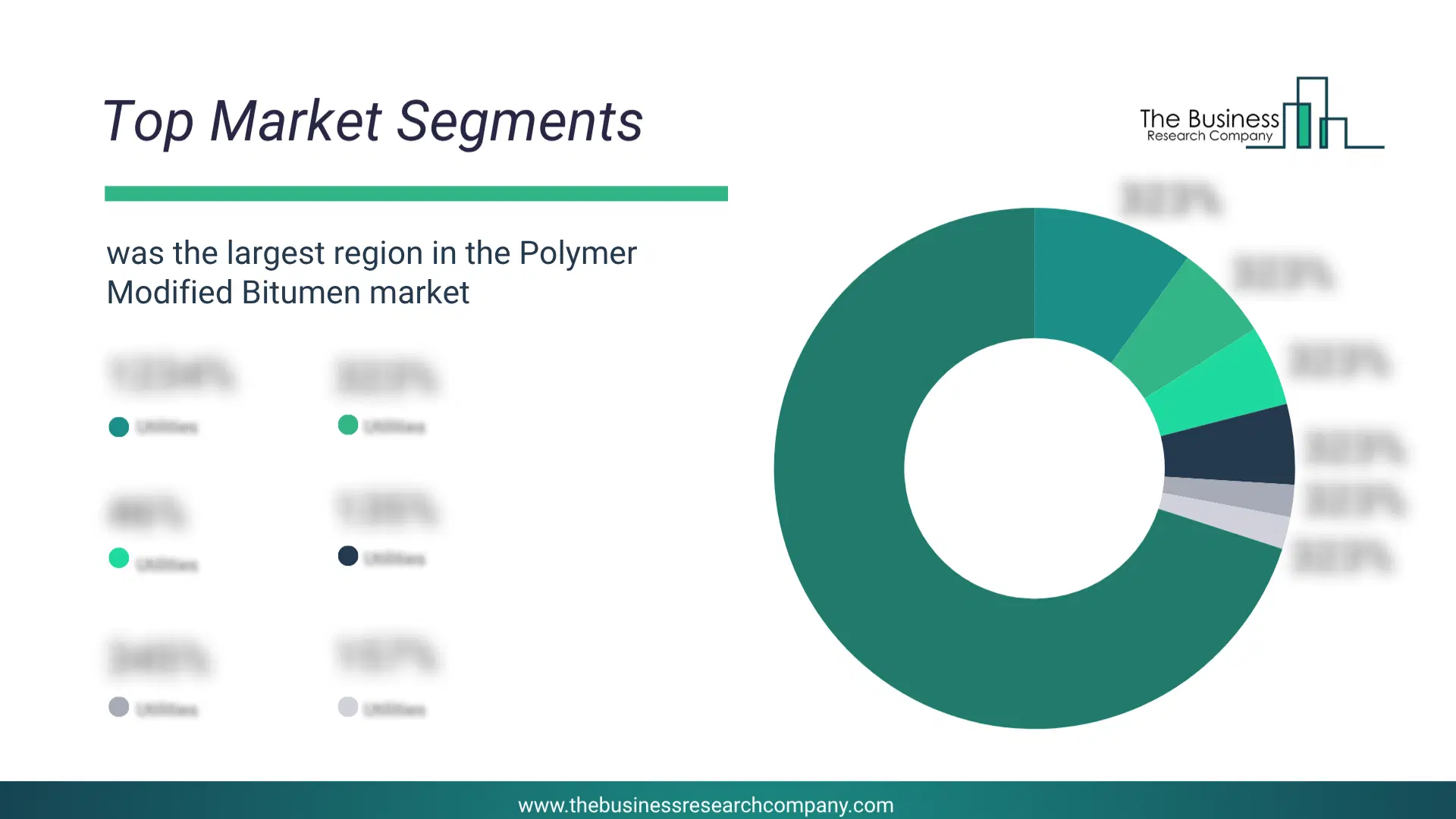
Asia-Pacific was the largest region in the polymer modified bitumen market in 2025. The regions covered in this market report are Asia-Pacific, South East Asia, Western Europe, Eastern Europe, North America, South America, Middle East, Africa The countries covered in this market report are Australia, Brazil, China, France, Germany, India, Indonesia, Japan, Taiwan, Russia, South Korea, UK, USA, Canada, Italy, SpainWhat Defines the Polymer Modified Bitumen Market?
The polymer modified bitumen market consists of sales of latex-modified bitumen, recycled plastic-modified bitumen, and polyisobutylene (PIB)-modified bitumen. Values in this market are ‘factory gate’ values, that is, the value of goods sold by the manufacturers or creators of the goods, whether to other entities (including downstream manufacturers, wholesalers, distributors, and retailers) or directly to end customers. The value of goods in this market includes related services sold by the creators of the goods.How is Market Value Defined and Measured?
The market value is defined as the revenues that enterprises gain from the sale of goods and/or services within the specified market and geography through sales, grants, or donations in terms of the currency (in USD unless otherwise specified). The revenues for a specified geography are consumption values that are revenues generated by organizations in the specified geography within the market, irrespective of where they are produced. It does not include revenues from resales along the supply chain, either further along the supply chain or as part of other products.
This chart presents market attractiveness based on a quantitative evaluation of growth, competition, strategic alignment, and risk, offering a clear view of opportunity areas for decision-making. This chart is for illustrative purposes; the full report contains the complete analysis.

This chart highlights the Total Addressable Market (TAM) by estimating the maximum revenue opportunity using an assumption-driven approach, supporting strategic planning and opportunity sizing across markets. The chart is illustrative; the full report provides a more comprehensive analysis.
What Key Data and Analysis Are Included in the Polymer Modified Bitumen Market Report 2026?
The polymer modified bitumen market research report is one of a series of new reports from The Business Research Company that provides market statistics, including industry global market size, regional shares, competitors with the market share, detailed market segments, market trends and opportunities, and any further data you may need to thrive in the polymer modified bitumen industry. The market research report delivers a complete perspective of everything you need, with an in-depth analysis of the current and future state of the industry.Polymer Modified Bitumen Market Report Forecast Analysis
| Report Attribute | Details |
|---|---|
| Market Size Value In 2026 | $12.91 billion |
| Revenue Forecast In 2030 | $16.33 billion |
| Growth Rate | CAGR of 6.3% from 2026 to 2030 |
| Base Year For Estimation | 2025 |
| Actual Estimates/Historical Data | 2020-2025 |
| Forecast Period | 2026 - 2030 |
| Market Representation | Revenue in USD Billion and CAGR from 2026 to 2030 |
| Segments Covered | Product Type, Distribution Channel, Application, End-User Industry |
| Regional Scope | Asia-Pacific, Western Europe, Eastern Europe, North America, South America, Middle East, Africa |
| Country Scope | The countries covered in this market report are Australia, Brazil, China, France, Germany, India, Indonesia, Japan, Taiwan, Russia, South Korea, UK, USA, Canada, Italy, Spain |
| Key Companies Profiled | ExxonMobil Corporation, Shell plc, BP plc, Marathon Petroleum Corporation, ENEOS Corporation, Indian Oil Corporation Limited, Hindustan Petroleum Corporation Limited, Repsol S.A., Gazprom Neft, Tipco Asphalt Public Company Limited, CEPSA, TotalEnergies SE, Valero Energy Corporation, Nynas AB, Alma Petroli S.p.A., Büsscher & Hoffmann GmbH, Polyglass S.p.A., Sinopec Group, China National Petroleum Corporation, RAHA Bitumen Inc. |
| Customization Scope | Request for Customization |
| Pricing And Purchase Options | Explore Purchase Options |