
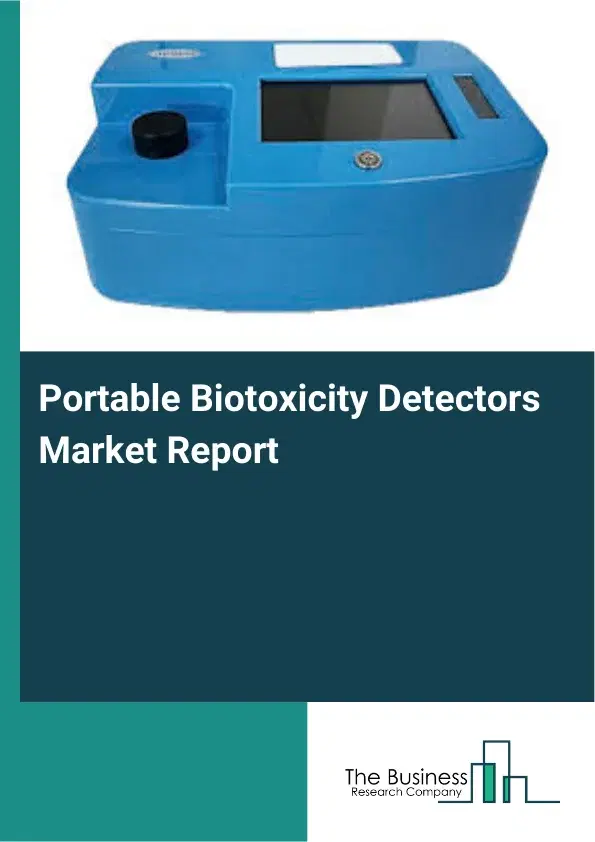
Portable Biotoxicity Detectors Market Report 2026
Global Outlook – By Product Type (Portable Biotoxicity Detectors, Stationary Biotoxicity Detectors, Handheld Detectors, Wearable Detectors), By Deployment Mode (On-field, On-site, In-lab), By Technology (Biosensors, Luminescent Microorganisms, Enzymatic Biosensors, Electrochemical Biosensors, Microfluidic Devices), By Application (Water Quality Testing, Soil Monitoring, Air Quality Monitoring, Industrial Waste Monitoring, Food Safety Testing) – Market Size, Trends, Strategies, and Forecast to 2030
Portable Biotoxicity Detectors Market Overview
• Portable Biotoxicity Detectors market size has reached to $1.03 billion in 2025 • Expected to grow to $2.31 billion in 2030 at a compound annual growth rate (CAGR) of 17.5% • Growth Driver: Rising Threat Of Biological Hazards Fueling The Growth Of The Market Due To Increasing Zoonotic Outbreaks And Public Health Urgency • Market Trend: Enhancing Pathogen Identification Through Miniaturized Optical And Nanomaterial Based Sensing Platforms • North America was the largest region in 2025 and Asia-Pacific is the fastest growing region.What Is Covered Under Portable Biotoxicity Detectors Market?
Portable biotoxicity detectors are compact devices designed to quickly identify and measure the presence of harmful biological substances in various environments. They use specialized sensors and analytical techniques to detect toxins, pathogens, or other biohazards, providing rapid and reliable results. These detectors are useful for environmental monitoring, safety assessments, and emergency response situations where immediate detection of biological threats is critical. The main product types of portable biotoxicity detectors include portable biotoxicity detectors, stationary biotoxicity detectors, handheld detectors, and wearable detectors. Portable biotoxicity detectors refer to devices designed to rapidly assess the presence of toxic biological agents in various environments, providing real-time monitoring for safety and compliance. These detectors are deployed in modes such as on-field, on-site, and in-lab. They use technologies including Biosensors, luminescent microorganisms, enzymatic biosensors, electrochemical biosensors, and microfluidic devices, and are applied across areas such as water quality testing, soil monitoring, air quality monitoring, industrial waste monitoring, and food safety testing.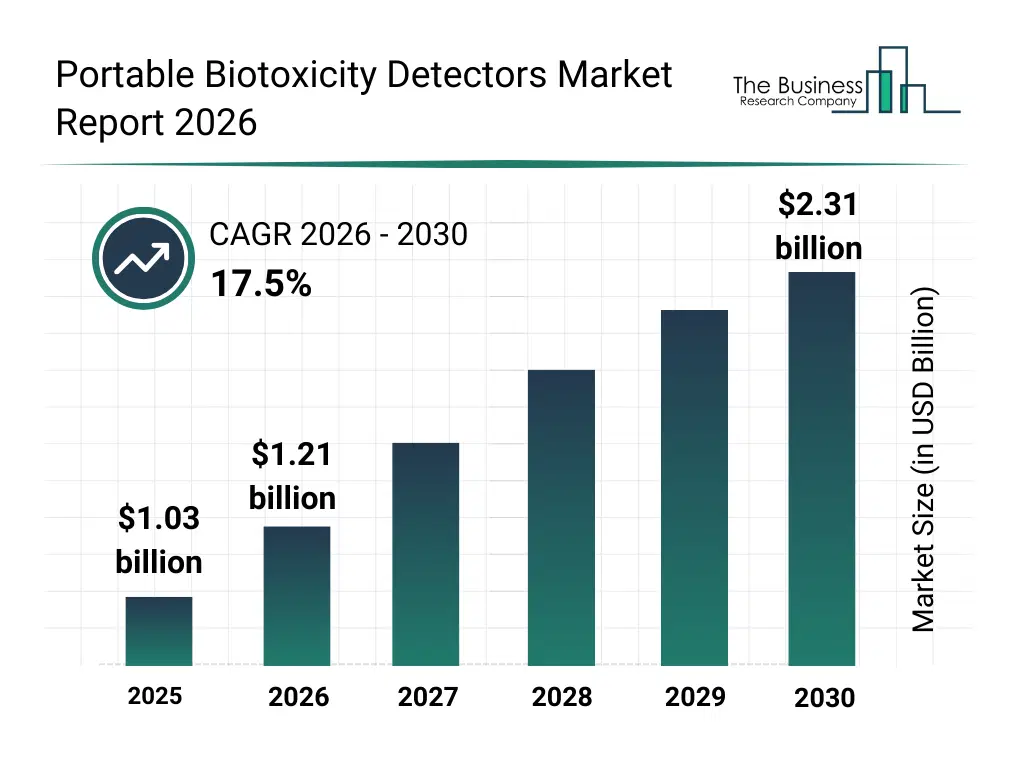
What Is The Portable Biotoxicity Detectors Market Size and Share 2026?
The portable biotoxicity detectors market size has grown rapidly in recent years. It will grow from $1.03 billion in 2025 to $1.21 billion in 2026 at a compound annual growth rate (CAGR) of 17.3%. The growth in the historic period can be attributed to increase in environmental pollution monitoring needs, past biohazard and contamination incidents, growth in industrial safety regulations, expansion of water and air quality testing programs, rise in laboratory and field biosensor research.What Is The Portable Biotoxicity Detectors Market Growth Forecast?
The portable biotoxicity detectors market size is expected to see rapid growth in the next few years. It will grow to $2.31 billion in 2030 at a compound annual growth rate (CAGR) of 17.5%. The growth in the forecast period can be attributed to growing demand for rapid on field diagnostics, expansion of smart environmental monitoring networks, rising food and water safety compliance requirements, increasing investment in portable analytical instrumentation, higher adoption in defense and homeland security applications. Major trends in the forecast period include portable multi parameter detection devices, rapid field biohazard screening, miniaturized biosensor platforms, real time environmental toxicity monitoring, emergency response detection kits.
Global Portable Biotoxicity Detectors Market Segmentation
1) By Product Type: Portable Biotoxicity Detectors; Stationary Biotoxicity Detectors; Handheld Detectors; Wearable Detectors 2) By Deployment Mode: On-field; On-site; In-lab 3) By Technology: Biosensors; Luminescent Microorganisms; Enzymatic Biosensors; Electrochemical Biosensors; Microfluidic Devices 4) By Application: Water Quality Testing; Soil Monitoring; Air Quality Monitoring; Industrial Waste Monitoring; Food Safety Testing Subsegments: 1) By Portable Biotoxicity Detectors: Battery Operated Portable Detectors; Smartphone Integrated Portable Detectors; Multi Parameter Portable Detectors; Field Deployable Rapid Detection Units 2) By Stationary Biotoxicity Detectors: Bench Top Laboratory Detectors; Fixed Industrial Monitoring Systems; Continuous Monitoring Stationary Units; Automated High Throughput Detection Systems 3) By Handheld Detectors: Single Use Handheld Detectors; Reusable Handheld Detection Devices; Real Time Handheld Detection Instruments; Compact Manual Sampling Detectors 4) By Wearable Detectors: Clip On Wearable Detectors; Wrist Mounted Wearable Detectors; Body Mounted Continuous Monitoring Devices; Personal Safety Wearable Detection SystemsWhat Is The Driver Of The Portable Biotoxicity Detectors Market?
The rising threat of biological hazards is expected to propel the growth of the portable biotoxicity detectors market going forward. Biological hazards include pathogens and toxins from bacteria, viruses, or other organisms that pose risks to human health and the environment. The rise in biological hazards stems from increasing zoonotic spillover events driven by environmental changes and human-animal interactions. Portable biotoxicity detectors support rising biological hazard threats by enabling rapid on-site identification and containment to prevent widespread contamination. For instance, in April 2024, according to the World Health Organization, more than 7.6 million dengue cases were reported globally by 30 April 2024, including 3.4 million confirmed cases, over 16,000 severe cases, and more than 3,000 deaths, with the Region of the Americas exceeding seven million cases, surpassing the 2023 annual total of 4.6 million cases. Therefore, the rising threat of biological hazards is driving the growth of the portable biotoxicity detectors industry.Key Players In The Global Portable Biotoxicity Detectors Market
Major companies operating in the portable biotoxicity detectors market are Abbott Laboratories, Siemens Healthineers AG, Merck KGaA, Agilent Technologies, Mettler-Toledo International Inc., Bruker Corporation, QIAGEN N.V., DiaSorin S.p.A., Tecan Group Ltd., Neogen Corporation, Smiths Detection Group Ltd., Yokogawa Electric Corporation, Quanterix Corporation, Envirologix Inc., BlueSense Diagnostics A/S, Optosky Technologies, Eurofins Technologies, Alexeter Technologies LLC, Biosensing Instrument Inc., Changsha Langshuo Technology Co. Ltd.
This chart is for illustrative purposes; the full report includes a detailed competitor analysis and comprehensive overview of the top 10 companies in the market.
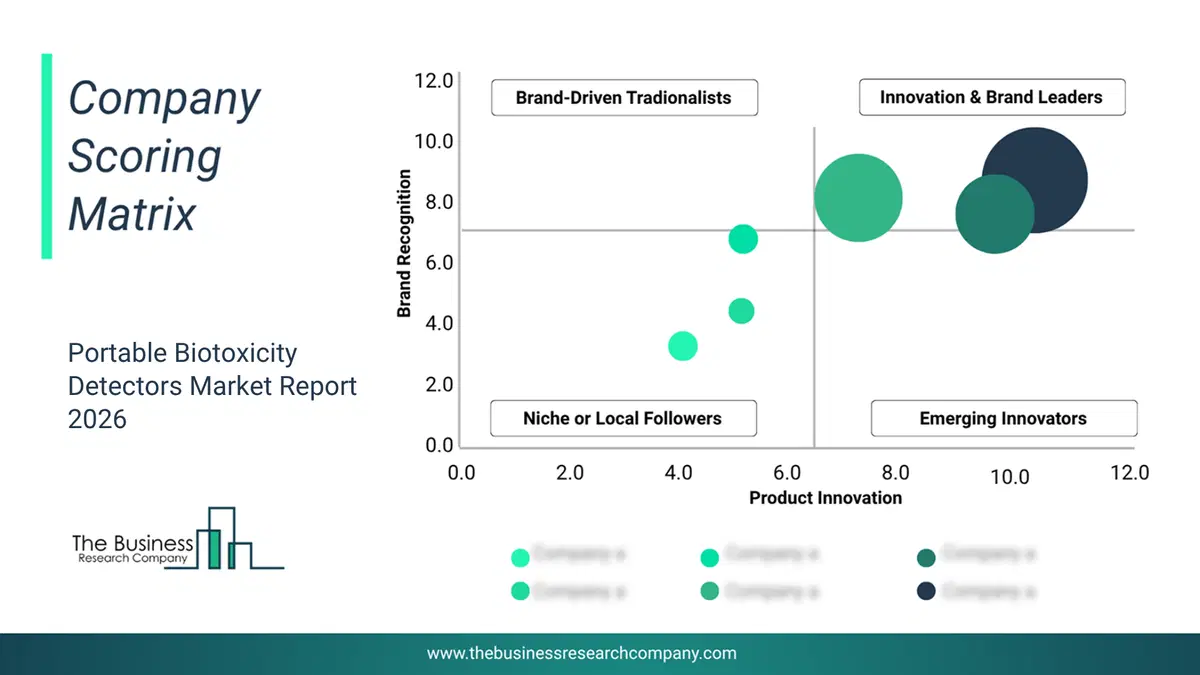
This chart maps companies by product innovation and brand strength, with bubble size indicating relative revenue, helping identify market leaders, challengers, and niche players. This is an illustrative chart; the full report provides a complete and accurate competitive analysis.
Global Portable Biotoxicity Detectors Market Trends and Insights
Major companies operating in the portable biotoxicity detectors market are focusing on developing innovation in field-deployable diagnostics, such as aptamer-integrated colorimetric detection, to enable ultra-sensitive, real-time, and cost-effective identification of hazardous substances through automated optical systems and nanomaterial-driven signal amplification. Aptamer-integrated colorimetric detection refers to a sensing mechanism that uses synthetic nucleic acid ligands, or aptamers, designed to bind specifically to toxic targets, triggering a visible color change in gold nanoparticles that can be electronically measured without complex laboratory equipment. For instance, in November 2025, the Indian Institute of Technology Madras, an India-based public technical and research university, introduced the Smart Malathion Detection Device (Smart MDD). The smart malathion detection device offers rapid and accurate identification of malathion residues in air, water, and agricultural products. It features real-time monitoring with high sensitivity, ensuring early detection and improved safety. The device is portable, easy to operate, and suitable for field as well as laboratory use. With IoT connectivity and data logging, it enables remote monitoring and instant alerts.What Are Latest Mergers And Acquisitions In The Portable Biotoxicity Detectors Market?
In January 2023, Heska Corporation, a US-based healthcare technology company, acquired LightDeck Diagnostics for an undisclosed amount. With this acquisition, Heska sought to vertically integrate LightDeck’s planar waveguide technology to accelerate the manufacturing of high-sensitivity, portable diagnostic cartridges and expand their test menu for both veterinary and environmental health. LightDeck Diagnostics is a US-based provider of portable laser-activated biosensing systems and multiplexed cartridges that provide rapid, laboratory-quality detection of biological toxins, pathogens, and water contaminants.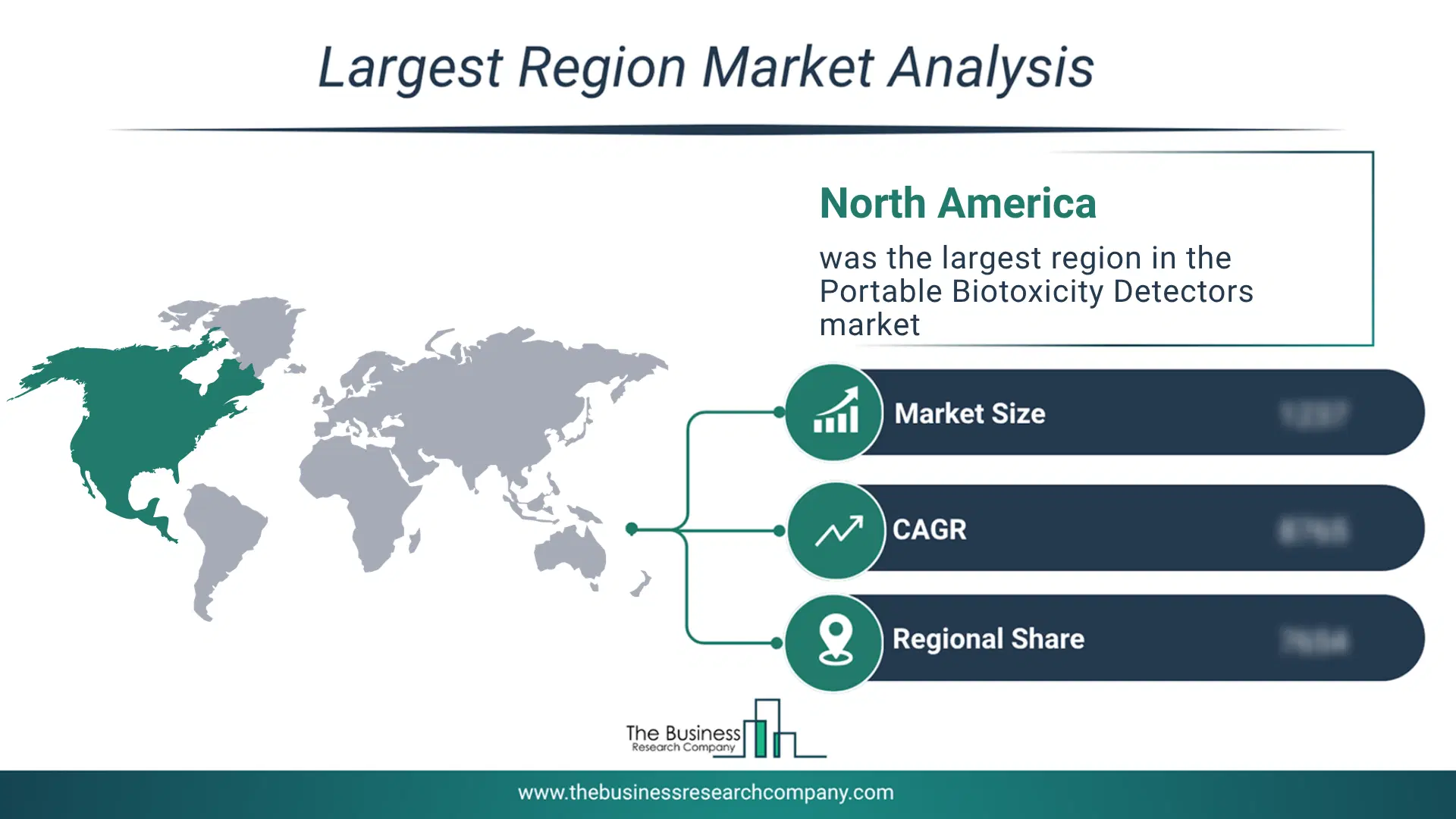
Regional Insights
North America was the largest region in the portable biotoxicity detectors market in 2025. Asia-Pacific is expected to be the fastest-growing region in the forecast period. The regions covered in this market report are Asia-Pacific, South East Asia, Western Europe, Eastern Europe, North America, South America, Middle East, Africa. The countries covered in this market report are Australia, Brazil, China, France, Germany, India, Indonesia, Japan, Taiwan, Russia, South Korea, UK, USA, Canada, Italy, Spain.What Defines the Portable Biotoxicity Detectors Market?
The portable biotoxicity detectors market consists of sales of luminescent bacterial biotoxicity analyzers, biosensor-based toxicity detectors, biological aerosol/toxin identifiers, multi-parameter environmental toxicity monitors, and electrochemical biotoxicity sensors. Values in this market are ‘factory gate’ values, that is, the value of goods sold by the manufacturers or creators of the goods, whether to other entities (including downstream manufacturers, wholesalers, distributors, and retailers) or directly to end customers. The value of goods in this market includes related services sold by the creators of the goods.How is Market Value Defined and Measured?
The market value is defined as the revenues that enterprises gain from the sale of goods and/or services within the specified market and geography through sales, grants, or donations in terms of the currency (in USD unless otherwise specified). The revenues for a specified geography are consumption values that are revenues generated by organizations in the specified geography within the market, irrespective of where they are produced. It does not include revenues from resales along the supply chain, either further along the supply chain or as part of other products.
This chart presents market attractiveness based on a quantitative evaluation of growth, competition, strategic alignment, and risk, offering a clear view of opportunity areas for decision-making. This chart is for illustrative purposes; the full report contains the complete analysis.

This chart highlights the Total Addressable Market (TAM) by estimating the maximum revenue opportunity using an assumption-driven approach, supporting strategic planning and opportunity sizing across markets. The chart is illustrative; the full report provides a more comprehensive analysis.
What Key Data and Analysis Are Included in the Portable Biotoxicity Detectors Market Report 2026?
The portable biotoxicity detectors market research report is one of a series of new reports from The Business Research Company that provides market statistics, including industry global market size, regional shares, competitors with the market share, detailed market segments, market trends and opportunities, and any further data you may need to thrive in the portable biotoxicity detectors industry. The market research report delivers a complete perspective of everything you need, with an in-depth analysis of the current and future state of the industry.Portable Biotoxicity Detectors Market Report Forecast Analysis
| Report Attribute | Details |
|---|---|
| Market Size Value In 2026 | $1.21 billion |
| Revenue Forecast In 2030 | $2.31 billion |
| Growth Rate | CAGR of 17.5% from 2026 to 2030 |
| Base Year For Estimation | 2025 |
| Actual Estimates/Historical Data | 2020-2025 |
| Forecast Period | 2026 - 2030 |
| Market Representation | Revenue in USD Billion and CAGR from 2026 to 2030 |
| Segments Covered | Product Type, Deployment Mode, Technology, Application |
| Regional Scope | Asia-Pacific, Western Europe, Eastern Europe, North America, South America, Middle East, Africa |
| Country Scope | The countries covered in the report are Australia, Brazil, China, France, Germany, India, Indonesia, Japan, Taiwan, Russia, South Korea, UK, USA, Canada, Italy, Spain. |
| Key Companies Profiled | Abbott Laboratories, Siemens Healthineers AG, Merck KGaA, Agilent Technologies, Mettler-Toledo International Inc., Bruker Corporation, QIAGEN N.V., DiaSorin S.p.A., Tecan Group Ltd., Neogen Corporation, Smiths Detection Group Ltd., Yokogawa Electric Corporation, Quanterix Corporation, Envirologix Inc., BlueSense Diagnostics A/S, Optosky Technologies, Eurofins Technologies, Alexeter Technologies LLC, Biosensing Instrument Inc., Changsha Langshuo Technology Co. Ltd. |
| Customization Scope | Request for Customization |
| Pricing And Purchase Options | Explore Purchase Options |