

Pre-Analytical Automation Market Report 2026
Global Outlook – By Product Type (Automated Sample Preparation, Automated Sample Transport, Automated Sample Sorting, Automated Sample Storage, Other Product Types), By Workflow Type (Standalone Automation Systems, Integrated Automation Systems), By Automation Level (Total Laboratory Automation Systems, Modular Pre-Analytical Automation Systems, Standalone Automation Components), By Application (Clinical Chemistry, Immunoassay, Hematology, Microbiology, Molecular Diagnostics, Blood Bank Processing), By End User (Diagnostic Laboratories, Hospitals, Blood Banks, Research And Academic Institutes, Other End Users) – Market Size, Trends, Strategies, and Forecast to 2030
Pre-Analytical Automation Market Overview
• Pre-Analytical Automation market size has reached to $7.04 billion in 2025 • Expected to grow to $11.38 billion in 2030 at a compound annual growth rate (CAGR) of 10.1% • Growth Driver: Growing Prevalence Of Infectious Diseases Driving The Market Growth Due To Increasing Demand For Safe And Low-Risk Medical Interventions • Market Trend: Automated Sample Preparation System Streamlines Laboratory Workflows And Improves Diagnostic Consistency • North America was the largest region in 2025 and Asia-Pacific is the fastest growing region.What Is Covered Under Pre-Analytical Automation Market?
Pre-analytical automation refers to the use of automated systems and technologies to manage and standardize laboratory processes that occur before sample analysis. It ensures greater consistency, efficiency, and reliability in the early stage of diagnostic workflows by minimizing manual intervention. This helps improve overall data quality and reduces the likelihood of errors that can affect downstream testing results. The main product types of pre-analytical automation include automated sample preparation, automated sample transport, automated sample sorting, automated sample storage, and other product types. Automated sample preparation refers to systems designed to standardize and streamline specimen handling before analysis to improve efficiency and accuracy. These systems are categorized by workflow type including standalone automation systems and integrated automation systems and by automation level including total laboratory automation systems, modular pre-analytical automation systems, and standalone automation components. The various applications involved are clinical chemistry, immunoassay, hematology, microbiology, molecular diagnostics, and blood bank processing, and they are used by several end users such as diagnostic laboratories, hospitals, blood banks, research and academic institutes, and others.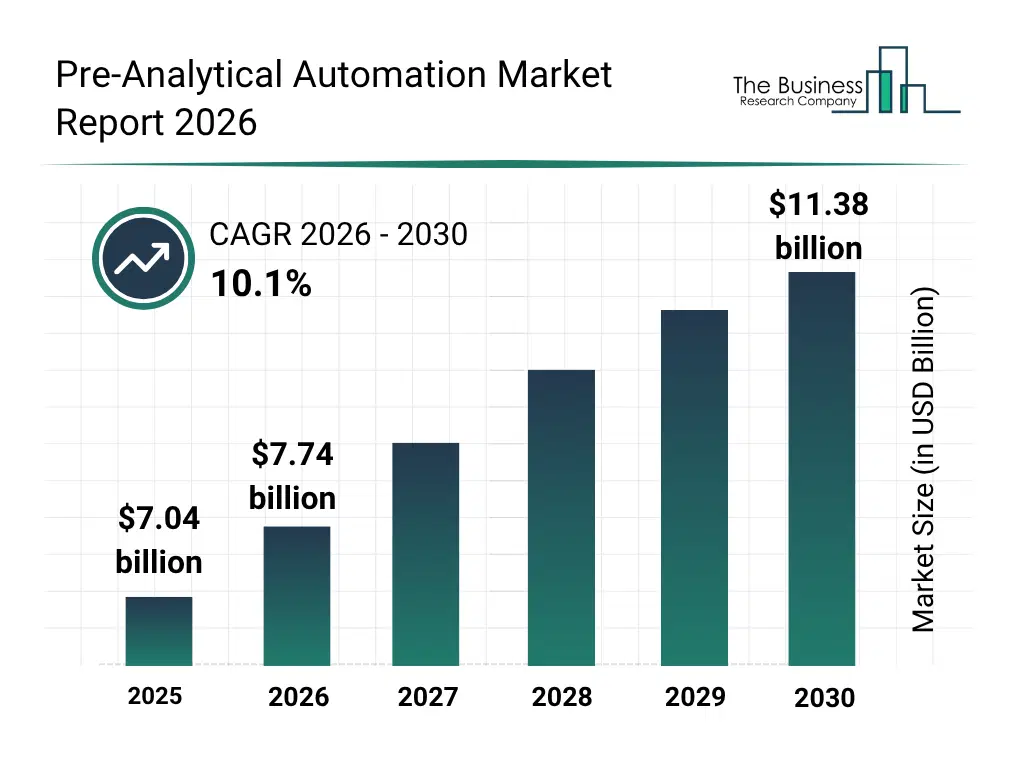
What Is The Pre-Analytical Automation Market Size and Share 2026?
The pre-analytical automation market size has grown strongly in recent years. It will grow from $7.04 billion in 2025 to $7.74 billion in 2026 at a compound annual growth rate (CAGR) of 9.9%. The growth in the historic period can be attributed to rising demand for high throughput diagnostic testing, increasing laboratory workload and sample volumes, growing need to reduce human errors in sample handling, expansion of clinical laboratory networks, adoption of basic automation in specimen processing.What Is The Pre-Analytical Automation Market Growth Forecast?
The pre-analytical automation market size is expected to see rapid growth in the next few years. It will grow to $11.38 billion in 2030 at a compound annual growth rate (CAGR) of 10.1%. The growth in the forecast period can be attributed to increasing adoption of ai enabled laboratory automation systems, rising demand for precision diagnostics and faster turnaround times, expansion of integrated healthcare laboratory networks, growing investment in smart hospital infrastructure, increasing focus on standardization and quality control in diagnostics. Major trends in the forecast period include ai driven laboratory workflow optimization for pre analytical sample processing automation, robotic sample handling systems for high throughput diagnostic laboratories, integrated laboratory information systems for end to end pre analytical data tracking, smart barcode and specimen identification systems for error free sample management, modular automated sample transport and sorting systems for improved laboratory efficiency.
Global Pre-Analytical Automation Market Segmentation
1) By Product Type: Automated Sample Preparation, Automated Sample Transport, Automated Sample Sorting, Automated Sample Storage, Other Product Types 2) By Workflow Type: Standalone Automation Systems, Integrated Automation Systems 3) By Automation Level: Total Laboratory Automation Systems, Modular Pre-Analytical Automation Systems, Standalone Automation Components 4) By Application: Clinical Chemistry, Immunoassay, Hematology, Microbiology, Molecular Diagnostics, Blood Bank Processing 5) By End User: Diagnostic Laboratories, Hospitals, Blood Banks, Research And Academic Institutes, Other End Users Subsegments: 1) By Automated Sample Preparation: Nucleic Acid Extraction Systems, Protein Isolation Systems, Liquid Handling Systems, Reagent Dispensing Systems, Sample Dilution Systems 2) By Automated Sample Transport: Conveyor Based Transport Systems, Robotic Arm Transport Systems, Pneumatic Tube Transport Systems, Track Based Transport Systems, Automated Guided Vehicle Systems 3) By Automated Sample Sorting: Barcode Based Sorting Systems, Centrifuge Based Sorting Systems, Rack Based Sorting Systems, Tube Sorting Systems, Specimen Identification Systems 4) By Automated Sample Storage: Refrigerated Storage Systems, Frozen Storage Systems, Ambient Storage Systems, High Density Storage Systems, Retrieval And Archiving Systems 5) By Other Product Types: Quality Control Systems, Sample Tracking Systems, Data Management Systems, Laboratory Information Integration Systems, Maintenance And Calibration SystemsWhat Is The Driver Of The Pre-Analytical Automation Market?
The growing prevalence of infectious diseases is expected to propel the growth of the pre-analytical automation market going forward. Infectious diseases are illnesses caused by harmful microorganisms that spread between individuals or through environmental exposure. The prevalence of infectious diseases is rising due to increased urbanization, where dense living conditions promote faster transmission of pathogens. Pre-analytical automation enhances infectious disease diagnostics by streamlining and standardizing early laboratory workflows, enabling faster, more accurate, and contamination-reduced processing of clinical samples for timely detection and surveillance. For instance, in March 2024, according to the Centers for Disease Control and Prevention, a US-based government agency, the number of tuberculosis cases increased from 8,320 in 2022 to 9,615 in 2023, representing a rise of 1,295 cases. Therefore, the growing prevalence of infectious diseases is driving the growth of the pre-analytical automation industry.Key Players In The Global Pre-Analytical Automation Market
Major companies operating in the pre-analytical automation market are Thermo Fisher Scientific Inc., Abbott Laboratories, Danaher Corporation, Roche Diagnostics International AG, Siemens Healthineers AG, Becton Dickinson and Company, Agilent Technologies Inc., Sysmex Corporation, PerkinElmer's Life Sciences & Diagnostics business, Tecan Group Ltd., Sarstedt Aktiengesellschaft And Co. KG, Hamilton Company, Brooks Automation Inc., Inpeco SA, Automata Technologies Limited, Opentrons Labworks Inc., BICO Group AB, Peak Analysis and Automation Limited, Hudson Robotics Inc., Dynamic Devices Ltd., Aurora Biomed Inc., VEON Scientific LimitedGlobal Pre-Analytical Automation Market Trends and Insights
Major companies operating in the pre-analytical automation market are focusing on developing innovative solutions such as integrated sample preparation platforms to standardize workflows, reduce manual handling errors, and improve overall laboratory efficiency and diagnostic accuracy. Integrated sample preparation platforms are automated systems that make the early parts of lab testing easier by combining several steps like dividing, mixing, labeling, and getting samples ready into one organized process, which helps maintain consistency and traceability, unlike traditional methods that are slow and can vary. For instance, in April 2026, Invivoscribe Inc., a US-based molecular diagnostics company, launched the PrepQuant System, an integrated sample preparation platform designed to standardize and streamline pre-analytical workflows. The system automates and organizes the steps for processing samples to make sure the quality and accuracy are the same for all tests, helping with molecular diagnostics and making labs work more efficiently. It is designed to make workflows more reliable, decrease differences in how samples are prepared, and allow labs to handle more tests efficiently in busy diagnostic settings.What Are Latest Mergers And Acquisitions In The Pre-Analytical Automation Market?
In March 2023, Brooks Automation US LLC, a US-based science and technology company acquired Aim Lab Automation Technologies Pty Ltd. for an undisclosed amount. Through this acquisition, Brooks aims to expand its capabilities in clinical laboratory automation by integrating Aim Lab’s robotic instrumentation and pre-analytical automation technologies, thereby strengthening its presence beyond drug discovery into the diagnostics market. Aim Lab Automation Technologies Pty Ltd. is an Australia-based company specializing in the design and manufacturing of robotic systems, including autosamplers, tube decappers, and modular solutions for pre- and post-analytical laboratory processes.Regional Outlook
North America was the largest region in the pre-analytical automation market in 2025. Asia-Pacific is expected to be the fastest-growing region in the forecast period. The regions covered in this market report are Australia, Brazil, China, France, Germany, India, Indonesia, Japan, Taiwan, Russia, South Korea, UK, USA, Canada, Italy, Spain. The countries covered in this market report are Australia, Brazil, China, France, Germany, India, Indonesia, Japan, Taiwan, Russia, South Korea, UK, USA, Canada, Italy, Spain.What Defines the Pre-Analytical Automation Market?
The pre-analytical automation market consists of revenues earned by entities by providing services such as sample collection management, specimen sorting, labeling, centrifugation, aliquoting, and sample tracking prior to laboratory analysis. The market value includes the value of related goods sold by the service provider or included within the service offering. The pre-analytical automation market also includes sales of automated sample preparation systems, robotic handling equipment, and conveyor systems. Values in this market are ‘factory gate’ values, that is, the value of goods sold by the manufacturers or creators of the goods, whether to other entities (including downstream manufacturers, wholesalers, distributors, and retailers) or directly to end customers. The value of goods in this market includes related services sold by the creators of the goods.How is Market Value Defined and Measured?
The market value is defined as the revenues that enterprises gain from the sale of goods and/or services within the specified market and geography through sales, grants, or donations in terms of the currency (in USD unless otherwise specified). The revenues for a specified geography are consumption values that are revenues generated by organizations in the specified geography within the market, irrespective of where they are produced. It does not include revenues from resales along the supply chain, either further along the supply chain or as part of other products.What Key Data and Analysis Are Included in the Pre-Analytical Automation Market Report 2026?
The pre-analytical automation market research report is one of a series of new reports from The Business Research Company that provides pre-analytical automation market statistics, including pre-analytical automation industry global market size, regional shares, competitors with a pre-analytical automation market share, detailed pre-analytical automation market segments, market trends and opportunities, and any further data you may need to thrive in the pre-analytical automation industry. This pre-analytical automation market research report delivers a complete perspective of everything you need, with an in-depth analysis of the current and future scenario of the industry.Pre-Analytical Automation Market Report Forecast Analysis
| Report Attribute | Details |
|---|---|
| Market Size Value In 2026 | $7.74 billion |
| Revenue Forecast In 2030 | $11.38 billion |
| Growth Rate | CAGR of 10.1% from 2026 to 2030 |
| Base Year For Estimation | 2025 |
| Actual Estimates/Historical Data | 2020-2025 |
| Forecast Period | 2026 - 2030 |
| Market Representation | Revenue in USD Billion and CAGR from 2026 to 2030 |
| Segments Covered | Product Type, Workflow Type, Automation Level, Application, End User |
| Regional Scope | Asia-Pacific, Western Europe, Eastern Europe, North America, South America, Middle East, Africa |
| Country Scope | The countries covered in the pre-analytical automation market report are Australia, Brazil, China, France, Germany, India, Indonesia, Japan, Taiwan, Russia, South Korea, UK, USA, Canada, Italy, Spain. |
| Key Companies Profiled | Thermo Fisher Scientific Inc., Abbott Laboratories, Danaher Corporation, Roche Diagnostics International AG, Siemens Healthineers AG, Becton Dickinson and Company, Agilent Technologies Inc., Sysmex Corporation, PerkinElmer's Life Sciences & Diagnostics business, Tecan Group Ltd., Sarstedt Aktiengesellschaft And Co. KG, Hamilton Company, Brooks Automation Inc., Inpeco SA, Automata Technologies Limited, Opentrons Labworks Inc., BICO Group AB, Peak Analysis and Automation Limited, Hudson Robotics Inc., Dynamic Devices Ltd., Aurora Biomed Inc., VEON Scientific Limited |
| Customization Scope | Request for Customization |
| Pricing And Purchase Options | Explore Purchase Options |