
Precision Cancer Imaging Market Report 2026
Global Outlook – By Component (Hardware, Software, Services), By Cancer Type (Breast Cancer, Lung Cancer, Prostate Cancer, Colorectal Cancer, Other Cancer Types), By Imaging Modality (Magnetic Resonance Imaging (MRI), Computed Tomography (CT), Positron Emission Tomography (PET), Single Photon Emission Computed Tomography (SPECT), Other Modalities), By Application (Cardiovascular, Neurology, Gastroenterology, Infectious Diseases, Oncology, Other Applications), By End-user (Hospitals And Clinics, Diagnostic Imaging Centers, Ambulatory Surgical Centers, Other End-users) – Market Size, Trends, Strategies, and Forecast to 2035
Precision Cancer Imaging Market Overview
• Precision Cancer Imaging market size has reached to $17.39 billion in 2025 • Expected to grow to $31.71 billion in 2030 at a compound annual growth rate (CAGR) of 12.8% • Growth Driver: The Growing Prevalence Of Cancer Cases The Growth Of The Market Due To An Aging Population And Rising Global Cancer Burden • Market Trend: Growing Adoption Of Artificial Intelligence–Enabled Imaging Platforms To Enhance Diagnostic Accuracy, Optimize Workflow Efficiency, And Advance Precision Cancer Treatment Planning • North America was the largest region in 2025 and Asia-Pacific is the fastest growing region.What Is Covered Under Precision Cancer Imaging Market?
Precision cancer imaging refers to an advanced medical imaging approach that uses highly accurate and targeted imaging techniques to detect, characterize, and monitor cancer at an early stage. It integrates modalities such as molecular imaging, functional imaging, and high-resolution anatomical imaging to improve diagnostic accuracy and support personalized cancer treatment planning. The main components of precision cancer imaging include hardware, software, and services. Hardware refers to advanced imaging equipment and systems used to capture high-resolution anatomical and functional images for accurate cancer detection and treatment planning. The types of cancer include breast cancer, lung cancer, prostate cancer, colorectal cancer, and other cancer types and the imaging modalities include magnetic resonance imaging (MRI), computed tomography (CT), positron emission tomography (PET), single photon emission computed tomography (SPECT), and other modalities. They find application in cardiovascular, neurology, gastroenterology, infectious diseases, oncology, and other applications, serving end users including hospitals and clinics, diagnostic imaging centers, ambulatory surgical centers, and other end-users.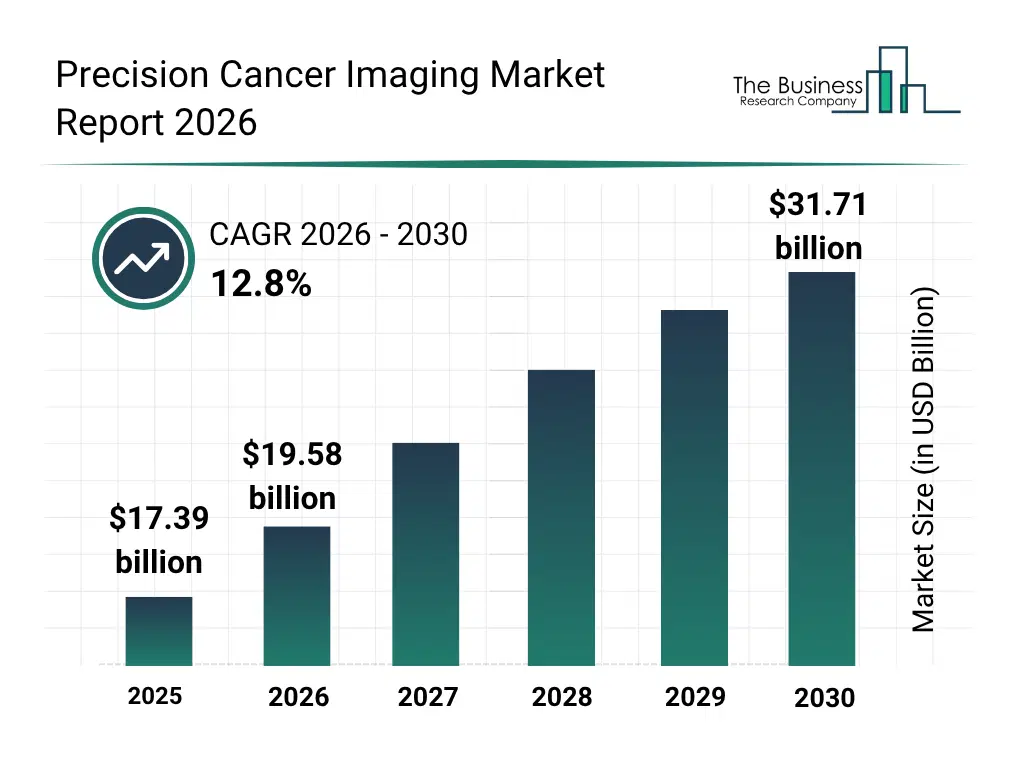
What Is The Precision Cancer Imaging Market Size and Share 2026?
The precision cancer imaging market size has grown rapidly in recent years.It will grow from $17.39 billion in 2025 to $19.58 billion in 2026 at a compound annual growth rate (CAGR) of 12.6%. The growth in the historic period can be attributed to rising prevalence of cancer cases, advancements in molecular imaging technologies, increasing adoption of PET and MRI systems, expansion of hospital diagnostic infrastructure, growth in government cancer screening initiatives.What Is The Precision Cancer Imaging Market Growth Forecast?
The precision cancer imaging market size is expected to see rapid growth in the next few years.It will grow to $31.71 billion by 2030 at a compound annual growth rate (CAGR) of 12.8%. The growth in the forecast period can be attributed to increasing demand for personalized oncology treatments, expansion of AI-driven imaging analytics, growing investments in precision medicine research, rising adoption of cloud-based imaging platforms, increasing development of non-invasive diagnostic solutions.Major trends in the forecast period include precision oncology imaging adoption, hybrid imaging system integration, multi-modal diagnostic workflows, radiomics-based tumor characterization, early-stage cancer detection advancements.
Global Precision Cancer Imaging Market Segmentation
1) By Component: Hardware, Software, Services 2) By Cancer Type: Breast Cancer, Lung Cancer, Prostate Cancer, Colorectal Cancer, Other Cancer Types 3) By Imaging Modality: Magnetic Resonance Imaging (MRI), Computed Tomography (CT), Positron Emission Tomography (PET), Single Photon Emission Computed Tomography (SPECT), Other Modalities 4) By Application: Cardiovascular, Neurology, Gastroenterology, Infectious Diseases, Oncology, Other Applications 5) By End-user: Hospitals And Clinics, Diagnostic Imaging Centers, Ambulatory Surgical Centers, Other End-users Subsegments: 1) By Hardware: Imaging Systems, Detection Devices, Radiation Equipment, Biopsy Guidance Systems, Monitoring Devices 2) By Software: Image Analysis Software, Visualization Software, Data Management Software, Diagnostic Software, Reporting Software 3) By Services: Imaging Services, Consulting Services, Maintenance Services, Training Services, Integration ServicesWhat Is The Driver Of The Precision Cancer Imaging Market?
The growing prevalence of cancer cases is expected to propel the growth of the precision cancer imaging industry going forward.The growing prevalence of cancer cases is primarily due to an aging population, as older individuals have a higher risk of developing cancer because of the accumulation of genetic mutations and longer exposure to risk factors over time.Precision cancer imaging helps cancer management by enabling earlier detection, more accurate tumor localization, and personalized treatment planning that improves therapeutic outcomes and reduces unnecessary interventions.For instance, in February 2024, according to the World Health Organization, a Switzerland-based international organization specializing in global health policy and public health initiatives, over 35 million new cancer cases are predicted in 2050, a 77% increase from the estimated 20 million cases in 2022.Therefore, the growing prevalence of cancer cases is driving the growth of the precision cancer imaging industry.Key Players In The Global Precision Cancer Imaging Market
Major companies operating in the precision cancer imaging market are Hitachi Medical Corporation, Thermo Fisher Scientific Inc., Siemens Healthineers AG, FUJIFILM Holdings Corporation, Koninklijke Philips N. V., GE HealthCare Technologies Inc., Shimadzu Corporation, Agilent Technologies Inc., Mindray Bio-Medical Electronics Co Ltd., Bruker Corporation, Canon Medical Systems Corporation, Shanghai United Imaging Healthcare Co Ltd., Agfa-Gevaert N. V., Hologic Inc., Carestream Health Inc., Perceptive Discovery, Esaote S. p. A., Alliance Medical Group, Quibim S. L., Mediso LtdGlobal Precision Cancer Imaging Market Trends and Insights
Major companies operating in the precision cancer imaging market are focusing on leveraging innovative technologies such as, artificial intelligence‑built imaging platforms to enhance diagnostic accuracy and streamline cancer treatment planning. Artificial intelligence‑built imaging platforms are advanced CT and MR systems that use machine learning algorithms to enhance image reconstruction, tumor detection, and anatomical visualization, helping clinicians achieve faster, more accurate diagnoses and more precise cancer treatment planning. For instance, in September 2025, Koninklijke Philips N. V., a Netherlands-based health technology company, unveiled its latest CT and MR solutions at the American Society for Radiation Oncology (ASTRO) 2025 meeting, designed specifically to advance precision cancer care. These platforms feature ultra-fast AI-assisted reconstruction, helium-free MR systems for sustainable operation, extended field-of-view 4D imaging, and intuitive interfaces that streamline radiation therapy planning and improve patient comfort. By combining high image quality with efficient workflows, these innovations enable oncology teams to deliver personalized treatment with greater confidence and precision.What Are Latest Mergers And Acquisitions In The Precision Cancer Imaging Market?
In January 2025, Telix Pharmaceuticals Limited, an Australia-based healthcare technology company, acquired ImaginAb for an undisclosed amount. With this acquisition, Telix Pharmaceuticals aims to strengthen its radiopharmaceutical and precision oncology pipeline by integrating next-generation biologics and antibody-based imaging technologies to enhance target identification, improve therapeutic development capabilities, and accelerate its expansion in precision cancer diagnostics and therapy. ImaginAb Inc. is a US-based biotechnology company that specializes in precision cancer imaging, focusing on immuno-oncology imaging to provide actionable insights for patient selection and treatment progress.Regional Insights
North America was the largest region in the precision cancer imaging market in 2025. Asia-Pacific is expected to be the fastest-growing region in the forecast period. The regions covered in this market report are Asia-Pacific, South East Asia, Western Europe, Eastern Europe, North America, South America, Middle East and Africa. The countries covered in this market report are Australia, Brazil, China, France, Germany, India, Indonesia, Japan, Taiwan, Russia, South Korea, UK, USA, Canada, Italy, Spain.What Defines the Precision Cancer Imaging Market?
The precision cancer imaging market consists of revenues earned by entities by providing services such as tumor detection imaging services, cancer diagnosis and characterization services, image-guided biopsy support services, AI-based imaging analysis services, and treatment monitoring and response assessment services. The market value includes the value of related goods sold by the service provider or included within the service offering. The precision cancer imaging market also includes sales of positron emission tomography (PET) tracers, computed tomography (CT) contrast agents, magnetic resonance imaging (MRI) contrast agents, ingle photon emission computed tomography (SPECT) radiotracers, and hybrid imaging systems. Values in this market are ‘factory gate’ values, that is the value of goods sold by the manufacturers or creators of the goods, whether to other entities (including downstream manufacturers, wholesalers, distributors and retailers) or directly to end customers. The value of goods in this market includes related services sold by the creators of the goods.What is the Market Assessment and Strategic Outlook for the Precision Cancer Imaging Industry?
The precision cancer imaging market research report is one of a series of new reports from The Business Research Company that provides market statistics, including industry global market size, regional shares, competitors with the market share, detailed market segments, market trends and opportunities, and any further data you may need to thrive in the precision cancer imaging industry. The market research report delivers a complete perspective of everything you need, with an in-depth analysis of the current and future state of the industry.What is the Market Assessment and Strategic Outlook for the Precision Cancer Imaging Market Report 2026?
The precision cancer imaging market research report is one of a series of new reports from The Business Research Company that provides precision cancer imaging market statistics, including precision cancer imaging industry global market size, regional shares, competitors with a precision cancer imaging market share, detailed precision cancer imaging market segments, market trends and opportunities, and any further data you may need to thrive in the precision cancer imaging industry. This precision cancer imaging market research report delivers a complete perspective of everything you need, with an in-depth analysis of the current and future scenario of the industry.Precision Cancer Imaging Market Report Forecast Analysis
| Report Attribute | Details |
|---|---|
| Market Size Value In 2026 | $19.58 billion |
| Revenue Forecast In 2035 | $31.71 billion |
| Growth Rate | CAGR of 12.8% from 2026 to 2035 |
| Base Year For Estimation | 2025 |
| Actual Estimates/Historical Data | 2020-2025 |
| Forecast Period | 2026 - 2030 - 2035 |
| Market Representation | Revenue in USD Billion and CAGR from 2026 to 2035 |
| Segments Covered | Component, Cancer Type, Imaging Modality, Application, End-user |
| Regional Scope | Asia-Pacific, Western Europe, Eastern Europe, North America, South America, Middle East, Africa |
| Country Scope | The countries covered in the report are Australia, Brazil, China, France, Germany, India, Indonesia, Japan, Taiwan, Russia, South Korea, UK, USA, Canada, Italy, Spain. |
| Key Companies Profiled | Hitachi Medical Corporation, Thermo Fisher Scientific Inc., Siemens Healthineers AG, FUJIFILM Holdings Corporation, Koninklijke Philips N. V., GE HealthCare Technologies Inc., Shimadzu Corporation, Agilent Technologies Inc., Mindray Bio-Medical Electronics Co Ltd., Bruker Corporation, Canon Medical Systems Corporation, Shanghai United Imaging Healthcare Co Ltd., Agfa-Gevaert N. V., Hologic Inc., Carestream Health Inc., Perceptive Discovery, Esaote S. p. A., Alliance Medical Group, Quibim S. L., Mediso Ltd |
| Customization Scope | Request for Customization |
| Pricing And Purchase Options | Explore Purchase Options |