
Prefabricated Construction Market Report 2026
Global Outlook – By Product Type (Modular Buildings, Prefabricated Panels, Pre-Engineered Buildings, Volumetric Modules), By Material Type (Concrete, Steel, Wood, Glass, Plastic And Composite Materials), By Construction Type (Permanent Construction, Relocatable Construction), By Installation Type (On-Site Assembly, Off-Site Assembly), By End User Application (Residential Construction, Commercial Construction, Industrial Construction, Institutional Construction, Infrastructure Construction) – Market Size, Trends, Strategies, and Forecast to 2030
Prefabricated Construction Market Overview
• Prefabricated Construction market size has reached to $139.26 billion in 2025 • Expected to grow to $151.48 billion in 2030 at a compound annual growth rate (CAGR) of 9% • Growth Driver: Increasing Demand For Sustainable And Low-waste Building Solutions Fueling The Growth Of The Market Due To Reduced Material Waste, Higher Resource Efficiency, And Faster Construction Processes • Market Trend: Advanced Prefabricated Wall And Roof Assemblies Accelerate Residential Construction • North America was the largest region in 2025 and Asia-Pacific is the fastest growing region.What Is Covered Under Prefabricated Construction Market?
Prefabricated construction refers to a construction method in which building components or complete structural modules are manufactured in a controlled factory environment and then transported to the construction site for assembly and installation. These systems are designed to improve construction speed, enhance quality control, reduce material waste, and increase efficiency compared to traditional on-site building methods. It enables standardized production, faster project completion, and improved cost predictability across building projects. The main product types of prefabricated construction include modular buildings, prefabricated panels, pre-engineered buildings, and volumetric modules. Modular buildings refer to structures manufactured in factory-controlled conditions in separate modules and assembled on-site for faster construction and improved quality control. These materials are categorized based on material type into concrete, steel, wood, glass, and plastic and composite materials. They are classified based on construction type into permanent construction and relocatable construction depending on intended lifespan and mobility requirements. They are installed through on-site assembly and off-site assembly based on construction processes and logistics planning, while the end-use includes residential construction, commercial construction, industrial construction, institutional construction, and infrastructure construction.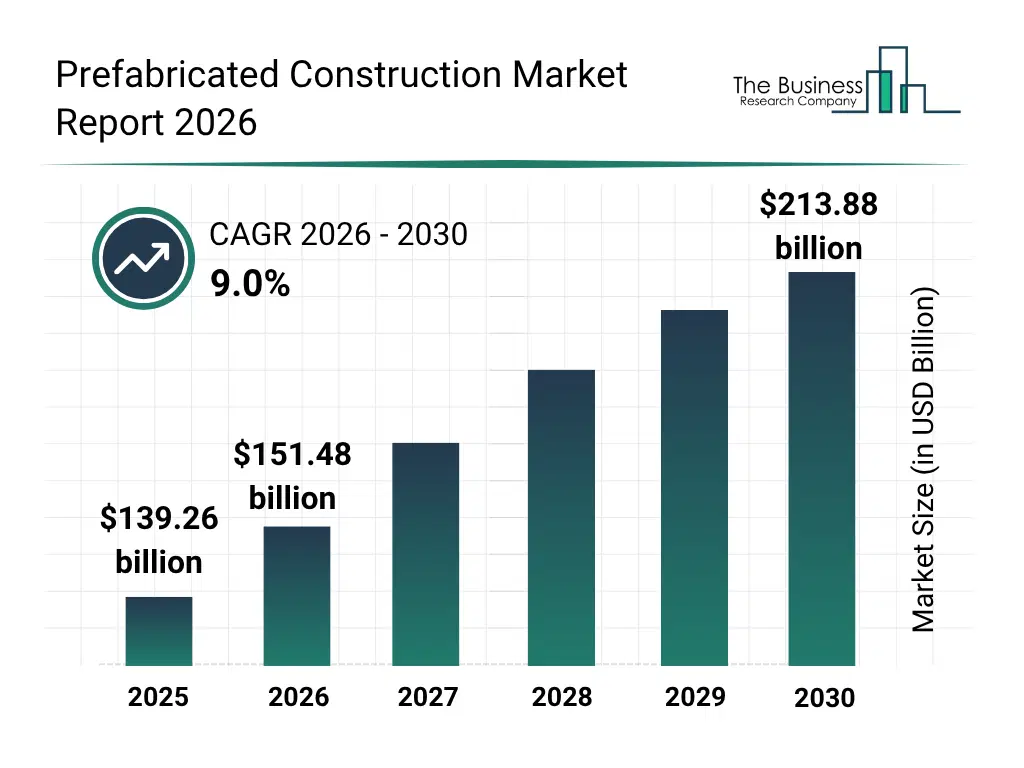
What Is The Prefabricated Construction Market Size and Share 2026?
The prefabricated construction market size has grown strongly in recent years. It will grow from $139.26 billion in 2025 to $151.48 billion in 2026 at a compound annual growth rate (CAGR) of 8.8%. The growth in the historic period can be attributed to increasing urbanization and housing demand, rising labor shortages in construction industry, growing need for reduced construction timelines, expansion of commercial infrastructure projects, increasing focus on construction cost predictability.What Is The Prefabricated Construction Market Growth Forecast?
The prefabricated construction market size is expected to see strong growth in the next few years. It will grow to $213.88 billion by 2030 at a compound annual growth rate (CAGR) of 9.0%. The growth in the forecast period can be attributed to growing investment in smart city infrastructure, increasing demand for sustainable building solutions, rising adoption of automated off-site manufacturing, expansion of affordable housing projects, growing need for disaster-resilient construction methods. Major trends in the forecast period include increasing adoption of modular building solutions, rising demand for fast-track construction methods, growing use of lightweight composite construction materials, expansion of off-site manufacturing facilities, rising preference for cost-efficient standardized building components.
Global Prefabricated Construction Market Segmentation
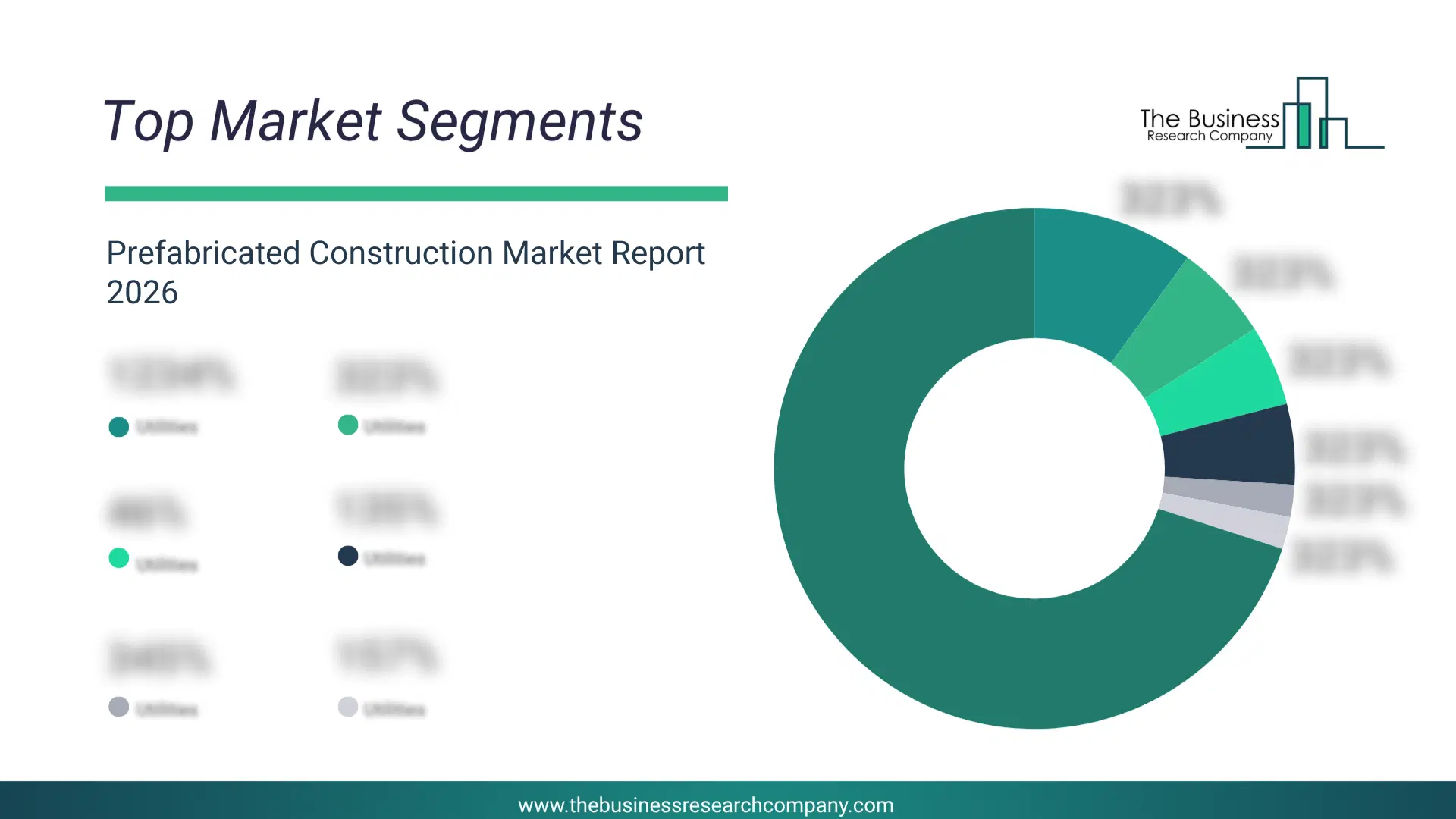
1) By Product Type: Modular Buildings, Prefabricated Panels, Pre-Engineered Buildings, Volumetric Modules 2) By Material Type: Concrete, Steel, Wood, Glass, Plastic And Composite Materials 3) By Construction Type: Permanent Construction, Relocatable Construction 4) By Installation Type: On-Site Assembly, Off-Site Assembly 5) By End User Application: Residential Construction, Commercial Construction, Industrial Construction, Institutional Construction, Infrastructure Construction Subsegments: 1) By Modular Buildings: Permanent Modular Buildings, Relocatable Modular Buildings, Residential Modular Buildings, Commercial Modular Buildings, Institutional Modular Buildings 2) By Prefabricated Panels: Wall Panels, Floor Panels, Roof Panels, Facade Panels, Insulated Panels 3) By Pre-Engineered Buildings: Industrial Pre-Engineered Buildings, Commercial Pre-Engineered Buildings, Warehouse Pre-Engineered Buildings, Agricultural Pre-Engineered Buildings, Institutional Pre-Engineered Buildings 4) By Volumetric Modules: Bathroom Pods, Kitchen Modules, Bedroom Modules, Living Room Modules, Utility ModulesWhat Is The Driver Of The Prefabricated Construction Market?
The increasing demand for sustainable and low-waste building solutions is expected to propel the growth of the prefabricated construction market going forward. Demand for sustainable and low-waste building solutions refers to the rising preference among homebuyers, developers, institutions, and commercial property owners for buildings that reduce material waste, improve resource efficiency, and lower environmental impact across construction and use. The demand for sustainable and low-waste building solutions is increasing due to growing consumer and developer preference for environmentally responsible construction practices that reduce material waste and improve resource efficiency. Prefabricated construction is used in sustainable and low-waste building solutions by enabling precise factory-based production that reduces material waste, lowers energy use, minimizes on-site disruption, and improves construction efficiency. For instance, in February 2024, according to the Green Building Council, a US-based non-profit organization, in 2023, there was a 9% rise in LEED certifications from the previous year, along with 21 additional certifications for single-family homes. New LEED project registrations jumped by 51%, showing remarkable growth. Therefore, the increasing demand for sustainable and low-waste building solutions is driving the growth of the prefabricated construction industry.Key Players In The Global Prefabricated Construction Market
Major companies operating in the prefabricated construction market are Daiwa House Industry Co. Ltd., Laing O’Rourke Holdings Limited, Tata BlueScope Steel Private Limited, Interarch Building Products Limited, Pennar Industries Limited, Everest Industries Limited, Lindbäcks Group AB, Alghanim Industries, Walker Modular Ltd., Interpod Offsite Pty Ltd., Huf Haus GmbH & Co. KG, Guerdon LLC, Dvele Omega Inc., SurePods, Zamil Steel Holding Company, Algeco UK Limited, EPACK Prefab Technologies Limited, NorgesHus Tootmise OÜ, Guizhou Glamni Prefabricated Housing Co. Ltd., Modulart SpA.
This chart is for illustrative purposes; the full report includes a detailed competitor analysis and comprehensive overview of the top 10 companies in the market.
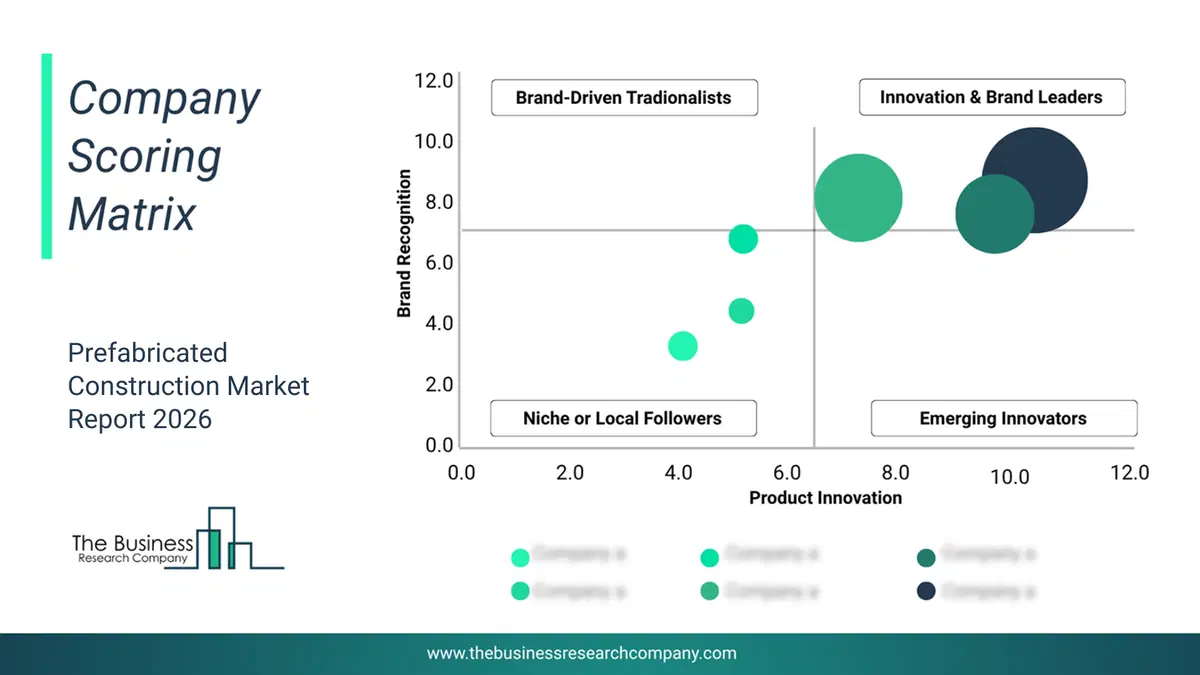
This chart maps companies by product innovation and brand strength, with bubble size indicating relative revenue, helping identify market leaders, challengers, and niche players. This is an illustrative chart; the full report provides a complete and accurate competitive analysis.
Global Prefabricated Construction Market Trends and Insights
Major companies operating in the prefabricated construction market are focusing on developing innovative products, such as precision-engineered prefabricated wall, floor, ceiling, and roof assemblies, to accelerate residential project completion, improve construction quality, reduce on-site labor dependency, and minimize jobsite risks. Precision-engineered prefabricated wall, floor, ceiling, and roof assemblies refer to factory-manufactured building components that are designed to exact specifications and delivered ready for rapid on-site installation, ensuring higher accuracy, faster construction, and improved quality control. For instance, in March 2023, CertainTeed, a US-based building materials company, launched one precision assemblies. This offsite panelized construction solution integrates digital design processes with factory-built wall, floor, and roof assemblies. It offers features such as pre-engineered panel systems for faster installation, improved thermal performance for energy efficiency, and reduced on-site labor dependency.What Are Latest Mergers And Acquisitions In The Prefabricated Construction Market?
In January 2023, ATCO Ltd., a Canada-based provider of infrastructure solutions, acquired Triple M Housing Ltd. for an undisclosed amount. With this acquisition, ATCO aimed to expand its presence in the North American residential modular housing market and strengthen its capabilities in factory-built housing solutions to address growing housing demand. Triple M Housing Ltd. is a Canada-based provider of modular and manufactured homes, offering factory-built residential housing solutions including single-family homes, multi-unit dwellings, and institutional modular buildings.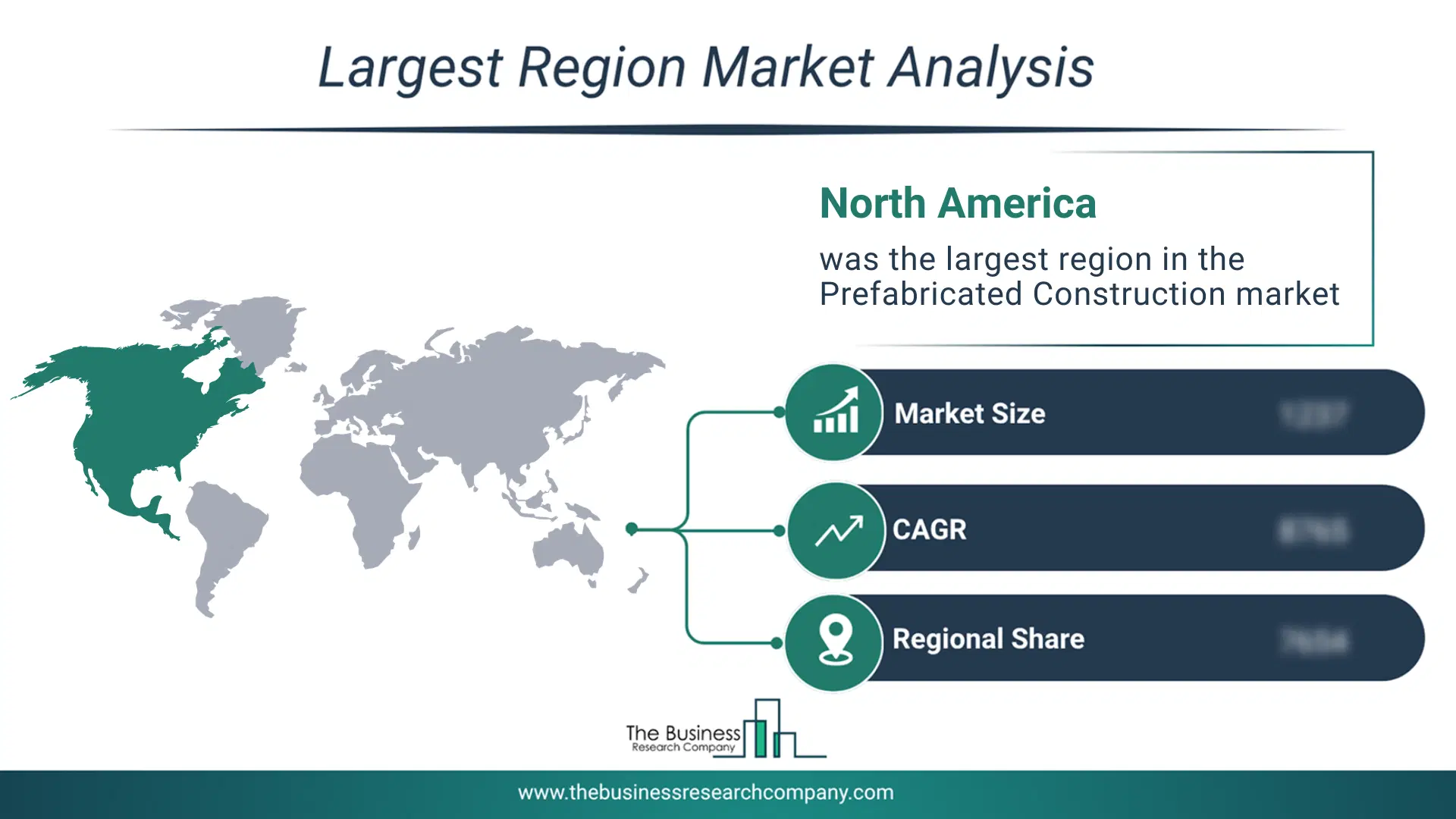
Regional Insights
North America was the largest region in the prefabricated construction market in 2025. Asia-Pacific is expected to be the fastest-growing region in the forecast period. The regions covered in this market report are Asia-Pacific, South East Asia, Western Europe, Eastern Europe, North America, South America, Middle East, Africa. The countries covered in this market report are Australia, Brazil, China, France, Germany, India, Indonesia, Japan, Taiwan, Russia, South Korea, UK, USA, Canada, Italy, Spain.What Defines the Prefabricated Construction Market?
The prefabricated construction market consists of sales of precast concrete components, manufactured homes, panelized homes, staircases, facades, insulation panels, and other off-site manufactured building components. Values in this market are ‘factory gate’ values, that is, the value of goods sold by the manufacturers or creators of the goods, whether to other entities (including downstream manufacturers, wholesalers, distributors, and retailers) or directly to end customers. The value of goods in this market includes related services sold by the creators of the goods.How is Market Value Defined and Measured?
The market value is defined as the revenues that enterprises gain from the sale of goods and/or services within the specified market and geography through sales, grants, or donations in terms of the currency (in USD unless otherwise specified). The revenues for a specified geography are consumption values that are revenues generated by organizations in the specified geography within the market, irrespective of where they are produced. It does not include revenues from resales along the supply chain, either further along the supply chain or as part of other products.
This chart presents market attractiveness based on a quantitative evaluation of growth, competition, strategic alignment, and risk, offering a clear view of opportunity areas for decision-making. This chart is for illustrative purposes; the full report contains the complete analysis.

This chart highlights the Total Addressable Market (TAM) by estimating the maximum revenue opportunity using an assumption-driven approach, supporting strategic planning and opportunity sizing across markets. The chart is illustrative; the full report provides a more comprehensive analysis.
What Key Data and Analysis Are Included in the Prefabricated Construction Market Report 2026?
The prefabricated construction market research report is one of a series of new reports from The Business Research Company that provides market statistics, including industry global market size, regional shares, competitors with the market share, detailed market segments, market trends and opportunities, and any further data you may need to thrive in the prefabricated construction industry. The market research report delivers a complete perspective of everything you need, with an in-depth analysis of the current and future state of the industry.Prefabricated Construction Market Report Forecast Analysis
| Report Attribute | Details |
|---|---|
| Market Size Value In 2026 | $151.48 billion |
| Revenue Forecast In 2030 | $213.88 billion |
| Growth Rate | CAGR of 9.00% from 2026 to 2030 |
| Base Year For Estimation | 2025 |
| Actual Estimates/Historical Data | 2020-2025 |
| Forecast Period | 2026 - 2030 |
| Market Representation | Revenue in USD Billion and CAGR from 2026 to 2030 |
| Segments Covered | Product Type, Material Type, Construction Type, Installation Type, End User Application |
| Regional Scope | Asia-Pacific, Western Europe, Eastern Europe, North America, South America, Middle East, Africa |
| Country Scope | The countries covered in this market report are Australia, Brazil, China, France, Germany, India, Indonesia, Japan, Taiwan, Russia, South Korea, UK, USA, Canada, Italy, Spain |
| Key Companies Profiled | Daiwa House Industry Co. Ltd., Laing O’Rourke Holdings Limited, Tata BlueScope Steel Private Limited, Interarch Building Products Limited, Pennar Industries Limited, Everest Industries Limited, Lindbäcks Group AB, Alghanim Industries, Walker Modular Ltd., Interpod Offsite Pty Ltd., Huf Haus GmbH & Co. KG, Guerdon LLC, Dvele Omega Inc., SurePods, Zamil Steel Holding Company, Algeco UK Limited, EPACK Prefab Technologies Limited, NorgesHus Tootmise OÜ, Guizhou Glamni Prefabricated Housing Co. Ltd., Modulart SpA. |
| Customization Scope | Request for Customization |
| Pricing And Purchase Options | Explore Purchase Options |