
Production Chemicals Market Report 2026
Global Outlook – By Type (Demulsifiers, Corrosion Inhibitors, Scale Inhibitors, Asphaltene Inhibitors, Biocides, Scavengers, Surfactants, Other Types), By Oilfield Type (Onshore, Offshore), By Application (Flow Assurance, Produced Water Treatment, Enhanced Oil Recovery (EOR), Well Integrity and Asset Protection, Separation and Treating, Reservoir Management, Other Applications) – Market Size, Trends, Strategies, and Forecast to 2030
Production Chemicals Market Overview
• Production Chemicals market size has reached to $7.12 billion in 2025 • Expected to grow to $9.59 billion in 2030 at a compound annual growth rate (CAGR) of 6.1% • Growth Driver: Increasing Demand For Oil And Gas Production To Boost Production Chemicals Market • Market Trend: Innovative Chemical Processing Technologies Revolutionize Production Chemical Market • North America was the largest region in 2025 and Asia-Pacific is the fastest growing region.What Is Covered Under Production Chemicals Market?
Production chemicals refer to a diverse group of substances manufactured and utilized in various industries, including agriculture, pharmaceuticals, construction, and manufacturing. It play a crucial role in ensuring the efficiency, safety, and environmental sustainability of industrial operations. The main types of production chemicals are demulsifiers, corrosion inhibitors, scale inhibitors, asphaltene inhibitors, biocides, scavengers, surfactants, and others. Demulsifiers are chemicals used to separate emulsions. They are used in various types of oil field include onshore and offshore for cementing, production chemicals, drilling fluids, improved oil recovery, well stimulation, and others.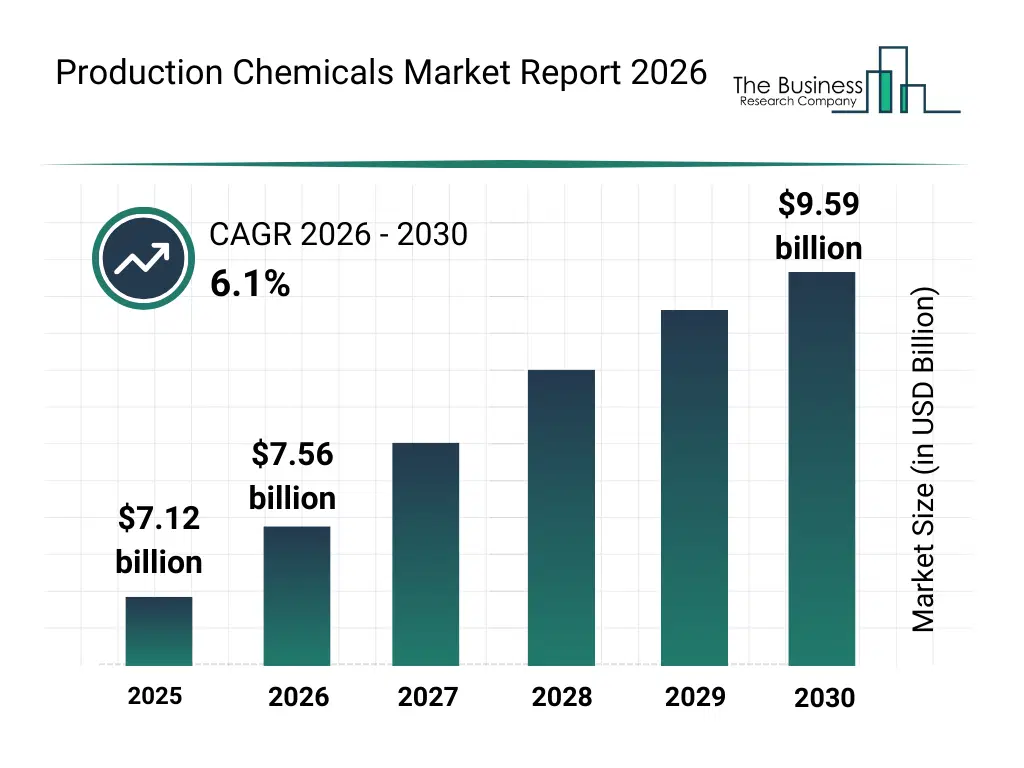
What Is The Production Chemicals Market Size and Share 2026?
The production chemicals market size has grown strongly in recent years. It will grow from $7.12 billion in 2025 to $7.56 billion in 2026 at a compound annual growth rate (CAGR) of 6.2%. The growth in the historic period can be attributed to growth of oil and gas production, expansion of onshore and offshore drilling, demand for flow assurance chemicals, increased well maintenance activities, industrial process optimization.What Is The Production Chemicals Market Growth Forecast?
The production chemicals market size is expected to see strong growth in the next few years. It will grow to $9.59 billion in 2030 at a compound annual growth rate (CAGR) of 6.1%. The growth in the forecast period can be attributed to aging oilfield infrastructure, rising enhanced oil recovery projects, stricter environmental compliance, increased offshore exploration, demand for specialty production chemicals. Major trends in the forecast period include increasing use of specialty oilfield chemicals, growing focus on operational efficiency, rising adoption of corrosion and scale control solutions, expansion of enhanced oil recovery chemicals, higher demand for environment friendly formulations.
Global Production Chemicals Market Segmentation
1) By Type: Demulsifiers, Corrosion Inhibitors, Scale Inhibitors, Asphaltene Inhibitors, Biocides, Scavengers, Surfactants, Other Types 2) By Oilfield Type: Onshore, Offshore 3) By Application: Flow Assurance, Produced Water Treatment, Enhanced Oil Recovery (EOR), Well Integrity and Asset Protection, Separation and Treating, Reservoir Management, Other Applications Subsegments: 1) By Demulsifiers: Oilfield Demulsifiers, Industrial Demulsifiers 2) By Corrosion Inhibitors: Oil And Gas Corrosion Inhibitors, Water Treatment Corrosion Inhibitors 3) By Scale Inhibitors: Organic Scale Inhibitors, Inorganic Scale Inhibitors 4) By Asphaltene Inhibitors: Solvent-Based Inhibitors, Non-Solvent-Based Inhibitors 5) By Biocides: Glutaraldehyde-Based Biocides, Non-Oxidizing Biocides 6) By Scavengers: Hydrogen Sulfide Scavengers, Carbon Dioxide Scavengers 7) By Surfactants: Anionic Surfactants, Cationic Surfactants, Non-Ionic Surfactants 8) By Other Types: Fluid Loss Additives, Foaming AgentsWhat Is The Driver Of The Production Chemicals Market?
The increasing demand for oil and gas is expected to propel the growth of the production chemicals market going forward. The demand for oil and gas is increasing due to economic growth, population increase, industrialization, transportation needs, petrochemical demand, and weather patterns. Production chemicals play a crucial role in the oil and gas industry by helping to optimize production, enhance operational efficiency, and ensure the integrity of production equipment. For instance, in September 2024, according to the Department for Energy Security and Net Zero, a UK-based governmental department, net imports of primary oils rose by 16% compared to Quarter 2 of 2023, as a 4.2% increase in exports during Quarter 2 of 2024 was outweighed by an 8.7% rise in imports. Meanwhile, demand for petroleum products grew by 1.7% in Quarter 2 of 2024 compared to the same quarter in 2023. Therefore, the increasing demand for oil and gas is driving the growth of the production chemicals industry.Key Players In The Global Production Chemicals Market
Major companies operating in the production chemicals market are Schlumberger Limited, Halliburton Company, Baker Hughes Company, BASF SE, Clariant AG, Ecolab Inc., Innospec Inc., Kemira Oyj, SNF Group, Croda International Plc, Stepan Company, Huntsman Corporation, Solvay S.A., Evonik Industries AG, LANXESS AG, Akzo Nobel N.V., Dow Inc., Sasol Limited, Mitsubishi Chemical Corporation, W. R. Grace & Co., Albemarle Corporation, Ashland Global Holdings Inc., Cabot Corporation, Calumet Specialty Products Partners, L.P.
This chart is for illustrative purposes; the full report includes a detailed competitor analysis and comprehensive overview of the top 10 companies in the market.
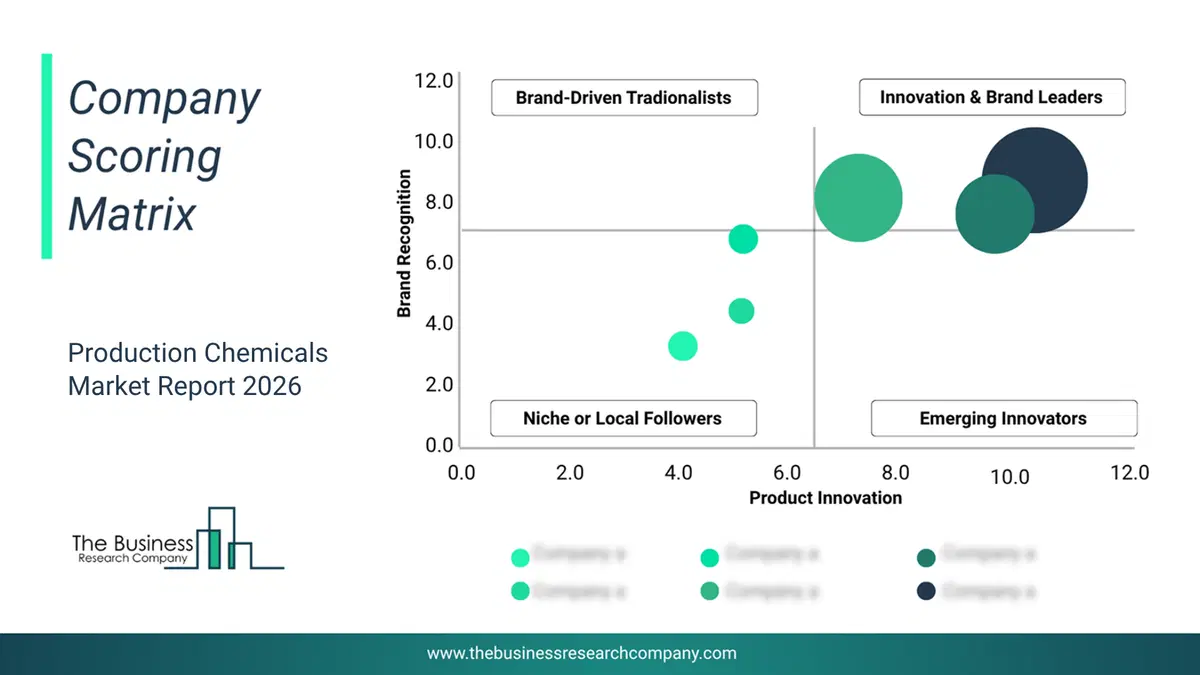
This chart maps companies by product innovation and brand strength, with bubble size indicating relative revenue, helping identify market leaders, challengers, and niche players. This is an illustrative chart; the full report provides a complete and accurate competitive analysis.
Global Production Chemicals Market Trends and Insights
Major companies operating in the production chemical market are focusing on innovative technologies, such as chemical processing technology to gain a competitive edge in the market. Chemical processing technology refers to the application of scientific principles and technical skills to the operation of chemical processing equipment in industries such as chemical manufacturing. For instance, in December 2023, Sulzer Ltd., a Switzerland-based industrial engineering and manufacturing firm, launched SULAC, a licensed new technology that enables polylactic acid (PLA) producers to seamlessly integrate new lactic acid to lactide capabilities, which is a crucial step in the production of PLA, an eco-friendly bioplastic. In order to manufacture PLA, lactic acid must be converted to lactide, which is restricted by current supply and supported by SULAC.What Are Latest Mergers And Acquisitions In The Production Chemicals Market?
In March 2024, International Chemical Investors Group (ICIG), a Luxemburg-based privately-owned industrial group focusing on mid-sized chemical and pharmaceutical businesses, acquired Vasant Chemicals for an undisclosed amount. The acquisition is a pivotal step in WeylChem's strategy to expand in the global specialty chemicals market and a major milestone in Vasant Chemical’s mission to grow its global presence and strengthen its customer value proposition. Vasant Chemicals is an India-based company that specializes in the production of specialty chemicals and pharmaceutical intermediates.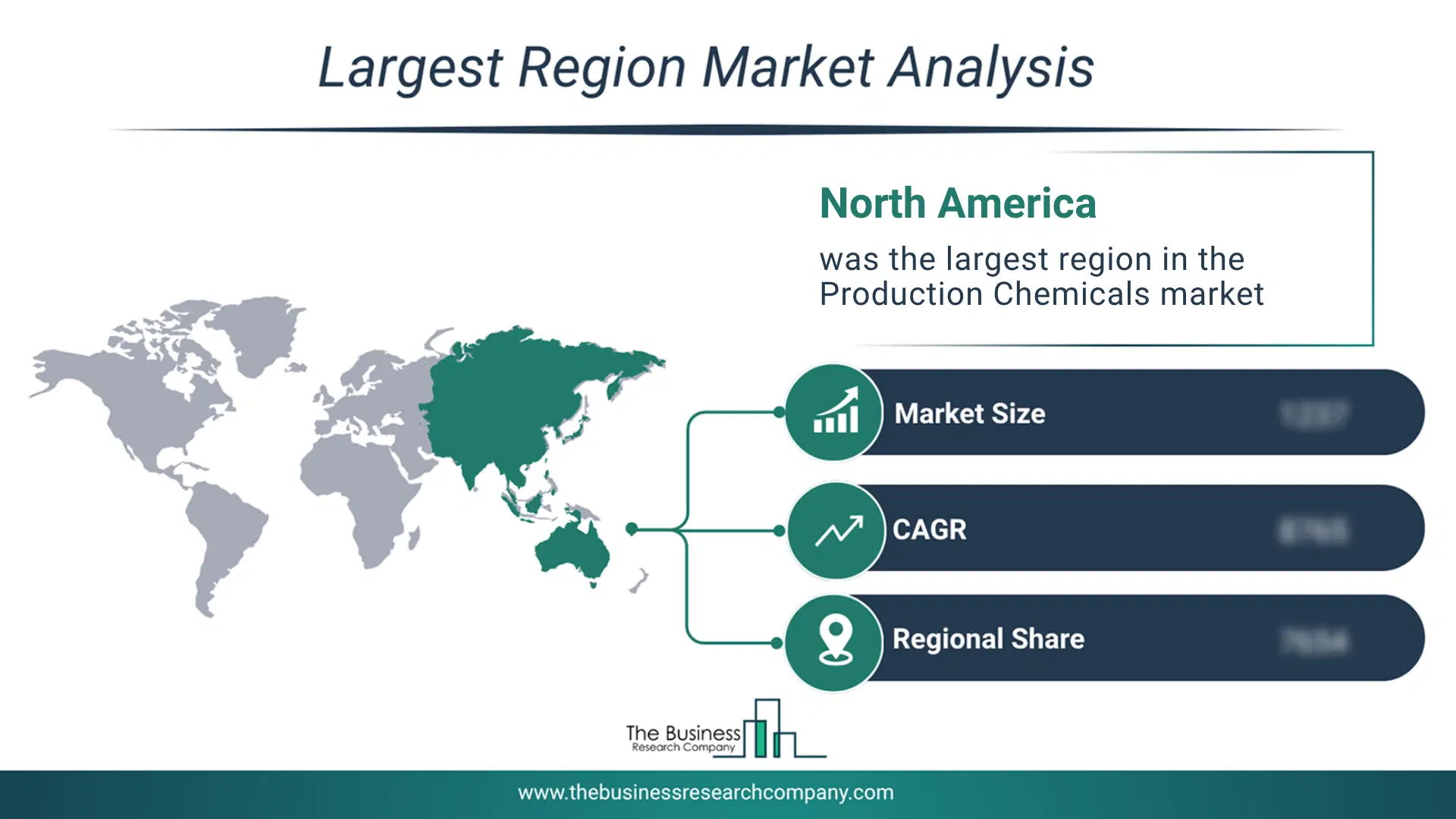
Regional Insights
North America was the largest region in the production chemicals market in 2025. Asia-Pacific is expected to be the fastest-growing region in the forecast period. The regions covered in this market report are Asia-Pacific, South East Asia, Western Europe, Eastern Europe, North America, South America, Middle East, Africa The countries covered in this market report are Australia, Brazil, China, France, Germany, India, Indonesia, Japan, Taiwan, Russia, South Korea, UK, USA, Canada, Italy, SpainWhat Defines the Production Chemicals Market?
The production chemicals market consists of sales of drag reducing agents, antifoaming agents, friction reducers, and emulsion breakers. Values in this market are ‘factory gate’ values, that is the value of goods sold by the manufacturers or creators of the goods, whether to other entities (including downstream manufacturers, wholesalers, distributors and retailers) or directly to end customers. The value of goods in this market includes related services sold by the creators of the goods.How is Market Value Defined and Measured?
The market value is defined as the revenues that enterprises gain from the sale of goods and/or services within the specified market and geography through sales, grants, or donations in terms of the currency (in USD unless otherwise specified). The revenues for a specified geography are consumption values that are revenues generated by organizations in the specified geography within the market, irrespective of where they are produced. It does not include revenues from resales along the supply chain, either further along the supply chain or as part of other products.
This chart presents market attractiveness based on a quantitative evaluation of growth, competition, strategic alignment, and risk, offering a clear view of opportunity areas for decision-making. This chart is for illustrative purposes; the full report contains the complete analysis.

This chart highlights the Total Addressable Market (TAM) by estimating the maximum revenue opportunity using an assumption-driven approach, supporting strategic planning and opportunity sizing across markets. The chart is illustrative; the full report provides a more comprehensive analysis.
What Key Data and Analysis Are Included in the Production Chemicals Market Report 2026?
The production chemicals market research report is one of a series of new reports from The Business Research Company that provides market statistics, including industry global market size, regional shares, competitors with the market share, detailed market segments, market trends and opportunities, and any further data you may need to thrive in the production chemicals industry. The market research report delivers a complete perspective of everything you need, with an in-depth analysis of the current and future state of the industry.Production Chemicals Market Report Forecast Analysis
| Report Attribute | Details |
|---|---|
| Market Size Value In 2026 | $7.56 billion |
| Revenue Forecast In 2030 | $9.59 billion |
| Growth Rate | CAGR of 6.2% from 2026 to 2030 |
| Base Year For Estimation | 2025 |
| Actual Estimates/Historical Data | 2020-2025 |
| Forecast Period | 2026 - 2030 |
| Market Representation | Revenue in USD Billion and CAGR from 2026 to 2030 |
| Segments Covered | Type, Oilfield Type, Application |
| Regional Scope | Asia-Pacific, Western Europe, Eastern Europe, North America, South America, Middle East, Africa |
| Country Scope | The countries covered in this market report are Australia, Brazil, China, France, Germany, India, Indonesia, Japan, Taiwan, Russia, South Korea, UK, USA, Canada, Italy, Spain |
| Key Companies Profiled | Schlumberger Limited, Halliburton Company, Baker Hughes Company, BASF SE, Clariant AG, Ecolab Inc., Innospec Inc., Kemira Oyj, SNF Group, Croda International Plc, Stepan Company, Huntsman Corporation, Solvay S.A., Evonik Industries AG, LANXESS AG, Akzo Nobel N.V., Dow Inc., Sasol Limited, Mitsubishi Chemical Corporation, W. R. Grace & Co., Albemarle Corporation, Ashland Global Holdings Inc., Cabot Corporation, Calumet Specialty Products Partners, L.P. |
| Customization Scope | Request for Customization |
| Pricing And Purchase Options | Explore Purchase Options |