
Proximity Sensor Market Report 2026
Global Outlook – By Product Type (Fixed Distance Proximity Sensor, Adjustable Distance Proximity Sensor), By Technology (Inductive, Capacitive, Magnetic, Photoelectric, Ultrasonic), By Application (Conveyor Systems, Assembly Line Automation, Anti-Aircraft Warfare, Parking Sensor Systems, Roller Coasters, Other Applications), By End-User Industry (Manufacturing Industry, Aerospace Industry, Energy Sector, Packaging Industry, Other End Users) – Market Size, Trends, Strategies, and Forecast to 2030
Proximity Sensor Market Overview
• Proximity Sensor market size has reached to $5.65 billion in 2025 • Expected to grow to $8.17 billion in 2030 at a compound annual growth rate (CAGR) of 7.7% • Growth Driver: Increasing Adoption Of Automation Drives Proximity Sensor Market Growth • Market Trend: High Resolution 3D Time of Flight (ToF) Sensors Driving Advanced Proximity Detection • North America was the largest region in 2025.What Is Covered Under Proximity Sensor Market?
A proximity sensor is a contactless device that detects the presence of an object by utilizing various methods such as sound, light, infrared radiation, or electromagnetic fields. These compact sensors are integrated into tight spaces or embedded within equipment, machinery, or electronic devices without adding significant bulk or complexity. The main product types of proximity sensor are fixed distance proximity sensor, adjustable distance proximity sensor. Fixed distance proximity sensor refers to a type of proximity sensor that has a fixed sensing range and cannot be adjusted. The various technologies include inductive, capacitive, magnetic, photoelectric, ultrasonic that are used in various applications such as conveyor systems, assembly line automation, anti-aircraft warfare, parking sensor systems, roller coasters, others and also by various end-user industries manufacturing industry, aerospace industry, energy sector, packaging industry, others.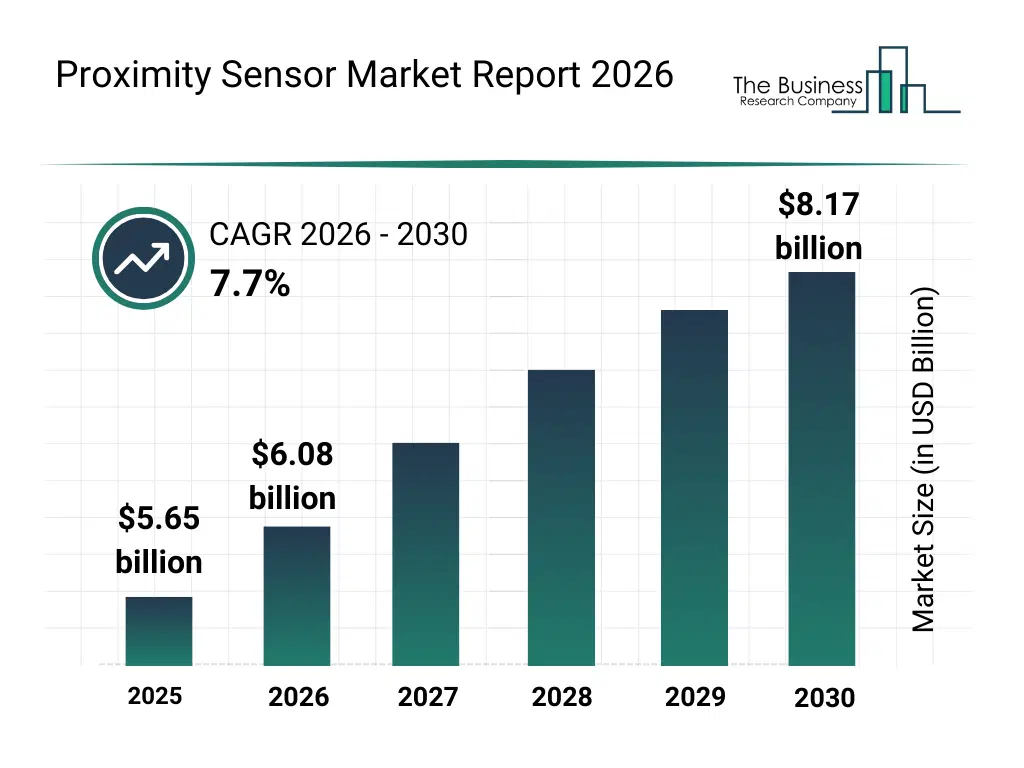
What Is The Proximity Sensor Market Size and Share 2026?
The proximity sensor market size has grown strongly in recent years. It will grow from $5.65 billion in 2025 to $6.08 billion in 2026 at a compound annual growth rate (CAGR) of 7.6%. The growth in the historic period can be attributed to increasing automation in industrial environments, widespread use of sensors in consumer electronics, growth of automotive electronic systems, rising adoption of safety automation, availability of cost-effective sensor technologies.What Is The Proximity Sensor Market Growth Forecast?
The proximity sensor market size is expected to see strong growth in the next few years. It will grow to $8.17 billion in 2030 at a compound annual growth rate (CAGR) of 7.7%. The growth in the forecast period can be attributed to expansion of electric and autonomous vehicles, rising deployment of smart infrastructure projects, increasing use of sensors in robotics, growing demand for energy-efficient sensing devices, integration of AI-based signal processing. Major trends in the forecast period include increasing integration of proximity sensors in smart manufacturing, rising demand for miniaturized sensor designs, growing adoption in automotive safety systems, expansion of contactless sensing applications, enhanced focus on high-accuracy detection.
Global Proximity Sensor Market Segmentation
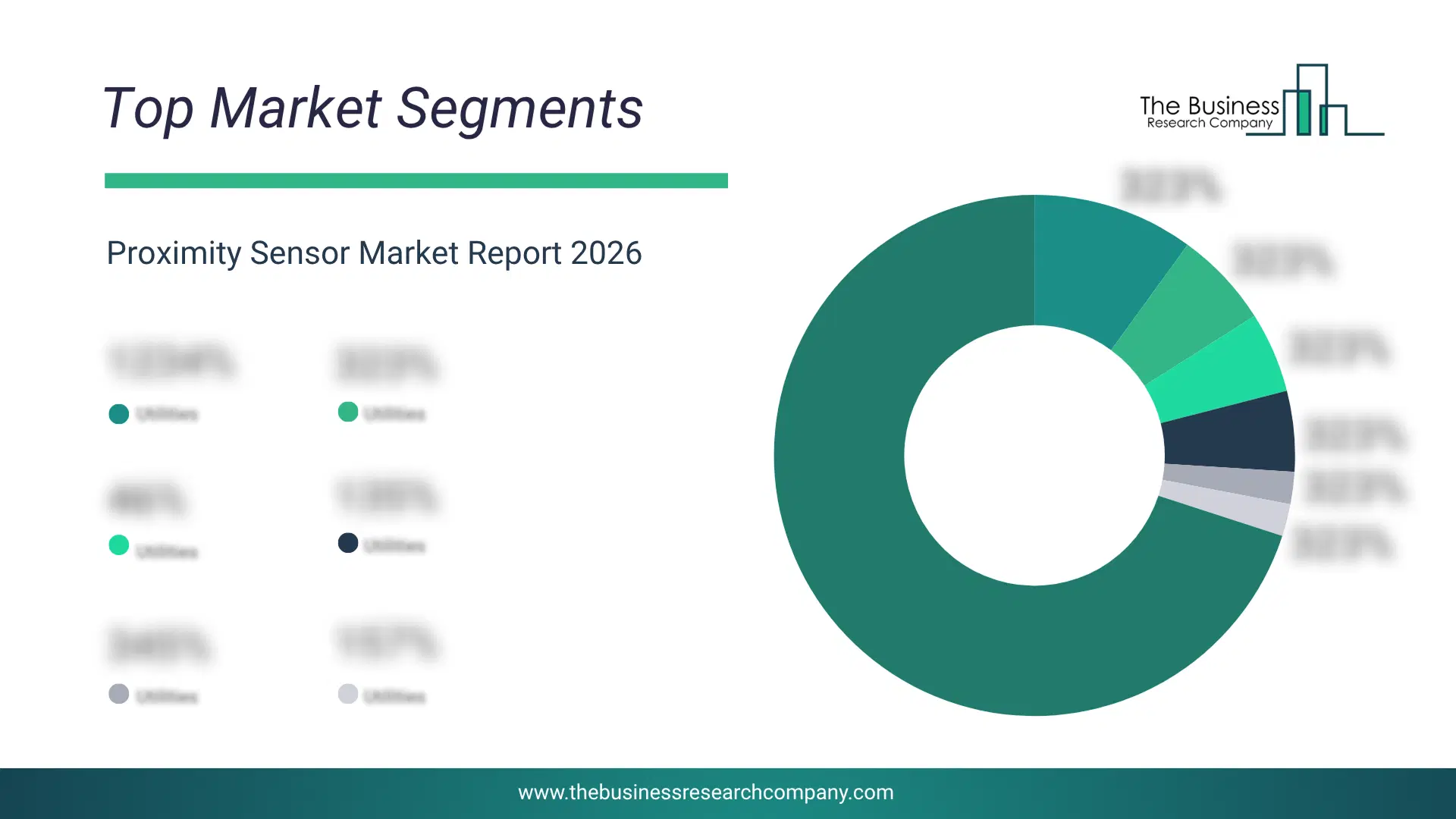
1) By Product Type: Fixed Distance Proximity Sensor, Adjustable Distance Proximity Sensor 2) By Technology: Inductive, Capacitive, Magnetic, Photoelectric, Ultrasonic 3) By Application: Conveyor Systems, Assembly Line Automation, Anti-Aircraft Warfare, Parking Sensor Systems, Roller Coasters, Other Applications 4) By End-User Industry: Manufacturing Industry, Aerospace Industry, Energy Sector, Packaging Industry, Other End Users Subsegments: 1) By Fixed Distance Proximity Sensor: Capacitive Proximity Sensors, Inductive Proximity Sensors, Photoelectric Proximity Sensors 2) By Adjustable Distance Proximity Sensor: Ultrasonic Proximity Sensors, Laser Proximity SensorsWhat Is The Driver Of The Proximity Sensor Market?
The growing demand for automation is expected to propel the growth of the proximity sensor market going forward. Automation uses technology, machinery, or systems to perform tasks or processes with minimal human intervention. The demand for automation is increasing due to various factors, such as the increasing need for enhanced efficiency, safety, productivity, and energy efficiency in multiple industries. Proximity sensors enable precise detection and measurement of objects without physical contact, facilitating seamless automation processes. For instance, in April 2024, according to the International Federation of Robotics, a Germany-based robotics industry association, the total number of industrial robot installations increased by 12%, reaching 44,303 units in 2023. Therefore, the emerging industrial IoT and automation operations are driving the growth of artificial intelligence (AI) in the packaging market. Therefore, the growing demand for automated vehicles is driving the growth of the proximity sensor industry.Key Players In The Global Proximity Sensor Market
Major companies operating in the proximity sensor market are Omron Corporation, Keyence Corporation, IFM Electronic GmbH, SICK AG, Pepperl + Fuchs GmbH, Balluff GmbH, Honeywell International Inc., Panasonic Corporation, Rockwell Automation Inc., Schneider Electric SE, Robert Bosch GmbH, Hans Turck GmbH & Co. KG, Kaman Corporation, Lion Precision Inc., Baumer Group, Autonics Corporation, Contrinex AG, Leuze electronic GmbH + Co. KG, Festo SE & Co. KG, Datalogic S.p.A.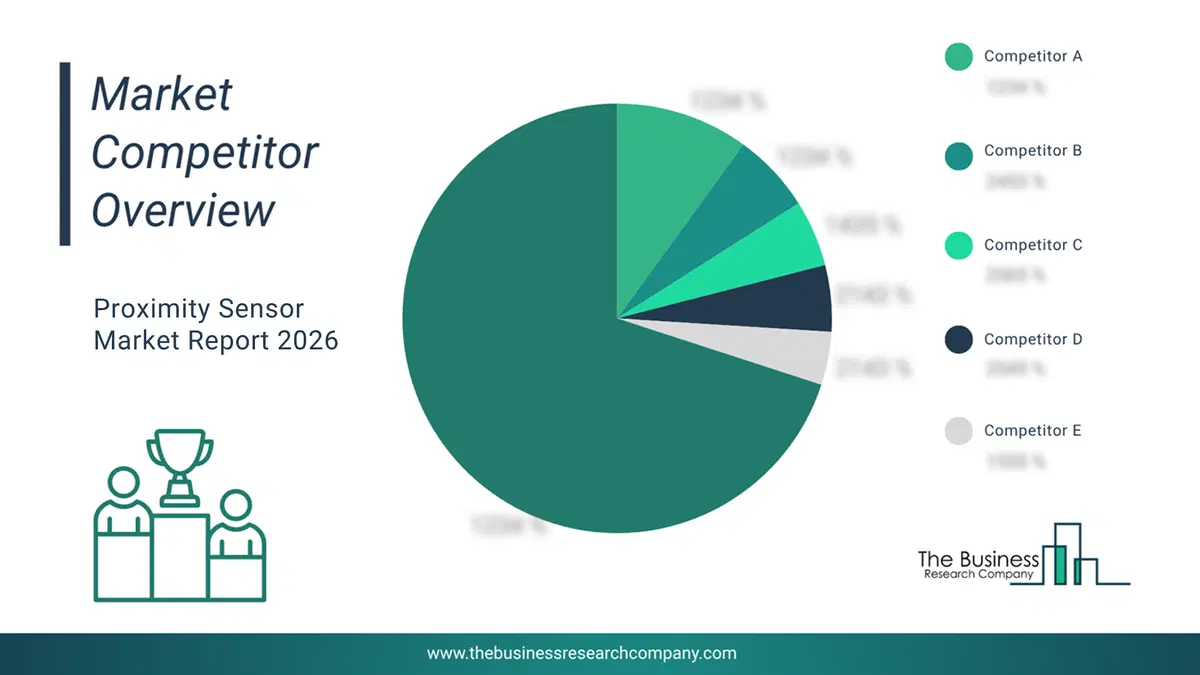
This chart is for illustrative purposes; the full report includes a detailed competitor analysis and comprehensive overview of the top 10 companies in the market.
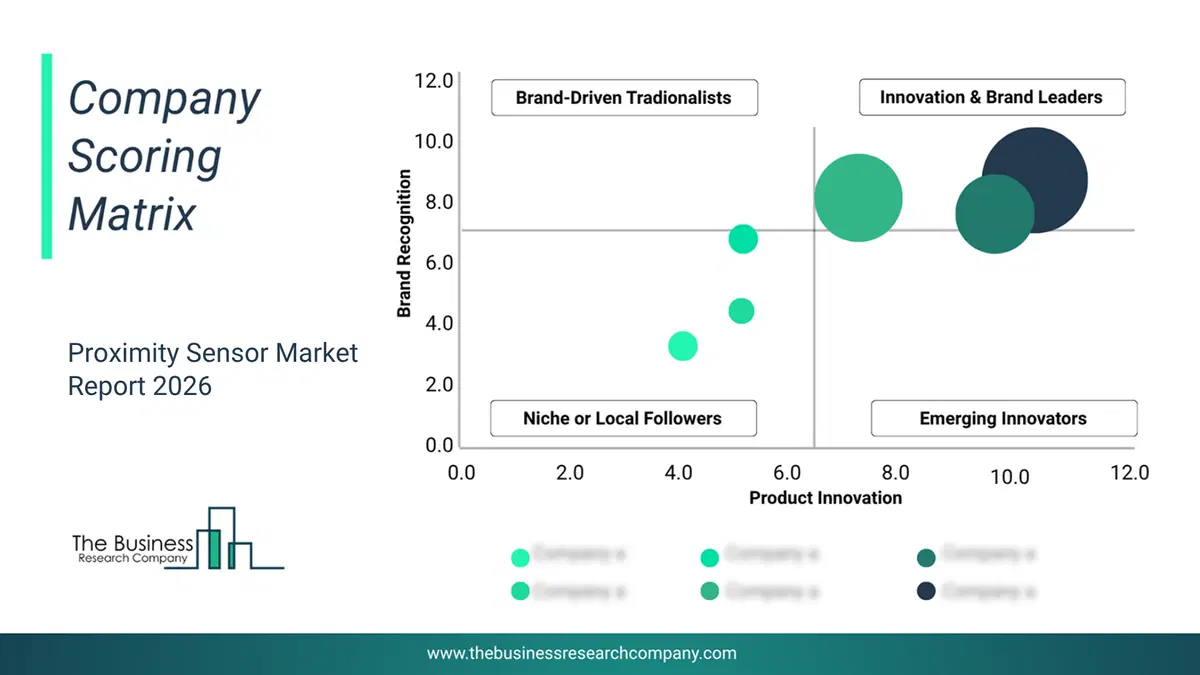
This chart maps companies by product innovation and brand strength, with bubble size indicating relative revenue, helping identify market leaders, challengers, and niche players. This is an illustrative chart; the full report provides a complete and accurate competitive analysis.
Global Proximity Sensor Market Trends and Insights
Major companies operating in the proximity sensor market are focusing on developing technologically advanced solutions, such as high-resolution Time-of-Flight (ToF) sensors, to improve object detection accuracy, enhance 3D depth imaging, and enable seamless integration with IoT and AI-driven applications. High-resolution ToF sensors refer to devices that measure the time it takes for light to travel to an object and back, creating a precise 3D depth map for detecting the presence or absence of objects without physical contact. For instance, in July 2023, STMicroelectronics, a Switzerland-based technology company, unveiled its FlightSense™ multi-zone distance sensor, featuring a 90° field of view 33% larger than the previous generation native 64-zone sensing, and a maximum distance capability of 350 cm. Designed for integration with smart devices and IoT systems, this sensor enhances detection accuracy, supports remote monitoring, and improves device interaction reliability.What Are Latest Mergers And Acquisitions In The Proximity Sensor Market?
In May 2024, SMK Corporation (Japan) and Pontosense Inc. (Canada) announced a strategic partnership to develop contactless mmWave sensors for automotive safety applications, including child‑presence detection (CPD) and vital‑sign monitoring in vehicles. Therefore, this collaboration demonstrates the driving role of advanced proximity/presence sensors in safety‑critical automotive systems.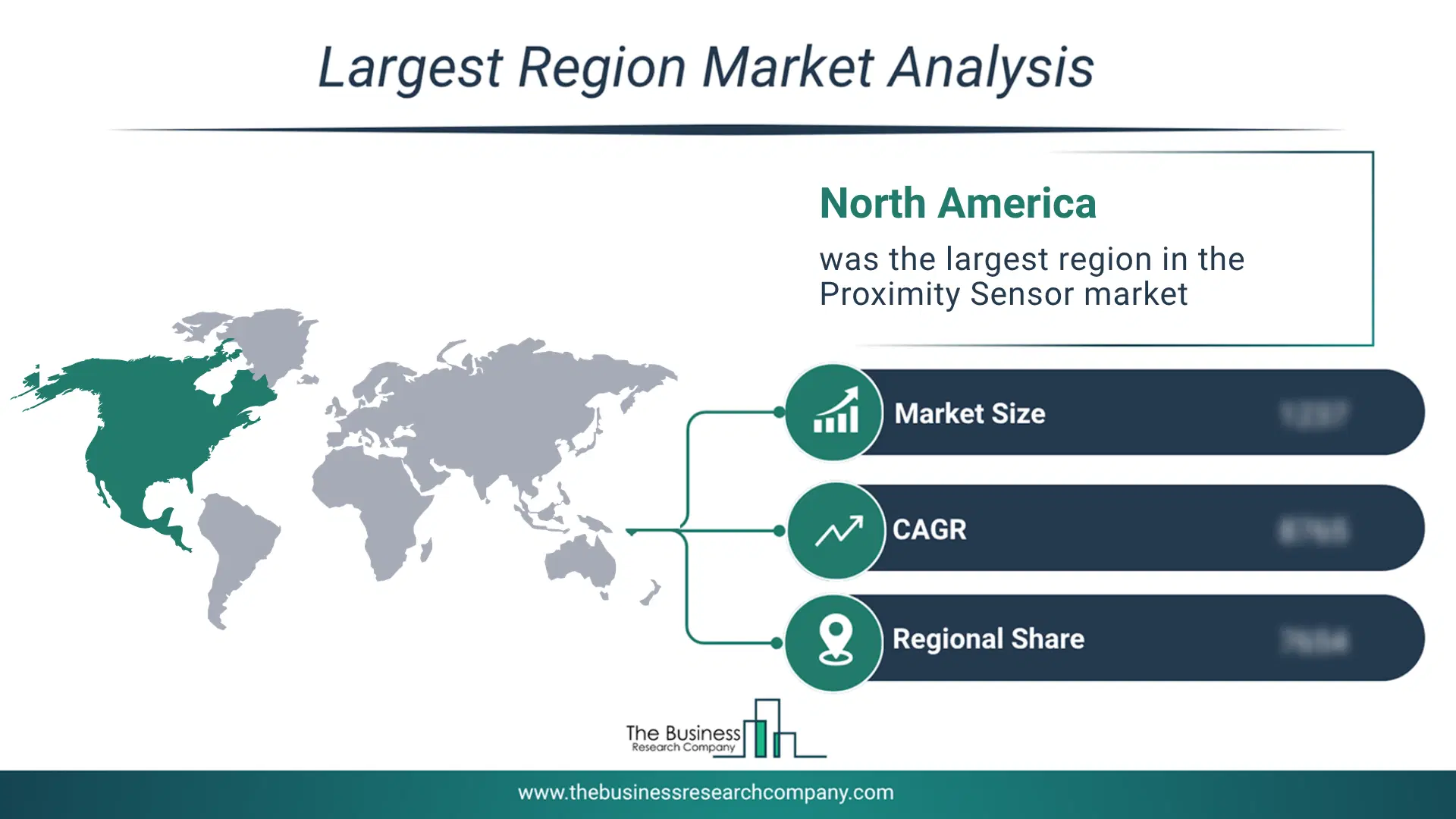
Regional Insights
North America was the largest region in the proximity sensors market in 2025. The regions covered in this market report are Asia-Pacific, South East Asia, Western Europe, Eastern Europe, North America, South America, Middle East, Africa. The countries covered in this market report are Australia, Brazil, China, France, Germany, India, Indonesia, Japan, Taiwan, Russia, South Korea, UK, USA, Canada, Italy, Spain.What Defines the Proximity Sensor Market?
The proximity sensor market consists of sales of capacitive sensors, inductive sensors, photoelectric sensors, ultrasonic sensors, and magnetic sensors. Values in this market are ‘factory gate’ values, that is the value of goods sold by the manufacturers or creators of the goods, whether to other entities (including downstream manufacturers, wholesalers, distributors, and retailers) or directly to end customers. The value of goods in this market includes related services sold by the creators of the goods.How is Market Value Defined and Measured?
The market value is defined as the revenues that enterprises gain from the sale of goods and/or services within the specified market and geography through sales, grants, or donations in terms of the currency (in USD unless otherwise specified). The revenues for a specified geography are consumption values that are revenues generated by organizations in the specified geography within the market, irrespective of where they are produced. It does not include revenues from resales along the supply chain, either further along the supply chain or as part of other products.
This chart presents market attractiveness based on a quantitative evaluation of growth, competition, strategic alignment, and risk, offering a clear view of opportunity areas for decision-making. This chart is for illustrative purposes; the full report contains the complete analysis.

This chart highlights the Total Addressable Market (TAM) by estimating the maximum revenue opportunity using an assumption-driven approach, supporting strategic planning and opportunity sizing across markets. The chart is illustrative; the full report provides a more comprehensive analysis.
What Key Data and Analysis Are Included in the Proximity Sensor Market Report 2026?
The proximity sensor market research report is one of a series of new reports from The Business Research Company that provides market statistics, including industry global market size, regional shares, competitors with the market share, detailed market segments, market trends and opportunities, and any further data you may need to thrive in the proximity sensor industry. The market research report delivers a complete perspective of everything you need, with an in-depth analysis of the current and future state of the industry.Proximity Sensor Market Report Forecast Analysis
| Report Attribute | Details |
|---|---|
| Market Size Value In 2026 | $6.08 billion |
| Revenue Forecast In 2030 | $8.17 billion |
| Growth Rate | CAGR of 7.7% from 2026 to 2030 |
| Base Year For Estimation | 2025 |
| Actual Estimates/Historical Data | 2020-2025 |
| Forecast Period | 2026 - 2030 |
| Market Representation | Revenue in USD Billion and CAGR from 2026 to 2030 |
| Segments Covered | Product Type, Technology, Application, End-User Industry |
| Regional Scope | Asia-Pacific, Western Europe, Eastern Europe, North America, South America, Middle East, Africa |
| Country Scope | The Countries Covered In This Market Report Are Australia, Brazil, China, France, Germany, India, Indonesia, Japan, Taiwan, Russia, South Korea, Uk, Usa, Canada, Italy, Spain. |
| Key Companies Profiled | Omron Corporation, Keyence Corporation, IFM Electronic GmbH, SICK AG, Pepperl + Fuchs GmbH, Balluff GmbH, Honeywell International Inc., Panasonic Corporation, Rockwell Automation Inc., Schneider Electric SE, Robert Bosch GmbH, Hans Turck GmbH & Co. KG, Kaman Corporation, Lion Precision Inc., Baumer Group, Autonics Corporation, Contrinex AG, Leuze electronic GmbH + Co. KG, Festo SE & Co. KG, Datalogic S.p.A. |
| Customization Scope | Request for Customization |
| Pricing And Purchase Options | Explore Purchase Options |