

Pulp And Paper Automation Market Report 2026
Global Outlook – By Product (Distributed Control Systems (DCS), Programmable Logic Controllers (PLCs), Supervisory Control And Data Acquisition (SCADA), Sensors And Transmitters, Flowmeters, Manufacturing Execution Systems (MES), Asset Performance Management (APM), Advanced Process Control (APC), Other Products), By Application (Pre-Press Printing, Print And Publication, Paper Mills Processing, Paper Packaging), By End-User (Paper, Pulp, Tissue, Board) – Market Size, Trends, Strategies, and Forecast to 2030
Pulp And Paper Automation Market Overview
• Pulp And Paper Automation market size has reached to $6.79 billion in 2025 • Expected to grow to $9.58 billion in 2030 at a compound annual growth rate (CAGR) of 7.1% • Growth Driver: The Impact of Rising Industrial Automation Demand on the Pulp and Paper Automation Market • Market Trend: Advancements In Pulp And Paper Automation Reshape Industry Landscape • Europe was the largest region in 2025.Market Gains By 2030 – Top Opportunities By Segment
Market Gain identifies the most promising market opportunities by highlighting the segments or products expected to generate the highest incremental revenue growth over the next five years.
What Is Covered Under Pulp And Paper Automation Market?
Pulp and paper automation involves integrating state-of-the-art technological systems and procedures within pulp and paper manufacturing plants to improve the industry's productivity, efficiency, and sustainability. This automation covers a broad spectrum of applications, ranging from individual measurements to comprehensive mill-wide projects, with objectives including optimizing pulping processes, ensuring consistent product quality, boosting energy generation, and reducing energy and chemical usage. The main product types of pulp and paper automation are distributed control systems (DCS), programmable logic controllers (PLCs), supervisory control and data acquisition (SCADA), sensors and transmitters, flowmeters, manufacturing execution systems (MES), asset performance management (APM), advanced process control (APC), others. Distributed control systems (DCS) are computerized systems that control processes in various parts of a plant, allowing for efficient coordination and monitoring. These are used in various applications such as pre-press printing, print and publication, paper mills processing, and paper packaging and also by various end-users such as paper, pulp, tissue, and board.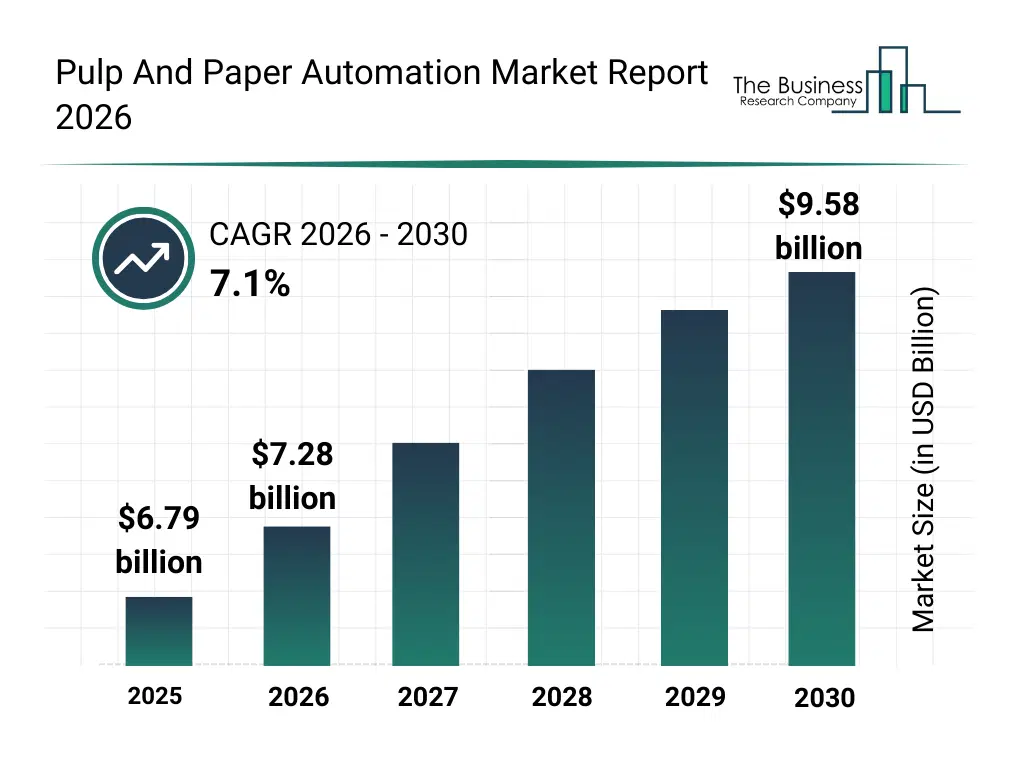
What Is The Pulp And Paper Automation Market Size and Share 2026?
The pulp and paper automation market size has grown strongly in recent years. It will grow from $6.79 billion in 2025 to $7.28 billion in 2026 at a compound annual growth rate (CAGR) of 7.3%. The growth in the historic period can be attributed to increasing demand for operational efficiency, expansion of large-scale pulp and paper plants, rising energy cost pressures, availability of industrial automation solutions, growing focus on production optimization.What Is The Pulp And Paper Automation Market Growth Forecast?
The pulp and paper automation market size is expected to see strong growth in the next few years. It will grow to $9.58 billion in 2030 at a compound annual growth rate (CAGR) of 7.1%. The growth in the forecast period can be attributed to increasing investments in smart manufacturing initiatives, rising adoption of AI-driven process optimization, expansion of digital twin technologies, growing emphasis on sustainability compliance, increasing demand for real-time production analytics. Major trends in the forecast period include increasing deployment of mill-wide automation systems, rising adoption of advanced process control solutions, growing integration of predictive maintenance platforms, expansion of energy optimization automation, enhanced focus on quality consistency.

Global Pulp And Paper Automation Market Segmentation
1) By Product: Distributed Control Systems (DCS), Programmable Logic Controllers (PLCs), Supervisory Control And Data Acquisition (SCADA), Sensors And Transmitters, Flowmeters, Manufacturing Execution Systems (MES), Asset Performance Management (APM), Advanced Process Control (APC), Other Products 2) By Application: Pre-Press Printing, Print And Publication, Paper Mills Processing, Paper Packaging 3) By End-User: Paper, Pulp, Tissue, Board Subsegments: 1) By Distributed Control Systems (DCS): Process Control Distributed Control Systems (DCS), Batch Control Distributed Control Systems (DCS) 2) By Programmable Logic Controllers (PLCs): Compact Programmable Logic Controllers (PLCs), Modular Programmable Logic Controllers (PLCs) 3) By Supervisory Control And Data Acquisition (SCADA): Hardware Supervisory Control And Data Acquisition (SCADA), Software Supervisory Control And Data Acquisition (SCADA) 4) By Sensors And Transmitters: Pressure Sensors, Temperature Sensors, Level Sensors, Flow Sensors 5) By Flowmeters: Electromagnetic Flowmeters, Ultrasonic Flowmeters, Mass Flowmeters 6) By Manufacturing Execution Systems (MES): Production Tracking, Quality Management, Performance Analysis 7) By Asset Performance Management (APM): Condition Monitoring, Predictive Maintenance 8) By Advanced Process Control (APC): Model Predictive Control (MPC), Adaptive Control 9) By Other Products: Industrial Networking Solutions, Safety Systems The top segments in the pulp and paper automation market will be: • Paper Mills Processing will reach $4655.9 Million by 2025. • Paper will reach $2620.93 Million by 2025. • Distributed Control Systems (DCS) will reach $1804.27 Million by 2025. • Pulp will reach $1586.5 Million by 2025. • Tissue will reach $1534.91 Million by 2025.What Is The Driver Of The Pulp And Paper Automation Market?
The increasing demand for industrial automation is expected to propel the growth of the pulp and paper automation market going forward. Industrial automation uses advanced technologies such as robotics, control systems, and computer software to streamline and optimize manufacturing processes, reducing human intervention and enhancing efficiency and productivity in industrial settings. Industrial automation systems monitor and control various pulp and paper production stages to improve product quality, reduce waste, and minimize energy consumption. For instance, in April 2024, according to the International Federation of Robotics, a Germany-based international organization, In the United States, manufacturing companies have significantly increased their automation efforts, with total industrial robot installations rising 12% to 44, 303 units in 2023. Therefore, the increasing demand for industrial automation is driving the growth of the pulp and paper automation industry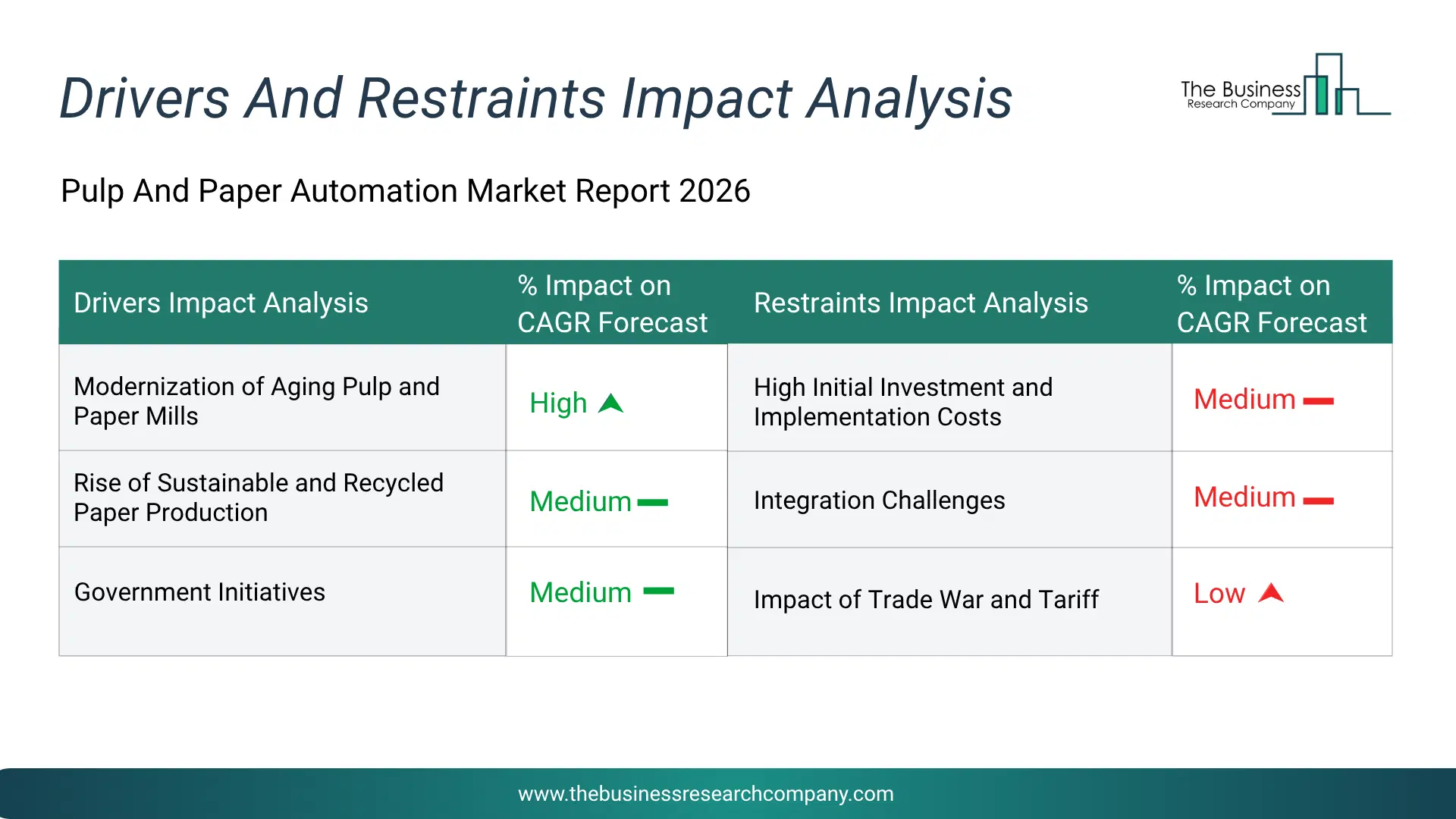
Infographic Chart Showing Key Market Drivers Analysis And Restraints For Pulp And Paper Automation Market
The chart presents an impact analysis of key drivers and restraints, quantifying their relative influence on the market's growth rate and helping assess the balance between growth enablers and limiting factors. This chart offers a high-level perspective; the full report contains more detailed insights.
How Will The Drivers Impact Growth In The Global Pulp And Paper Automation Market?
• Modernization of Aging Pulp and Paper Mills (High) – The modernization of aging pulp and paper mills will become a key driver of growth in the pulp and paper automation market by 2030. Many mills across North America, Europe and Asia-Pacific are replacing outdated distributed control systems (DCS) and programmable logic controllers (PLC) with advanced process automation, AI-based optimization and predictive maintenance platforms. This shift enables real-time process control, reduced downtime and better integration of digital twins and IoT (internet of things) solutions, essential for achieving operational excellence in older facilities. Consequently, modernization initiatives will accelerate investment in automation software, control systems and intelligent equipment across the pulp and paper value chain. As a result, the modernization of aging pulp and paper mills is anticipated to contributing to a 2.0% annual growth in the market. • Rise of Sustainable and Recycled Paper Production (Medium) – The rise of sustainable and recycled paper Production will emerge as a major factor driving the expansion of the pulp and paper automation market by 2030. Growing global demand for eco-friendly and recycled paper products is pushing mills to adopt automation to handle complex waste fiber processing and ensure consistent quality. Automated pulping, sorting and water treatment systems enable efficient recovery of fibers and minimize resource wastage. Intelligent sensors and advanced control software also help mills optimize chemical usage during de-inking and bleaching while maintaining environmental compliance. As sustainability becomes a key operational goal, automation systems that enable closed-loop water usage, emission tracking and resource efficiency will become indispensable, driving higher adoption rates across modernized recycling plants and sustainable paper mills. Consequently, the accelerating rise of sustainable and recycled paper capabilities is projected to contributing to a 1.5% annual growth in the market. • Government Initiatives (Medium) – The government initiatives processes will serve as a key growth catalyst for the pulp and paper automation market by 2030. Policies in regions like the EU, the US and Australia are encouraging mills to invest in advanced process control, energy-efficient technologies and digital monitoring platforms to reduce emissions and improve sustainability reporting. Financial subsidies for smart manufacturing, carbon reduction targets and innovation grants for Industry 4.0 adoption are prompting both large and mid-sized mills to integrate automation into production and resource management systems. This alignment of regulatory pressure with financial support will continue to fuel automation-driven modernization in the forecast period. Therefore, this government initiatives operations is projected to supporting to a 1.0% annual growth in the market. • Growth in Tissue and Hygiene Paper Demand (Low) – The growth in tissue and hygiene paper demand will become a significant driver contributing to the growth of the pulp and paper automation market by 2030. This is encouraging manufacturers to expand production capacity. To meet high throughput and product consistency demands, mills are increasingly deploying automation systems for process control, quality assurance and packaging. Automated handling, converting and rolling lines help maintain precision, reduce labour dependency and enable rapid changeovers for different tissue grades. As producers scale up operations, intelligent manufacturing solutions integrated with real-time analytics and robotics will become vital in optimizing production speed and maintaining quality, further strengthening automation’s role in the growing tissue segment. Consequently, the growth in tissue and hygiene paper demand strategies is projected to contributing to a 0.5% annual growth in the market.How Will The Restraints Impact Growth In The Global Pulp And Paper Automation Market?
• High Initial Investment and Implementation Costs (Medium) – High Initial Investment and Implementation Costs will restrict the growth of the Pulp And Paper Automation market during the forecast period. Automation implementation requires significant capital investment in hardware, software, and system integration. High costs create barriers for smaller pulp and paper mills with limited budgets. Cost constraints can delay modernization projects and limit automation adoption. • Integration Challenges (Medium) – Integration Challenges will restrict the growth of the Pulp And Paper Automation market during the forecast period. Automation of pulp and paper mills faces challenges in integrating with existing equipment and legacy control systems. Compatibility issues and data format differences can complicate implementation. Integration challenges can increase project costs and timelines, affecting automation adoption. • Impact of Trade War and Tariff (Low) – Impact of Trade War and Tariff will restrict the growth of the Pulp And Paper Automation market during the forecast period. Trade tariffs on automation equipment and components can increase implementation costs. Trade barriers may impact the availability and cost of technology from international suppliers. Trade tensions can affect pulp and paper production and investment in automation.Key Players In The Global Pulp And Paper Automation Market
Major companies operating in the pulp and paper automation market are Siemens AG, Honeywell International Inc., ABB Ltd., Emerson Electric Co., Schneider Electric SE, Rockwell Automation Inc., Omron Corporation, Andritz AG, Metso Corporation, Valmet Corporation, Voith Group, Yokogawa Electric Corporation, Fuji Electric Co. Ltd., Fanuc Corporation, BTG Group BV, Ecolab Inc., Solenis LLC, Kemira Oyj, Hitachi Ltd., General Electric Company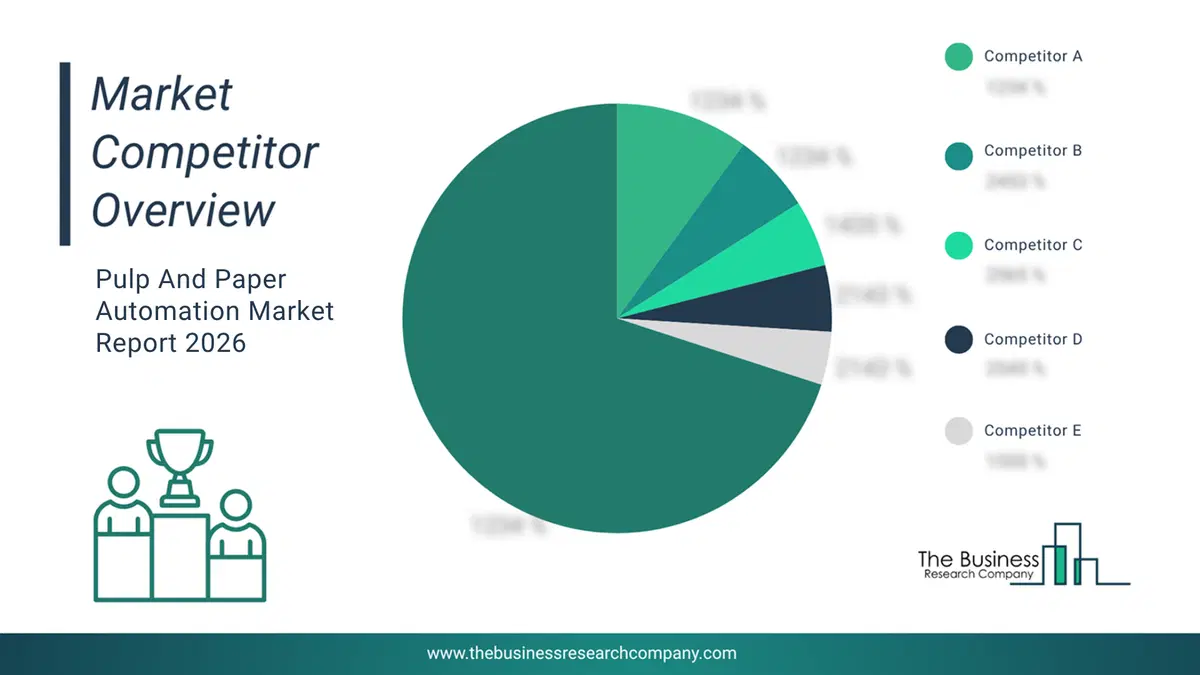
This chart is for illustrative purposes; the full report includes a detailed competitor analysis and comprehensive overview of the top 10 companies in the market.
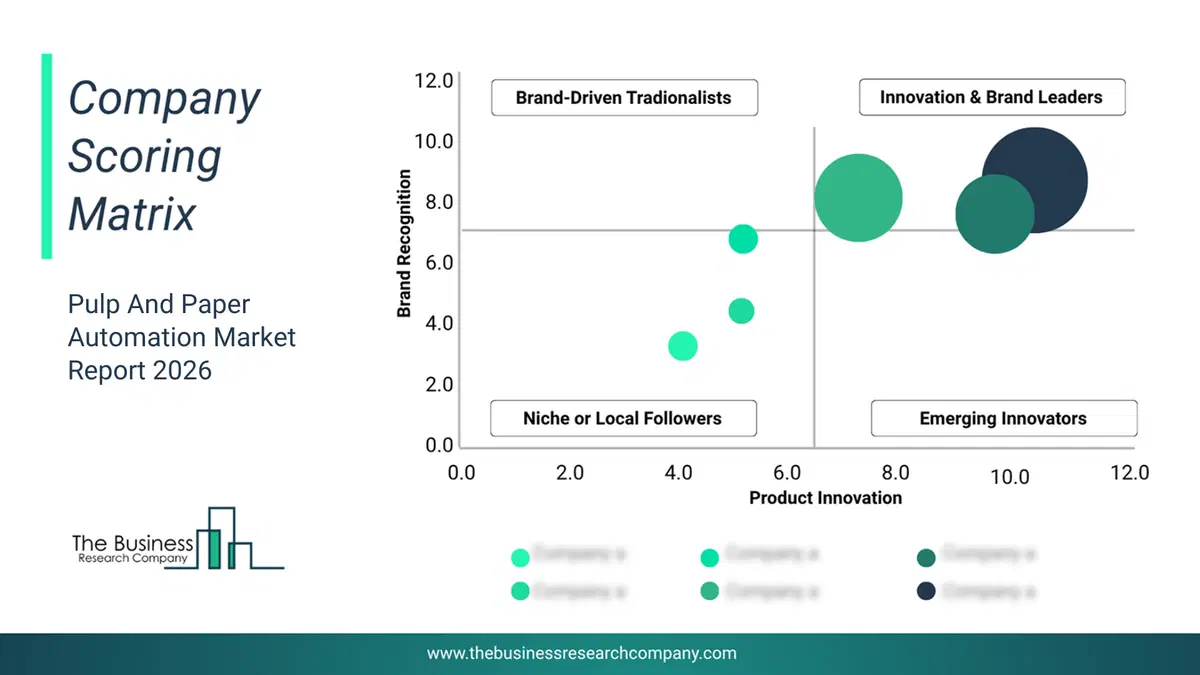
This chart maps companies by product innovation and brand strength, with bubble size indicating relative revenue, helping identify market leaders, challengers, and niche players. This is an illustrative chart; the full report provides a complete and accurate competitive analysis.
Global Pulp And Paper Automation Market Trends and Insights
Major companies operating in the pulp and paper automation market are developing innovative products such as Bleached Chemi-Thermo Mechanical Pulp (BCTMP) technology to drive their revenues in the market. BCTMP is a mechanical pulping process that uses sodium sulfite for impregnation. The BCTMP technology produces high-brightness, hardwood-based, customized TCF (total chlorine-free) pulps for various uses, including printing and writing papers, tissue products, paperboard products, wood-free papers, and specialty papers. For instance, in January 2023, Valmet, a Europe-based developer and supplier of process technologies, automation, and services for the pulp, paper, and energy industries, launched the Valmet Polymer Concentration Measurement (Valmet PCM), an advanced optical inline polymer measurement system. This innovation is designed to measure polymer concentration in real-time, enabling the optimization of polymer usage in industrial wastewater treatment as well as in paper and board production applications. The Valmet PCM is the first of its kind, offering enhanced accuracy and efficiency in monitoring and controlling polymer concentration, ultimately contributing to improved process performance and resource utilization.What Are Latest Mergers And Acquisitions In The Pulp And Paper Automation Market?
In July 2023, Valmet Oyj, a Finland-based developer and supplier of process technologies, automation, and services for the pulp, paper, and energy industries, acquired Körber’s business area tissue for an amount of EUR 380 million (0.4294 billion USD). This acquisition aims to strengthen Valmet's position in the tissue industry and create the market's most comprehensive technology, automation, and service offering, covering the entire tissue value chain. The acquisition complements Valmet's tissue-making offering with solid expertise and complete solutions from tissue conversion and packaging technologies. Körber is a Germany-based company that offers pulp and paper automation.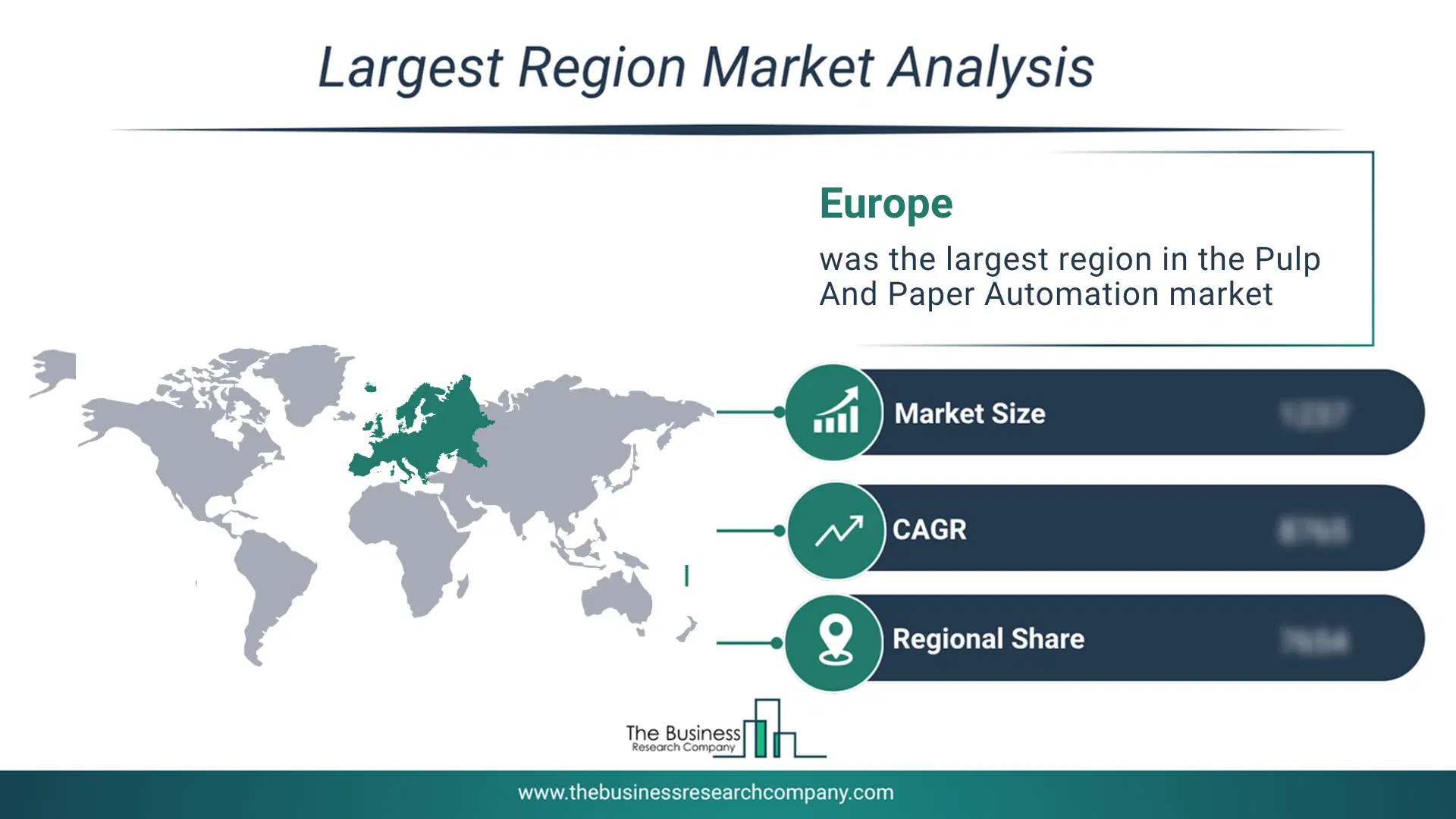
Regional Outlook
Europe was the largest region in the pulp and paper automation market in 2025. The regions covered in this market report are Asia-Pacific, South East Asia, Western Europe, Eastern Europe, North America, South America, Middle East, Africa. The countries covered in this market report are Australia, Brazil, China, France, Germany, India, Indonesia, Japan, Taiwan, Russia, South Korea, UK, USA, Canada, Italy, Spain.What Defines the Pulp And Paper Automation Market?
The pulp and paper automation market consists of sales of operator training systems (OTS), control valves, packaging equipment, material handling equipment, process electrochemical systems, and process engineering tools. Values in this market are ‘factory gate’ values, that is the value of goods sold by the manufacturers or creators of the goods, whether to other entities (including downstream manufacturers, wholesalers, distributors, and retailers) or directly to end customers. The value of goods in this market includes related services sold by the creators of the goods.How is Market Value Defined and Measured?
The market value is defined as the revenues that enterprises gain from the sale of goods and/or services within the specified market and geography through sales, grants, or donations in terms of the currency (in USD unless otherwise specified). The revenues for a specified geography are consumption values that are revenues generated by organizations in the specified geography within the market, irrespective of where they are produced. It does not include revenues from resales along the supply chain, either further along the supply chain or as part of other products.
This chart presents market attractiveness based on a quantitative evaluation of growth, competition, strategic alignment, and risk, offering a clear view of opportunity areas for decision-making. This chart is for illustrative purposes; the full report contains the complete analysis.

This chart highlights the Total Addressable Market (TAM) by estimating the maximum revenue opportunity using an assumption-driven approach, supporting strategic planning and opportunity sizing across markets. The chart is illustrative; the full report provides a more comprehensive analysis.
What Key Data and Analysis Are Included in the Pulp And Paper Automation Market Report 2026?
The pulp and paper automation market research report is one of a series of new reports from The Business Research Company that provides market statistics, including Market Report 2026?global market size, regional shares, competitors with the market share, detailed market segments, market trends and opportunities, and any further data you may need to thrive in the pulp and paper automation Market Report 2026? The market research report delivers a complete perspective of everything you need, with an in-depth analysis of the current and future state of the Market Report 2026?Pulp And Paper Automation Market Report Forecast Analysis
| Report Attribute | Details |
|---|---|
| Market Size Value In 2026 | $7.28 billion |
| Revenue Forecast In 2030 | $9.58 billion |
| Growth Rate | CAGR of 7.3% from 2026 to 2030 |
| Base Year For Estimation | 2025 |
| Actual Estimates/Historical Data | 2020-2025 |
| Forecast Period | 2026 - 2030 |
| Market Representation | Revenue in USD Billion and CAGR from 2026 to 2030 |
| Segments Covered | Product, Application, End-User |
| Regional Scope | Asia-Pacific, Western Europe, Eastern Europe, North America, South America, Middle East, Africa |
| Country Scope | The countries covered in the report are Australia, Brazil, China, France, Germany, India, Indonesia, Japan, Taiwan, Russia, South Korea, UK, USA, Canada, Italy, Spain. |
| Key Companies Profiled | Siemens AG, Honeywell International Inc., ABB Ltd., Emerson Electric Co., Schneider Electric SE, Rockwell Automation Inc., Omron Corporation, Andritz AG, Metso Corporation, Valmet Corporation, Voith Group, Yokogawa Electric Corporation, Fuji Electric Co. Ltd., Fanuc Corporation, BTG Group BV, Ecolab Inc., Solenis LLC, Kemira Oyj, Hitachi Ltd., General Electric Company |
| Customization Scope | Request for Customization |
| Pricing And Purchase Options | Explore Purchase Options |