
Purchase Order Management Market Report 2026
Global Outlook – By Component (Software, Services), By Deployment Type (Cloud Based Solutions, On Premise Solutions), By Organization Size (Small And Medium Enterprises, Large Enterprises), By Functionality (Order Creation And Approval, Order Tracking And Visibility, Supplier Collaboration And Communication, Compliance And Audit Management, Spend Analysis And Reporting), By Industry Vertical (Manufacturing, Retail And Consumer Goods, Healthcare And Life Sciences, Banking Financial Services And Insurance, Information Technology And Telecommunications, Energy And Utilities, Logistics And Transportation) – Market Size, Trends, Strategies, and Forecast to 2030
Purchase Order Management Market Overview
• Purchase Order Management market size has reached to $3.55 billion in 2025 • Expected to grow to $3.98 billion in 2030 at a compound annual growth rate (CAGR) of 12.2% • Growth Driver: Rising E-Commerce Adoption Driving The Market Growth Due To Increasing Demand For Efficient Order Processing And Fulfillment Systems • Market Trend: Artificial Intelligence-Driven Innovation Enhancing Supply Chain Accuracy And Real-Time Procurement Efficiency • North America was the largest region in 2025 and Asia-Pacific is the fastest growing region.What Is Covered Under Purchase Order Management Market?
Purchase order management refers to the systematic process of creating, approving, tracking, and fulfilling purchase orders within an organization to ensure efficient procurement of goods and services. It enables structured communication between buyers and suppliers, improves procurement accuracy, reduces manual errors, and enhances visibility across the purchasing lifecycle. It supports streamlined procurement operations through automation, compliance control, and real-time tracking of order status from requisition to delivery. The main components of purchase order management are software and services. Software refers to digital solutions that automate and streamline the creation, processing, and monitoring of purchase orders, improving accuracy, efficiency, and procurement control across organizations. They are deployed through cloud-based solutions and on-premise solutions and are used by organizations of different sizes, including small and medium enterprises and large enterprises. They are used for functionalities such as order creation and approval, order tracking and visibility, supplier collaboration and communication, compliance and audit management, and spend analysis and reporting, and are applied across industry verticals including manufacturing, retail and consumer goods, healthcare and life sciences, banking, financial services and insurance, information technology and telecommunications, energy and utilities, and logistics and transportation.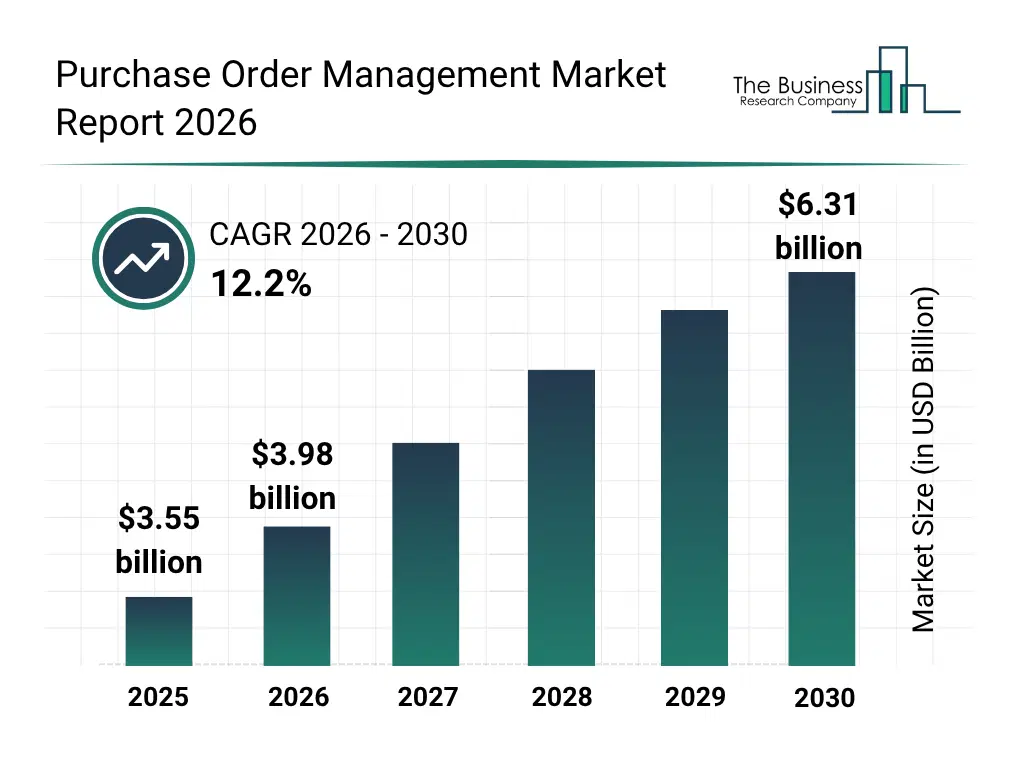
What Is The Purchase Order Management Market Size and Share 2026?
The purchase order management market size has grown rapidly in recent years. It will grow from $3.55 billion in 2025 to $3.98 billion in 2026 at a compound annual growth rate (CAGR) of 12.0%. The growth in the historic period can be attributed to manual purchase order processing, paper based approval systems, fragmented procurement operations, limited supplier visibility, high procurement cycle time.What Is The Purchase Order Management Market Growth Forecast?
The purchase order management market size is expected to see rapid growth in the next few years. It will grow to $6.31 billion by 2030 at a compound annual growth rate (CAGR) of 12.2%. The growth in the forecast period can be attributed to AI assisted procurement automation adoption, autonomous procurement workflow execution, blockchain enabled purchase order validation, predictive demand driven purchasing models, globally integrated supplier procurement ecosystems. Major trends in the forecast period include automated procurement workflow orchestration, real-time supplier collaboration platforms, integrated enterprise resource planning (ERP) based purchase order systems, predictive procurement and demand planning models, contract lifecycle and compliance-driven order management systems.
Global Purchase Order Management Market Segmentation
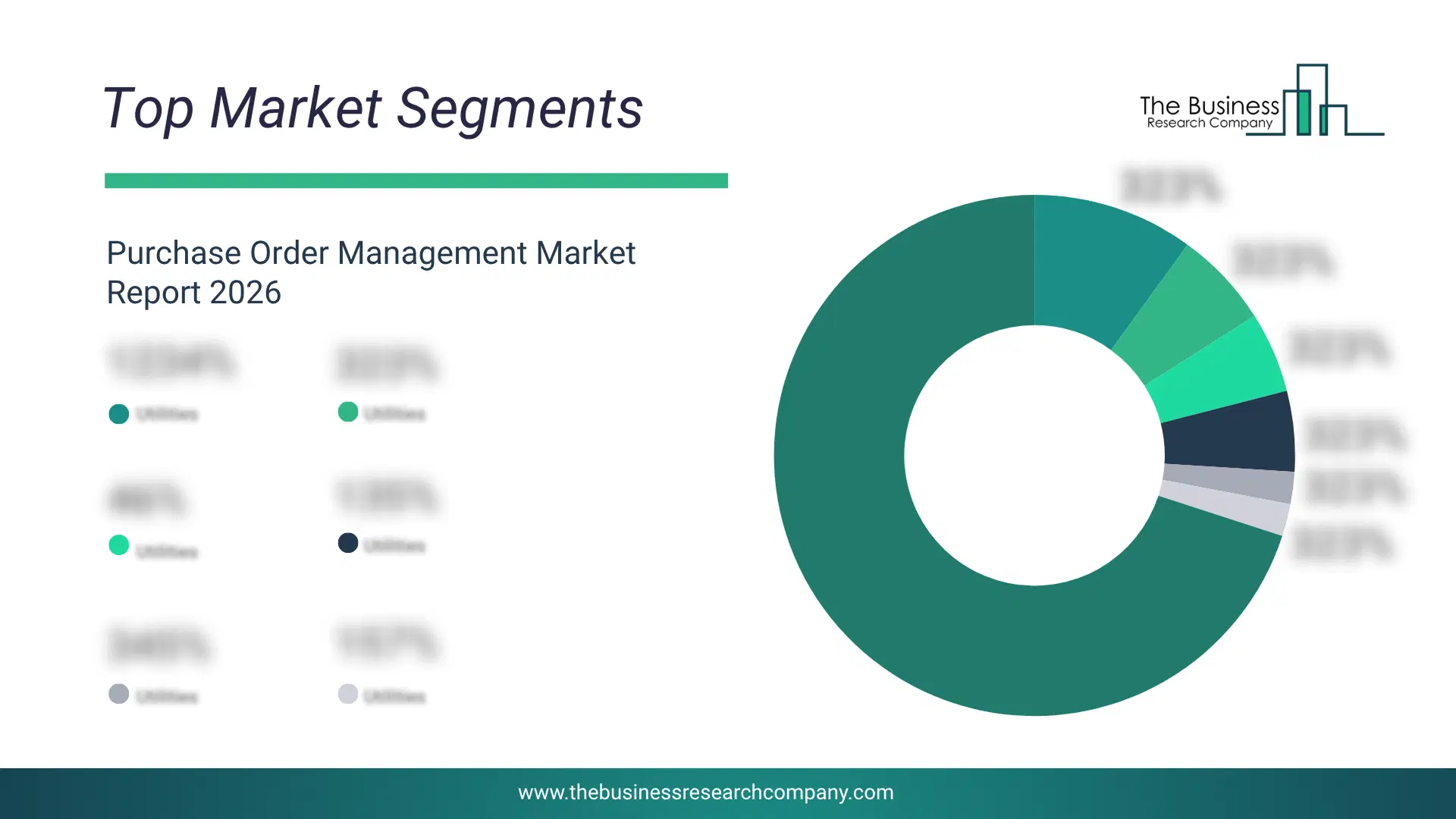
1) By Component: Software, Services 2) By Deployment Type: Cloud Based Solutions, On Premise Solutions 3) By Organization Size: Small And Medium Enterprises, Large Enterprises 4) By Functionality: Order Creation And Approval, Order Tracking And Visibility, Supplier Collaboration And Communication, Compliance And Audit Management, Spend Analysis And Reporting 5) By Industry Vertical: Manufacturing, Retail And Consumer Goods, Healthcare And Life Sciences, Banking Financial Services And Insurance, Information Technology And Telecommunications, Energy And Utilities, Logistics And Transportation Subsegments: 1) By Software: Purchase Order Automation Software, Procurement Management Software, Invoice Matching And Validation Software, Order Tracking And Workflow Software 2) By Services: Implementation And Integration Services, Consulting And Advisory Services, Training And Education Services, Maintenance And Support ServicesWhat Is The Driver Of The Purchase Order Management Market?
The rising e-commerce adoption is expected to propel the growth of the purchase order management market going forward. E-commerce adoption refers to the increasing use and acceptance of digital platforms by businesses and consumers to buy and sell goods and services online. E-commerce adoption is growing due to the rapid expansion of internet connectivity, which enables more people and businesses to access online platforms easily, participate in digital transactions, and engage in online buying and selling without geographical limitations. Purchase order management enhances e-commerce by streamlining the creation, tracking, and fulfillment of orders in a structured and automated manner, ensuring that high volumes of online transactions are processed accurately, efficiently, and on time across multiple suppliers and channels. For instance, in February 2024, according to the United States Census Bureau, a US-based federal statistical agency, total e-commerce sales for 2023 were $1,118.7 billion, an increase of 7.6% from 2022. Therefore, the rising e-commerce adoption is driving the growth of the purchase order management industry.Key Players In The Global Purchase Order Management Market
Major companies operating in the purchase order management market are Oracle Corporation, SAP SE, Infor Inc., Odoo S.A., Basware Corp, Zycus Inc., JAGGAER LLC, Acumatica Inc., Ivalua Inc., Corcentric LLC, Kissflow Inc., Procurify Technologies Inc., Vroozi Inc., Precoro Inc., Fraxion Solutions (Pty) Ltd, Bellwether Software LLC, Epicor Software Corporation, Planergy Ltd, Tradogram Inc., Vinculum Solutions Pvt. Ltd., Spendwise Inc., GEP Worldwide LLC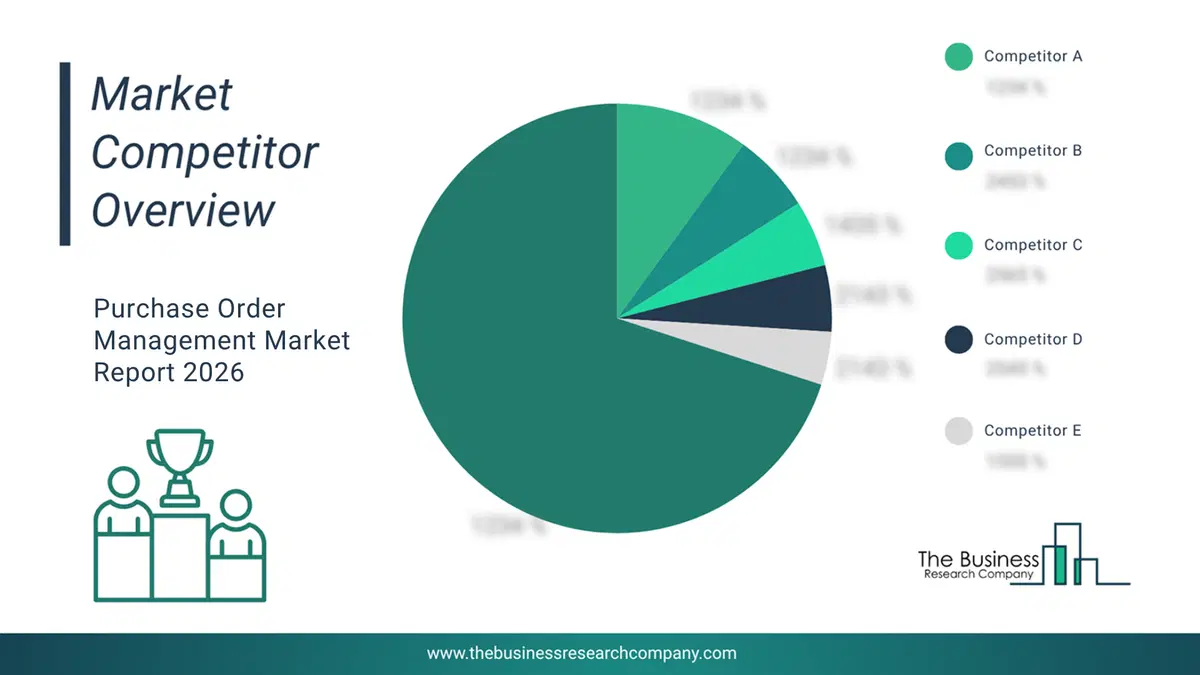
This chart is for illustrative purposes; the full report includes a detailed competitor analysis and comprehensive overview of the top 10 companies in the market.
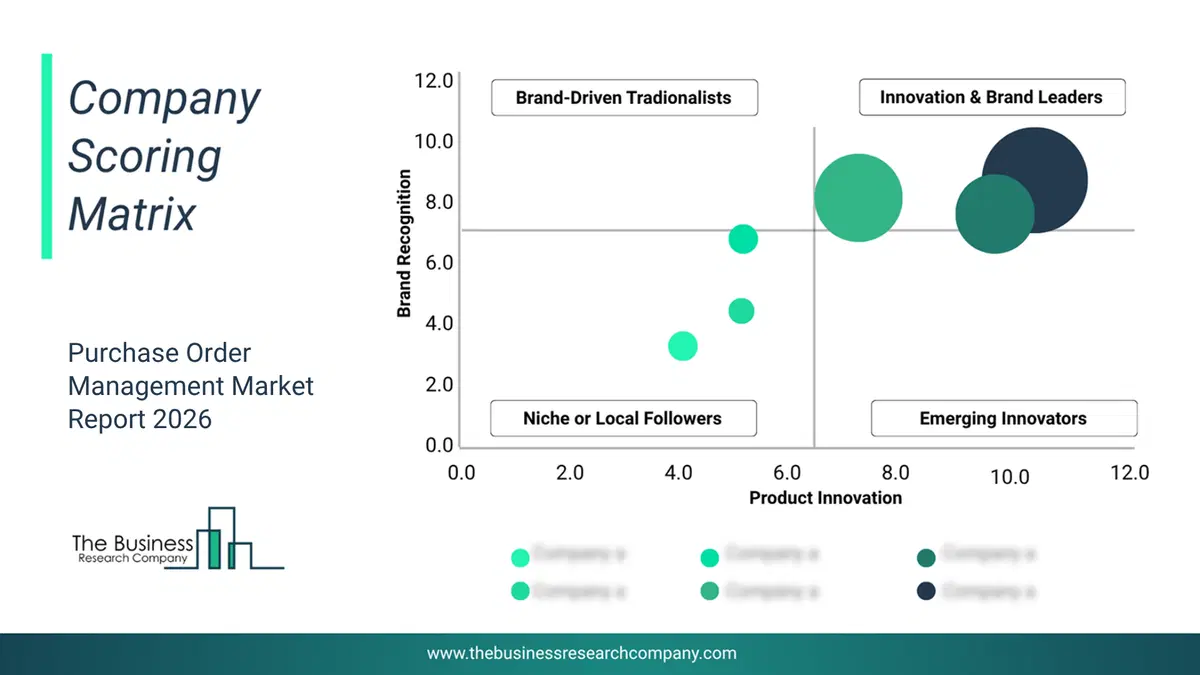
This chart maps companies by product innovation and brand strength, with bubble size indicating relative revenue, helping identify market leaders, challengers, and niche players. This is an illustrative chart; the full report provides a complete and accurate competitive analysis.
Global Purchase Order Management Market Trends and Insights
Major companies operating in the purchase order management market are focusing on leveraging innovative technologies such as, artificial intelligence (AI)-based automation to improve order accuracy, streamline procurement workflows, and enhance real-time decision-making. Artificial intelligence (AI)-based automation is the use of intelligent systems to perform and optimize tasks with minimal human intervention, helping improve accuracy, speed, and efficiency in decision-making and operations. For instance, in October 2025, Digital Wave Technology, a US-based enterprise AI and software solutions provider, launched an AI-native Purchase Order Management solution, an innovative platform designed to transform supply chain accuracy and merchandising alignment. This solution consolidates multi-channel order information into a centralized AI-driven system that ensures real-time visibility across procurement activities while reducing dependency on fragmented legacy systems. It features embedded AI capabilities that automate workflows, flag potential risks, and optimize approval processes, while also enabling seamless coordination between merchandising, financial planning, and supplier operations.What Are Latest Mergers And Acquisitions In The Purchase Order Management Market?
In February 2023, Thoma Bravo L.P., a US-based private equity and software investment firm, acquired Coupa Software Incorporated for $8.0 billion. With this acquisition, Thoma Bravo aimed to strengthen Coupa’s long-term growth trajectory by accelerating product innovation, enhancing operational efficiency, and expanding its leadership position in the global business spend management software market through strategic investment and value creation initiatives. Coupa Software Incorporated is a US-based technology company that specializes in providing cloud-based business spend management (BSM) software.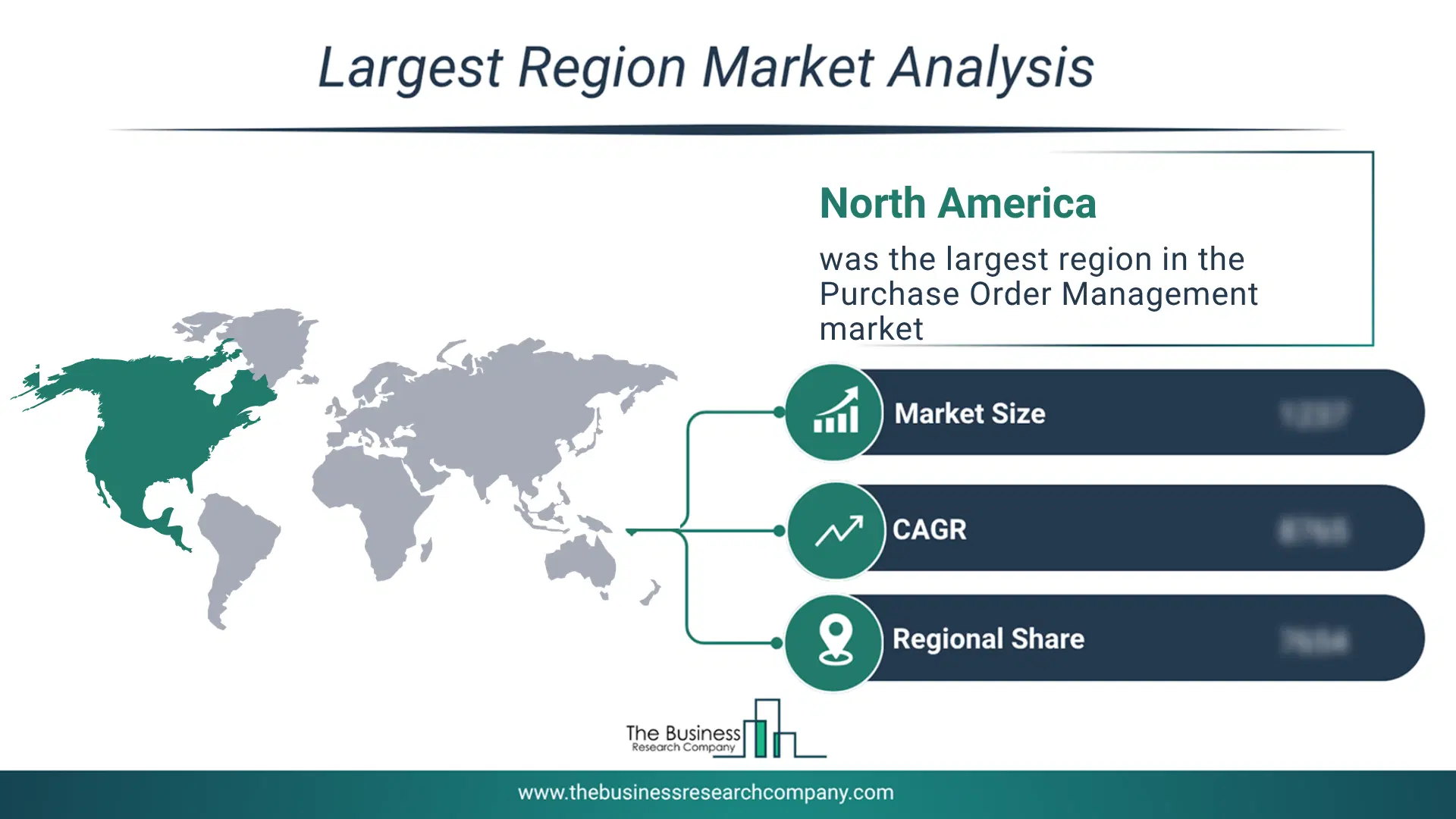
Regional Insights
North America was the largest region in the purchase order management market in 2025. Asia-Pacific is expected to be the fastest-growing region in the forecast period. The regions covered in this market report are Asia-Pacific, South East Asia, Western Europe, Eastern Europe, North America, South America, Middle East, Africa. The countries covered in this market report are Australia, Brazil, China, France, Germany, India, Indonesia, Japan, Taiwan, Russia, South Korea, UK, USA, Canada, Italy, Spain.What Defines the Purchase Order Management Market?
The purchase order management market includes revenues earned by entities by providing services such as purchase order creation and automation, workflow approval management, supplier order tracking, procurement analytics, invoice matching and reconciliation, system integration with ERP platforms, cloud-based procurement solutions, customization, consulting, implementation, and ongoing technical support and maintenance. The market value includes the value of related goods sold by the service provider or included within the service offering. Only goods and services traded between entities or sold to end users are included.How is Market Value Defined and Measured?
The market value is defined as the revenues that enterprises gain from the sale of goods and/or services within the specified market and geography through sales, grants, or donations in terms of the currency (in USD unless otherwise specified). The revenues for a specified geography are consumption values that are revenues generated by organizations in the specified geography within the market, irrespective of where they are produced. It does not include revenues from resales along the supply chain, either further along the supply chain or as part of other products.
This chart presents market attractiveness based on a quantitative evaluation of growth, competition, strategic alignment, and risk, offering a clear view of opportunity areas for decision-making. This chart is for illustrative purposes; the full report contains the complete analysis.

This chart highlights the Total Addressable Market (TAM) by estimating the maximum revenue opportunity using an assumption-driven approach, supporting strategic planning and opportunity sizing across markets. The chart is illustrative; the full report provides a more comprehensive analysis.
What Key Data and Analysis Are Included in the Purchase Order Management Market Report 2026?
The purchase order management market research report is one of a series of new reports from The Business Research Company that provides market statistics, including industry global market size, regional shares, competitors with the market share, detailed market segments, market trends and opportunities, and any further data you may need to thrive in the purchase order management industry. The market research report delivers a complete perspective of everything you need, with an in-depth analysis of the current and future state of the industry.Purchase Order Management Market Report Forecast Analysis
| Report Attribute | Details |
|---|---|
| Market Size Value In 2026 | $3.98 billion |
| Revenue Forecast In 2030 | $6.31 billion |
| Growth Rate | CAGR of 12.2% from 2026 to 2030 |
| Base Year For Estimation | 2025 |
| Actual Estimates/Historical Data | 2020-2025 |
| Forecast Period | 2026 - 2030 |
| Market Representation | Revenue in USD Billion and CAGR from 2026 to 2030 |
| Segments Covered | Component, Deployment Type, Organization Size, Functionality, Industry Vertical |
| Regional Scope | Asia-Pacific, Western Europe, Eastern Europe, North America, South America, Middle East, Africa |
| Country Scope | The Countries Covered In This Market Report Are Australia, Brazil, China, France, Germany, India, Indonesia, Japan, Taiwan, Russia, South Korea, Uk, Usa, Canada, Italy, Spain. |
| Key Companies Profiled | Oracle Corporation, SAP SE, Infor Inc., Odoo S.A., Basware Corp, Zycus Inc., JAGGAER LLC, Acumatica Inc., Ivalua Inc., Corcentric LLC, Kissflow Inc., Procurify Technologies Inc., Vroozi Inc., Precoro Inc., Fraxion Solutions (Pty) Ltd, Bellwether Software LLC, Epicor Software Corporation, Planergy Ltd, Tradogram Inc., Vinculum Solutions Pvt. Ltd., Spendwise Inc., GEP Worldwide LLC |
| Customization Scope | Request for Customization |
| Pricing And Purchase Options | Explore Purchase Options |