

Pyrethroids Market Report 2026
Global Outlook – By Product Type (Bifenthrin, Deltamethrin, Permethrin, Cypermethrin, Cyfluthrin, Lambda-Cyhalothrin, Other Types), By Non-Crop Based (Turfs, Ornamentals, Other Non-Crops), By Pest Type (Lepidoptera, Sucking Pests, Coleoptera, Diptera, Other Pest Types), By Application (Cereals And Grains, Oilseeds And Pulses, Fruits And Vegetables, Other Applications) – Market Size, Trends, Strategies, and Forecast to 2030
Pyrethroids Market Overview
• Pyrethroids market size has reached to $4.04 billion in 2025 • Expected to grow to $5.41 billion in 2030 at a compound annual growth rate (CAGR) of 6.1% • Growth Driver: Surge In Vector-Borne Diseases Fuels Demand For Pyrethroids Market • Market Trend: Innovative In Bifenthrin Solutions Transforming Agriculture • Asia-Pacific was the largest region in 2025 and Asia-Pacific is the fastest growing region.What Is Covered Under Pyrethroids Market?
Pyrethroids refer to a class of synthetic insecticides that are similar to natural pyrethrins, which are found in the flowers of chrysanthemum plants. Pyrethroids are widely used in agricultural, household, and public health applications for their insecticidal properties. The main pyrethroid products are bifenthrin, deltamethrin, permethrin, cypermethrin, cyfluthrin, lambda-cyhalothrin, and others. Bifenthrin refers to a synthetic pyrethroid insecticide widely used for pest control in various agricultural and residential settings. These are also used for non-crop based such as turfs, ornamentals, and others. These are used for various pest types including Lepidoptera, sucking pests, Coleoptera, Diptera, mites, and others, and applied in cereals and grains, oilseeds and pulses, fruits and vegetables, and others.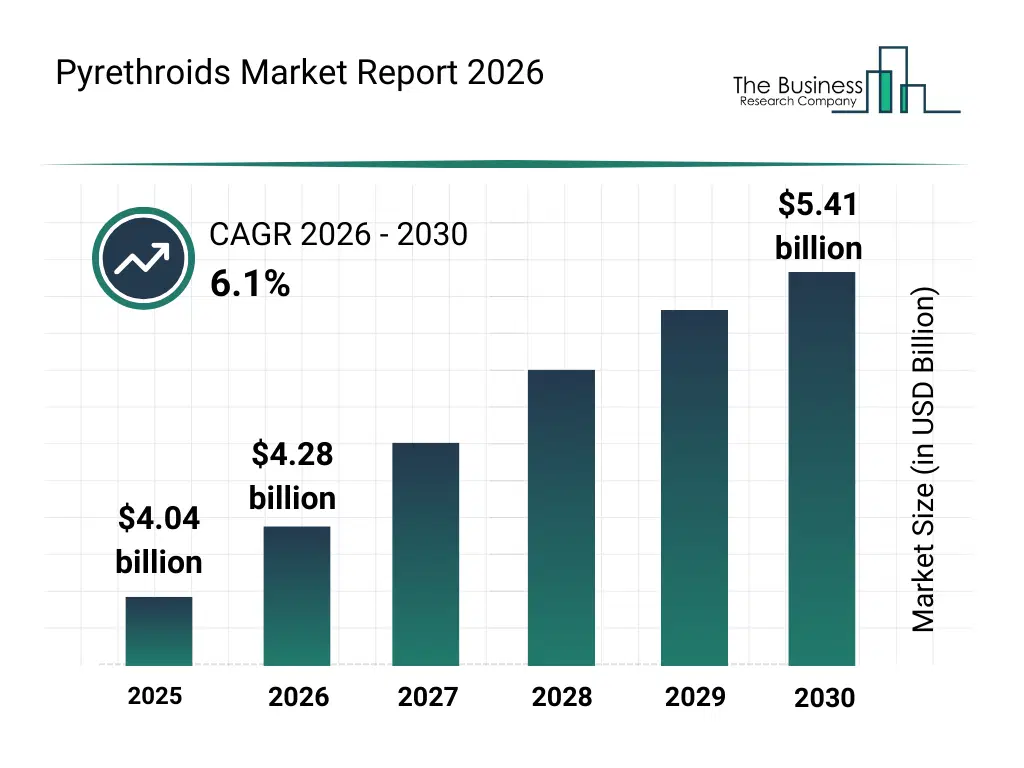
What Is The Pyrethroids Market Size and Share 2026?
The pyrethroids market size has grown strongly in recent years. It will grow from $4.04 billion in 2025 to $4.28 billion in 2026 at a compound annual growth rate (CAGR) of 5.9%. The growth in the historic period can be attributed to expansion of agricultural crop production, rising incidence of pest infestations, growth of public health insect control programs, increasing demand for effective insecticides, availability of synthetic pyrethroid formulations.What Is The Pyrethroids Market Growth Forecast?
The pyrethroids market size is expected to see strong growth in the next few years. It will grow to $5.41 billion in 2030 at a compound annual growth rate (CAGR) of 6.1%. The growth in the forecast period can be attributed to increasing adoption of integrated pest management practices, rising demand for low-toxicity insecticides, expansion of vector control initiatives, growing focus on resistance management strategies, increasing regulatory compliance requirements. Major trends in the forecast period include increasing adoption of broad-spectrum insecticides, rising use in crop protection programs, growing demand for public health vector control, expansion of household pest control applications, enhanced focus on target-specific formulations.
Global Pyrethroids Market Segmentation
1) By Product Type: Bifenthrin, Deltamethrin, Permethrin, Cypermethrin, Cyfluthrin, Lambda-Cyhalothrin, Other Types 2) By Non-Crop Based: Turfs, Ornamentals, Other Non-Crops 3) By Pest Type: Lepidoptera, Sucking Pests, Coleoptera, Diptera, Other Pest Types 4) By Application: Cereals And Grains, Oilseeds And Pulses, Fruits And Vegetables, Other Applications Subsegments: 1) By Bifenthrin: Agricultural Formulations, Residential Use Formulations, Specialty Applications 2) By Deltamethrin: Agricultural Insecticides, Public Health Applications, Household Insecticides 3) By Permethrin: Agricultural Products, Household Insect Sprays, Fabric Treatments 4) By Cypermethrin: Agricultural Insecticides, Veterinary Products, Residential Use Products 5) By Cyfluthrin: Indoor Insecticides, Outdoor Insecticides, Specialty Pest Control Products 6) By Lambda-Cyhalothrin: Agricultural Formulations, Residential Insecticides, Professional Pest Control Products 7) By Other Types: Fenvalerate, Esfenvalerate, Other Specialty PyrethroidsWhat Are The Drivers Of The Pyrethroids Market?
The rising vector-born disease incidence is expected to propel the growth of the pyrethroid market. Vector-borne diseases are illnesses caused by pathogens and parasites transmitted to humans through the bites of infected arthropods, such as mosquitoes, ticks, and fleas. The rise in vector-borne diseases can be attributed to factors such as climate change, which expands the habitats of vectors such as mosquitoes and ticks, allowing them to thrive in new regions. Additionally, urbanization, deforestation, and increased human-animal interactions create conducive environments for disease transmission, further exacerbating the spread of these illnesses. Pyrethroids as synthetic insecticides are widely used to control mosquito and tick populations that transmit such illnesses. For instance, in December 2023, according to GOV.UK., a UK-based public sector information website created by the Government Digital Service, in 2023, there were 2004 cases of malaria confirmed in England, Wales, and Northern Ireland following travel abroad, compared to 1369 in 2022. Therefore, rising vector-born disease incidence is driving the growth of the pyrethroid industry. The increased food demands of a growing population are expected to propel the growth of the pyrethroids market going forward. The food demands of a growing population refer to the increasing requirements for food resources driven by the expanding global population. Pyrethroids are used to ensure higher crop yields by effectively managing insect infestations, contributing to food security, and meeting the demand for greater agricultural productivity to sustain the needs of a growing global population. For instance, in January 2024, according to the United States Department of Agriculture, a US-based federal executive department, in 2023, food expenditures made up an average of 12.9 percent of U.S. household spending, slightly up from 12.8 percent in 2022. Therefore, the increased food demands of a growing population are driving the pyrethroids industry.Key Players In The Global Pyrethroids Market
Major companies operating in the pyrethroids market are Bayer AG, Syngenta AG, FMC Corporation, Sumitomo Chemical, BASF SE, Corteva Agriscience, UPL Limited, Nufarm Limited, Gharda Chemicals, Tagros Chemicals, Heranba Industries, PI Industries, Nissan Chemical, Albaugh LLC, Insecticides India Limited, Dhanuka Agritech, Meghmani Organics, Bharat Rasayan, Coromandel International, Jiangsu Yangnong Chemical, Sharda Cropchem
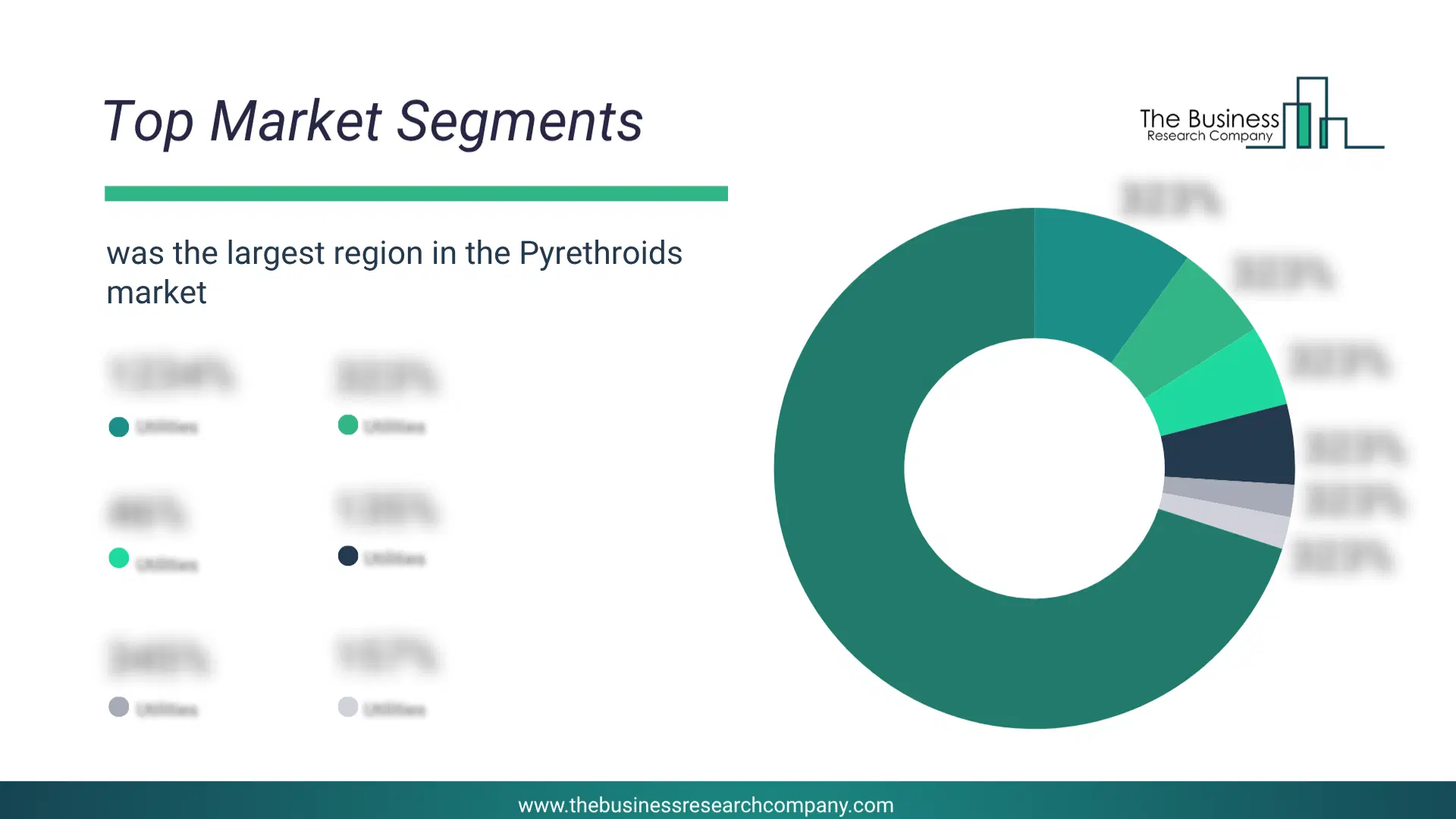
This chart is for illustrative purposes; the full report includes a detailed competitor analysis and comprehensive overview of the top 10 companies in the market.
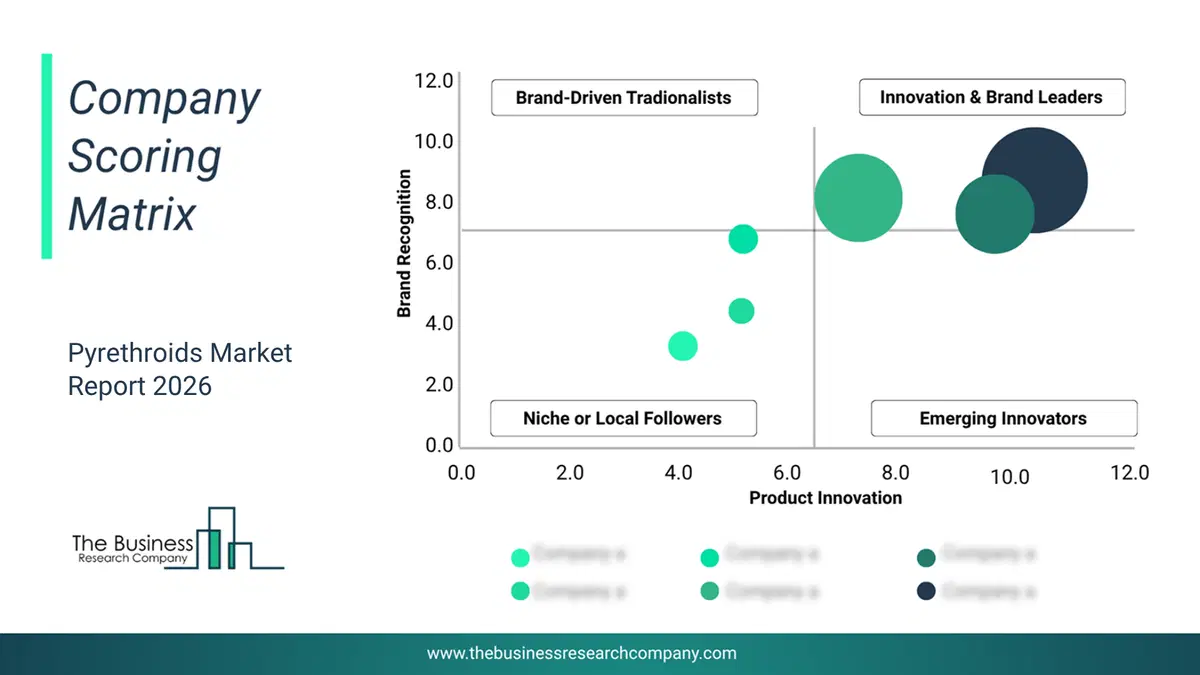
This chart maps companies by product innovation and brand strength, with bubble size indicating relative revenue, helping identify market leaders, challengers, and niche players. This is an illustrative chart; the full report provides a complete and accurate competitive analysis.
Global Pyrethroids Market Trends and Insights
Major companies operating in the pyrethroids market are focusing on developing product innovations to enhance pest management efficiency and sustainability in agricultural applications. Pyrethroids are synthetic chemical compounds widely used to control a variety of crop pests. For instance, in August 2023, Albaugh LLC, an Ankeny-based chemical manufacturing company, launched Afiado, a new soybean insecticide combining acetamiprid and bifenthrin. The product is designed to suppress soybean stinkbugs, a notoriously difficult-to-control pest in Brazil. By integrating a pyrethroid with a broad-spectrum insecticide, Afiado provides farmers with an effective solution to protect soybean yields, reflecting Albaugh’s commitment to agricultural innovation and sustainable crop protection.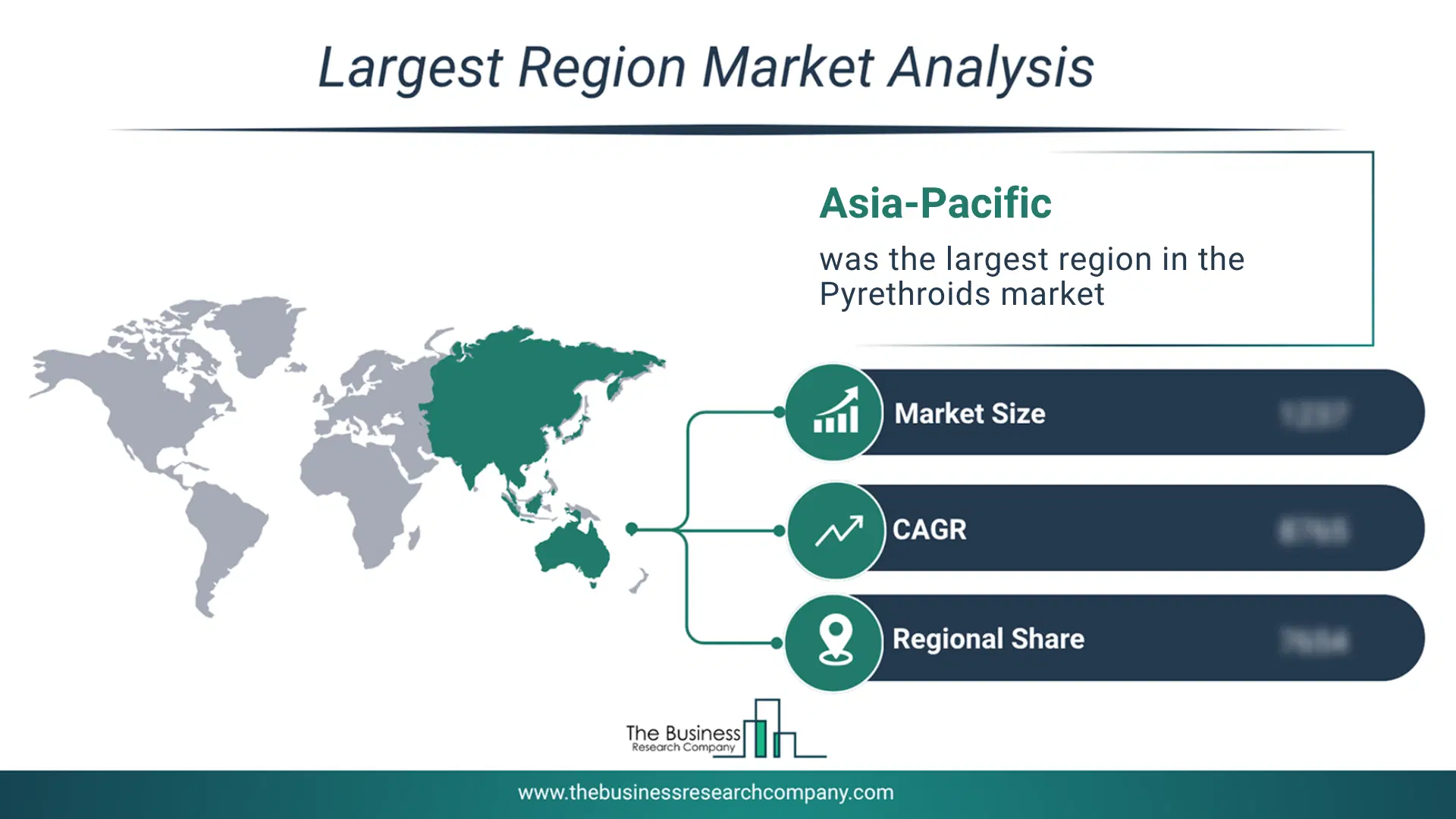
Regional Insights
Asia-Pacific was the largest region in the pyrethroids market in 2025. North America is expected to be the fastest-growing region in the forecast period. The regions covered in this market report are Asia-Pacific, South East Asia, Western Europe, Eastern Europe, North America, South America, Middle East, Africa The countries covered in this market report are Australia, Brazil, China, France, Germany, India, Indonesia, Japan, Taiwan, Russia, South Korea, UK, USA, Canada, Italy, SpainWhat Defines the Pyrethroids Market?
The pyrethroids market consists of sales of agricultural products such as sprays, dust, and granules, household insecticides including aerosol, liquid concentrates, and ready-to-use formulations. Values in this market are ‘factory gate’ values, that is the value of goods sold by the manufacturers or creators of the goods, whether to other entities (including downstream manufacturers, wholesalers, distributors, and retailers) or directly to end customers. The value of goods in this market includes related services sold by the creators of the goods.How is Market Value Defined and Measured?
The market value is defined as the revenues that enterprises gain from the sale of goods and/or services within the specified market and geography through sales, grants, or donations in terms of the currency (in USD unless otherwise specified). The revenues for a specified geography are consumption values that are revenues generated by organizations in the specified geography within the market, irrespective of where they are produced. It does not include revenues from resales along the supply chain, either further along the supply chain or as part of other products.
This chart presents market attractiveness based on a quantitative evaluation of growth, competition, strategic alignment, and risk, offering a clear view of opportunity areas for decision-making. This chart is for illustrative purposes; the full report contains the complete analysis.

This chart highlights the Total Addressable Market (TAM) by estimating the maximum revenue opportunity using an assumption-driven approach, supporting strategic planning and opportunity sizing across markets. The chart is illustrative; the full report provides a more comprehensive analysis.
What Key Data and Analysis Are Included in the Pyrethroids Market Report 2026?
The pyrethroids market research report is one of a series of new reports from The Business Research Company that provides market statistics, including industry global market size, regional shares, competitors with the market share, detailed market segments, market trends and opportunities, and any further data you may need to thrive in the pyrethroids industry. The market research report delivers a complete perspective of everything you need, with an in-depth analysis of the current and future state of the industry.Pyrethroids Market Report Forecast Analysis
| Report Attribute | Details |
|---|---|
| Market Size Value In 2026 | $4.28 billion |
| Revenue Forecast In 2030 | $5.41 billion |
| Growth Rate | CAGR of 5.9% from 2026 to 2030 |
| Base Year For Estimation | 2025 |
| Actual Estimates/Historical Data | 2020-2025 |
| Forecast Period | 2026 - 2030 |
| Market Representation | Revenue in USD Billion and CAGR from 2026 to 2030 |
| Segments Covered | Product Type, Non-Crop Based, Pest Type, Application |
| Regional Scope | Asia-Pacific, Western Europe, Eastern Europe, North America, South America, Middle East, Africa |
| Country Scope | The countries covered in this market report are Australia, Brazil, China, France, Germany, India, Indonesia, Japan, Taiwan, Russia, South Korea, UK, USA, Canada, Italy, Spain |
| Key Companies Profiled | Bayer AG, Syngenta AG, FMC Corporation, Sumitomo Chemical, BASF SE, Corteva Agriscience, UPL Limited, Nufarm Limited, Gharda Chemicals, Tagros Chemicals, Heranba Industries, PI Industries, Nissan Chemical, Albaugh LLC, Insecticides India Limited, Dhanuka Agritech, Meghmani Organics, Bharat Rasayan, Coromandel International, Jiangsu Yangnong Chemical, Sharda Cropchem |
| Customization Scope | Request for Customization |
| Pricing And Purchase Options | Explore Purchase Options |