
Radio Frequency Energy Weapon Market Report 2026
Global Outlook – By Product Type (Directed Energy Weapons, Non-Lethal Weapons, Counter-Drone Systems, Other Product Types), By Technology (High Power Microwave, Ultra-Wideband, Other Technologies), By Platform (Land-Based, Airborne, Naval, Portable), By Application (Military, Homeland Security, Law Enforcement, Other Applications), By End-User (Defense, Commercial, Other End-Users) – Market Size, Trends, Strategies, and Forecast to 2030
Radio Frequency Energy Weapon Market Overview
• Radio Frequency Energy Weapon market size has reached to $2.02 billion in 2025 • Expected to grow to $4.67 billion in 2030 at a compound annual growth rate (CAGR) of 18.2% • Growth Driver: Escalating Cyber-Physical Attacks Driving Market Growth due to Rising Threats to Critical Infrastructure and Connected Systems • Market Trend: Innovations In Non-Lethal And Electronic Disruption Weapons • North America was the largest region in 2025 and Asia-Pacific is the fastest growing region.What Is Covered Under Radio Frequency Energy Weapon Market?
A radio frequency energy weapon is a device that emits highly focused and controlled radio waves to disrupt, damage, or incapacitate electronic systems or living tissue by interfering with their normal function. It operates by transmitting electromagnetic energy at specific frequencies and power levels, which can induce heat, electrical currents, or other physical effects capable of impairing or destroying sensitive components or biological targets. The main product types of the radio frequency energy weapon include directed energy weapons, non-lethal weapons, counter-drone systems, and others. Directed energy weapons refer to systems that emit concentrated radio frequency energy to disrupt, disable, or damage electronic components and communication systems of targeted equipment, offering precise, rapid-response capabilities with minimal physical collateral damage. The technologies used in this market include high power microwave, ultra-wideband, and other technologies. The platforms include land-based, airborne, naval, and portable systems. The key applications include military, homeland security, law enforcement, and other applications, and they are used by several end-users such as defense, commercial, and others.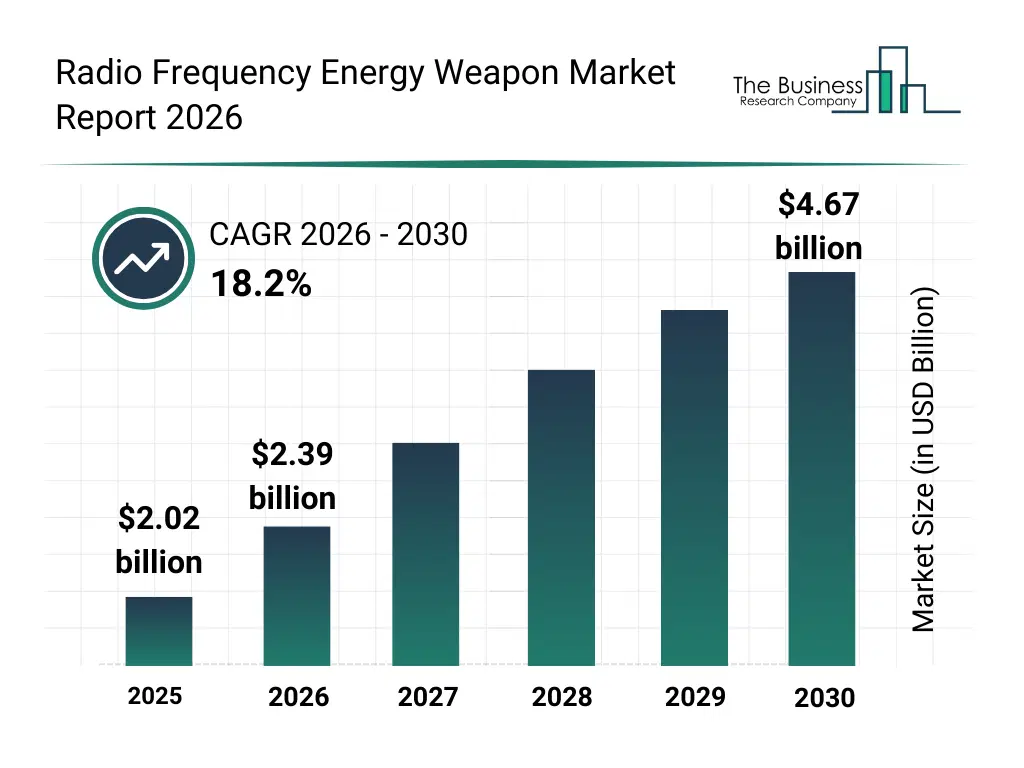
What Is The Radio Frequency Energy Weapon Market Size and Share 2026?
The radio frequency energy weapon market size has grown rapidly in recent years. It will grow from $2.02 billion in 2025 to $2.39 billion in 2026 at a compound annual growth rate (CAGR) of 18.5%. The growth in the historic period can be attributed to development of directed energy weapon prototypes, military investment in non-lethal disabling technologies, advancement in rf amplifier and antenna technology, increasing defense R&D budgets for electronic warfare, early adoption of counter-drone systems.What Is The Radio Frequency Energy Weapon Market Growth Forecast?
The radio frequency energy weapon market size is expected to see rapid growth in the next few years. It will grow to $4.67 billion in 2030 at a compound annual growth rate (CAGR) of 18.2%. The growth in the forecast period can be attributed to rising demand for anti-drone and cyber-physical attack solutions, integration with autonomous and unmanned defense systems, expansion of rf energy weapons for vehicle immobilization, improvement in targeting sensors and pulse modulators, deployment in border and maritime security applications. Major trends in the forecast period include growing adoption of high-power microwave systems for counter-drone and counter-swarm defense, miniaturization and swap (size, weight, and power) optimization of rf energy weapon platforms, increasing integration of rf energy weapons into layered air-defense and electronic warfare architectures, rising demand for non-lethal rf-based crowd-control and area-denial solutions, transition from prototype demonstrators to fielded rf energy weapon systems with export-ready variants.
Global Radio Frequency Energy Weapon Market Segmentation
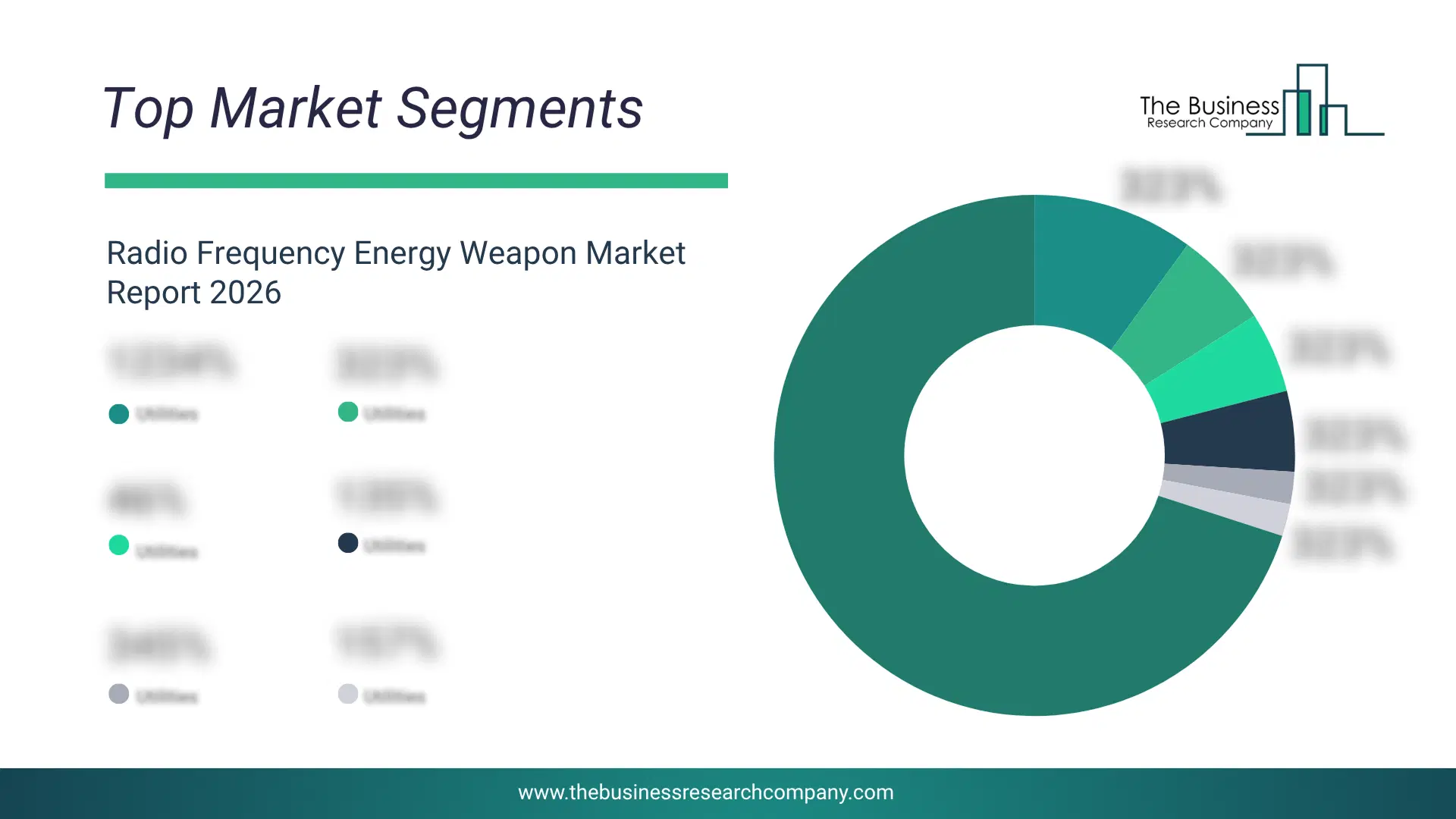
1) By Product Type: Directed Energy Weapons, Non-Lethal Weapons, Counter-Drone Systems, Other Product Types 2) By Technology: High Power Microwave, Ultra-Wideband, Other Technologies 3) By Platform: Land-Based, Airborne, Naval, Portable 4) By Application: Military, Homeland Security, Law Enforcement, Other Applications 5) By End-User: Defense, Commercial, Other End-Users Subsegments: 1) By Directed Energy Weapons (DEWs): High-Power Microwave (HPM) Weapons, Electromagnetic Weapons (EMW) 2) By Non-Lethal Weapons (NLWs): Active Denial Systems (ADS), Stun Devices (SD), Radio Frequency Crowd Control Systems (RFCCS), Incapacitating Devices (ID) 3) By Counter-Drone Systems (CDS): Radio Frequency Jammers (RFJ), Global Positioning System Spoofers (GPS Spoofers), Laser-Based Anti-Drone Systems (LBADS), Drone Detection Systems (DDS) 4) By Other Products (OP): Radio Frequency Sensors (RFS), Communication Disruption Devices (CDD), Electronic Warfare Tools (EWT), Miscellaneous Radio Frequency Equipment (MRFE)What Is Driver Of The Radio Frequency Energy Weapon Market?
The increasing sophistication of cyber-physical attacks (CPA) is expected to propel the growth of the radio frequency energy weapon market going forward. Cyber-physical attacks (CPA) refer to malicious actions where cyberattacks target physical systems, causing disruption or damage to real-world devices, infrastructure, or processes. The rise in cyber-physical attacks (CPA) is due to increasing connectivity of physical systems to the internet, which expands the attack surface and exposes critical infrastructure to remote cyber threats, making it easier for attackers to exploit vulnerabilities, disrupt operations, or cause physical damage. Radio frequency energy weapon supports cyber-physical attacks (CPA) by emitting electromagnetic interference that disrupts or damages electronic systems, thereby exposing physical infrastructure to cyber vulnerabilities. For instance, in February 2024, according to the Cyber Threat Intelligence Integration Center (CTIIC), a US-based government agency, in 2022, the healthcare sector experienced 214 ransomware attack victims worldwide. Additionally, in the United States, attacks rose even more sharply, increasing by 128% from 113 victims in 2022 to 258 in 2023. This trend underscores the escalating cyber threats targeting healthcare systems globally. Therefore, the increasing sophistication of cyber-physical attacks (CPA) is driving the growth of the radio frequency energy weapon industry.Key Players In The Global Radio Frequency Energy Weapon Market
Major companies operating in the radio frequency energy weapon market are RTX Corporation, Lockheed Martin Corporation, BAE Systems plc, Thales S.A., L3Harris Technologies Inc., Leonardo S.p.A., Elbit Systems Ltd., Israel Aerospace Industries Ltd., Rafael Advanced Defense Systems Ltd., MBDA Limited, Bharat Electronics Limited, QinetiQ Group plc, Kratos Defense & Security Solutions Inc., Anduril Industries Inc., Teledyne e2v Ltd., Radiance Technologies Inc., HORIBA MIRA Ltd., Tonbo Imaging India Private Limited, Epirus Inc., Paras Defence and Space Technologies Private Limited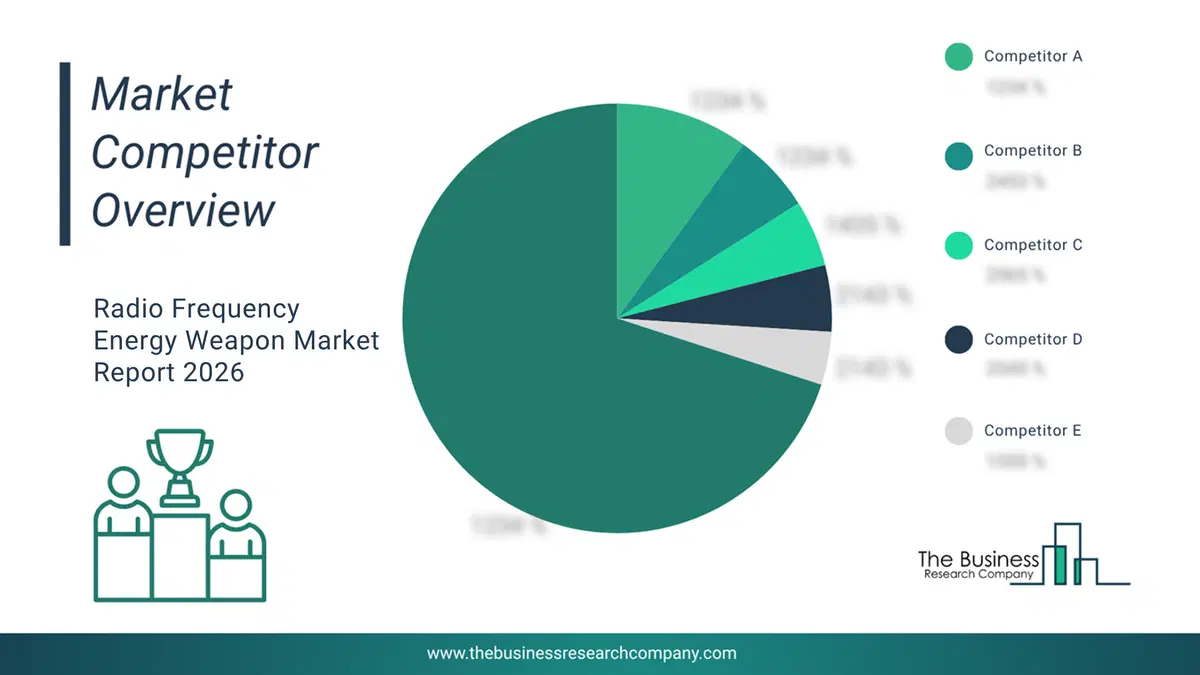
This chart is for illustrative purposes; the full report includes a detailed competitor analysis and comprehensive overview of the top 10 companies in the market.
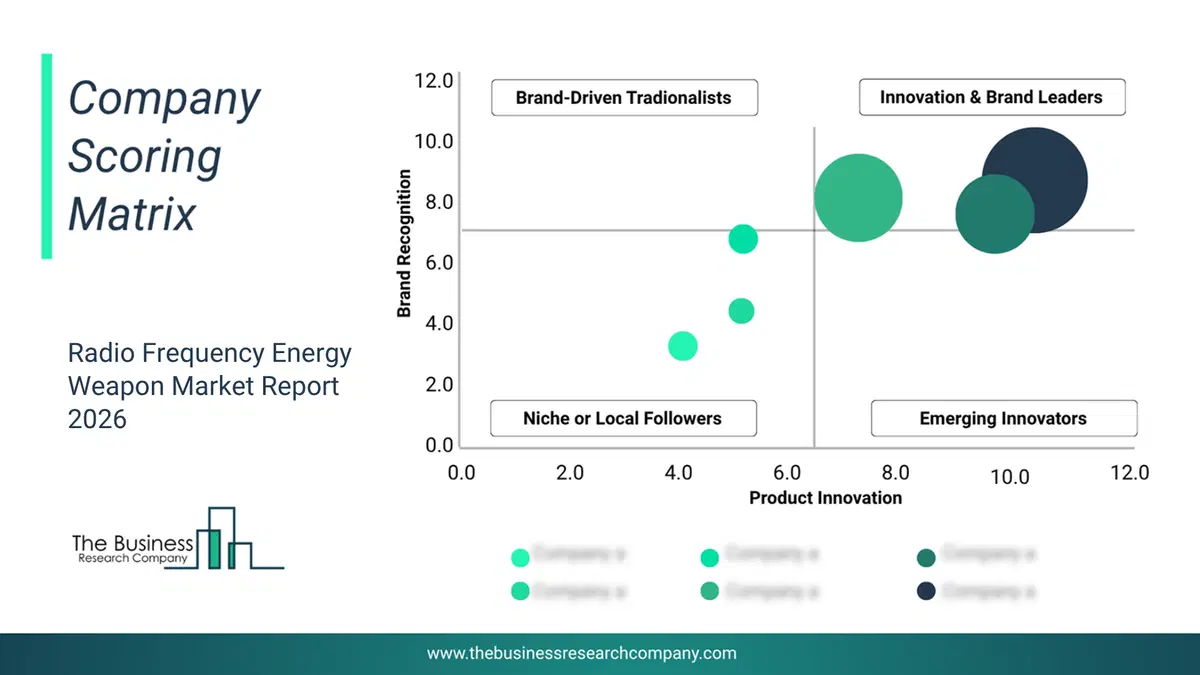
This chart maps companies by product innovation and brand strength, with bubble size indicating relative revenue, helping identify market leaders, challengers, and niche players. This is an illustrative chart; the full report provides a complete and accurate competitive analysis.
Global Radio Frequency Energy Weapon Market Trends and Insights
Major companies operating in the radio frequency energy weapon market are focusing on leveraging innovative technologies such as active electronically scanned arrays (AESA) to enhance precision, range, and targeting effectiveness. Active electronically scanned arrays (AESA) are advanced radar systems that use electronically controlled antennas to steer radio waves without moving parts, helping improve speed, accuracy, multitarget tracking, and resistance to jamming. For instance, in February 2025, Tonbo Imaging India Private Limited, an India-based defense technology company, unveiled a high-power microwave (HPM) directed energy weapon (DEW) system that aims to disable or disrupt hostile electronic systems, enhance perimeter security, and provide non-kinetic defensive capabilities for military and critical infrastructure applications. Tonbo Imaging's microwave-based directed energy weapon (DEW) features precise, non-kinetic targeting to neutralize electronic threats without causing permanent damage. It delivers high-power microwave pulses capable of disrupting multiple devices simultaneously, enhancing area denial and perimeter security.What Are Latest Mergers And Acquisitions In The Radio Frequency Energy Weapon Market? Aerovironment Acquires Bluehalo To Strengthen Defense Technology Capabilities
In May 2025, AeroVironment Inc., a US-based public defense and technology company, acquired BlueHalo LLC for approximately $4.1 billion. With this acquisition, AeroVironment aims to accelerate innovation, enhance customer partnerships, and deliver strategic advantages across air, land, sea, space, and cyber domains. BlueHalo LLC is a US-based company, specializes in providing radio frequency energy weapon.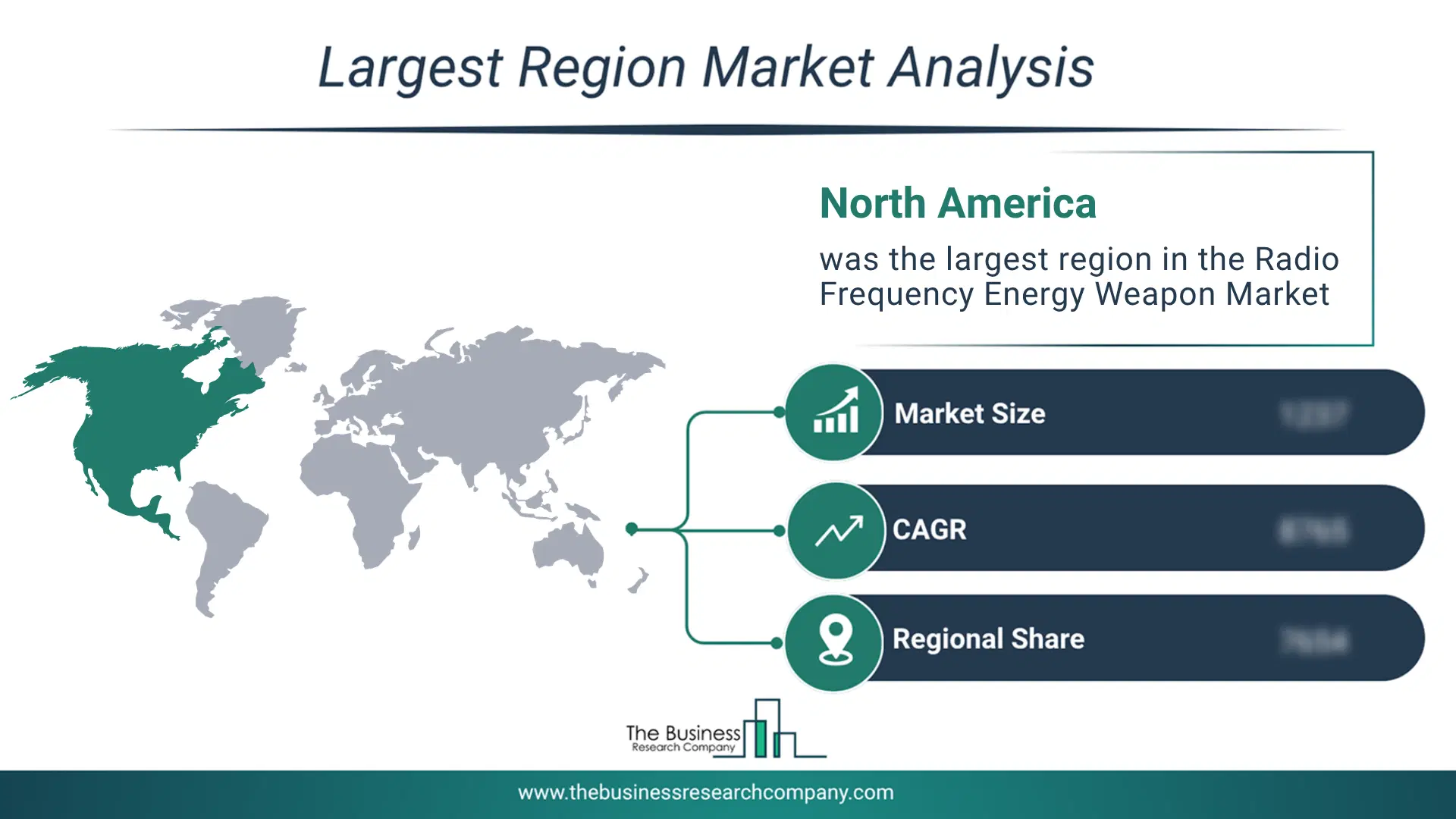
Regional Insights
North America was the largest region in the radio frequency energy weapon market in 2025. Asia-Pacific is expected to be the fastest-growing region in the forecast period. The regions covered in this market report are Asia-Pacific, South East Asia, Western Europe, Eastern Europe, North America, South America, Middle East, Africa. The countries covered in this market report are Australia, Brazil, China, France, Germany, India, Indonesia, Japan, Taiwan, Russia, South Korea, UK, USA, Canada, Italy, SpainWhat Defines the Radio Frequency Energy Weapon Market?
The radio frequency energy weapon market consists of revenues earned by entities by providing services such as vehicle immobilization, counter-drone operations, communication jamming, radar disruption, and cyber-physical attack support. The market value includes the value of related goods sold by the service provider or included within the service offering. The radio frequency energy weapon market also includes sales of RF amplifiers, waveguides, antennas, cooling systems, targeting sensors, and pulse modulators. Values in this market are 'factory gate' values, that is the value of goods sold by the manufacturers or creators of the goods, whether to other entities (including downstream manufacturers, wholesalers, distributors and retailers) or directly to end customers. The value of goods in this market includes related services sold by the creators of the goods.How is Market Value Defined and Measured?
The market value is defined as the revenues that enterprises gain from the sale of goods and/or services within the specified market and geography through sales, grants, or donations in terms of the currency (in USD unless otherwise specified). The revenues for a specified geography are consumption values that are revenues generated by organizations in the specified geography within the market, irrespective of where they are produced. It does not include revenues from resales along the supply chain, either further along the supply chain or as part of other products.
This chart presents market attractiveness based on a quantitative evaluation of growth, competition, strategic alignment, and risk, offering a clear view of opportunity areas for decision-making. This chart is for illustrative purposes; the full report contains the complete analysis.

This chart highlights the Total Addressable Market (TAM) by estimating the maximum revenue opportunity using an assumption-driven approach, supporting strategic planning and opportunity sizing across markets. The chart is illustrative; the full report provides a more comprehensive analysis.
What Key Data and Analysis Are Included in the Radio Frequency Energy Weapon Market Report 2026?
The radio frequency energy weapon market research report is one of a series of new reports from The Business Research Company that provides market statistics, including industry global market size, regional shares, competitors with the market share, detailed market segments, market trends and opportunities, and any further data you may need to thrive in the radio frequency energy weapon industry. The market research report delivers a complete perspective of everything you need, with an in-depth analysis of the current and future state of the industry.Radio Frequency Energy Weapon Market Report Forecast Analysis
| Report Attribute | Details |
|---|---|
| Market Size Value In 2026 | $2.39 billion |
| Revenue Forecast In 2030 | $4.67 billion |
| Growth Rate | CAGR of 18.2% from 2026 to 2030 |
| Base Year For Estimation | 2025 |
| Actual Estimates/Historical Data | 2020-2025 |
| Forecast Period | 2026 - 2030 |
| Market Representation | Revenue in USD Billion and CAGR from 2026 to 2030 |
| Segments Covered | Product Type, Technology, Platform, Application, End-User |
| Regional Scope | Asia-Pacific, Western Europe, Eastern Europe, North America, South America, Middle East, Africa |
| Country Scope | The countries covered in the radio frequency energy weapon market report are Australia, Brazil, China, France, Germany, India, Indonesia, Japan, Taiwan, Russia, South Korea, UK, USA, Canada, Italy, Spain |
| Key Companies Profiled | RTX Corporation, Lockheed Martin Corporation, BAE Systems plc, Thales S.A., L3Harris Technologies Inc., Leonardo S.p.A., Elbit Systems Ltd., Israel Aerospace Industries Ltd., Rafael Advanced Defense Systems Ltd., MBDA Limited, Bharat Electronics Limited, QinetiQ Group plc, Kratos Defense & Security Solutions Inc., Anduril Industries Inc., Teledyne e2v Ltd., Radiance Technologies Inc., HORIBA MIRA Ltd., Tonbo Imaging India Private Limited, Epirus Inc., Paras Defence and Space Technologies Private Limited |
| Customization Scope | Request for Customization |
| Pricing And Purchase Options | Explore Purchase Options |