

Directed Energy Weapons Market Report 2026
Global Outlook – By Product (Lethal Weapons, Non-Lethal Weapons), By Technology (High Energy Laser, High Power Microwave, Electromagnetic Weapons, Sonic Weapons), By End-User (Land, Airborne, Naval) – Market Size, Trends, Strategies, and Forecast to 2030
Directed Energy Weapons Market Overview
• Directed Energy Weapons market size has reached to $8.72 billion in 2025 • Expected to grow to $23.83 billion in 2030 at a compound annual growth rate (CAGR) of 22% • Growth Driver: Modernization And Military Investments Fuel Directed Energy Weapons Market • Market Trend: Strategic Partnerships To Gain A Competitive Edge • North America was the largest region in 2025 and Asia-Pacific is the fastest growing region.Market Gains By 2030 – Top Opportunities By Segment
Market Gain identifies the most promising market opportunities by highlighting the segments or products expected to generate the highest incremental revenue growth over the next five years.
What Is Covered Under Directed Energy Weapons Market?
The directed energy weapons refer to a system that uses energy primarily as a direct means to disable, harm, or destroy enemy facilities, equipment, and troops. The directed energy weapons use technologies that focus electromagnetic energy or create atomic or subatomic particles. High-powered radio frequency or microwave devices, charged or neutral particle beam weapons, and high-energy lasers are some of the direct energy weapons. The main products of the directed energy weapons include lethal weapons and non-lethal weapons. Lethal weapons refer to systems designed to incapacitate or destroy targets through high-energy means, such as lasers or electromagnetic pulses, ensuring direct damage or neutralization of threats. The different technology types include high energy laser, high power microwave, electromagnetic weapons, and sonic weapons, and they are used by several end-users such as land, airborne, and naval platforms.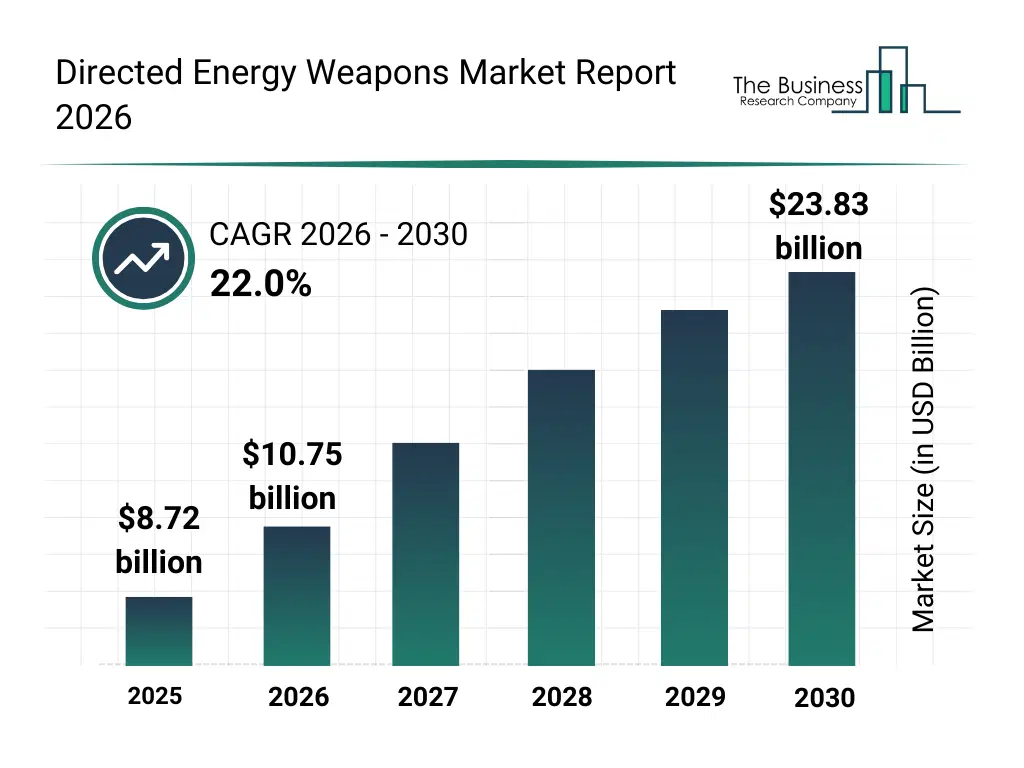
What Is The Directed Energy Weapons Market Size and Share 2026?
The directed energy weapons market size has grown exponentially in recent years. It will grow from $8.72 billion in 2025 to $10.75 billion in 2026 at a compound annual growth rate (CAGR) of 23.4%. The growth in the historic period can be attributed to early development of high-energy laser systems for precision targeting and area denial, increasing military investment in microwave-based directed energy technologies to counter drones and electronic threats, prototype deployment of particle beam and plasma systems for testing advanced defensive capabilities, rising demand for non-kinetic weapons to reduce collateral damage in combat operations, growth in research programs focused on power generation and thermal management for directed energy platforms.What Is The Directed Energy Weapons Market Growth Forecast?
The directed energy weapons market size is expected to see exponential growth in the next few years. It will grow to $23.83 billion in 2030 at a compound annual growth rate (CAGR) of 22.0%. The growth in the forecast period can be attributed to expanding integration of directed energy systems, increasing investment in high-power laser technologies to counter next-generation aerial and missile threats, rising demand for scalable microwave weapons for electronic disruption and anti-drone missions, continued advancement in particle beam and plasma weapon research to achieve higher range and precision, growing adoption of compact power and cooling solutions enabling fieldable directed energy weapon systems. Major trends in the forecast period include advancements in high-energy laser systems for precision targeting, growing adoption of microwave-based non-lethal deterrent systems, increased development of compact and mobile directed energy platforms, rising integration of particle beam technologies for next-generation weaponry, expansion of multi-role directed energy systems for both offensive and defensive missions.
Global Directed Energy Weapons Market Segmentation
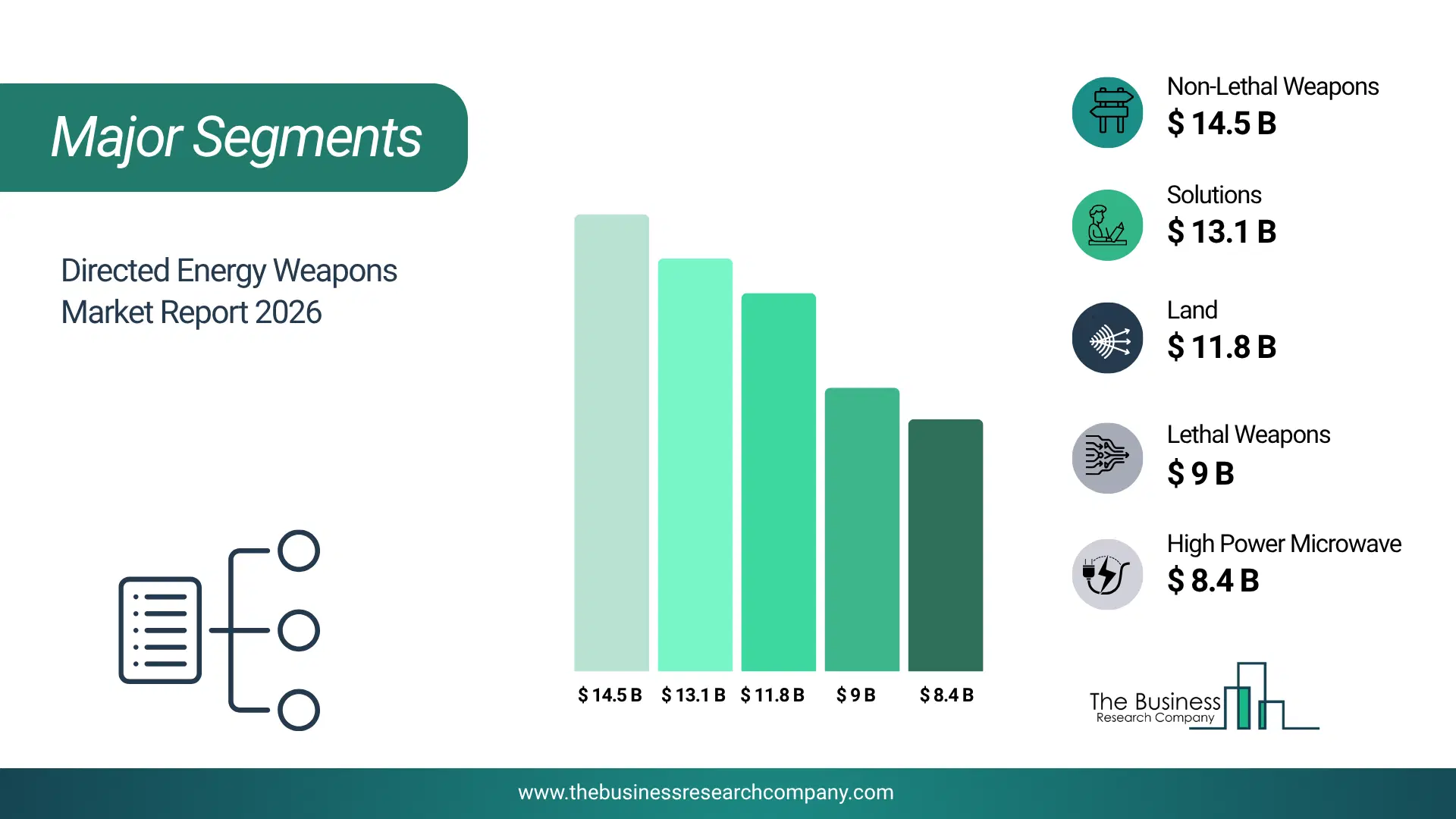
1) By Product: Lethal Weapons, Non-Lethal Weapons 2) By Technology: High Energy Laser, High Power Microwave, Electromagnetic Weapons, Sonic Weapons 3) By End-User: Land, Airborne, Naval Subsegments: 1) By Lethal Weapons: High-Energy Laser Weapons, Particle Beam Weapons 2) By Non-Lethal Weapons: High-Power Microwave Weapons, Acoustic Weapons, Electromagnetic Pulses (EMP), Non-Lethal Laser Systems The top segments in the directed energy weapons market will be: • High Energy Laser will reach $13182.26 Million by 2030. • Non-Lethal Weapons will reach $14516.68 Million by 2030. • Land will reach $11847.57 Million by 2030. • Lethal Weapons will reach $9051.12 Million by 2030. • High Power Microwave will reach $8452.51 Million by 2030.What Is Driver Of The Directed Energy Weapons Market?
The rising modernization and investment in military platforms is expected to the growth of the directed energy weapons market. Modernization and investment in military platforms refer to the process of upgrading, enhancing, and developing new defense systems, technologies, and equipment to improve the effectiveness, readiness, and capabilities of a nation’s armed forces. The rising modernization and investment in military platforms is increasing due to the growing need to address evolving security threats, technological advancements, and the demand for enhanced operational readiness across multi-domain battle environments. The directed energy weapons market supports the rising modernization and investment in military platforms by providing advanced, precise, and cost-effective defense technologies that enhance combat effectiveness and reduce reliance on traditional munitions. For instance, in April 2024, according to the Truthout, a California -based non-profit organization, world military expenditure reached a new record high of $916 billion in 2023, 2.3 percent compared to the previous year. China, which poured an estimated $296 billion into its military. According to data on U.S. military spending in 2023, militarised programs accounted for 62% of the nation's federal discretionary budget, leaving less than half for domestic priorities like healthcare, housing, nutrition assistance, and education. Therefore, such investments in military and defense will propel the directed energy weapons industry.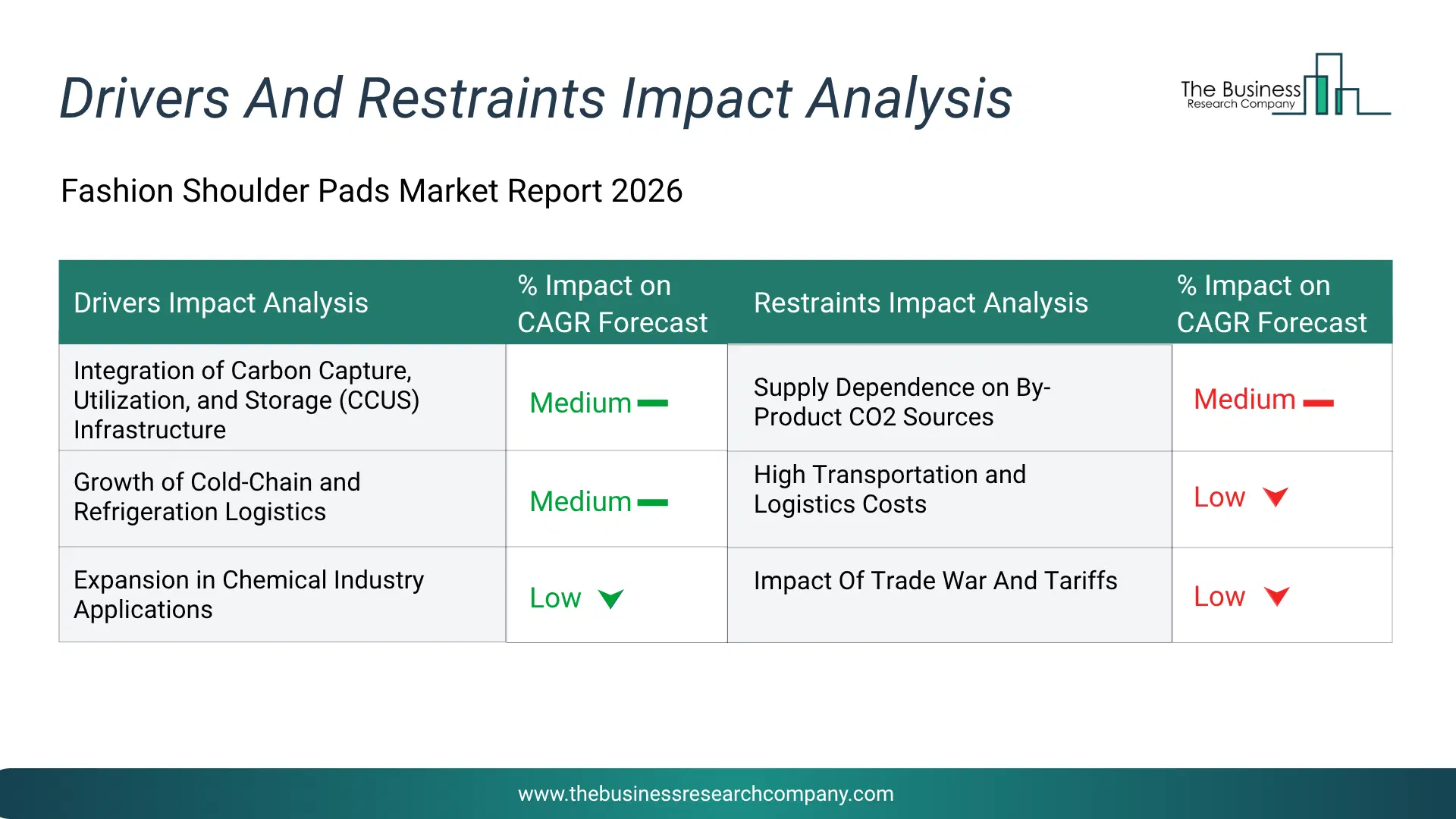
Infographic Chart Showing Key Market Drivers Analysis And Restraints For Directed Energy Weapons Market
The chart presents an impact analysis of key drivers and restraints, quantifying their relative influence on the market's growth rate and helping assess the balance between growth enablers and limiting factors. This chart offers a high-level perspective; the full report contains more detailed insights.
How Will The Drivers Impact Growth In The Global Directed Energy Weapons Market?
• Increasing Demand for Advanced Missile and Drone Defense (Medium) – During the forecast period, increasing demand for advanced missile and drone defense will become a key driver of growth in the directed energy weapons market by 2030. the growing threat posed by advanced missiles, hypersonic systems and unmanned aerial platforms is accelerating demand for innovative defense solutions capable of rapid, precise and repeated engagements. directed energy weapons, particularly high-energy lasers and high-power microwave systems, offer the ability to counter a wide range of aerial threats with high accuracy and minimal collateral damage. their integration into existing air and missile defense networks enhances interception capacity and operational resilience, driving adoption across land, airborne and naval platforms and supporting expansion of the directed energy weapons market. as a result, increasing demand for advanced missile and drone defense is projected to contributing to a 2.0% annual growth in the market. • Rising Geopolitical Tensions (Medium) – During the forecast period, the rising geopolitical tensions will propel the growth of the directed energy weapons market. escalating geopolitical tensions are increasing the likelihood of regional conflicts, proxy engagements and contested operational environments, driving militaries to strengthen defensive readiness and deterrence capabilities. directed energy weapons provide scalable, precision-based responses that enhance air defense, counter-drone operations and electronic protection without escalating conflicts through kinetic strikes. as nations seek to modernize their defense postures and maintain strategic advantages in increasingly contested theaters, directed energy systems are gaining traction as a critical component of next-generation military capabilities, supporting sustained market growth. therefore, this rising geopolitical tensions is projected to supporting to a 1.1% annual growth in the market. • Shift Toward Asymmetric Warfare Tactics (Medium) – During the forecast period, the shift toward asymmetric warfare tactics is expected to be a key driver of the growth of the directed energy weapons market in the forecast period. the increasing shift toward asymmetric warfare tactics is driving demand for directed energy weapons as adversaries rely on low-cost, high-volume threats such as unmanned aerial systems, loitering munitions and improvised aerial platforms to challenge conventional military forces. directed energy weapons offer a cost-effective and rapid-response solution capable of engaging multiple targets at the speed of light, making them well suited for countering swarm-based and unconventional threats. as militaries adapt to dispersed, fast-evolving threat environments, investment in directed energy capabilities is expected to increase to enhance force protection, reduce reliance on expensive kinetic interceptors and strengthen layered defense architectures. consequently, the accelerating adoption of shift toward asymmetric warfare tactics is projected to contributing to a 1.5% annual growth in the market. • Growing Focus on National Security and Border Protection (Low) – During the forecast period, the growing focus on national security and border protection will propel the growth of the directed energy weapons market. Heightened focus on national security and border protection is increasing demand for persistent surveillance and defensive systems capable of addressing aerial intrusions, unauthorized drones and cross-border threats. Directed energy weapons provide a non-kinetic, precise and scalable option for securing sensitive installations, borders and critical infrastructure against evolving aerial and electronic threats. As governments strengthen homeland defense and border security frameworks, directed energy systems are increasingly being considered for integration into security architectures, contributing to sustained growth of the directed energy weapons market. The growing focus on national security and border protection during the forecast period in 2025 is 0.8%.How Will The Restraints Impact Growth In The Global Directed Energy Weapons Market?
• Line-of-Sight Engagement Limitations (Medium) – During the forecast period, line-of-sight engagement limitations is restricting the growth of the directed energy weapons market during the forecast period. directed energy weapons rely online-of-sight engagement to effectively transmit energy to targets, making their performance sensitive to environmental and operational conditions. obstacles such as terrain, buildings, weather and atmospheric effects can degrade beam propagation and reduce engagement effectiveness. these limitations restrict operational flexibility, particularly in complex or cluttered battlefields and can limit the range of missions where directed energy systems are considered viable, slowing broader adoption across diverse defense scenarios. growth affected by the line-of-sight engagement limitations during the forecast period in 2025 is -2.6%. • Budget Prioritization Challenges (Medium) – During the forecast period, budget prioritization challenges is restricting the growth of the directed energy weapons market during the forecast period. defense budgets are subject to competing priorities across conventional weapons, cyber capabilities, space systems and emerging technologies. directed energy weapons, many of which are still transitioning from development to operational deployment, must compete for funding against proven kinetic systems with established combat records. this competition can lead to delayed approvals, reduced funding allocations, or phased procurement, slowing the pace of development, testing and fielding of dew systems. growth affected by the budget prioritization challenges during the forecast period in 2025 is -2.1%. • Impact of Trade War and Tariff (Medium) – During the forecast period, the impact of the trade war and tariffs restricting the growth of the directed energy weapons market during the forecast period. trade tensions and tariffs can disrupt the global supply chains critical to directed energy weapon development, particularly for advanced electronic components, optical materials and specialized manufacturing equipment. increased import costs and restrictions on technology transfer can raise production expenses and delay system delivery. additionally, export controls and trade barriers can limit international collaboration and defense exports, reducing market access for manufacturers and slowing the global expansion of directed energy weapon programs. growth affected by the impact of the trade war and tariffs during the forecast period in 2025 is -0.3%.Key Players In The Global Directed Energy Weapons Market
Major companies operating in the directed energy weapons market are Lockheed Martin Corporation, Northrop Grumman Corporation, Raytheon Company, Boeing Co., BAE Systems PLC, L3Harris Technologies Inc., Rheinmetall AG, Thales Group, Leonardo S.p.A., QinetiQ, General Atomics, Rafael Advanced Defense Systems Ltd., Dynetics Inc., Kord Technologies Inc., Applied Research Associates Inc., BlueHalo LLC, Radiance Technologies Inc., Saab AB, Textron Inc., Moog Inc., Elbit Systems Ltd., Kratos Defense & Security Solutions Inc.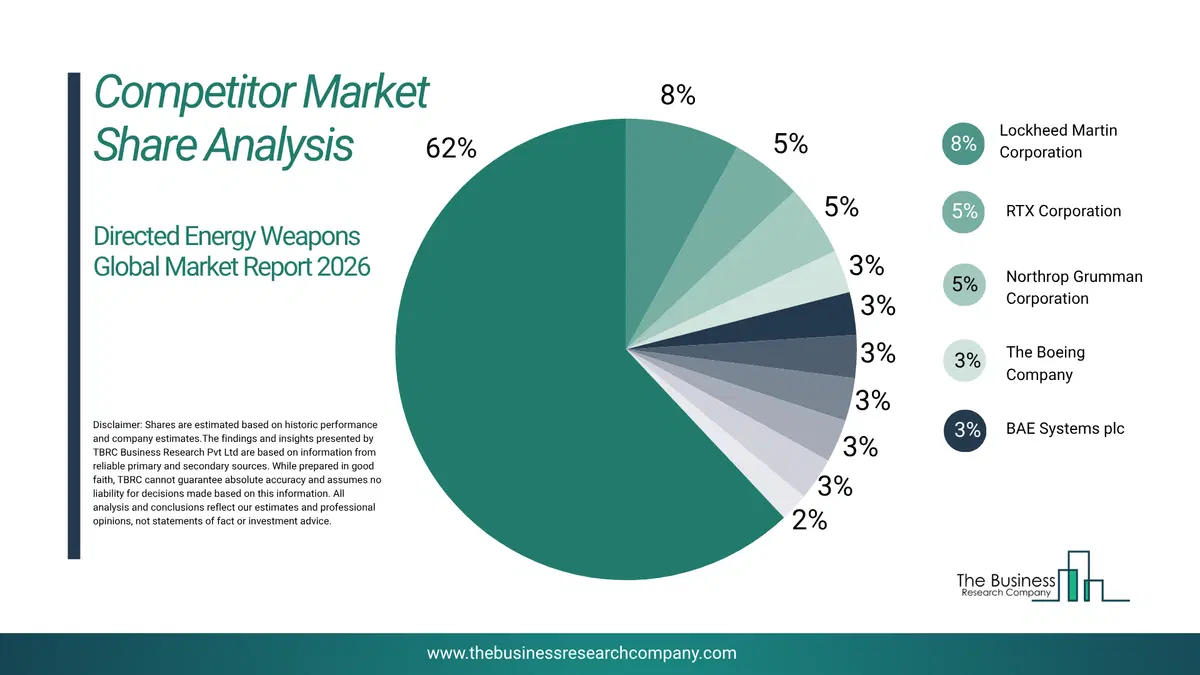
This chart is for illustrative purposes; the full report includes a detailed competitor analysis and comprehensive overview of the top 10 companies in the market.
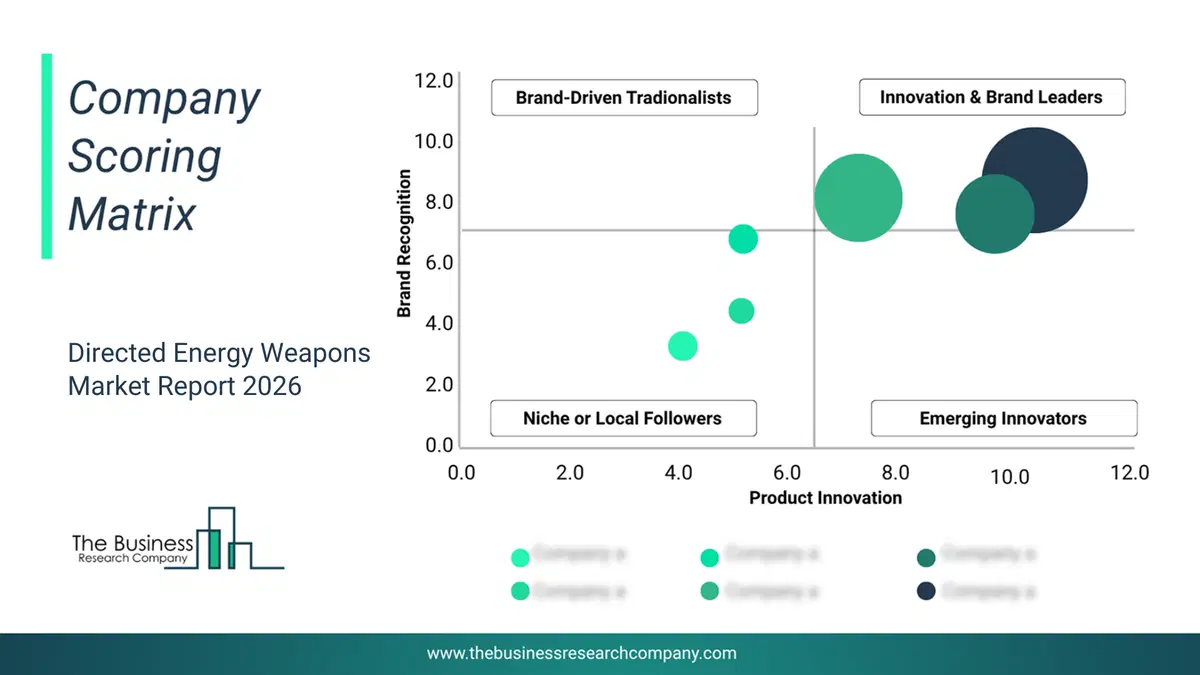
This chart maps companies by product innovation and brand strength, with bubble size indicating relative revenue, helping identify market leaders, challengers, and niche players. This is an illustrative chart; the full report provides a complete and accurate competitive analysis.
Global Directed Energy Weapons Market Trends and Insights
Major companies operating in the directed energy weapons market are focused on developing strategic partnerships to drive revenues in the market. Strategic partnerships enable directed energy weapons firms to access complementary technologies and expand their market reach, fostering innovation and competitive advantage. For instance, in 2023, BAE Systems PLC, a UK-based security and aerospace company collaborated with Thales UK a UK-based Aerospace and defense company to develop the Laser Directed Energy Weapon (LDEW) capability as part of the MOD’s Novel Weapons Program. This collaboration, referred to as Project Tracey, has the goal of developing and testing advanced prototypes for the Royal Navy, including user trials on a Type 23 frigate commencing in 2023. The LDEW system is intended for the detection, tracking, engagement, and defense against Unmanned Aerial Vehicles (UAVs). The consortium responsible for the laser technology in this initiative comprises BAE Systems, Chess Dynamics, Vision4CE, and IPG. BAE Systems will provide support to Thales UK as the platform and combat system integrator, leveraging their expertise in synthetic training, modeling, combat systems, and platform integration to position the Royal Navy at the forefront of understanding the operational integration of these innovative weapons.What Are Latest Mergers And Acquisitions In The Directed Energy Weapons Market? EDGE Acquired CONDOR Non-Lethal Technologies.
In May 2024, EDGE, a UAE-based defense company acquired CONDOR Non-Lethal Technologies for an undisclosed amount. With this acquisition, EDGE aims to enhance its portfolio in the defense sector by integrating CONDOR Non-Lethal Technologies' innovative solutions, thereby bolstering its capabilities in providing advanced non-lethal defense systems and expanding its market presence in the security and defense landscape. CONDOR Non-Lethal Technologies is a Brazil-based company that manufactures defense equipment.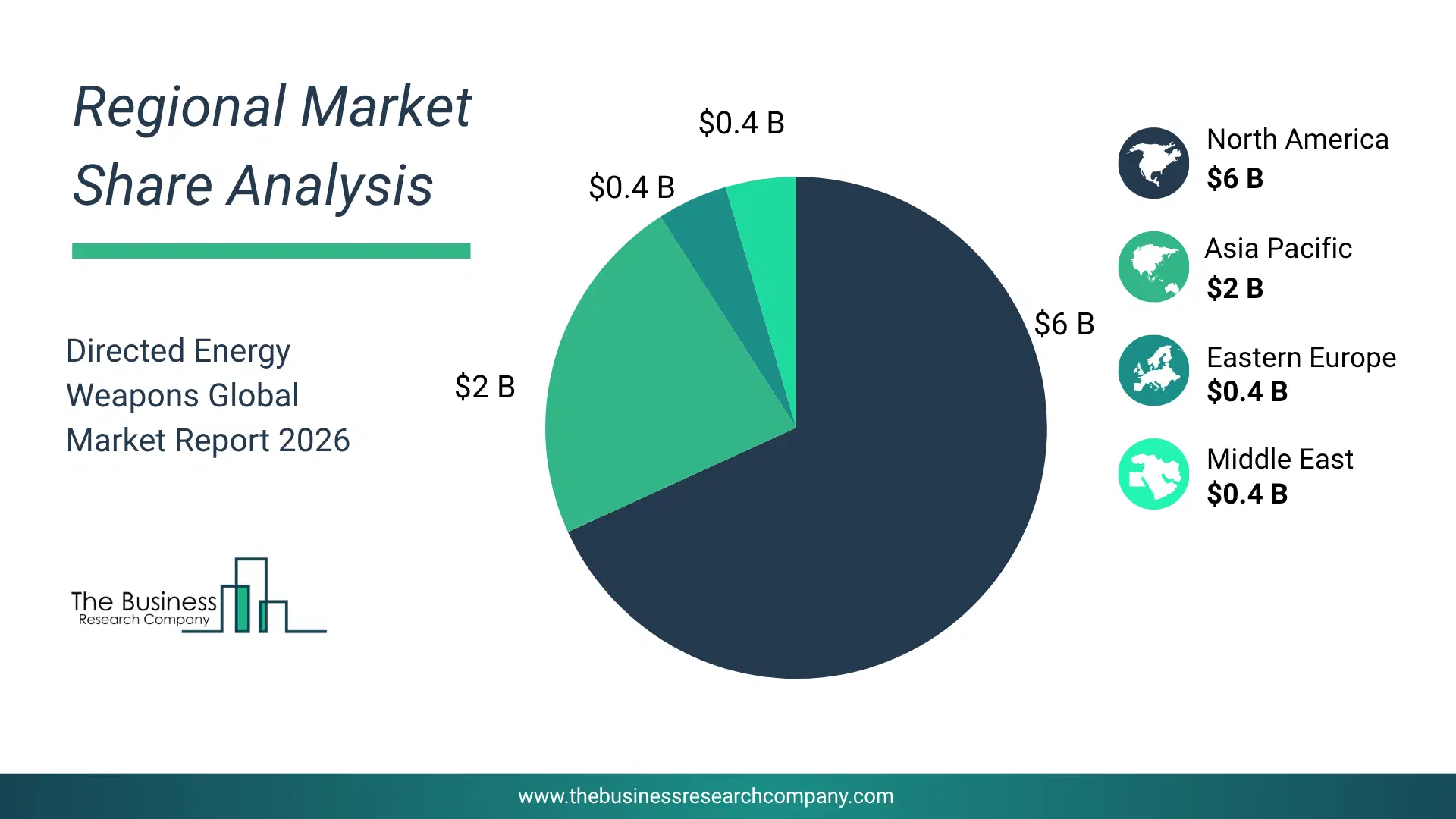
Regional Insights
North America was the largest region in the directed energy weapons market in 2025. Asia-Pacific is expected to be the fastest-growing region in the forecast period. The regions covered in this market report are Asia-Pacific, South East Asia, Western Europe, Eastern Europe, North America, South America, Middle East, Africa. The countries covered in this market report are Australia, Brazil, China, France, Germany, India, Indonesia, Japan, Taiwan, Russia, South Korea, UK, USA, Canada, Italy, SpainWhat Defines the Directed Energy Weapons Market?
The directed energy weapons market consists of sales of particle beam and plasma. Values in this market are ‘factory gate’ values, that is the value of goods sold by the manufacturers or creators of the goods, whether to other entities (including downstream manufacturers, wholesalers, distributors, and retailers) or directly to end customers. The value of goods in this market includes related services sold by the creators of the goods.How is Market Value Defined and Measured?
The market value is defined as the revenues that enterprises gain from the sale of goods and/or services within the specified market and geography through sales, grants, or donations in terms of the currency (in USD unless otherwise specified). The revenues for a specified geography are consumption values that are revenues generated by organizations in the specified geography within the market, irrespective of where they are produced. It does not include revenues from resales along the supply chain, either further along the supply chain or as part of other products.
This chart presents market attractiveness based on a quantitative evaluation of growth, competition, strategic alignment, and risk, offering a clear view of opportunity areas for decision-making. This chart is for illustrative purposes; the full report contains the complete analysis.

This chart highlights the Total Addressable Market (TAM) by estimating the maximum revenue opportunity using an assumption-driven approach, supporting strategic planning and opportunity sizing across markets. The chart is illustrative; the full report provides a more comprehensive analysis.
What Key Data and Analysis Are Included in the Directed Energy Weapons Market Report 2026?
The directed energy weapons market research report is one of a series of new reports from The Business Research Company that provides market statistics, including industry global market size, regional shares, competitors with the market share, detailed market segments, market trends and opportunities, and any further data you may need to thrive in the directed energy weapons industry. The market research report delivers a complete perspective of everything you need, with an in-depth analysis of the current and future state of the industry.Directed Energy Weapons Market Report Forecast Analysis
| Report Attribute | Details |
|---|---|
| Market Size Value In 2026 | $10.75 billion |
| Revenue Forecast In 2030 | $23.83 billion |
| Growth Rate | CAGR of 23.4% from 2026 to 2030 |
| Base Year For Estimation | 2025 |
| Actual Estimates/Historical Data | 2020-2025 |
| Forecast Period | 2026 - 2030 - 2035 |
| Market Representation | Revenue in USD Billion and CAGR from 2026 to 2030 |
| Segments Covered | Product, Technology, End-User |
| Regional Scope | Asia-Pacific, Western Europe, Eastern Europe, North America, South America, Middle East, Africa |
| Country Scope | The countries covered in the report are Australia, Brazil, China, France, Germany, India, Indonesia, Japan, Taiwan, Russia, South Korea, UK, USA, Canada, Italy, Spain. |
| Key Companies Profiled | Lockheed Martin Corporation, Northrop Grumman Corporation, Raytheon Company, Boeing Co., BAE Systems PLC, L3Harris Technologies Inc., Rheinmetall AG, Thales Group, Leonardo S.p.A., QinetiQ, General Atomics, Rafael Advanced Defense Systems Ltd., Dynetics Inc., Kord Technologies Inc., Applied Research Associates Inc., BlueHalo LLC, Radiance Technologies Inc., Saab AB, Textron Inc., Moog Inc., Elbit Systems Ltd., Kratos Defense & Security Solutions Inc. |
| Customization Scope | Request for Customization |
| Pricing And Purchase Options | Explore Purchase Options |