
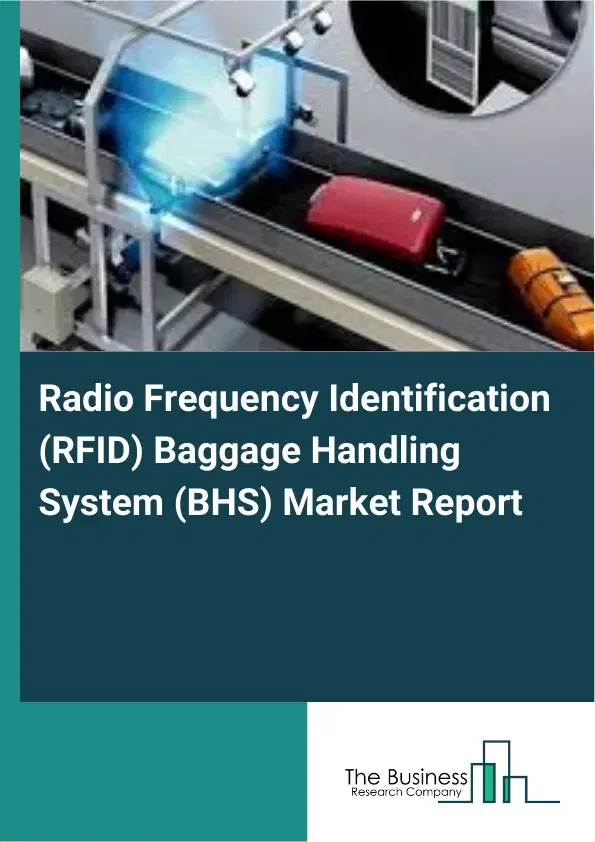
Radio Frequency Identification (RFID) Baggage Handling System (BHS) Market Report 2026
Global Outlook – By Type (Semi-Automatic, Fully Automatic), By Component (Radio Frequency Identification (RFID) Tags, Radio Frequency Identification (RFID) Readers, Conveyor Systems, Sortation Systems, Baggage Tracking Software), By Technology (Active Radio Frequency Identification (RFID), Passive Radio Frequency Identification (RFID), Semi-Passive Radio Frequency Identification (RFID), Chipless Radio Frequency Identification (RFID)), By Deployment (Cloud Based Systems, On Premise Systems, Hybrid Systems), By Application (Baggage Tracking, Sorting And Routing, Security Screening, Lost Baggage Recovery) – Market Size, Trends, Strategies, and Forecast to 2030
Radio Frequency Identification (RFID) Baggage Handling System (BHS) Market Overview
• Radio Frequency Identification (RFID) Baggage Handling System (BHS) market size has reached to $2.11 billion in 2025 • Expected to grow to $3.14 billion in 2030 at a compound annual growth rate (CAGR) of 8.3% • Growth Driver: Rising Air Passenger Traffic Driving the Growth of the RFID Baggage Handling System (BHS) Market Due to Increasing Demand for Efficient Baggage Management • Market Trend: Machine Learning–Driven RFID Systems Transform Automated Baggage Recovery And Airport Operations • North America was the largest region in 2025 and Asia-Pacific is the fastest growing region.What Is Covered Under Radio Frequency Identification (RFID) Baggage Handling System (BHS) Market?
Radio frequency identification (RFID) baggage handling system (BHS) refers to an automated airport baggage tracking and management system that uses RFID tags and readers to identify and track luggage throughout the handling process. It enables real-time visibility of baggage from check-in to aircraft loading and arrival. It helps to reduce baggage mishandling, improve operational efficiency, and enhance passenger satisfaction through accurate and reliable baggage tracking. The main types of radio frequency identification baggage handling system include semi-automatic and fully automatic systems. Semi-automatic systems refer to solutions that combine automated components with manual operations to manage baggage flow efficiently. The components of these systems include radio frequency identification tags, radio frequency identification readers, conveyor systems, sortation systems, and baggage tracking software. They are deployed through cloud-based systems, on-premise systems, and hybrid systems depending on operational requirements and infrastructure. These solutions utilize technologies such as active radio frequency identification, passive radio frequency identification, semi-passive radio frequency identification, and chipless radio frequency identification to track and manage baggage. The various applications involved are baggage tracking, sorting and routing, security screening, and lost baggage recovery.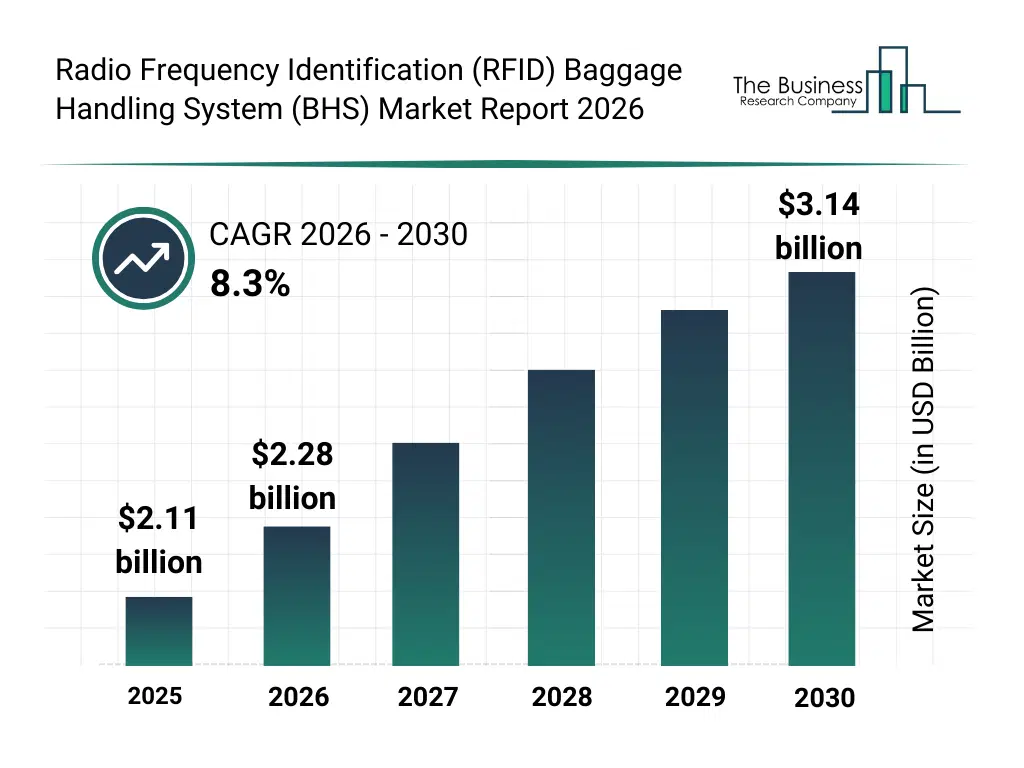
What Is The Radio Frequency Identification (RFID) Baggage Handling System (BHS) Market Size and Share 2026?
The radio frequency identification (rfid) baggage handling system (bhs) market size has grown strongly in recent years. It will grow from $2.11 billion in 2025 to $2.28 billion in 2026 at a compound annual growth rate (CAGR) of 8.1%. The growth in the historic period can be attributed to growth in global air passenger traffic, expansion of airport infrastructure projects, increasing need to reduce baggage mishandling, rise in airport automation initiatives, early adoption of RFID tracking technologies.What Is The Radio Frequency Identification (RFID) Baggage Handling System (BHS) Market Growth Forecast?
The radio frequency identification (rfid) baggage handling system (bhs) market size is expected to see strong growth in the next few years. It will grow to $3.14 billion in 2030 at a compound annual growth rate (CAGR) of 8.3%. The growth in the forecast period can be attributed to growing smart airport developments, rising demand for seamless passenger experience, expansion of international air travel, increasing investment in airport digitalization, growth in automated logistics and tracking systems. Major trends in the forecast period include rising adoption of fully automated baggage handling systems, increasing integration of real time tracking and visibility platforms, expansion of intelligent sorting and routing technologies, growing deployment of cloud based baggage management solutions, enhancement of security screening and lost baggage recovery systems.
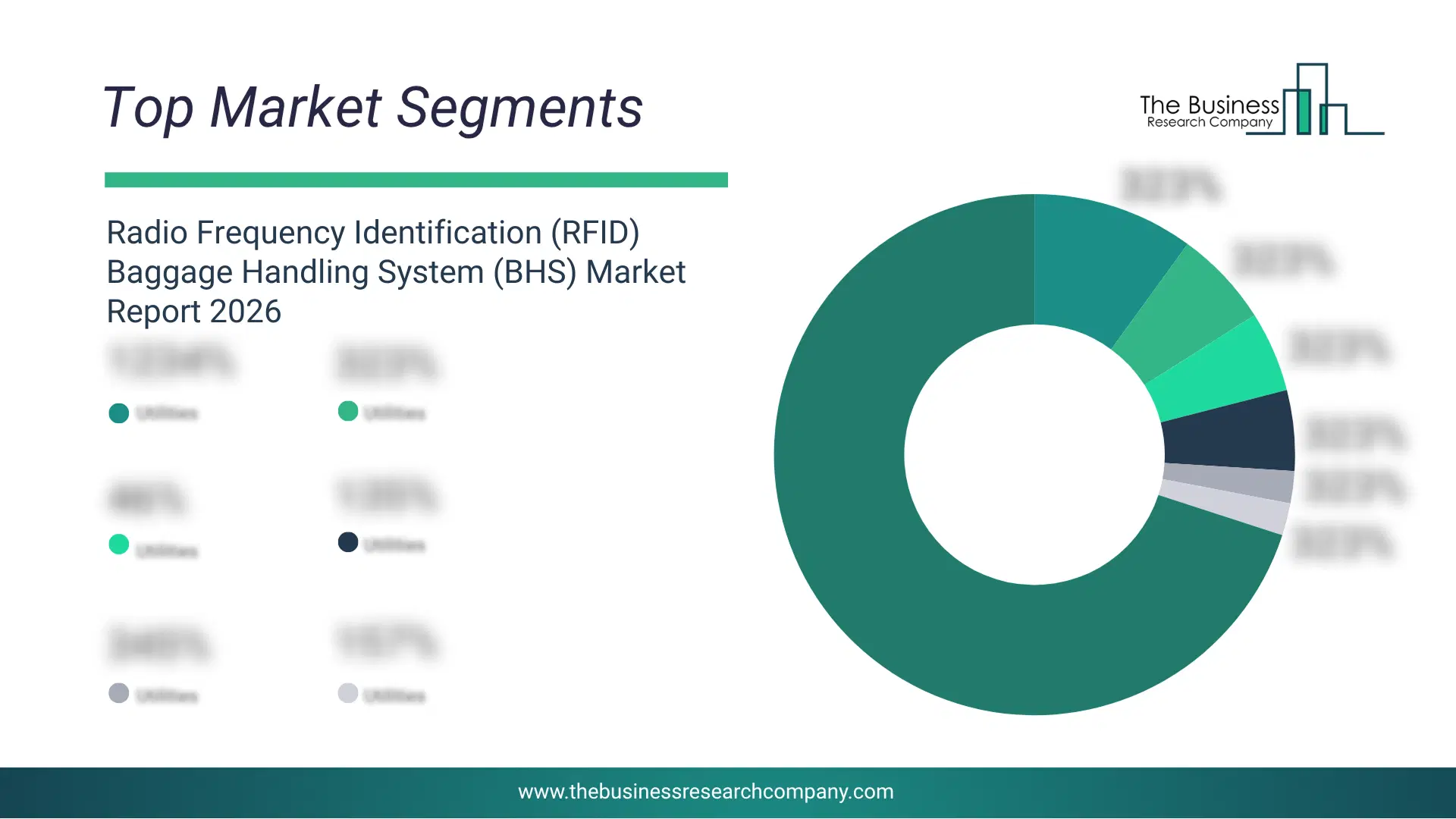
Global Radio Frequency Identification (RFID) Baggage Handling System (BHS) Market Segmentation
1) By Type: Semi-Automatic, Fully Automatic 2) By Component: Radio Frequency Identification (RFID) Tags, Radio Frequency Identification (RFID) Readers, Conveyor Systems, Sortation Systems, Baggage Tracking Software 3) By Technology: Active Radio Frequency Identification (RFID), Passive Radio Frequency Identification (RFID), Semi-Passive Radio Frequency Identification (RFID), Chipless Radio Frequency Identification (RFID) 4) By Deployment: Cloud Based Systems, On Premise Systems, Hybrid Systems 5) By Application: Baggage Tracking, Sorting And Routing, Security Screening, Lost Baggage Recovery Subsegments: 1) By Semi-Automatic: Conveyor Based Handling, Manual Assisted Sorting, Semi Automated Tagging, Mechanical Diverter Systems 2) By Fully Automatic: Automated Sorting Systems, High Speed Conveyor Networks, Automated Tag Reading Systems, Intelligent Routing SystemsWhat Is The Driver Of The Radio Frequency Identification (RFID) Baggage Handling System (BHS) Market?
The increasing air passenger traffic is expected to propel the growth of the radio frequency identification (RFID) baggage handling system (BHS) market going forward. Air passenger traffic refers to the volume or number of passengers transported by various modes of transportation, such as air, rail, road, or other vehicles, often measured over a specific period like a year. Increasing air passenger traffic is due to the expansion of low-cost carriers, which has made air travel more affordable and accessible, thereby encouraging more frequent travel for both leisure and business purposes across a broader population. Radio frequency identification (RFID) baggage handling systems (BHS) support increasing air passenger traffic by improving the longevity and performance of transit infrastructure. For instance, in August 2025, according to the International Air Transport Association (IATA), a Canada-based trade association, in 2024, it carried about 876 million passengers, which was an increase of 5.2% compared to 2023. Therefore, the increasing air passenger traffic is driving the growth of the radio frequency identification (RFID) baggage handling system (BHS) industry.Key Players In The Global Radio Frequency Identification (RFID) Baggage Handling System (BHS) Market
Major companies operating in the radio frequency identification (rfid) baggage handling system (bhs) market are Honeywell Intelligrated Inc., Zebra Technologies Corporation, Daifuku Co. Ltd., Fives S.A., Vanderlande Industries B.V., BEUMER Group GmbH & Co. KG, SITA (Société Internationale de Télécommunications Aéronautiques), Checkpoint Systems Inc., Datalogic S.p.A., ALSTEF Group S.A., FEIG ELECTRONIC GmbH, Invengo Information Technology Co. Ltd., Alien Technology LLC, TAGSYS RFID S.A.S., Tageos SAS, KATHREIN Solutions GmbH, ICM Airport Technics GmbH, MCS Automation Inc., Nordic ID Oyj, and Quantum Aviation Solutions Inc.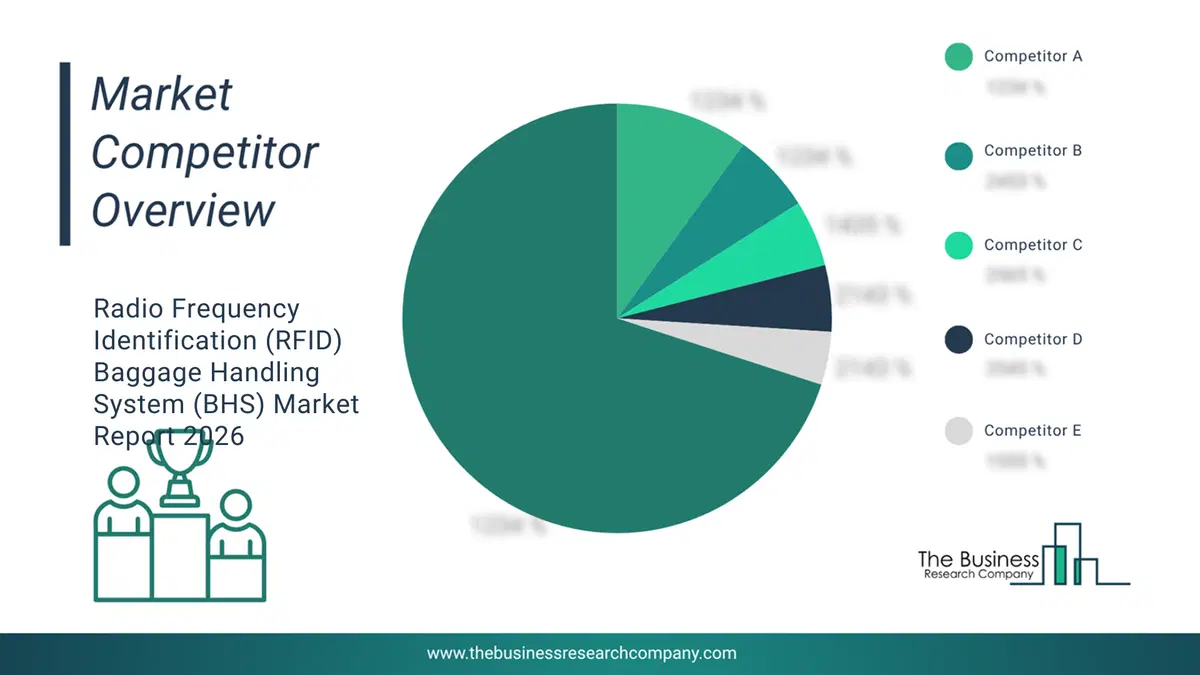
This chart is for illustrative purposes; the full report includes a detailed competitor analysis and comprehensive overview of the top 10 companies in the market.
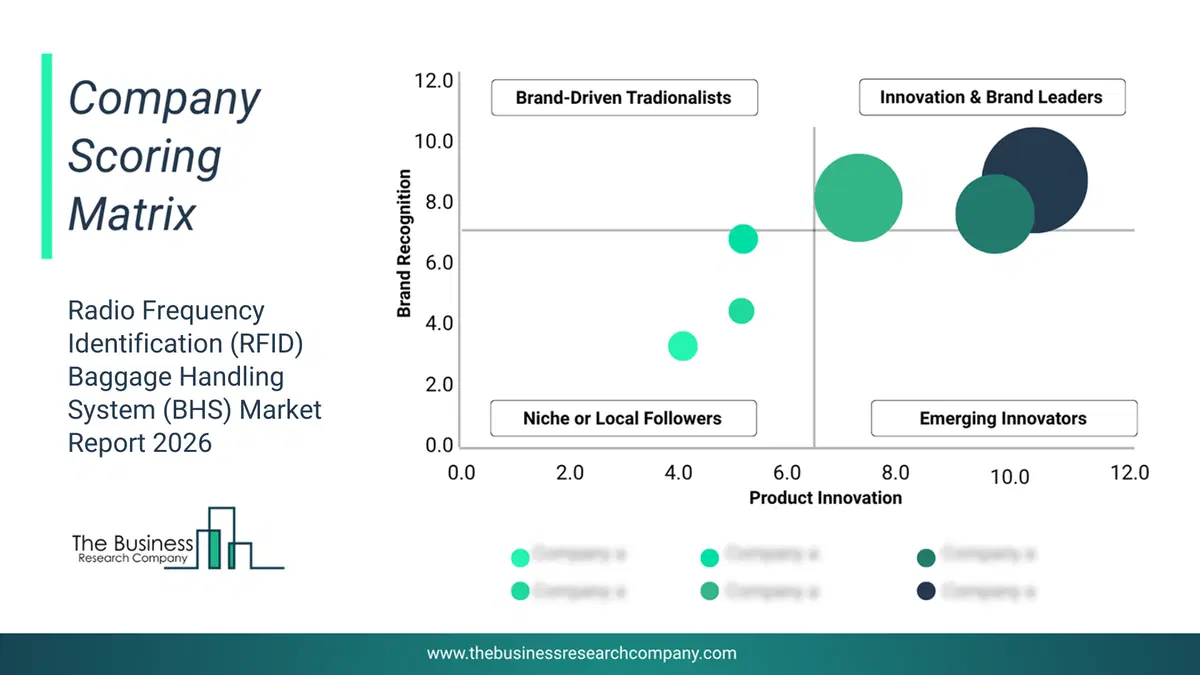
This chart maps companies by product innovation and brand strength, with bubble size indicating relative revenue, helping identify market leaders, challengers, and niche players. This is an illustrative chart; the full report provides a complete and accurate competitive analysis.
Global Radio Frequency Identification (RFID) Baggage Handling System (BHS) Market Trends and Insights
Major companies operating in the radio frequency identification (RFID) baggage handling system (BHS) market are focusing on technical advancements in machine learning, such as auto reflight algorithms within WorldTracer platforms, to meet the rising demand for automated recovery of mishandled baggage amid record passenger volumes surpassing. Auto Reflight algorithms use machine learning trained on global RFID scan data and historical mishandling patterns to automatically suggest optimal rerouting for delayed or lost bags, achieving 70% automated reflights and 60% recovery within 1.6 days. For instance, in November 2024, SITA, a Switzerland-based air transport IT provider, integrated Intelligent Passenger Solutions, an enhanced Gold Standard Offer incorporating WorldTracer Auto Reflight with intelligent self-bag drop systems supporting RFID tagging. This solution combines ML-powered Auto Reflight with CUSS kiosks and self-bag drop units equipped for RFID tag printing and scanning at check-in. It functions by encoding unique RFID inlays into tags linked to passenger data, enabling continuous tracking through BHS conveyors and reconciliation via SITA's global database. The unique features include cloud-managed automation for 80% reduced human involvement, biometric integration for seamless verification, and predictive analytics for peak-hour surge handling. The applications cover end-to-end baggage from off-airport check-in to recovery, supporting over 150,000 daily drops across 120+ airports. The benefits comprise 77% lower lost baggage via combined tech stacks, cost savings from automation, and frictionless passenger flows with real-time notifications.What Are Latest Mergers And Acquisitions In The Radio Frequency Identification (RFID) Baggage Handling System (BHS) Market?
In December 2025, Vanderlande, a Netherlands-based provider of logistics automation systems, acquired Siemens Logistics for approximately €300 million (about $325 million). With this acquisition, Vanderlande aims to expand its airport solutions footprint and enhance its technological capabilities in automated baggage and cargo handling by combining Siemens Logistics’ innovative hardware, software, and service offerings with its own portfolio. Siemens Logistics is a Germany-based provider of innovative airport logistics solutions, including baggage and cargo handling systems, digitalization software, and comprehensive services for logistics operations.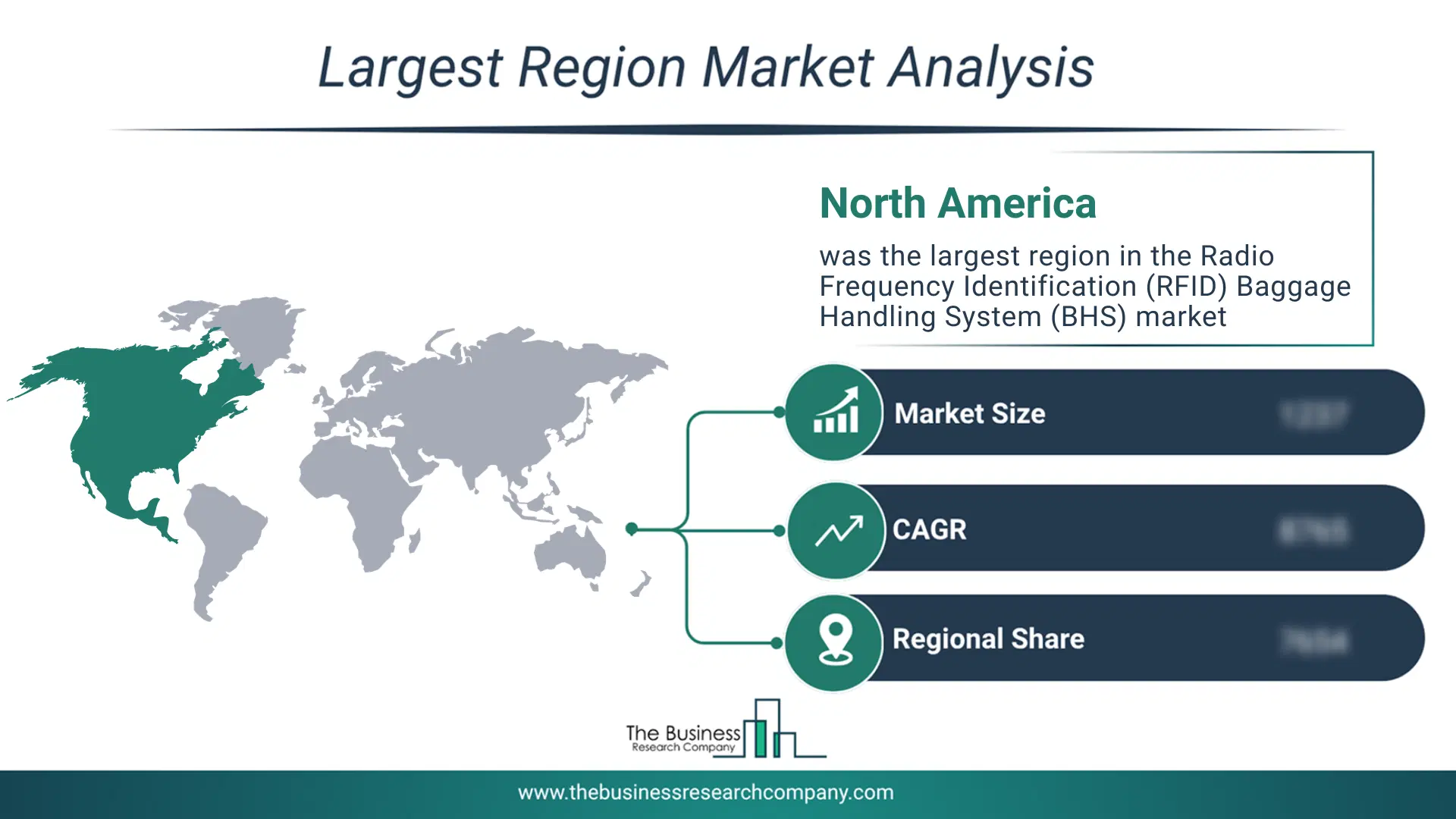
Regional Outlook
North America was the largest region in theradio frequency identification (rfid) baggage handling system (bhs) in 2025. Asia-Pacific is expected to be the fastest-growing region in the forecast period. The regions covered in this market report are Asia-Pacific, South East Asia, Western Europe, Eastern Europe, North America, South America, Middle East, Africa. The countries covered in this market report are Australia, Brazil, China, France, Germany, India, Indonesia, Japan, Taiwan, Russia, South Korea, UK, USA, Canada, Italy, Spain.What Defines the Radio Frequency Identification (RFID) Baggage Handling System (BHS) Market?
The radio frequency identification (RFID) baggage handling system (BHS) market consists of sales of radio frequency identification (RFID) tags, radio frequency identification (RFID) readers, conveyor systems, sortation systems, automated baggage handling systems, tracking and control software, and integrated airport baggage management platforms. Values in this market are ‘factory gate’ values, that is the value of goods sold by the manufacturers or creators of the goods, whether to other entities (including downstream manufacturers, wholesalers, distributors and retailers) or directly to end customers. The value of goods in this market includes related services sold by the creators of the goods.How is Market Value Defined and Measured?
The market value is defined as the revenues that enterprises gain from the sale of goods and/or services within the specified market and geography through sales, grants, or donations in terms of the currency (in USD unless otherwise specified). The revenues for a specified geography are consumption values that are revenues generated by organizations in the specified geography within the market, irrespective of where they are produced. It does not include revenues from resales along the supply chain, either further along the supply chain or as part of other products.
This chart presents market attractiveness based on a quantitative evaluation of growth, competition, strategic alignment, and risk, offering a clear view of opportunity areas for decision-making. This chart is for illustrative purposes; the full report contains the complete analysis.

This chart highlights the Total Addressable Market (TAM) by estimating the maximum revenue opportunity using an assumption-driven approach, supporting strategic planning and opportunity sizing across markets. The chart is illustrative; the full report provides a more comprehensive analysis.
What Key Data and Analysis Are Included in the Radio Frequency Identification (RFID) Baggage Handling System (BHS) Market Report 2026?
The radio frequency identification (rfid) baggage handling system (bhs) market research report is one of a series of new reports from The Business Research Company that provides market statistics, including industry global market size, regional shares, competitors with the market share, detailed market segments, market trends and opportunities, and any further data you may need to thrive in the radio frequency identification (rfid) baggage handling system (bhs) industry. The market research report delivers a complete perspective of everything you need, with an in-depth analysis of the current and future state of the industry.Radio Frequency Identification (RFID) Baggage Handling System (BHS) Market Report Forecast Analysis
| Report Attribute | Details |
|---|---|
| Market Size Value In 2026 | $2.28 billion |
| Revenue Forecast In 2030 | $3.14 billion |
| Growth Rate | CAGR of 8.1% from 2026 to 2030 |
| Base Year For Estimation | 2025 |
| Actual Estimates/Historical Data | 2020-2025 |
| Forecast Period | 2026 - 2030 - 2030 |
| Market Representation | Revenue in USD Billion and CAGR from 2026 to 2030 |
| Segments Covered | Type, Component, Technology, Deployment, Application |
| Regional Scope | Asia-Pacific, Western Europe, Eastern Europe, North America, South America, Middle East, Africa |
| Country Scope | The countries covered in the report are Australia, Brazil, China, France, Germany, India, Indonesia, Japan, Taiwan, Russia, South Korea, UK, USA, Canada, Italy, Spain. |
| Key Companies Profiled | Honeywell Intelligrated Inc., Zebra Technologies Corporation, Daifuku Co. Ltd., Fives S.A., Vanderlande Industries B.V., BEUMER Group GmbH & Co. KG, SITA (Société Internationale de Télécommunications Aéronautiques), Checkpoint Systems Inc., Datalogic S.p.A., ALSTEF Group S.A., FEIG ELECTRONIC GmbH, Invengo Information Technology Co. Ltd., Alien Technology LLC, TAGSYS RFID S.A.S., Tageos SAS, KATHREIN Solutions GmbH, ICM Airport Technics GmbH, MCS Automation Inc., Nordic ID Oyj, and Quantum Aviation Solutions Inc. |
| Customization Scope | Request for Customization |
| Pricing And Purchase Options | Explore Purchase Options |