
Radio Frequency (RF) Energy Harvesting Market Report 2026
Global Outlook – By Component (Transducer, Thermoelectric And Radio Frequency (RF) Transducer, Power Management Integrated Circuit), By Frequency Range (Low Frequency (<1 GHz), Medium Frequency (1-10 GHz), High Frequency (>10 GHz)), By Application (Wireless Switching System, Wireless Heating, Ventilation, And Air Conditioning (HVAC) System, Wireless Sensing And Telematics System, Tire Pressure Monitoring System, Asset Tracking System, Remote Health Monitoring System, Regenerative Energy Harvesting System), By End-User Industry (Electronics, Healthcare, Defense And Aerospace, Automotive, Telecommunications, Other End-User Industries) – Market Size, Trends, Strategies, and Forecast to 2030
Radio Frequency (RF) Energy Harvesting Market Overview
• Radio Frequency (RF) Energy Harvesting market size has reached to $27.96 billion in 2025 • Expected to grow to $84.32 billion in 2030 at a compound annual growth rate (CAGR) of 23.8% • Growth Driver: IoT And Wireless Device Demand Fuels RF Energy Harvesting Market Expansion • Market Trend: Energy-Harvesting Bluetooth Solutions Driving Market Growth • North America was the largest region in 2025.What Is Covered Under Radio Frequency (RF) Energy Harvesting Market?
Radiofrequency (RF) energy harvesting refers to the process of capturing electromagnetic energy from radio frequency sources such as Wi-Fi, cellular, or broadcast transmissions. This harvested energy is converted into electrical power to sustainably power low-power electronic devices and sensors without the need for traditional batteries or wired power sources, enabling wireless connectivity and autonomous operation in various applications. The main components of radio frequency (RF) energy harvesting are the transducer, photovoltaic and electrodynamic, thermoelectric and radio frequency (RF) transducer, power management integrated circuit, and secondary battery. A transducer refers to an electronic device that transforms energy from one form into another. The energy sources are electric, gravitational, magnetic, nuclear, thermal, chemical, mechanical, and radiation, and the frequency range is low frequency (<1 GHz), medium frequency (1–10 GHz), and high frequency (>10 GHz). The application of radio frequency (RF) energy harvesting includes a wireless switching system, a wireless heating, ventilation, and air conditioning (HVAC) system, a wireless sensing and telematics system, a tire pressure monitoring system, an asset tracking system, a remote health monitoring system, and a regenerative energy harvesting system. It is used by various end-user industries such as electronics, healthcare, defense and aerospace, automotive, and telecommunications.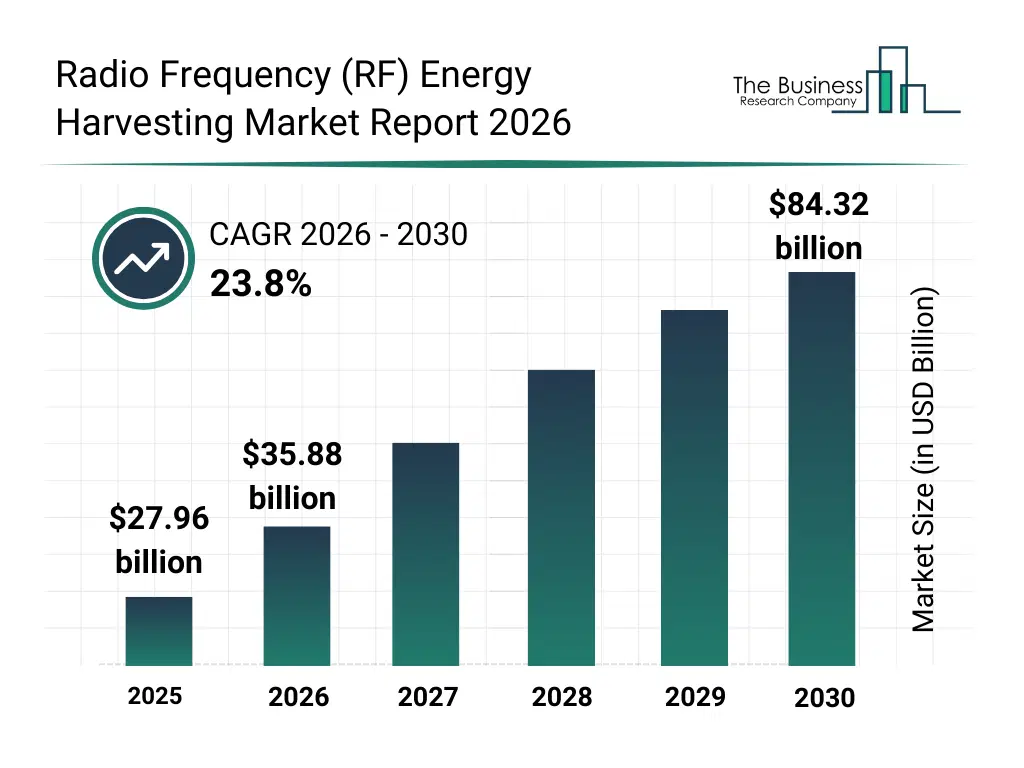
What Is The Radio Frequency (RF) Energy Harvesting Market Size and Share 2026?
The radio frequency (rf) energy harvesting market size has grown exponentially in recent years. It will grow from $27.96 billion in 2025 to $35.88 billion in 2026 at a compound annual growth rate (CAGR) of 28.4%. The growth in the historic period can be attributed to growth in low-power electronics development, early adoption of wireless sensor networks, expansion of rf transmission infrastructure, advancements in semiconductor miniaturization, increasing research in ambient energy harvesting.What Is The Radio Frequency (RF) Energy Harvesting Market Growth Forecast?
The radio frequency (rf) energy harvesting market size is expected to see exponential growth in the next few years. It will grow to $84.32 billion in 2030 at a compound annual growth rate (CAGR) of 23.8%. The growth in the forecast period can be attributed to increasing deployment of massive iot networks, rising demand for maintenance-free sensor systems, expansion of smart city and industrial iot applications, growing focus on sustainable power solutions, improving efficiency of rf energy conversion technologies. Major trends in the forecast period include increasing use of battery-free iot devices, rising adoption of rf-powered wireless sensors, expansion of energy harvesting for asset tracking, growing integration with low-power communication protocols, enhanced focus on miniaturized energy harvesting components.
Global Radio Frequency (RF) Energy Harvesting Market Segmentation
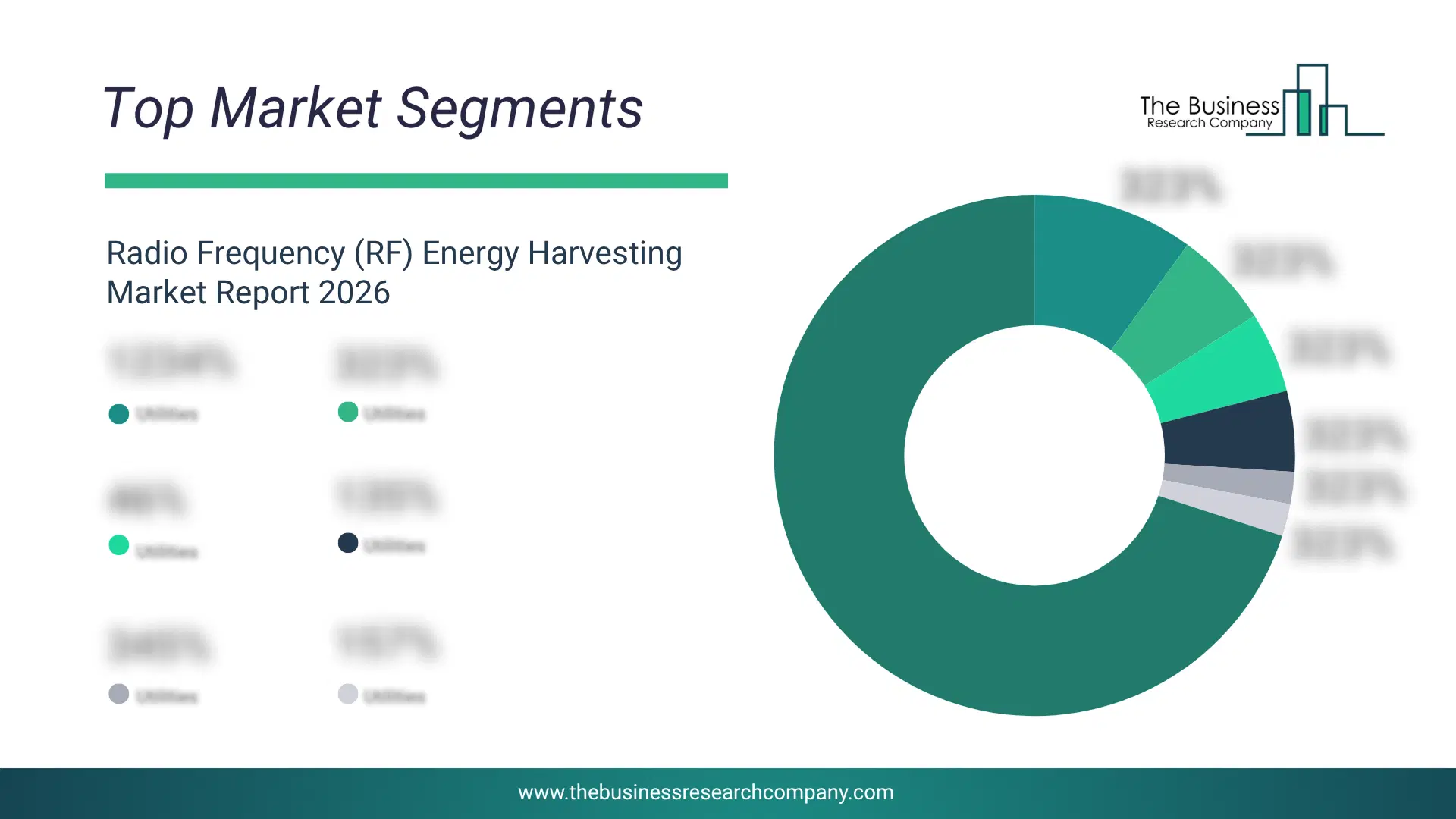
1) By Component: Transducer, Thermoelectric And Radio Frequency (RF) Transducer, Power Management Integrated Circuit 2) By Frequency Range: Low Frequency (<1 GHz), Medium Frequency (1-10 GHz), High Frequency (>10 GHz) 3) By Application: Wireless Switching System, Wireless Heating, Ventilation, And Air Conditioning (HVAC) System, Wireless Sensing And Telematics System, Tire Pressure Monitoring System, Asset Tracking System, Remote Health Monitoring System, Regenerative Energy Harvesting System 4) By End-User Industry: Electronics, Healthcare, Defense And Aerospace, Automotive, Telecommunications, Other End-User Industries Subsegments: 1) By Transducer: RF Transducers (Rectennas), Electromagnetic Transducers 2) By Thermoelectric And Radio Frequency (RF) Transducer: Thermoelectric Energy Harvesting Systems, RF Energy Harvesting Systems, Hybrid RF-Thermoelectric Systems 3) By Power Management Integrated Circuit (PMIC): Voltage Regulators, Power Converters, Energy Management ControllersWhat Is The Driver Of The Radio Frequency (RF) Energy Harvesting Market?
The growing demand for IoT and wireless devices is expected to propel the growth of the radio frequency (RF) energy harvesting market going forward. IoT (Internet of Things) and wireless devices refer to interconnected devices that can communicate with each other wirelessly, enabling data exchange and remote-control functionalities over the internet. The increasing demand for IoT and wireless devices can be attributed to the proliferation of internet connectivity, the adoption of IoT technology, and the decreasing costs of hardware components. Radio frequency (RF) energy harvesting is used to generate a modest amount of electrical power, which is utilized to activate specific circuits in wireless communication electronic devices. For instance, in October 2023, according to SmartTek Solutions, a US-based software company, total spending on IoT in 2022 was $1 billion ($1 trillion) which increased to $1,100 billion ($1.1 trillion). Therefore, the growing demand for IoT and wireless devices is driving the growth of the radio frequency (RF) energy harvesting industry.Key Players In The Global Radio Frequency (RF) Energy Harvesting Market
Major companies operating in the radio frequency (rf) energy harvesting market are Powercast Corp, Nikola Labs Inc., Everactive Inc, e-peas S.A., Wiliot Inc., Enocean GmbH, PowerFilm Inc., Texas Instruments Incorporated, NXP Semiconductors N.V., Microchip Technology Inc, Silicon Laboratories Inc., ON Semiconductor, ZF Friedrichshafen AG, ABB Limited, Fujitsu Limited, Telefonaktiebolaget LM Ericsson, Mide Technology Corp, Micropelt GmbH, Drayson Technologies Ltd, Sodaq B.V., ONiO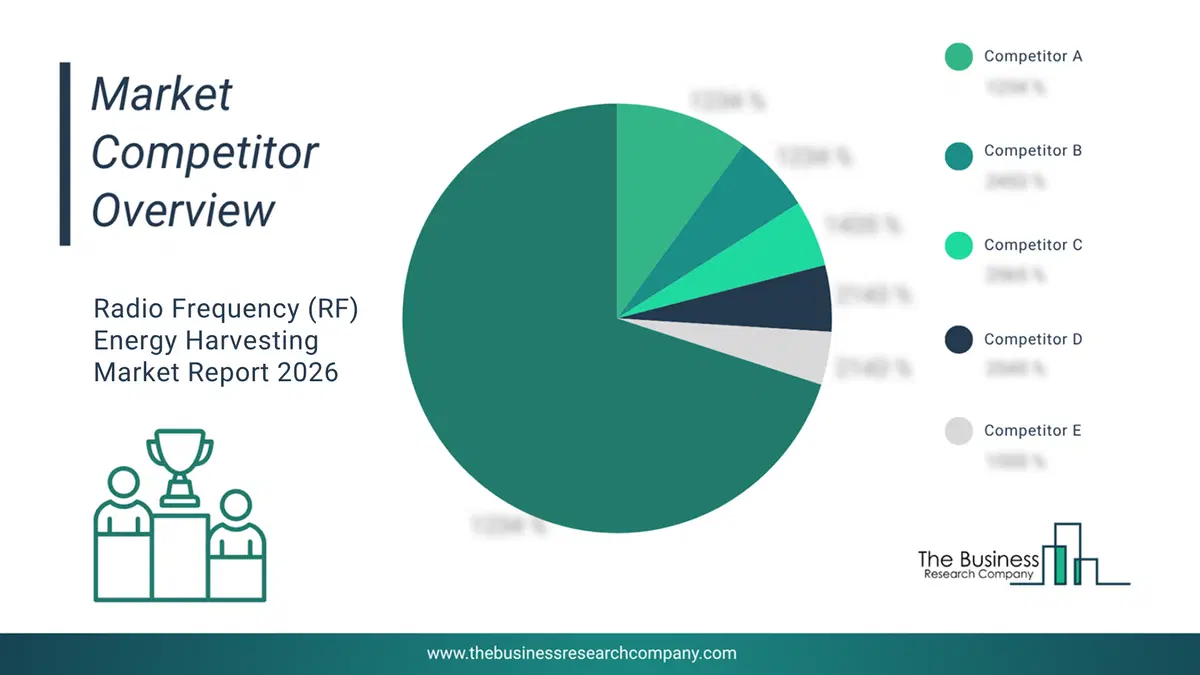
This chart is for illustrative purposes; the full report includes a detailed competitor analysis and comprehensive overview of the top 10 companies in the market.
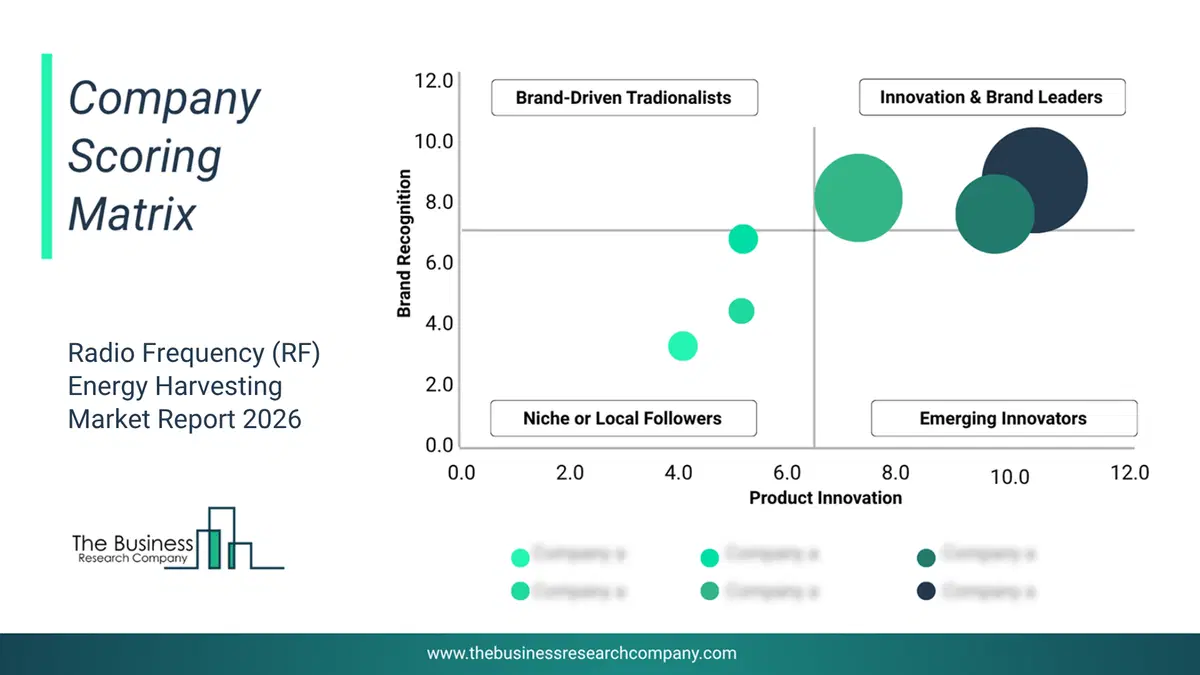
This chart maps companies by product innovation and brand strength, with bubble size indicating relative revenue, helping identify market leaders, challengers, and niche players. This is an illustrative chart; the full report provides a complete and accurate competitive analysis.
Global Radio Frequency (RF) Energy Harvesting Market Trends and Insights
Major companies operating in the radio frequency (RF) energy harvesting market are prioritizing advancements, such as energy-harvesting bluetooth, to enhance the efficiency and sustainability of wireless communication and IoT devices. Energy harvesting bluetooth refers to the utilization of Bluetooth technology in devices that are powered by harvested energy from the surrounding environment, such as solar, kinetic, or radio frequency sources, rather than traditional battery power. For instance, in October 2023, Globalscale Technologies Inc., a US-based provider of IoT solutions, launched the energy harvesting bluetooth LE 5.3 module, which uses the extremely low-power ATM33/e Series SoC from Atmosic Technologies. This module, known as the GTI-ATM3330e, integrates a Bluetooth 5.3-compliant radio with an ARM Cortex M33F application processor, 128KB of RAM, 64KB of ROM, 512 KB of nonvolatile memory (NVM), ARM TrustZone-enabled security features, and state-of-the-art power management to enable maximum lifetime in battery-operated devices.What Are Latest Mergers And Acquisitions In The Radio Frequency (RF) Energy Harvesting Market?
In October 2024, Infineon Technologies AG, a Germany-based semiconductor and power electronics company, partnered with AWL-Electricity Inc., a Canada-based provider of MHz-resonant capacitive coupling wireless power transfer technology. Through this partnership, Infineon aims to enhance wireless power and energy harvesting capabilities by integrating its CoolGaN™ GS61008P gallium-nitride transistor technology with AWL-Electricity’s advanced wireless power solutions, enabling sealed, port-free systems that reduce battery reliance and improve power density and system efficiency.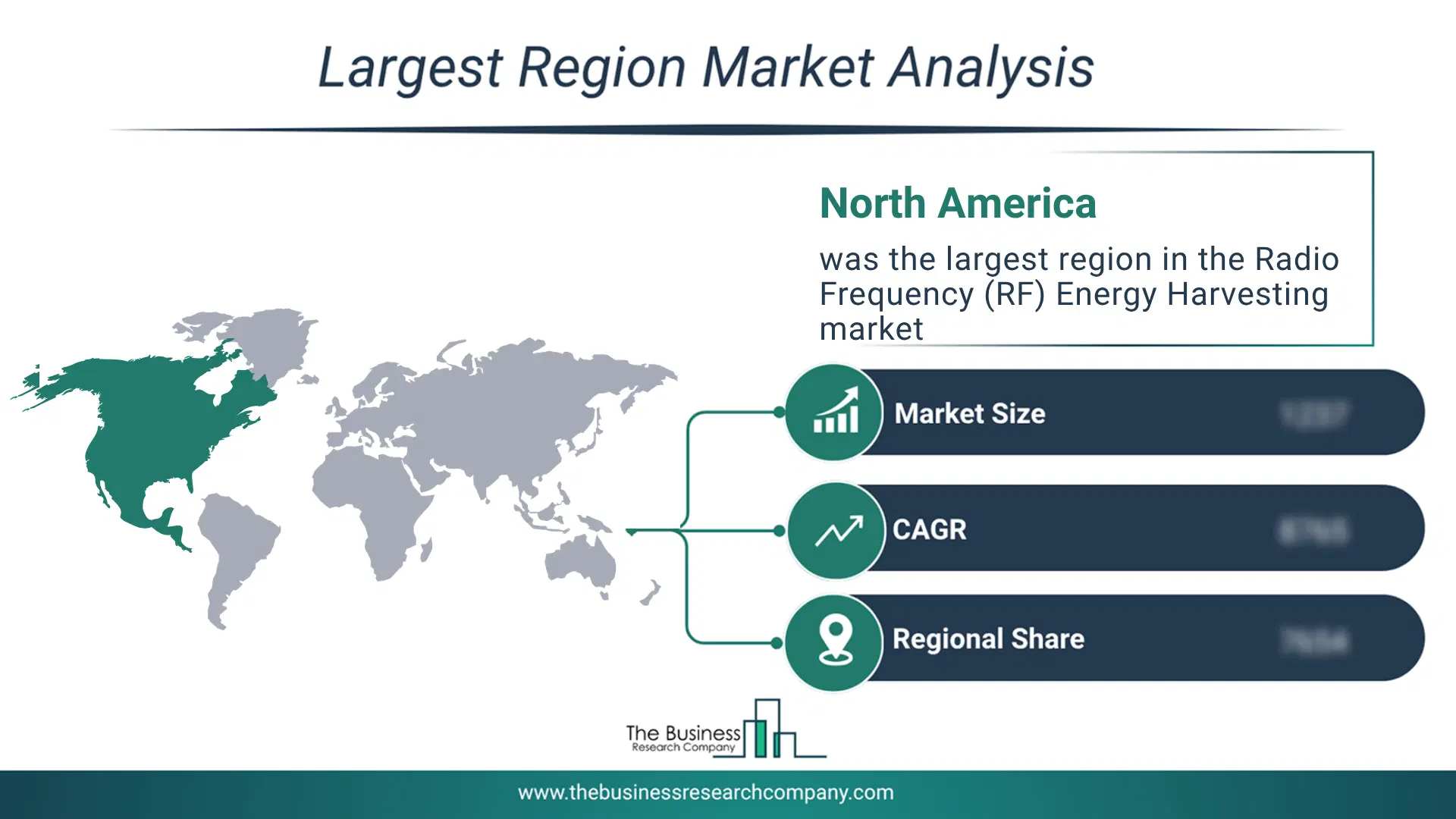
Regional Insights
North America was the largest region in the radio frequency (RF) energy harvesting market in 2025. The regions covered in this market report are Asia-Pacific, South East Asia, Western Europe, Eastern Europe, North America, South America, Middle East, Africa. The countries covered in this market report are Australia, Brazil, China, France, Germany, India, Indonesia, Japan, Taiwan, Russia, South Korea, UK, USA, Canada, Italy, Spain.What Defines the Radio Frequency (RF) Energy Harvesting Market?
The radio frequency (RF) energy harvesting market consists of revenues earned by entities by providing services such as real-time data monitoring, predictive maintenance, and environmental analysis. The market value includes the value of related goods sold by the service provider or included within the service offering. The radio frequency (RF) energy harvesting market also includes sales of RF-to-DC converters, RF transducers, metamaterial-based harvesters, and hybrid RF harvesting systems. Values in this market are ‘factory gate’ values, that is, the value of goods sold by the manufacturers or creators of the goods, whether to other entities (including downstream manufacturers, wholesalers, distributors, and retailers) or directly to end customers. The value of goods in this market includes related services sold by the creators of the goods.How is Market Value Defined and Measured?
The market value is defined as the revenues that enterprises gain from the sale of goods and/or services within the specified market and geography through sales, grants, or donations in terms of the currency (in USD unless otherwise specified). The revenues for a specified geography are consumption values that are revenues generated by organizations in the specified geography within the market, irrespective of where they are produced. It does not include revenues from resales along the supply chain, either further along the supply chain or as part of other products.
This chart presents market attractiveness based on a quantitative evaluation of growth, competition, strategic alignment, and risk, offering a clear view of opportunity areas for decision-making. This chart is for illustrative purposes; the full report contains the complete analysis.

This chart highlights the Total Addressable Market (TAM) by estimating the maximum revenue opportunity using an assumption-driven approach, supporting strategic planning and opportunity sizing across markets. The chart is illustrative; the full report provides a more comprehensive analysis.
What Key Data and Analysis Are Included in the Radio Frequency (RF) Energy Harvesting Market Report 2026?
The radio frequency (rf) energy harvesting market research report is one of a series of new reports from The Business Research Company that provides market statistics, including industry global market size, regional shares, competitors with the market share, detailed market segments, market trends and opportunities, and any further data you may need to thrive in the radio frequency (rf) energy harvesting industry. The market research report delivers a complete perspective of everything you need, with an in-depth analysis of the current and future state of the industry.Radio Frequency (RF) Energy Harvesting Market Report Forecast Analysis
| Report Attribute | Details |
|---|---|
| Market Size Value In 2026 | $35.88 billion |
| Revenue Forecast In 2030 | $84.32 billion |
| Growth Rate | CAGR of 23.8% from 2026 to 2030 |
| Base Year For Estimation | 2025 |
| Actual Estimates/Historical Data | 2020-2025 |
| Forecast Period | 2026 - 2030 |
| Market Representation | Revenue in USD Billion and CAGR from 2026 to 2030 |
| Segments Covered | Component, Frequency Range, Application, End-User Industry |
| Regional Scope | Asia-Pacific, Western Europe, Eastern Europe, North America, South America, Middle East, Africa |
| Country Scope | The Countries Covered In This Market Report Are Australia, Brazil, China, France, Germany, India, Indonesia, Japan, Taiwan, Russia, South Korea, Uk, Usa, Canada, Italy, Spain. |
| Key Companies Profiled | Powercast Corp, Nikola Labs Inc., Everactive Inc, e-peas S.A., Wiliot Inc., Enocean GmbH, PowerFilm Inc., Texas Instruments Incorporated, NXP Semiconductors N.V., Microchip Technology Inc, Silicon Laboratories Inc., ON Semiconductor, ZF Friedrichshafen AG, ABB Limited, Fujitsu Limited, Telefonaktiebolaget LM Ericsson, Mide Technology Corp, Micropelt GmbH, Drayson Technologies Ltd, Sodaq B.V., ONiO |
| Customization Scope | Request for Customization |
| Pricing And Purchase Options | Explore Purchase Options |