
Rare Inflammatory Disease Treatment Market Report 2026
Global Outlook – By Drug Class (Biologics, Organic Compounds), By Mode Of Administration (Injectables, Oral, Other Administration Modes), By Indication (Ulcerative Colitis, Juvenile Rheumatoid Arthritis, Psoriatic Arthritis, Other Indications), By Distribution Channel (Hospital Pharmacies, Retail Pharmacies, Online Pharmacies) - Market Size, Trends, Strategies, and Forecast to 2030
Rare Inflammatory Disease Treatment Market Overview
• Rare Inflammatory Disease Treatment market size has reached to $14.67 billion in 2025 • Expected to grow to $18.98 billion in 2030 at a compound annual growth rate (CAGR) of 5.1% • Growth Driver: Rising Autoimmune Conditions Fuel Rare Inflammatory Disease Treatment Market • Market Trend: Advancements in Monoclonal Antibody Therapies Strengthen Treatment Outcomes in Rare Inflammatory Diseases • North America was the largest region in 2025 and Asia-Pacific is the fastest growing region.What Is Covered Under Rare Inflammatory Disease Treatment Market?
Rare inflammatory disease treatment refers to the therapeutic interventions and strategies aimed at managing the symptoms, suppressing the inflammatory response, and potentially modifying the course of the disease in individuals affected by these uncommon inflammatory conditions. This encompasses a range of approaches, including pharmacological therapies, lifestyle modifications, supportive care measures, and participation in clinical trials or experimental treatments. The main drug class of rare inflammatory disease treatment is biologics and organic compounds. Biologics refer to medications derived from living organisms or their components, such as proteins, antibodies, or nucleic acids, that treat various diseases by targeting specific molecules involved in the disease process. The various modes of administration include injectables, oral, and others, and is used for indications such as ulcerative colitis, juvenile rheumatoid arthritis, psoriatic arthritis, and others. The various distribution channels include hospital pharmacies, retail pharmacies, and online pharmacies.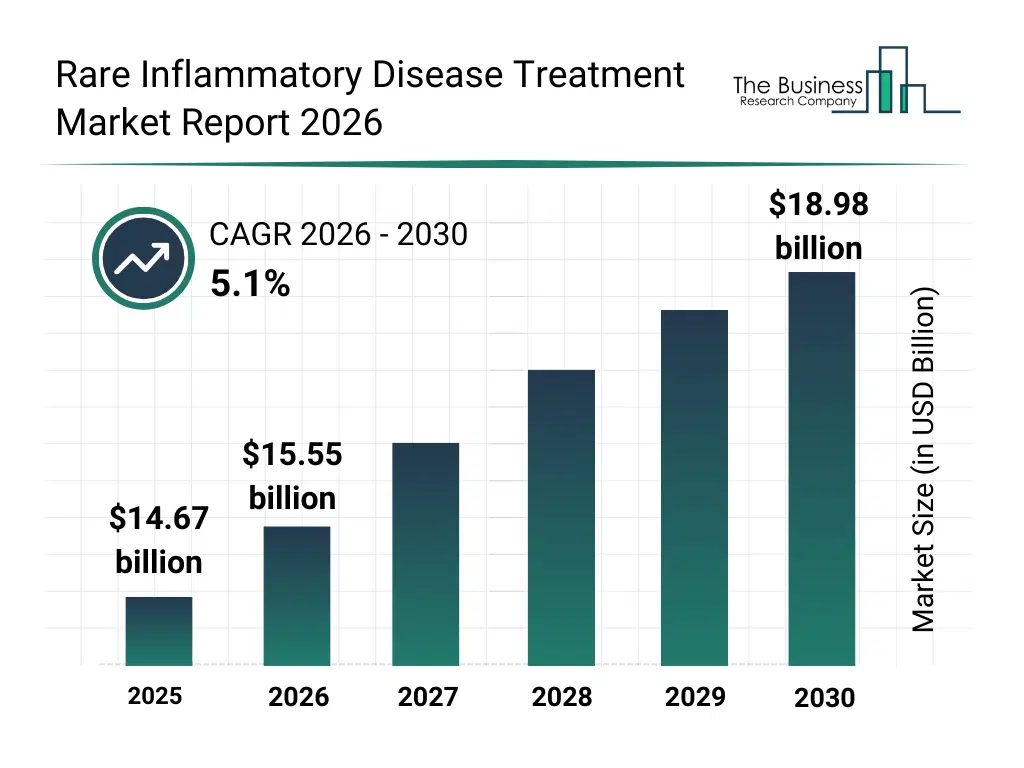
What Is The Rare Inflammatory Disease Treatment Market Size and Share 2026?
The rare inflammatory disease treatment market size has grown strongly in recent years. It will grow from $14.67 billion in 2025 to $15.55 billion in 2026 at a compound annual growth rate (CAGR) of 6.0%. The growth in the historic period can be attributed to expansion of biologics development pipelines, rising diagnosis rates of rare inflammatory conditions, growth of specialty pharmaceutical research, increasing use of immunomodulatory therapies, improved access to specialty care centers.What Is The Rare Inflammatory Disease Treatment Market Growth Forecast?
The rare inflammatory disease treatment market size is expected to see strong growth in the next few years. It will grow to $18.98 billion in 2030 at a compound annual growth rate (CAGR) of 5.1%. The growth in the forecast period can be attributed to expansion of precision immunology approaches, rising investments in orphan drug development, growing adoption of advanced biologics, increasing focus on disease-modifying therapies, expansion of digital patient monitoring platforms. Major trends in the forecast period include increasing development of targeted biologic therapies, rising adoption of personalized treatment approaches, growing use of combination drug regimens, expansion of clinical trial-based treatment access, enhanced focus on long-term disease management.
Global Rare Inflammatory Disease Treatment Market Segmentation
1) By Drug Class: Biologics, Organic Compounds 2) By Mode Of Administration: Injectables, Oral, Other Administration Modes 3) By Indication: Ulcerative Colitis, Juvenile Rheumatoid Arthritis, Psoriatic Arthritis, Other Indications 4) By Distribution Channel: Hospital Pharmacies, Retail Pharmacies, Online Pharmacies Subsegments: 1) By Biologics: Monoclonal Antibodies, Cytokine Inhibitors, Growth Factors, Enzyme Replacement Therapies 2) By Organic Compounds: Non-Steroidal Anti-Inflammatory Drugs (Nsaids), Immunosuppressants, Corticosteroids, Disease-Modifying Antirheumatic Drugs (Dmards)What Is The Driver Of The Rare Inflammatory Disease Treatment Market?
The increasing prevalence of autoimmune disorders is expected to propel the growth of the rare inflammatory disease treatment market going forward. Autoimmune disorders occur when the immune system mistakenly attacks healthy cells and tissues, causing inflammation and tissue damage. The rise in autoimmune conditions is attributed to genetic predisposition, environmental triggers, lifestyle changes, and improved diagnostic capabilities, which enable earlier detection and better disease recognition. Rare inflammatory disease treatments help manage these conditions by reducing inflammation and preventing the immune system from attacking healthy tissues. For instance, in February 2024, according to Arthritis Australia, an Australia-based charitable not-for-profit organisation advocating for people with arthritis and musculoskeletal conditions, by 2025, approximately 562,378 Australians are living with rheumatoid arthritis (RA), accounting for 14% of the total arthritis population. Therefore, the rising prevalence of autoimmune disorders is driving the growth of the rare inflammatory disease treatment industry.Key Players In The Global Rare Inflammatory Disease Treatment Market
Major companies operating in the rare inflammatory disease treatment market are Pfizer Inc., Johnson And Johnson, Roche Holding AG, Merck And Co Inc., AbbVie Inc., Bayer AG, Sanofi S.A., Bristol Myers Squibb, AstraZeneca Plc, Novartis AG, GlaxoSmithKline plc, Eli Lilly And Company, Gilead Sciences Inc., Amgen Inc., Regeneron Pharmaceuticals Inc., Biogen Inc., UCB S.A., Horizon Therapeutics plc, Kyowa Kirin Co. Ltd., Mallinckrodt Pharmaceuticals, Takeda Pharmaceutical Company Limited, Boehringer Ingelheim International GmbH, CSL Behring GmbH, Sobi Swedish Orphan Biovitrum AB
This chart is for illustrative purposes; the full report includes a detailed competitor analysis and comprehensive overview of the top 10 companies in the market.
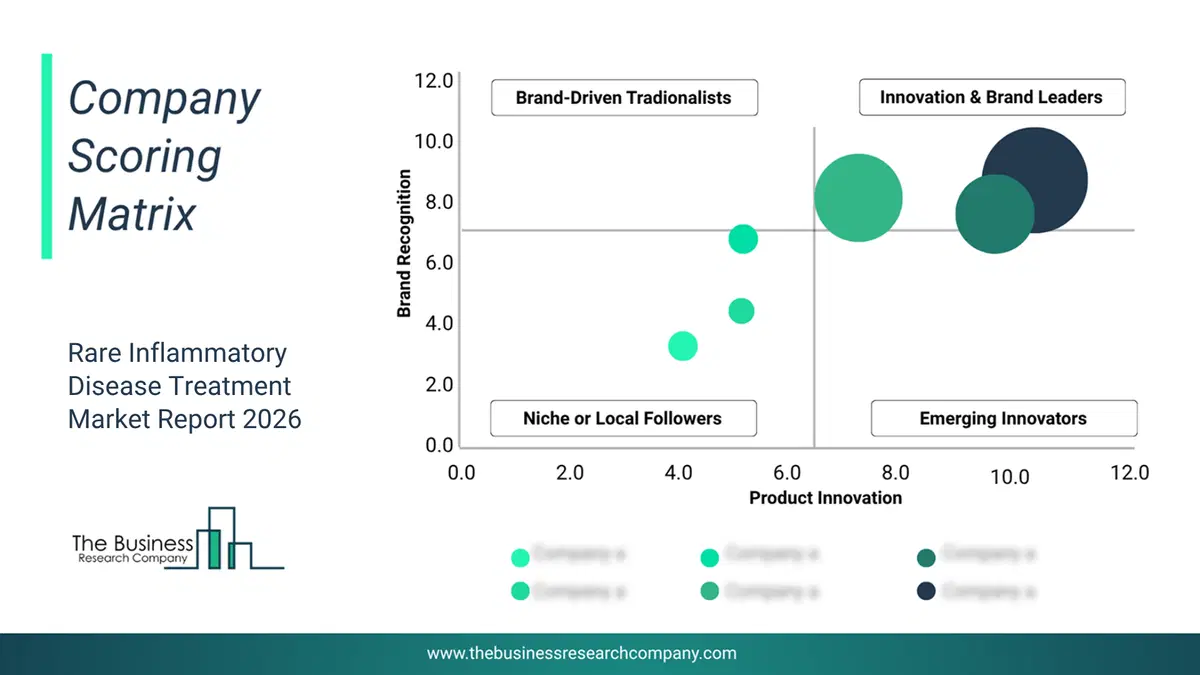
This chart maps companies by product innovation and brand strength, with bubble size indicating relative revenue, helping identify market leaders, challengers, and niche players. This is an illustrative chart; the full report provides a complete and accurate competitive analysis.
Global Rare Inflammatory Disease Treatment Market Trends and Insights
Major companies operating in the rare inflammatory disease treatment market are focusing on developing advanced solutions, such as precision-targeted monoclonal antibodies, to improve disease control, reduce immune-mediated damage, and enhance patient outcomes. Precision-targeted monoclonal antibodies are therapies engineered to selectively bind and eliminate specific immune cell populations involved in disease progression, helping to minimize systemic inflammation while preserving healthy immune function. For instance, in November 2024, Amgen, a US-based biopharmaceutical company, presented new data at the American College of Rheumatology (ACR) Convergence 2024 showing that its monoclonal antibody UPLIZNA (inebilizumab-cdon) significantly reduces disease activity in IgG4-related disease (IgG4-RD) by selectively depleting CD19+ B cells implicated in its pathogenesis. UPLIZNA exemplifies the advancement of targeted biologics in rare inflammatory disease management, highlighting industry efforts toward more effective and personalized therapeutic approaches.What Are Latest Mergers And Acquisitions In The Rare Inflammatory Disease Treatment Market?
In June 2025, TNF Pharmaceuticals, Inc., a US-based biopharmaceutical company, partnered with the DADA2 Foundation to conduct a compassionate use study of isomyosamine in pediatric patients with Deficiency of Adenosine Deaminase 2 (DADA2), a rare autoinflammatory disease. Through this collaboration, TNF Pharmaceuticals aims to evaluate the safety and potential therapeutic benefits of isomyosamine in treating DADA2 while expanding access to innovative treatments for children affected by this rare condition. The DADA2 Foundation is a US-based nonprofit organization dedicated to supporting research, patient advocacy, and education for individuals with DADA2.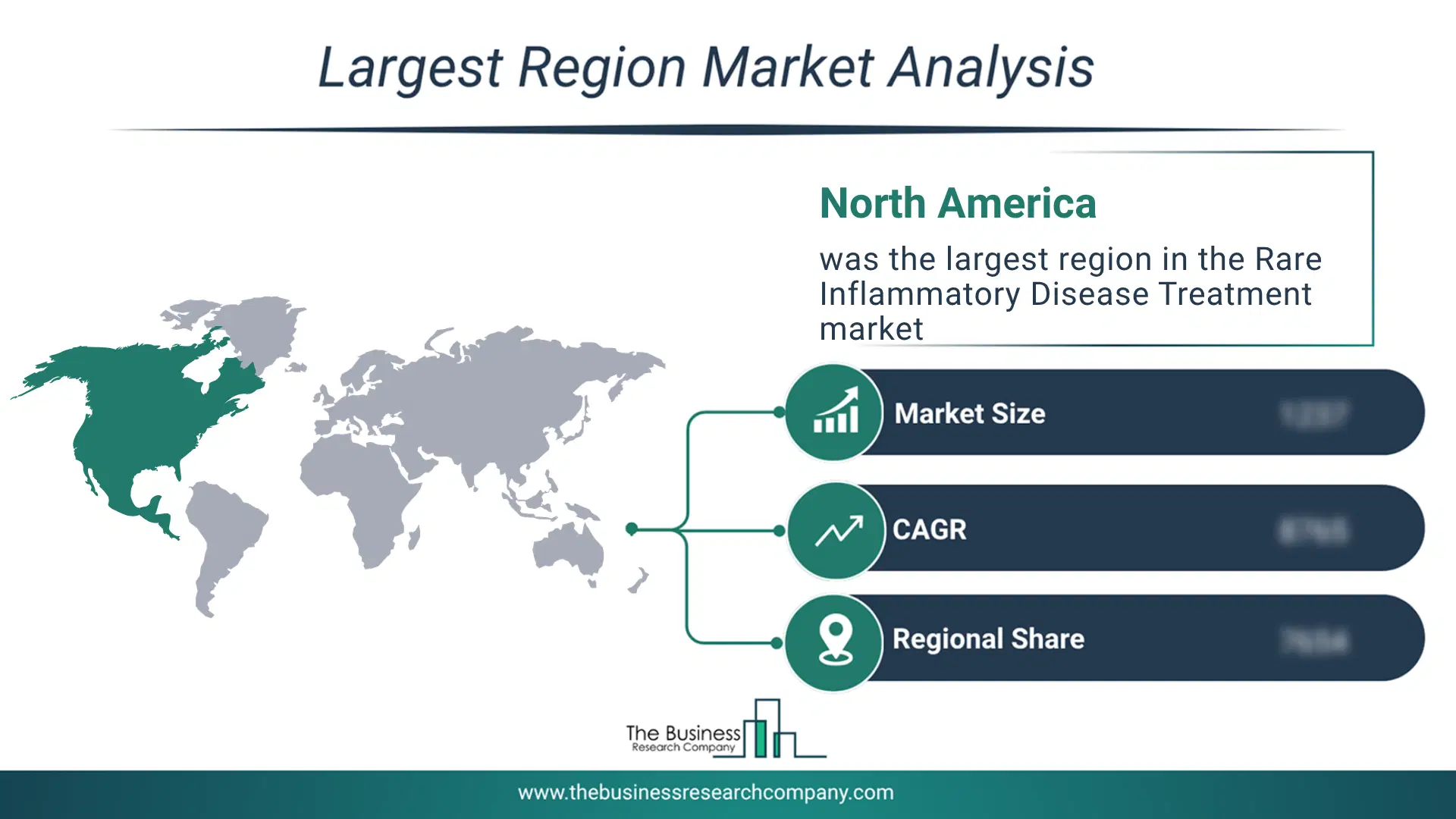
Regional Outlook
North America was the largest region in the rare inflammatory disease treatment market in 2025. Asia-Pacific is expected to be the fastest-growing region in the forecast period. The regions covered in this market report are Asia-Pacific, South East Asia, Western Europe, Eastern Europe, North America, South America, Middle East, Africa. The countries covered in this market report are Australia, Brazil, China, France, Germany, India, Indonesia, Japan, Taiwan, Russia, South Korea, UK, USA, Canada, Italy, Spain.What Defines the Rare Inflammatory Disease Treatment Market?
The rare inflammatory disease treatment market consists of revenues earned by entities by providing services such as clinical evaluation, parallel sequencing, targeted sequencing, laboratory testing, and specialist consultation. The market value includes the value of related goods sold by the service provider or included within the service offering. The rare inflammatory disease treatment market also includes sales of vision evaluation instruments, blood pressure cuffs, cardiac monitors, and advanced imaging equipment. Values in this market are ‘factory gate’ values, that is, the value of goods sold by the manufacturers or creators of the goods, whether to other entities (including downstream manufacturers, wholesalers, distributors, and retailers) or directly to end customers. The value of goods in this market includes related services sold by the creators of the goods.How is Market Value Defined and Measured?
The market value is defined as the revenues that enterprises gain from the sale of goods and/or services within the specified market and geography through sales, grants, or donations in terms of the currency (in USD unless otherwise specified). The revenues for a specified geography are consumption values that are revenues generated by organizations in the specified geography within the market, irrespective of where they are produced. It does not include revenues from resales along the supply chain, either further along the supply chain or as part of other products.
This chart presents market attractiveness based on a quantitative evaluation of growth, competition, strategic alignment, and risk, offering a clear view of opportunity areas for decision-making. This chart is for illustrative purposes; the full report contains the complete analysis.

This chart highlights the Total Addressable Market (TAM) by estimating the maximum revenue opportunity using an assumption-driven approach, supporting strategic planning and opportunity sizing across markets. The chart is illustrative; the full report provides a more comprehensive analysis.
What Key Data and Analysis Are Included in the Rare Inflammatory Disease Treatment Market Report 2026?
The rare inflammatory disease treatment market research report is one of a series of new reports from The Business Research Company that provides market statistics, including industry global market size, regional shares, competitors with the market share, detailed market segments, market trends and opportunities, and any further data you may need to thrive in the rare inflammatory disease treatment industry. The market research report delivers a complete perspective of everything you need, with an in-depth analysis of the current and future state of the industry.Rare Inflammatory Disease Treatment Market Report Forecast Analysis
| Report Attribute | Details |
|---|---|
| Market Size Value In 2026 | $15.55 billion |
| Revenue Forecast In 2030 | $18.98 billion |
| Growth Rate | CAGR of 5.1% from 2026 to 2030 |
| Base Year For Estimation | 2025 |
| Actual Estimates/Historical Data | 2020-2025 |
| Forecast Period | 2026 - 2030 |
| Market Representation | Revenue in USD Billion and CAGR from 2026 to 2030 |
| Segments Covered | Drug Class, Mode Of Administration, Indication, Distribution Channel |
| Regional Scope | Asia-Pacific, Western Europe, Eastern Europe, North America, South America, Middle East, Africa |
| Country Scope | The countries covered in the report are Australia, Brazil, China, France, Germany, India, Indonesia, Japan, Taiwan, Russia, South Korea, UK, USA, Canada, Italy, Spain |
| Key Companies Profiled | Pfizer Inc., Johnson And Johnson, Roche Holding AG, Merck And Co Inc., AbbVie Inc., Bayer AG, Sanofi S.A., Bristol Myers Squibb, AstraZeneca Plc, Novartis AG, GlaxoSmithKline plc, Eli Lilly And Company, Gilead Sciences Inc., Amgen Inc., Regeneron Pharmaceuticals Inc., Biogen Inc., UCB S.A., Horizon Therapeutics plc, Kyowa Kirin Co. Ltd., Mallinckrodt Pharmaceuticals, Takeda Pharmaceutical Company Limited, Boehringer Ingelheim International GmbH, CSL Behring GmbH, Sobi Swedish Orphan Biovitrum AB |
| Customization Scope | Request for Customization |
| Pricing And Purchase Options | Explore Purchase Options |