
Recreational Space Travel Market Report 2026
Global Outlook – By Type Of Space Travel (Suborbital Space Travel, Orbital Space Travel), By Purpose Of Travel (Leisure And Tourism, Space Adventure, Zero-Gravity Experiences), By Travel Mode (Spacecraft, Spaceplane, Reusable Rockets, Space Capsules) – Market Size, Trends, Strategies, and Forecast to 2030
Recreational Space Travel Market Overview
• Recreational Space Travel market size has reached to $1.43 billion in 2025 • Expected to grow to $3.26 billion in 2030 at a compound annual growth rate (CAGR) of 17.9% • Growth Driver: Increasing Interest In Space Exploration Fueling The Market Growth Due To Rising Commercial Investments • Market Trend: Pioneering Human Spaceflight Expands Access And Inspires Future Generations Worldwide • North America was the largest region in 2025.What Is Covered Under Recreational Space Travel Market?
Recreational space travel is the experience of journeying beyond Earth’s atmosphere for leisure and personal enjoyment rather than professional or scientific purposes. It allows individuals to experience weightlessness, view Earth from orbit, and explore aspects of spaceflight typically reserved for astronauts. This form of travel is enabled by commercial spacecraft designed to safely transport passengers on short-duration space missions. The main types of recreational space travel are suborbital space travel, orbital space travel, lunar travel, and interplanetary travel. Suborbital space travel is a brief journey beyond Earth’s atmosphere, offering a taste of space with weightlessness and panoramic views without entering orbit. These types of travel serve various purposes, including leisure and tourism, space adventure, scientific exploration, and zero-gravity experiences. They can be undertaken using different modes such as spacecraft, spaceplanes, reusable rockets, and space capsules. The applications are primarily for civilians and the rich, while the end-users include tourists, researchers, and the media and entertainment industry.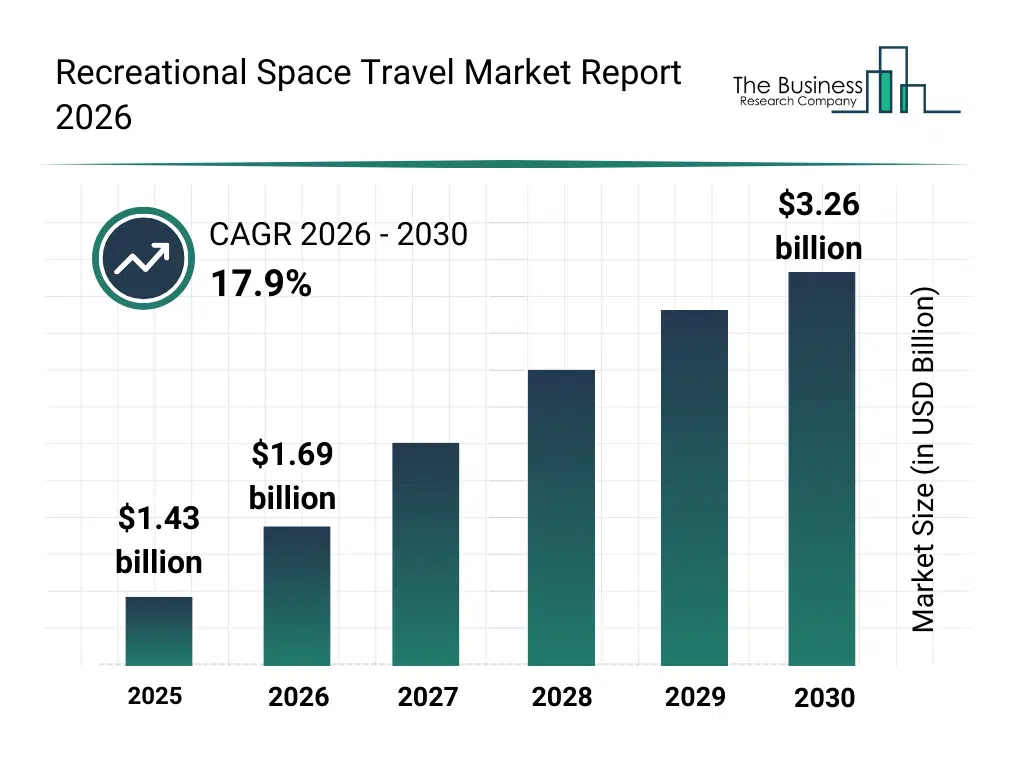
What Is The Recreational Space Travel Market Size and Share 2026?
The recreational space travel market size has grown rapidly in recent years. It will grow from $1.43 billion in 2025 to $1.69 billion in 2026 at a compound annual growth rate (CAGR) of 18.2%. The growth in the historic period can be attributed to early private sector involvement in spaceflight, advancements in reusable rocket technologies, rising interest in experiential luxury travel, initial regulatory approvals for commercial space missions, participation of high-net-worth individuals.What Is The Recreational Space Travel Market Growth Forecast?
The recreational space travel market size is expected to see rapid growth in the next few years. It will grow to $3.26 billion in 2030 at a compound annual growth rate (CAGR) of 17.9%. The growth in the forecast period can be attributed to increasing commercialization of space travel, rising investments in private space companies, expanding infrastructure for spaceports, growing demand for orbital tourism, advancements in spacecraft cost efficiency. Major trends in the forecast period include increasing adoption of reusable spacecraft systems, rising demand for suborbital tourism flights, growing investment in passenger safety and training programs, expansion of private spaceflight infrastructure, enhanced focus on luxury space travel experiences.
Global Recreational Space Travel Market Segmentation
1) By Type Of Space Travel: Suborbital Space Travel, Orbital Space Travel 2) By Purpose Of Travel: Leisure And Tourism, Space Adventure, Zero-Gravity Experiences 3) By Travel Mode: Spacecraft, Spaceplane, Reusable Rockets, Space Capsules Subsegments: 1) By Suborbital Space Travel: Short-Duration Flights, High-Altitude Parabolic Flights, Edge-of-Space Sightseeing 2) By Orbital Space Travel: Low Earth Orbit Tourism, Space Station Visits, Multi-Day Orbital CruisesWhat Is The Driver Of The Recreational Space Travel Market?
The increasing interest in space exploration is expected to propel the growth of the recreational space travel market going forward. Space exploration refers to the scientific investigation and discovery of outer space through human and robotic missions. The rising interest in space exploration is primarily due to the potential for scientific discoveries to help us understand the origins of the universe, the formation of planets, and the possibilities for life beyond earth. The growing interest in space exploration encourages people to participate in space travel experiences, as it fuels curiosity, inspires a sense of adventure, and motivates individuals to personally engage with the wonders of outer space, thereby boosting demand for recreational space trips. For instance, in July 2025, according to the Space Foundation, a US-based nonprofit advocate organisation, the 2025 Q2 highlights the fact that the global space economy reached a record value of $613 billion in 2024, fuelled by robust growth across the commercial space sector. Therefore, the increasing interest in space exploration is driving the growth of the recreational space travel industry.Key Players In The Global Recreational Space Travel Market
Major companies operating in the recreational space travel market are Virgin Galactic Holdings Inc., Blue Origin L.P., Space Exploration Technologies Corp., Axiom Space Inc., Space Adventures Inc., HALO Space S.L., Zephalto SAS, World View Enterprises Inc., Zero 2 Infinity S.L., PD Aerospace Ltd., Orion Span Inc., Orbital Assembly Corporation, RocketBreaks Ltd., Space Perspective Inc., EOS-X Space, Inspiration4 Foundation, Bigelow Aerospace, Celestis Inc., SpaceVIP, AstroForge Travel
This chart is for illustrative purposes; the full report includes a detailed competitor analysis and comprehensive overview of the top 10 companies in the market.

This chart maps companies by product innovation and brand strength, with bubble size indicating relative revenue, helping identify market leaders, challengers, and niche players. This is an illustrative chart; the full report provides a complete and accurate competitive analysis.
Global Recreational Space Travel Market Trends and Insights
Major companies operating in the recreational space travel market are focusing on leveraging innovative solutions such as suborbital flights for private astronauts to make space travel accessible and inspire future generations. Suborbital flights for private astronauts are trips that briefly cross the edge of space, providing weightlessness and Earth views, helping make space travel accessible, inspire science, technology, engineering, and mathematics (STEM) interest, and offer unique educational and recreational experiences. For instance, in November 2024, Blue Origin LLC, a US-based aerospace and spaceflight company, launched its 28th mission of the New Shepard program (NS-28), marking its ninth human spaceflight. The mission carried six crew members from Launch Site One in West Texas. Notably, two of the astronauts were returning flyers on the New Shepard program. The mission emphasized the importance of STEAM education and inspiring the next generation, with participants representing diverse initiatives, including outreach programs, STEM advocacy, and educational media. During the flight, participants experienced several minutes of weightlessness, breathtaking views of Earth from space, and the thrill of a fully automated suborbital launch and landing, highlighting Blue Origin, LLC’s ongoing innovation in reusable rocket technology and commercial spaceflight.What Are Latest Mergers And Acquisitions In The Recreational Space Travel Market?
In July 2025, Eos X Space S.L., a Spain-based manufacturing company, acquired Space Perspective Inc. for an undisclosed amount. With this acquisition, Eos X Space S.L. aims to revive and scale balloon-based stratospheric tourism by combining European ambition with U.S. expertise, expanding high-altitude travel infrastructure in Florida and California, and providing travel professionals with unique, luxury experiences for clients seeking once-in-a-lifetime journeys to the edge of space. Space Perspective Inc. is a U.S.-based space tourism company that specializes in high-tech balloon capsules for stratospheric sightseeing, offering serene, extended flights to altitudes near 100,000 feet to view earth’s curvature and the darkness of space.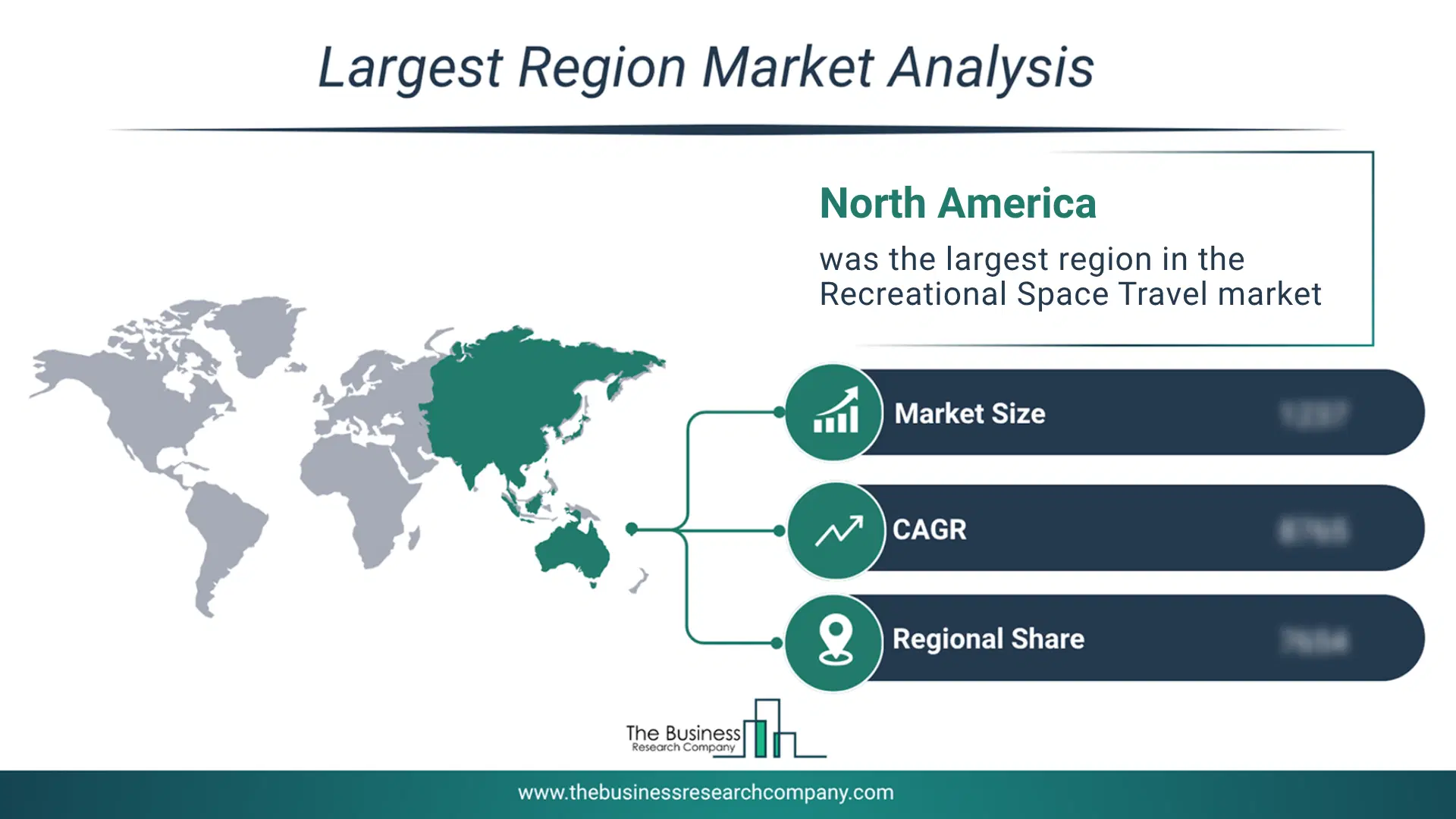
Regional Outlook
North America was the largest region in the recreational space travel market in 2025. The regions covered in this market report are Asia-Pacific, South East Asia, Western Europe, Eastern Europe, North America, South America, Middle East, Africa The countries covered in this market report are Australia, Brazil, China, France, Germany, India, Indonesia, Japan, Taiwan, Russia, South Korea, UK, USA, Canada, Italy, Spain.What Defines the Recreational Space Travel Market?
The recreational space travel market includes revenues earned by entities by providing services such as space station visits or stays, zero-gravity experiences, astronaut training and pre-flight experiences, media and entertainment services from space, and associated luxury services. The market value includes the value of related goods sold by the service provider or included within the service offering. Only goods and services traded between entities or sold to end consumers are included.How is Market Value Defined and Measured?
The market value is defined as the revenues that enterprises gain from the sale of goods and/or services within the specified market and geography through sales, grants, or donations in terms of the currency (in USD unless otherwise specified). The revenues for a specified geography are consumption values that are revenues generated by organizations in the specified geography within the market, irrespective of where they are produced. It does not include revenues from resales along the supply chain, either further along the supply chain or as part of other products.
This chart presents market attractiveness based on a quantitative evaluation of growth, competition, strategic alignment, and risk, offering a clear view of opportunity areas for decision-making. This chart is for illustrative purposes; the full report contains the complete analysis.

This chart highlights the Total Addressable Market (TAM) by estimating the maximum revenue opportunity using an assumption-driven approach, supporting strategic planning and opportunity sizing across markets. The chart is illustrative; the full report provides a more comprehensive analysis.
What Key Data and Analysis Are Included in the Recreational Space Travel Market Report 2026?
The recreational space travel market research report is one of a series of new reports from The Business Research Company that provides market statistics, including Market Report 2026?global market size, regional shares, competitors with the market share, detailed market segments, market trends and opportunities, and any further data you may need to thrive in the recreational space travel Market Report 2026? The market research report delivers a complete perspective of everything you need, with an in-depth analysis of the current and future state of the Market Report 2026?Recreational Space Travel Market Report Forecast Analysis
| Report Attribute | Details |
|---|---|
| Market Size Value In 2026 | $1.69 billion |
| Revenue Forecast In 2030 | $3.26 billion |
| Growth Rate | CAGR of 18.2% from 2026 to 2030 |
| Base Year For Estimation | 2025 |
| Actual Estimates/Historical Data | 2020-2025 |
| Forecast Period | 2026 - 2030 |
| Market Representation | Revenue in USD Billion and CAGR from 2026 to 2030 |
| Segments Covered | Type Of Space Travel, Purpose Of Travel, Travel Mode |
| Regional Scope | Asia-Pacific, Western Europe, Eastern Europe, North America, South America, Middle East, Africa |
| Country Scope | The countries covered in the report are Australia, Brazil, China, France, Germany, India, Indonesia, Japan, Taiwan, Russia, South Korea, UK, USA, Canada, Italy, Spain. |
| Key Companies Profiled | Virgin Galactic Holdings Inc., Blue Origin L.P., Space Exploration Technologies Corp., Axiom Space Inc., Space Adventures Inc., HALO Space S.L., Zephalto SAS, World View Enterprises Inc., Zero 2 Infinity S.L., PD Aerospace Ltd., Orion Span Inc., Orbital Assembly Corporation, RocketBreaks Ltd., Space Perspective Inc., EOS-X Space, Inspiration4 Foundation, Bigelow Aerospace, Celestis Inc., SpaceVIP, AstroForge Travel |
| Customization Scope | Request for Customization |
| Pricing And Purchase Options | Explore Purchase Options |