
Remote towers Market Report 2026
Global Outlook – By Operation Type (Single, Multiple, Contingency), By System Type (Airport Equipment, Remote Tower Module, Network Solution), By Application (Communication, Information And Control, Flight Data Handling, Surveillance, Visualization), By End User (Military Airport, Commercial Airport) – Market Size, Trends, Strategies, and Forecast to 2030
Remote towers Market Overview
• Remote towers market size has reached to $0.41 billion in 2025 • Expected to grow to $0.82 billion in 2030 at a compound annual growth rate (CAGR) of 14.7% • Growth Driver: Air Passenger Traffic Surge A Catalyst For Remote-Tower Market Expansion • Market Trend: Revolutionizing Remote Towers With Technological Advancements • Asia-Pacific was the largest region in 2025.What Is Covered Under Remote towers Market?
Remote towers are systems that enable the provision of aerodrome air traffic control (ATC) or flight information service (FIS) from a location other than the aerodrome while maintaining an operational safety level comparable to that possible using a manned tower at the aerodrome to monitor both air and ground movements. This technology has numerous safety advantages, such as viewing tools that improve air traffic controllers' situational awareness. The main types of systems of remote towers include airport equipment and remote tower module and network solution. Airport equipment includes an engine, propeller, appliance, and all records and documents pertaining to such equipment that are required to be surrendered or returned under the terms of any applicable security agreement, lease, or contract. They are operated in various types such as single, multiple, and contingency for applications in communication, information and control, flight data handling, surveillance, and visualization for use in end-users such as military airports and commercial airports.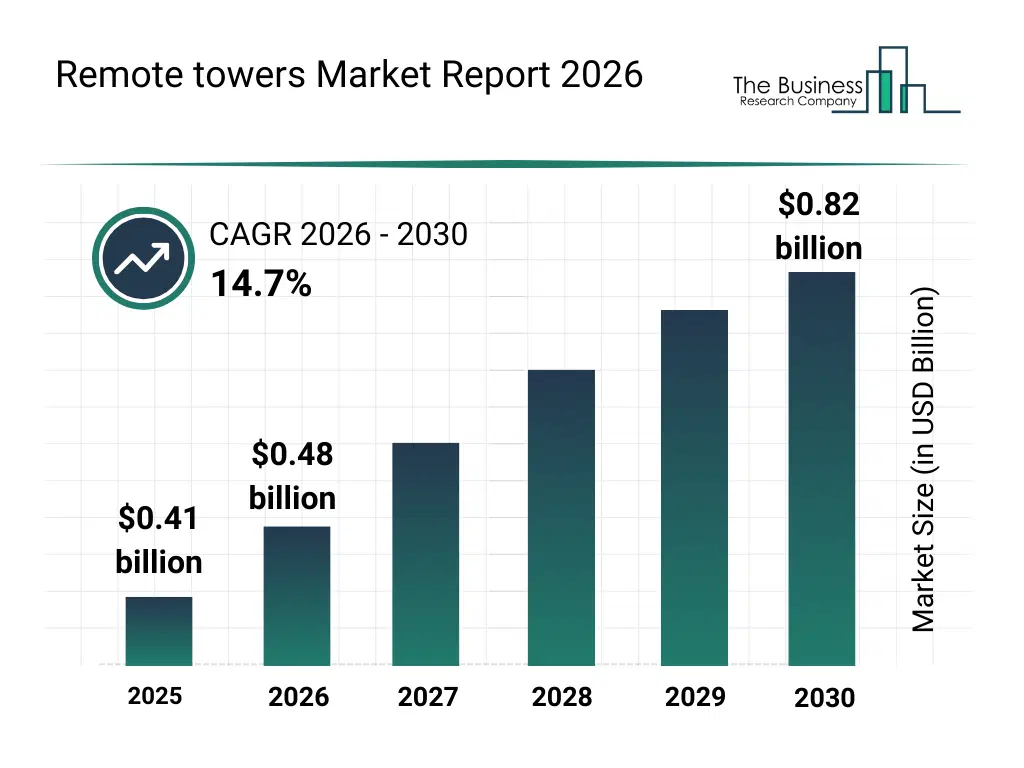
What Is The Remote towers Market Size and Share 2026?
The remote towers market size has grown rapidly in recent years. It will grow from $0.41 billion in 2025 to $0.48 billion in 2026 at a compound annual growth rate (CAGR) of 15.8%. The growth in the historic period can be attributed to expansion of regional and low-traffic airports, rising air traffic management modernization initiatives, early adoption of digital ATC technologies, increasing focus on operational cost optimization, availability of high-speed communication networks.What Is The Remote towers Market Growth Forecast?
The remote towers market size is expected to see rapid growth in the next few years. It will grow to $0.82 billion in 2030 at a compound annual growth rate (CAGR) of 14.7%. The growth in the forecast period can be attributed to increasing investments in smart airport infrastructure, rising adoption of centralized ATC models, expansion of digital surveillance and visualization tools, growing focus on remote and contingency operations, increasing regulatory acceptance of remote tower systems. Major trends in the forecast period include increasing adoption of remote air traffic control operations, rising deployment of multi-airport remote tower centers, growing integration of advanced visualization systems, expansion of high-availability network solutions, enhanced focus on controller situational awareness.
Global Remote towers Market Segmentation
1) By Operation Type: Single, Multiple, Contingency 2) By System Type: Airport Equipment, Remote Tower Module, Network Solution 3) By Application: Communication, Information And Control, Flight Data Handling, Surveillance, Visualization 4) By End User: Military Airport, Commercial Airport Subsegments: 1) By Single: Single Air Traffic Control Tower Operations, Standalone Remote Tower Operations, Independent Remote Tower Operations 2) By Multiple: Multi-Tower Integrated Operations, Coordinated Remote Tower Operations, Clustered Remote Tower Operations 3) By Contingency: Backup Remote Tower Operations, Emergency Remote Tower Operations, Temporary Remote Tower OperationsWhat Is The Driver Of The Remote towers Market?
The increasing number of passengers flying is expected to propel the growth of the remote-tower market going forward. Flying passenger traffic refers to the transportation of passengers by both aircraft and positioning flights. Remote towers give controllers a clearer and more thorough view of the airport and nearby airspace thanks to modern camera and sensor technology, which can result in safer operations and greater passenger trust. Hence, an increase in air travel is boosting the growth of the market. For instance, in November 2024, according to Eurostat, a Luxembourg-based statistical office of the European Union (EU), in 2023, air travel in the EU rose significantly, with 973 million passengers, marking a 19.3% increase compared to 2022. Therefore, the increasing number of passengers flying is driving the growth of the remote tower industry.Key Players In The Global Remote towers Market
Major companies operating in the remote towers market are Frequentis Group; Indra Sistemas S.A.; Thales Group; Svenska Aeroplan Aktiebolaget; L3Harris Technologies Inc.; Raytheon Technologies Corporation; Leonardo S.p.A; DFS Deutsche Flugsicherung GmbH; Searidge Technologies; RETIA Inc.; Kongsberg Gruppen; Rohde & Schwarz GmbH & Co KG; Altys Technologies; Atech; BAE Systems plc; Era Corporation; HungaroControl; Intelcan Technosystems; Isavia ANS; SkySoft-ATM
This chart is for illustrative purposes; the full report includes a detailed competitor analysis and comprehensive overview of the top 10 companies in the market.
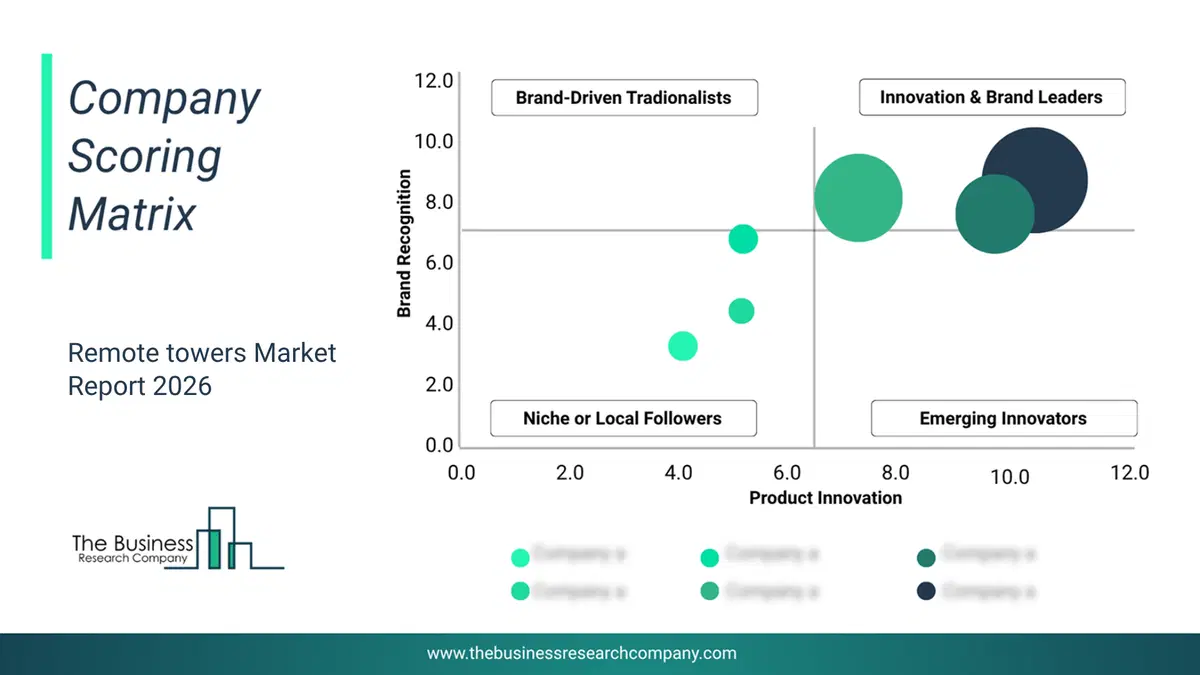
This chart maps companies by product innovation and brand strength, with bubble size indicating relative revenue, helping identify market leaders, challengers, and niche players. This is an illustrative chart; the full report provides a complete and accurate competitive analysis.
Global Remote towers Market Trends and Insights
Major companies operating in the remote towers market are focusing on developing advanced solutions, such as modular deployable towers, to enhance operational flexibility, ensure safety, and support rapid deployment in diverse scenarios. Modular deployable towers refer to digital air traffic control systems that can be quickly set up at permanent or temporary airstrips, providing full operational capabilities while being remotely controlled from secure locations. For instance, in June 2023, Saab AB, a Sweden-based aerospace and defense company, launched a unique r-TWR, a modular, safe, and fast-to-deploy digital tower for adaptable air traffic control operations, in collaboration with Conlog Oy. r-TWR Deployable is a digital tower that can be deployed while offering high availability, mission-to-mission modularity, and flexibility. It can be mission-ready in an hour and can be controlled remotely from a secure position on a base or linked to a centralized center hundreds of miles away, keeping military personnel safe. Some of these qualities may also be useful to foreign relief missions for the quick deployment of such utilities into a disaster-affected country. The r-TWR Deployable provides everything required for air traffic control at a permanent or temporary touchdown strip and can be carried quickly by rail or road on one or two standardized trailers, or in a cargo aircraft the size of a C-130 Hercules. Conlog Oy is a Finland-based company of principal defense systems integrators.What Are Latest Mergers And Acquisitions In The Remote towers Market?
In October 2023, Indra Sistemas S.A., a Spain-based information technology and defense systems company, acquired Park Air Systems Ltd for an undisclosed amount. Through this acquisition, Indra strengthens its air traffic management (ATM) and communication capabilities by integrating Park Air’s advanced ground-to-air radio communication systems into its portfolio. The acquisition enhances Indra’s position as a global leader in ATM solutions, supporting modernization and digitalization efforts within air traffic control infrastructure, including technologies that enable remote and virtual tower operations. Park Air Systems Ltd is a UK-based company specializing in ground-to-air radio systems for civil and military air traffic management.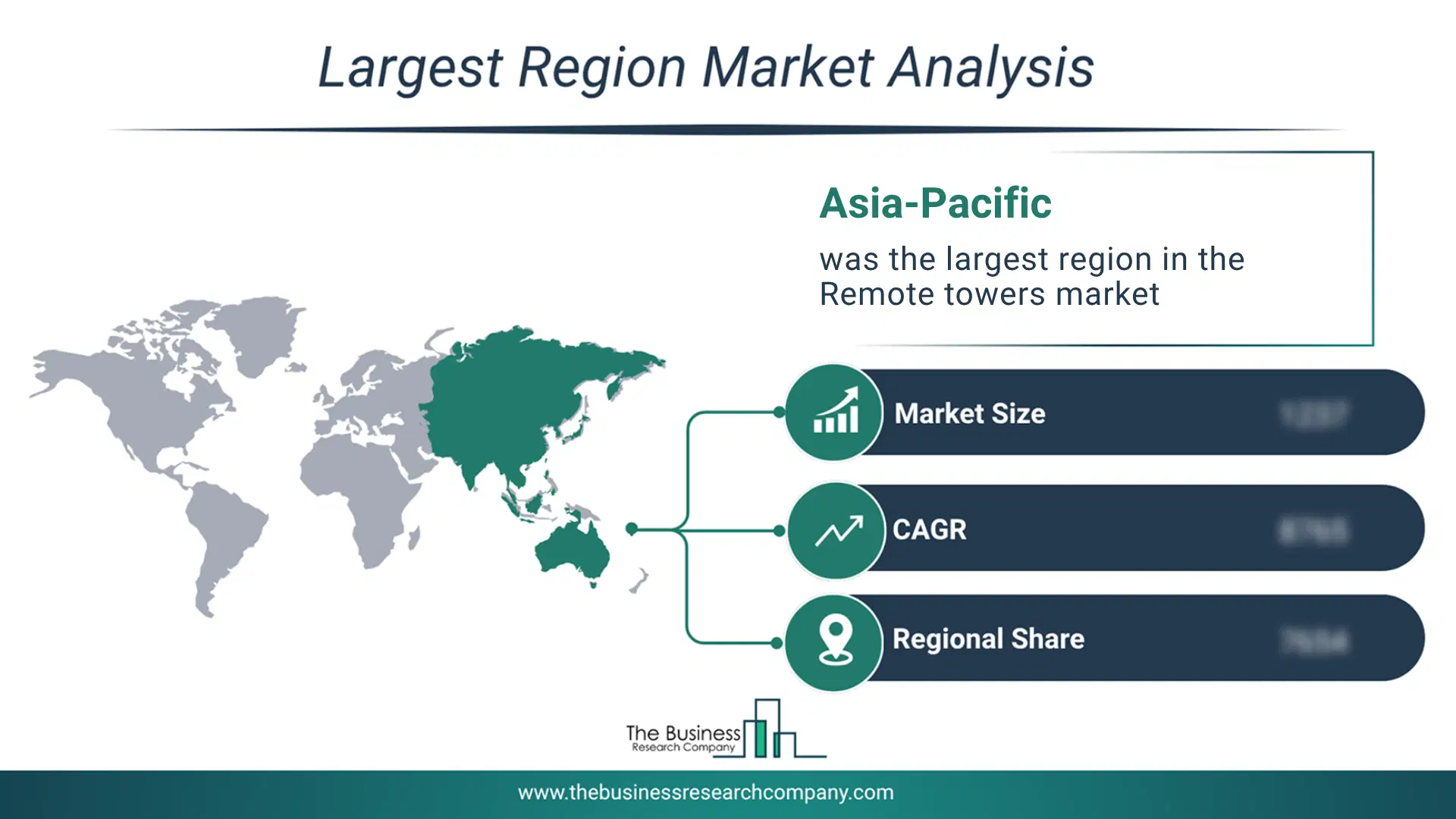
Regional Insights
Asia-Pacific was the largest region in the remote towers market in 2025 and is expected to be the fastest-growing region in the remote towers market report during the forecast period. The regions covered in this market report are Asia-Pacific, South East Asia, Western Europe, Eastern Europe, North America, South America, Middle East, Africa. The countries covered in this market report are Australia, Brazil, China, France, Germany, India, Indonesia, Japan, Taiwan, Russia, South Korea, UK, USA, Canada, Italy, SpainWhat Defines the Remote towers Market?
The remote towers market includes revenues earned by entities by providing remote monitoring activities, communication, and data handling. The market value includes the value of related goods sold by the service provider or included within the service offering. The remote towers market also includes the sales of virtual remote towers and mobile remote towers which are used in providing remote tower services. Values in this market are ‘factory gate’ values, that is the value of goods sold by the manufacturers or creators of the goods, whether to other entities (including downstream manufacturers, wholesalers, distributors, and retailers) or directly to end customers. The value of goods in this market includes related services sold by the creators of the goods.How is Market Value Defined and Measured?
The market value is defined as the revenues that enterprises gain from the sale of goods and/or services within the specified market and geography through sales, grants, or donations in terms of the currency (in USD unless otherwise specified). The revenues for a specified geography are consumption values that are revenues generated by organizations in the specified geography within the market, irrespective of where they are produced. It does not include revenues from resales along the supply chain, either further along the supply chain or as part of other products.
This chart presents market attractiveness based on a quantitative evaluation of growth, competition, strategic alignment, and risk, offering a clear view of opportunity areas for decision-making. This chart is for illustrative purposes; the full report contains the complete analysis.

This chart highlights the Total Addressable Market (TAM) by estimating the maximum revenue opportunity using an assumption-driven approach, supporting strategic planning and opportunity sizing across markets. The chart is illustrative; the full report provides a more comprehensive analysis.
What Key Data and Analysis Are Included in the Remote towers Market Report 2026?
The remote towers market research report is one of a series of new reports from The Business Research Company that provides market statistics, including industry global market size, regional shares, competitors with the market share, detailed market segments, market trends and opportunities, and any further data you may need to thrive in the remote towers industry. The market research report delivers a complete perspective of everything you need, with an in-depth analysis of the current and future state of the industry.Remote towers Market Report Forecast Analysis
| Report Attribute | Details |
|---|---|
| Market Size Value In 2026 | $0.48 billion |
| Revenue Forecast In 2030 | $0.82 billion |
| Growth Rate | CAGR of 14.7% from 2026 to 2030 |
| Base Year For Estimation | 2025 |
| Actual Estimates/Historical Data | 2020-2025 |
| Forecast Period | 2026 - 2030 |
| Market Representation | Revenue in USD Billion and CAGR from 2026 to 2030 |
| Segments Covered | Operation Type, System Type, Application, End User |
| Regional Scope | Asia-Pacific, Western Europe, Eastern Europe, North America, South America, Middle East, Africa |
| Country Scope | The Countries Covered In This Market Report Are Australia, Brazil, China, France, Germany, India, Indonesia, Japan, Taiwan, Russia, South Korea, Uk, Usa, Canada, Italy, Spain. |
| Key Companies Profiled | Frequentis Group, Indra Sistemas S.A., Thales Group, Svenska Aeroplan Aktiebolaget, L3Harris Technologies Inc., Raytheon Technologies Corporation, Leonardo S.p.A, DFS Deutsche Flugsicherung GmbH, Searidge Technologies, RETIA Inc., Kongsberg Gruppen, Rohde & Schwarz GmbH & Co KG, Altys Technologies, Atech, BAE Systems plc, Era Corporation, HungaroControl, Intelcan Technosystems, Isavia ANS, SkySoft-ATM |
| Customization Scope | Request for Customization |
| Pricing And Purchase Options | Explore Purchase Options |