
Remotely Piloted Aircraft System Market Report 2026
Global Outlook – By Type (Fixed-Wing, Rotary-Wing, Hybrid), By Component (Airframe, Payload, Avionics, Ground Control Station, Data Link, Software, Other Components), By Level of Autonomy (Remotely Operated, Semi-Autonomous), By Application (Intelligence, Surveillance, And Reconnaissance, Mapping And Surveying, Agriculture And Precision Farming, Logistics And Delivery, Disaster Management, Infrastructure Inspection, Environmental Monitoring, Media And Entertainment), By End-User (Government, Commercial, Consumer) – Market Size, Trends, Strategies, and Forecast to 2035
Remotely Piloted Aircraft System Market Overview
• Remotely Piloted Aircraft System market size has reached to $19.21 billion in 2025 • Expected to grow to $34.63 billion in 2030 at a compound annual growth rate (CAGR) of 12.6% • Growth Driver: The Increasing Defense Modernization Programs The Growth Of The Market Due To Rising Geopolitical Tensions • Market Trend: Expansion Of Autonomous Rotorcraft Technologies To Improve Operational Efficiency And Mission Flexibility • North America was the largest region in 2025 and Asia-Pacific is the fastest growing region.What Is Covered Under Remotely Piloted Aircraft System Market?
A remotely piloted aircraft system (RPAS) is an unmanned aircraft system that is controlled by a human pilot from a remote location rather than being operated onboard. It typically consists of the aircraft, a ground control station, and a communication link that enables real-time command and control. This system designed to operate safely in the airspace with continuous human oversight, even though the pilot is not physically present in the aircraft. The main types of remotely piloted aircraft system include fixed-wing, rotary-wing, and hybrid. Fixed-wing refers to aircraft designed with rigid wings that generate lift through forward motion, making them suitable for long-range and endurance missions. These systems are categorized by components such as airframe, payload, avionics, ground control station, data link, software, and other components and operate at levels of autonomy including remotely operated, and semi-autonomous. The various applications involved are intelligence, surveillance, and reconnaissance, mapping and surveying, agriculture and precision farming, logistics and delivery, disaster management, infrastructure inspection, environmental monitoring, and media and entertainment, and they are used by several end users such as government, commercial, and consumer.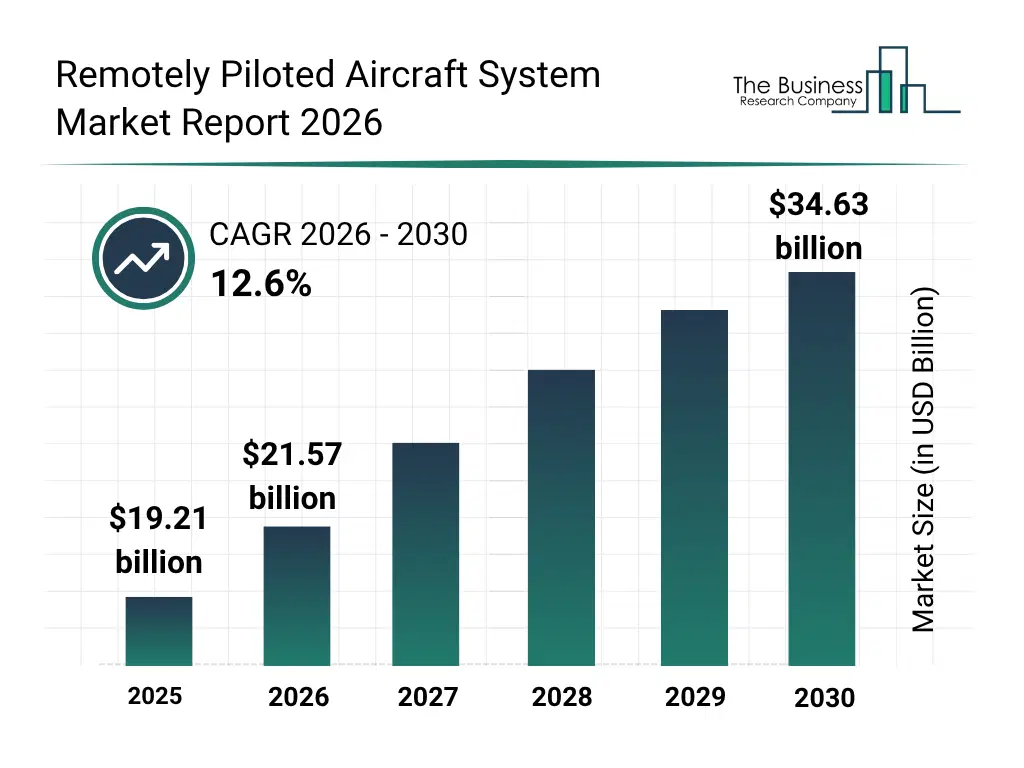
What Is The Remotely Piloted Aircraft System Market Size and Share 2026?
The remotely piloted aircraft system market size has grown rapidly in recent years. It will grow from $19.21 billion in 2025 to $21.57 billion in 2026 at a compound annual growth rate (CAGR) of 12.3%. The growth in the historic period can be attributed to military adoption of unmanned aerial systems for surveillance and reconnaissance, growth in aerial photography and media applications, advancements in gps and remote control technologies, increasing demand for cost effective alternatives to manned aircraft, expansion of commercial drone regulations enabling broader usage.What Is The Remotely Piloted Aircraft System Market Growth Forecast?
The remotely piloted aircraft system market size is expected to see rapid growth in the next few years. It will grow to $34.63 billion in 2030 at a compound annual growth rate (CAGR) of 12.6%. The growth in the forecast period can be attributed to rising demand for autonomous and semi autonomous aerial systems, increasing adoption in logistics and delivery ecosystems, growth in precision agriculture and smart farming applications, expansion of smart city infrastructure requiring aerial monitoring, continuous advancements in battery efficiency and lightweight materials. Major trends in the forecast period include increasing adoption of AI enabled flight control systems improving rpas navigation precision and mission efficiency, rising integration of advanced sensor fusion and payload technologies for enhanced surveillance and mapping capabilities, growing demand for long endurance and beyond visual line of sight operations supporting commercial and defense use cases, expansion of drone based logistics and last mile delivery services driven by e commerce growth, increasing use of rpas for infrastructure inspection and predictive maintenance across critical assets.
Global Remotely Piloted Aircraft System Market Segmentation
1) By Type: Fixed-Wing, Rotary-Wing, Hybrid 2) By Component: Airframe, Payload, Avionics, Ground Control Station, Data Link, Software, Other Components 3) By Level of Autonomy: Remotely Operated, Semi-Autonomous 4) By Application: Intelligence, Surveillance, And Reconnaissance, Mapping And Surveying, Agriculture And Precision Farming, Logistics And Delivery, Disaster Management, Infrastructure Inspection, Environmental Monitoring, Media And Entertainment 5) By End-User: Government, Commercial, Consumer Subsegments: 1) By Fixed-Wing: Small Fixed Wing Systems, Medium Fixed Wing Systems, Large Fixed Wing Systems, Long Endurance Fixed Wing Systems, Short Range Fixed Wing Systems 2) By Rotary-Wing: Single Rotor Systems, Multi Rotor Systems, Coaxial Rotor Systems, Helicopter Type Systems, Micro Rotary Wing Systems 3) By Hybrid: Vertical Takeoff And Landing Hybrid Systems, Tilt Rotor Hybrid Systems, Fixed Wing Vertical Lift Systems, Convertible Hybrid Systems, Dual Mode Hybrid SystemsWhat Is The Driver Of The Remotely Piloted Aircraft System Market?
The increasing defense modernization programs are expected to support the growth of the remotely piloted aircraft system market going forward. Defense modernization programs refer to structured government initiatives aimed at upgrading and enhancing military capabilities through the adoption of advanced technologies, improved equipment, and updated operational systems to maintain strategic readiness and effectiveness. These programs are expanding primarily due to rising geopolitical tensions, which are prompting nations to strengthen their military capabilities. Defense modernization programs contribute to the growth of remotely piloted aircraft systems by accelerating the integration of advanced unmanned technologies, improving surveillance and combat capabilities, and enhancing real-time intelligence, precision strike, and overall operational efficiency across defense forces. For instance, in March 2023, according to the European Security and Defense College, a Belgium-based autonomous institution, the ongoing U.S. Army modernization program is expected to field 35 new future force systems by 2030, forming the core of more than 500 development, acquisition, or upgrade initiatives. Therefore, defense modernization and procurement spending are driving the growth of the defense equipment market.Key Players In The Global Remotely Piloted Aircraft System Market
Major companies operating in the remotely piloted aircraft system market are Thales Group, General Atomics Aeronautical Systems Inc., Quantum-Systems GmbH, Terra Drone Corporation, Microdrones GmbH, Skydio Inc., Wingtra AG, Flyability SA, BRINC Drones Inc., Delair SAS, Freefly Systems Inc., Flybotix SA, Asteria Aerospace Limited, Skyfront Inc., Vantage Robotics Inc., Elistair SAS, Sky-Drones Technologies Ltd., Fixar Global Inc., Autel Robotics Co. Ltd., ideaForge Technology LimitedGlobal Remotely Piloted Aircraft System Market Trends and Insights
Major companies operating in the remotely piloted aircraft system market are focusing on strategic initiatives such as establishing dedicated unmanned aviation units to accelerate the development of autonomous flight technologies and expand their presence across defense and commercial applications. Unmanned helicopter systems are rotorcraft that operate without an onboard pilot, using remote control or autonomous technologies to perform missions such as surveillance, transport, and inspection. For instance, in March 2026, Robinson Helicopter Company, a US-based manufacturing company, announced the establishment of Robinson Unmanned, a new business unit dedicated to the development and support of a full suite of remotely piloted and autonomous aircraft. The initiative marks the company’s strategic expansion beyond conventional helicopter manufacturing into next-generation unmanned and autonomous aviation technologies for commercial and defense applications. This development enables the company to diversify its portfolio by integrating advanced flight autonomy, unmanned operations, and scalable rotorcraft solutions for a wide range of mission requirements.What Are Latest Mergers And Acquisitions In The Remotely Piloted Aircraft System Market?
In September 2023, Anduril Industries Inc., a US-based defense technology company acquired Blue Force Technologies Inc. for an undisclosed amount. Through this acquisition, Anduril aims to enhance its autonomous air combat capabilities by integrating Blue Force Technologies’ advanced unmanned aircraft design expertise and expanding its portfolio of high-performance AI-enabled military drone systems. Blue Force Technologies Inc. is a US-based company that develops remotely piloted aircraft systems (RPAS).Regional Outlook/Insights
North America was the largest region in the remotely piloted aircraft system market in 2025. Asia-Pacific is expected to be the fastest-growing region in the forecast period. The regions covered in this market report are Asia-Pacific, South East Asia, Western Europe, Eastern Europe, North America, South America, Middle East, Africa. The countries covered in this market report are Australia, Brazil, China, France, Germany, India, Indonesia, Japan, Taiwan, Russia, South Korea, UK, USA, Canada, Italy, Spain.What Defines the Remotely Piloted Aircraft System Market?
The remotely piloted aircraft system market consists of revenues earned by entities by providing services such as pilot training, maintenance and repair, leasing of drones, fleet management, and insurance services. The market value includes the value of related goods sold by the service provider or included within the service offering. The remotely piloted aircraft system market also includes sales of propellers and rotor blades, electric propulsion motors, high-capacity flight batteries, landing gear assemblies, and spare parts kits. Values in this market are ‘factory gate’ values, that is the value of goods sold by the manufacturers or creators of the goods, whether to other entities (including downstream manufacturers, wholesalers, distributors and retailers) or directly to end customers. The value of goods in this market includes related services sold by the creators of the goods.How is Market Value Defined and Measured?
The market value is defined as the revenues that enterprises gain from the sale of goods and/or services within the specified market and geography through sales, grants, or donations in terms of the currency (in USD unless otherwise specified). The revenues for a specified geography are consumption values that are revenues generated by organizations in the specified geography within the market, irrespective of where they are produced. It does not include revenues from resales along the supply chain, either further along the supply chain or as part of other products.What Key Data and Analysis Are Included in the Remotely Piloted Aircraft System Market Report 2026?
The remotely piloted aircraft system market research report is one of a series of new reports from The Business Research Company that provides market statistics, including industry global market size, regional shares, competitors with the market share, detailed market segments, market trends and opportunities, and any further data you may need to thrive in the remotely piloted aircraft system industry. The market research report delivers a complete perspective of everything you need, with an in-depth analysis of the current and future state of the industry.Remotely Piloted Aircraft System Market Report Forecast Analysis
| Report Attribute | Details |
|---|---|
| Market Size Value In 2026 | $21.57 billion |
| Revenue Forecast In 2035 | $34.63 billion |
| Growth Rate | CAGR of 12.6% from 2026 to 2035 |
| Base Year For Estimation | 2025 |
| Actual Estimates/Historical Data | 2020-2025 |
| Forecast Period | 2026 - 2030 - 2035 |
| Market Representation | Revenue in USD Billion and CAGR from 2026 to 2035 |
| Segments Covered | Type, Component, Level of Autonomy, Application, End-User |
| Regional Scope | Asia-Pacific, Western Europe, Eastern Europe, North America, South America, Middle East, Africa |
| Country Scope | The countries covered in the report are Australia, Brazil, China, France, Germany, India, Indonesia, Japan, Taiwan, Russia, South Korea, UK, USA, Canada, Italy, Spain. |
| Key Companies Profiled | Thales Group, General Atomics Aeronautical Systems Inc., Quantum-Systems GmbH, Terra Drone Corporation, Microdrones GmbH, Skydio Inc., Wingtra AG, Flyability SA, BRINC Drones Inc., Delair SAS, Freefly Systems Inc., Flybotix SA, Asteria Aerospace Limited, Skyfront Inc., Vantage Robotics Inc., Elistair SAS, Sky-Drones Technologies Ltd., Fixar Global Inc., Autel Robotics Co. Ltd., ideaForge Technology Limited |
| Customization Scope | Request for Customization |
| Pricing And Purchase Options | Explore Purchase Options |