
Resistance Welding Equipment For Electric Vehicle (EV) Battery Market Report 2026
Global Outlook – By Type (Spot Welding Equipment, Projection Welding Equipment, Other Types), By Technology (Semi-Automatic, Fully Automatic), By Application (Battery Module Assembly, Cell-to-Cell Welding, Busbar Welding, Other Applications ), By End-User (Automotive Original Equipment Manufacturers (OEMs), Battery Manufacturers, Other End-Users) – Market Size, Trends, Strategies, and Forecast to 2030
Resistance Welding Equipment For Electric Vehicle (EV) Battery Market Overview
• Resistance Welding Equipment For Electric Vehicle (EV) Battery market size has reached to $1.6 billion in 2025 • Expected to grow to $2.7 billion in 2030 at a compound annual growth rate (CAGR) of 10.9% • Growth Driver: Rising Adoption Of Electric Vehicles Fueling The Growth Of The Due To Increasing Demand For Efficient And Reliable Battery Assembly Solutions • Market Trend: Advancements In Welding Technologies Enhancing Precision And Efficiency In EV Battery Production • North America was the largest region in 2025 and Asia-Pacific is the fastest growing region.What Is Covered Under Resistance Welding Equipment For Electric Vehicle (EV) Battery Market?
Resistance welding equipment for electric vehicle (EV) batteries refers to specialized machinery designed to join battery components by applying pressure and passing electric current through the materials to generate heat at the contact point. This process creates strong, reliable, and consistent bonds without the need for additional materials like solder or adhesives. It is essential for ensuring the structural integrity, electrical conductivity, and performance efficiency of electric vehicle battery assemblies. The main types of resistance welding equipment for electric vehicle (EV) battery are spot welding equipment, seam welding equipment, projection welding equipment, flash welding equipment, and others. Spot welding equipment is primarily used to join multiple metal sheets by applying pressure and heat generated from an electric current at precise points. Based on technology, these systems are classified into manual, semi-automatic, and fully automatic. Major applications include battery module assembly, cell-to-cell welding, busbar welding, and others, serving users such as automotive original equipment manufacturers (OEMS), battery manufacturers, and others.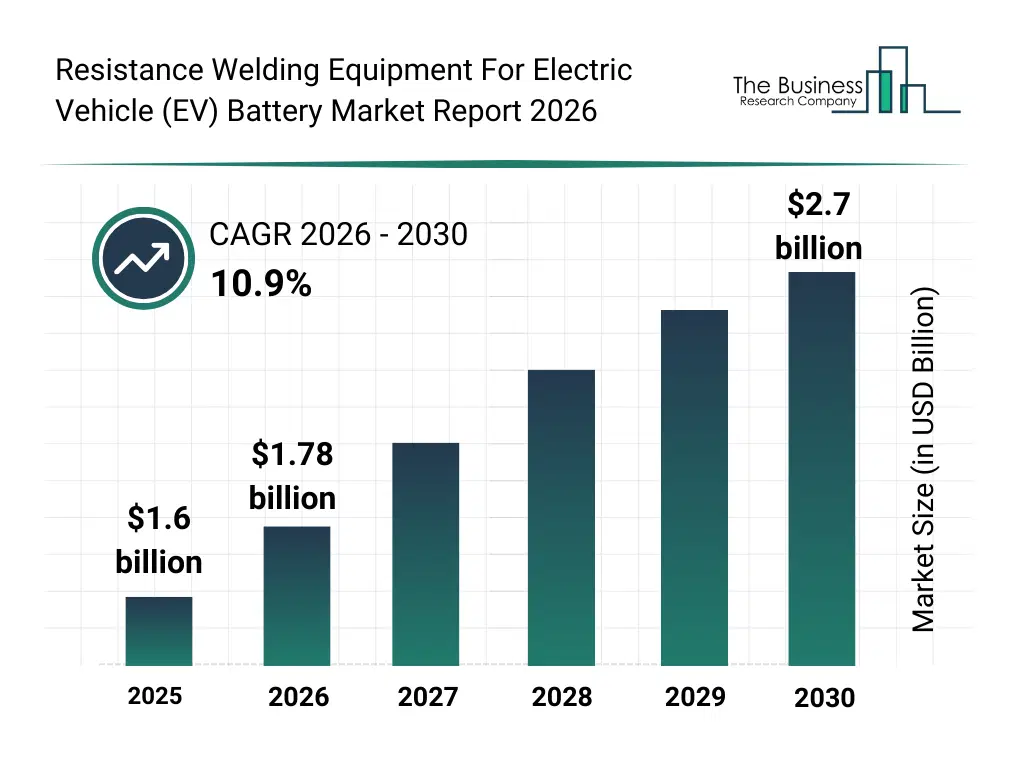
What Is The Resistance Welding Equipment For Electric Vehicle (EV) Battery Market Size and Share 2026?
The resistance welding equipment for electric vehicle (ev) battery market size has grown rapidly in recent years. It will grow from $1.6 billion in 2025 to $1.78 billion in 2026 at a compound annual growth rate (CAGR) of 11.2%. The growth in the historic period can be attributed to expansion of electric vehicle manufacturing, growth in lithium-ion battery production, increasing investments in battery gigafactories, availability of automated welding technologies, rising quality standards in battery assembly.What Is The Resistance Welding Equipment For Electric Vehicle (EV) Battery Market Growth Forecast?
The resistance welding equipment for electric vehicle (ev) battery market size is expected to see rapid growth in the next few years. It will grow to $2.7 billion in 2030 at a compound annual growth rate (CAGR) of 10.9%. The growth in the forecast period can be attributed to increasing global EV adoption, expansion of next-generation battery technologies, rising demand for lightweight battery designs, growing automation in automotive manufacturing, focus on high-throughput production systems. Major trends in the forecast period include increasing automation of battery welding lines, rising demand for high-precision joining technologies, expansion of servo-controlled welding systems, growing focus on weld quality and consistency, integration of smart monitoring systems.Tariff Impact On Resistance Welding Equipment For Electric Vehicle (EV) Battery Market
Tariffs are impacting the resistance welding equipment for EV battery market by increasing costs of imported power electronics, copper components, transformers, robotic systems, and control software. Automotive OEMs and battery manufacturers in North America, Europe, and Asia-Pacific are most affected due to dependence on specialized global suppliers. These tariffs are increasing production line setup costs and influencing sourcing strategies. At the same time, they are encouraging domestic manufacturing of welding equipment, regional technology partnerships, and innovation in cost-efficient and scalable battery welding solutions.
Global Resistance Welding Equipment For Electric Vehicle (EV) Battery Market Segmentation
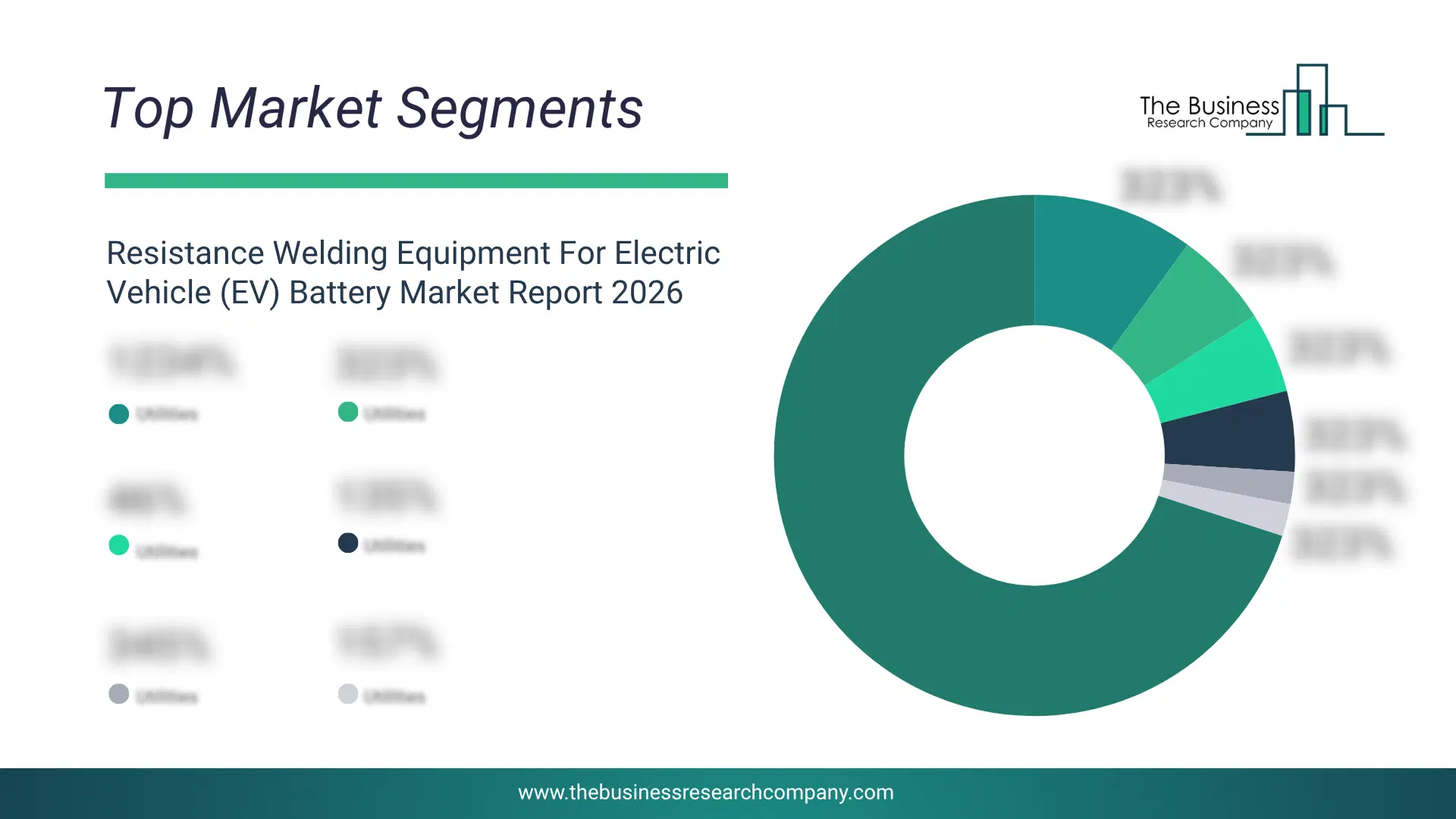
1) By Type: Spot Welding Equipment, Projection Welding Equipment, Other Types 2) By Technology: Semi-Automatic, Fully Automatic 3) By Application: Battery Module Assembly, Cell-to-Cell Welding, Busbar Welding, Other Applications 4) By End-User: Automotive Original Equipment Manufacturers (OEMs), Battery Manufacturers, Other End-Users Subsegments: 1) By Spot Welding Equipment: Manual Spot Welding Machines, Robotic Spot Welding Systems, Portable Spot Welders, Multi-Spot Welding Systems, Servo-Controlled Spot Welders 2) By Projection Welding Equipment: Nut And Bolt Projection Welders, Multi-Projection Welding Systems, Capacitor Discharge Projection Welders, Hydraulic Projection Welders, Automated Projection Welding Cells 3) By Other Types: Micro Resistance Welding Equipment, Customized Hybrid Resistance Welding SystemsWhat Is The Driver Of The Resistance Welding Equipment For Electric Vehicle (EV) Battery Market?
The increasing adoption of electric vehicles (EVs) is expected to propel the growth of the resistance welding equipment for electric vehicle (EV) battery market going forward. An electric vehicle (EV) is a mode of transportation powered entirely or primarily by electricity, utilizing electric motors instead of internal combustion engines. The adoption of electric vehicles is rising due to increasing environmental awareness and government incentives promoting clean and sustainable transportation. Resistance welding equipment for electric vehicle (EV) batteries is used to join battery cells, tabs, and busbars with high precision and strength, ensuring reliable electrical connections and efficient energy transfer within the battery pack of EV batteries. For instance, in April 2024, according to the International Energy Agency (IEA), a France-based intergovernmental organization, the number of new electric car registrations in China reached 8.1 million in 2023, representing a 35% increase compared to 2022. Therefore, the increasing adoption of electric vehicles is driving the growth of the resistance welding equipment for electric vehicle (EV) battery industry.Key Players In The Global Resistance Welding Equipment For Electric Vehicle (EV) Battery Market
Major companies operating in the resistance welding equipment for electric vehicle (ev) battery market are Panasonic Holdings Corporation, Illinois Tool Works Inc., KUKA AG, DAIHEN Corporation, AMADA WELD TECH INC., CenterLine (Windsor) Limited, ARO Welding Technologies SAS, NIMAK GmbH, Obara Corporation, Dengensha Manufacturing Company, TECNA S.p.A., Heron Intelligent Equipment Co. Ltd., T. J. Snow Company Inc., Milco Manufacturing Company Inc., Dai-ichi High Frequency Co., Ltd., Senfeng Laser Technology Co., Ltd., Suzhou Keda Technology Co., Ltd., Guangdong Hwashi Technology Inc., Taylor-Winfield Technologies, Inc., Guangdong Ur Welder Co., Ltd., SKS Welding Systems GmbH, Mechelonic Welding Systems Pvt. Ltd.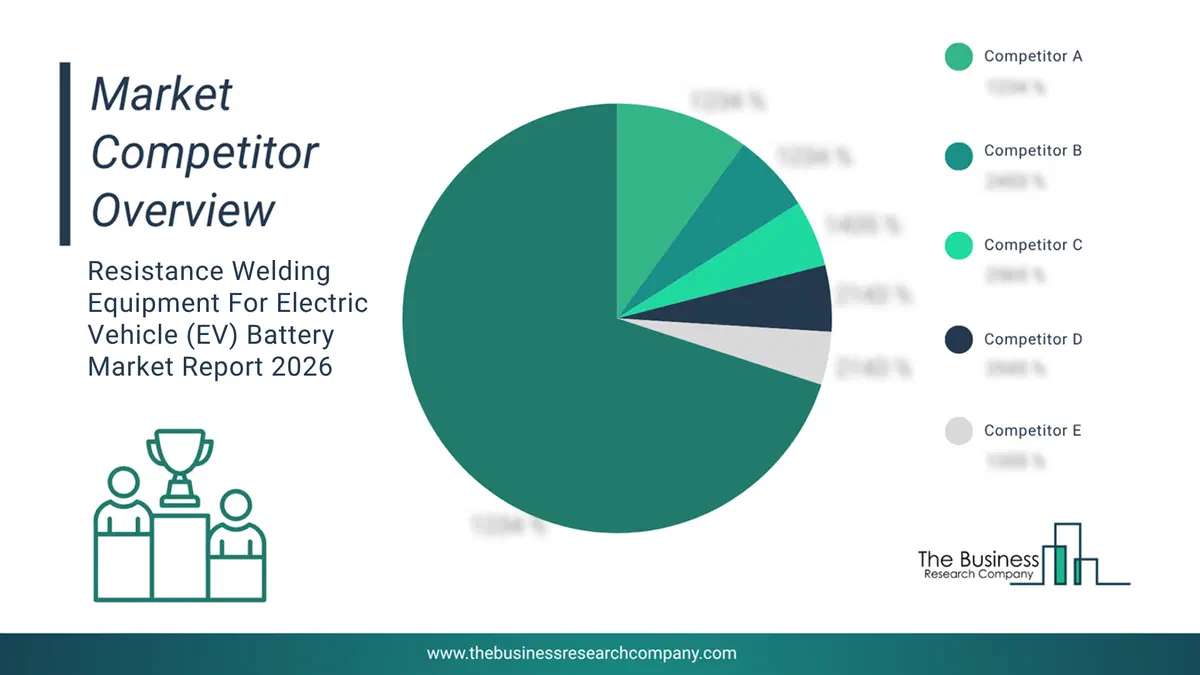
This chart is for illustrative purposes; the full report includes a detailed competitor analysis and comprehensive overview of the top 10 companies in the market.
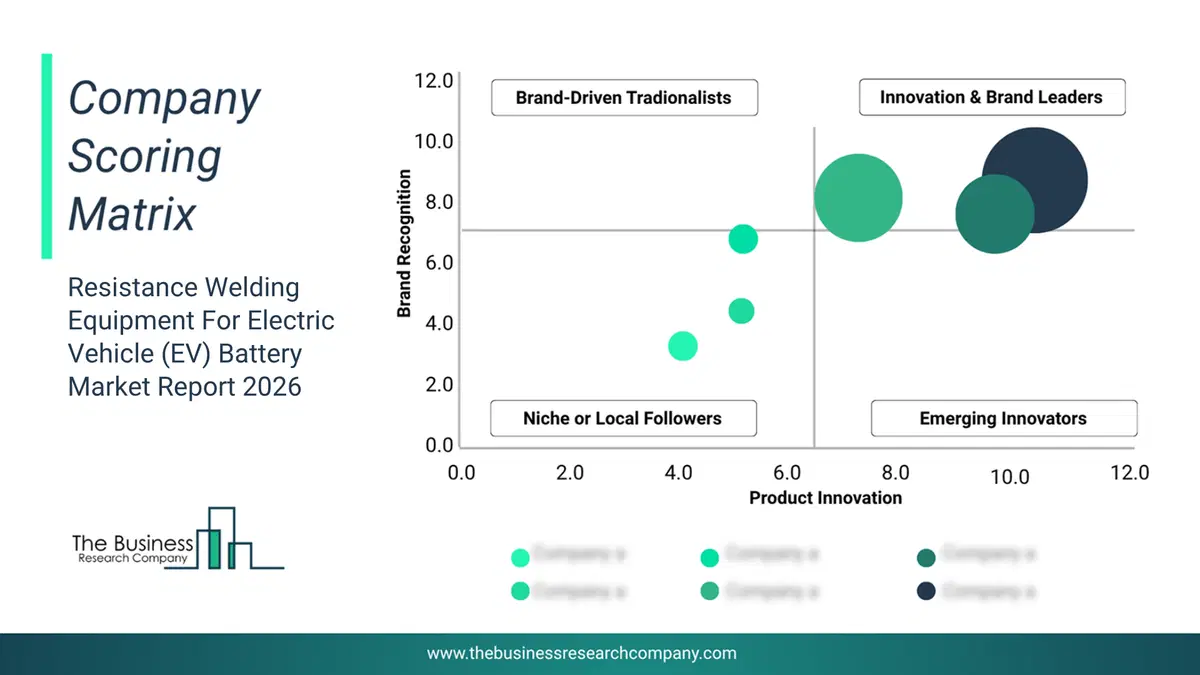
This chart maps companies by product innovation and brand strength, with bubble size indicating relative revenue, helping identify market leaders, challengers, and niche players. This is an illustrative chart; the full report provides a complete and accurate competitive analysis.
Global Resistance Welding Equipment For Electric Vehicle (EV) Battery Market Trends and Insights
Major companies operating in the resistance welding equipment for electric vehicle (EV) battery market are focusing on developing advanced welding technologies to enhance precision, efficiency, and traceability in battery manufacturing and electric mobility applications. Welding technology is the process of joining two or more materials, usually metals or thermoplastics, by applying heat, pressure, or both to form a strong, permanent bond. For instance, in September 2025, AMADA WELD TECH INC., a US-based manufacturer of welding and bonding equipment, showcased its advanced battery and EV welding solutions at The Battery Show 2025 in Detroit. The exhibit features technologies such as the TL-188B-EZ weld head, UB-4000 Linear DC Resistance Welding Power Supply, and WL-300A laser workstation with MM-L400A weld monitor, designed to enhance efficiency, traceability, and weld quality in EV battery manufacturing. Demonstrations also include wire compacting, crimping, and electric motor welding solutions for high-current and traction motor applications, reinforcing AMADA’s commitment to innovation and precision in e-mobility and battery production technologies.What Are Latest Mergers And Acquisitions In The Resistance Welding Equipment For Electric Vehicle (EV) Battery Market?
In January 2023, BMZ Group, a Germany-based battery system manufacturing company, entered into a $12.69 million (€11 million) partnership with AMADA WELD TECH to expand its German production capacity and enhance process efficiency to meet the rapidly growing demand in the global energy storage market. AMADA WELD TECH is a US-based welding technology company that specializes in providing resistance welding systems and automated metal joining solutions for battery manufacturing, automotive, and electronics.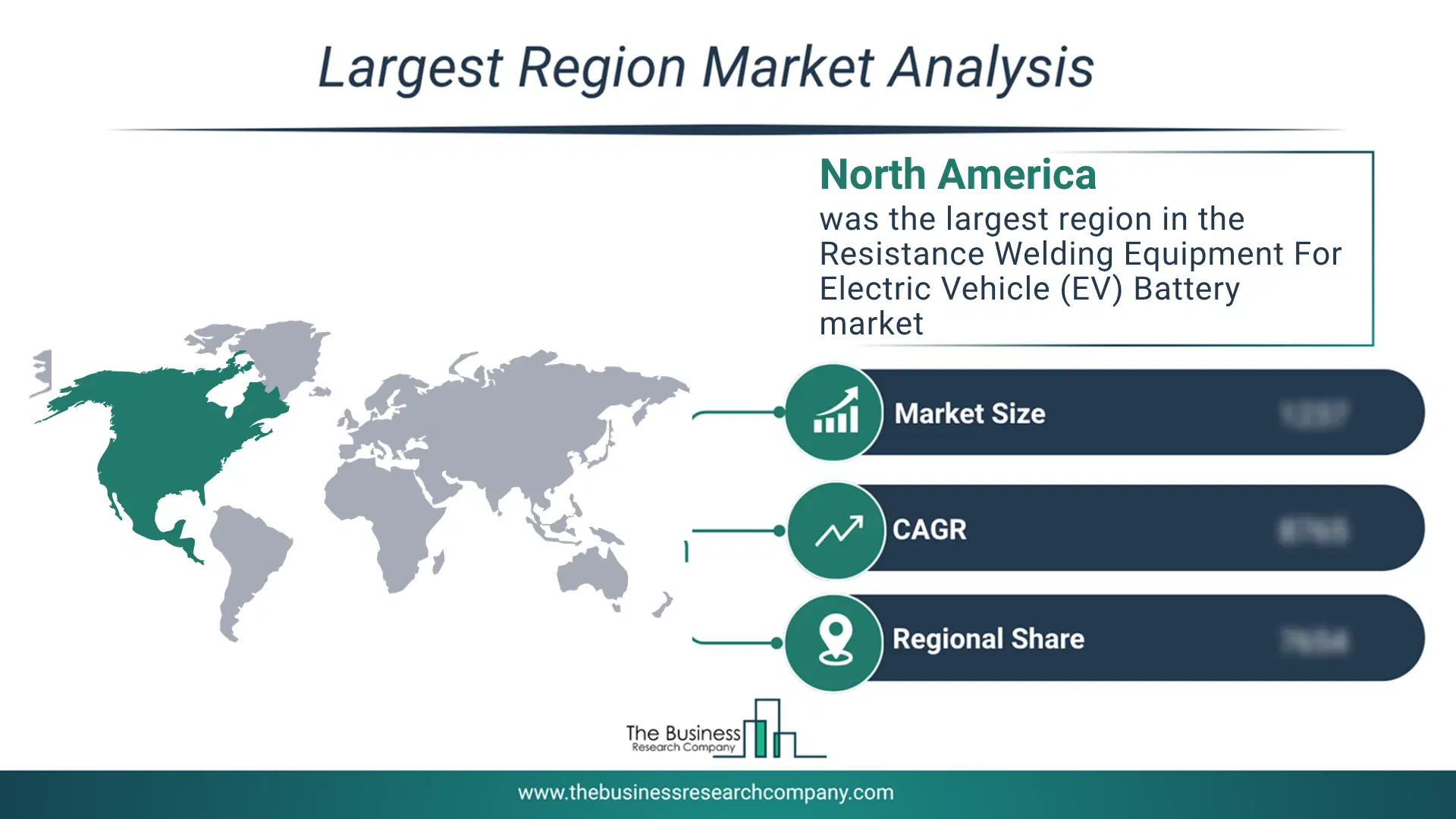
Regional Outlook
North America was the largest region in the resistance welding equipment for electric vehicle (EV) battery market in 2025. Asia-Pacific is expected to be the fastest-growing region in the forecast period. The regions covered in this market report are Asia-Pacific, South East Asia, Western Europe, Eastern Europe, North America, South America, Middle East, Africa The countries covered in this market report are Australia, Brazil, China, France, Germany, India, Indonesia, Japan, Taiwan, Russia, South Korea, UK, USA, Canada, Italy, Spain.What Defines the Resistance Welding Equipment For Electric Vehicle (EV) Battery Market?
The resistance welding equipment for electric vehicle (EV) battery market consists of sales of welding power supplies, weld heads, electrode systems, weld monitors, robotic welding arms, laser processing workstations, welding controllers, and cooling systems. Values in this market are ‘factory gate’s values, that is, the value of goods sold by the manufacturers or creators of the goods, whether to other entities (including downstream manufacturers, wholesalers, distributors, and retailers) or directly to end customers. The value of goods in this market includes related services sold by the creators of the goods.How is Market Value Defined and Measured?
The market value is defined as the revenues that enterprises gain from the sale of goods and/or services within the specified market and geography through sales, grants, or donations in terms of the currency (in USD unless otherwise specified). The revenues for a specified geography are consumption values that are revenues generated by organizations in the specified geography within the market, irrespective of where they are produced. It does not include revenues from resales along the supply chain, either further along the supply chain or as part of other products.
This chart presents market attractiveness based on a quantitative evaluation of growth, competition, strategic alignment, and risk, offering a clear view of opportunity areas for decision-making. This chart is for illustrative purposes; the full report contains the complete analysis.

This chart highlights the Total Addressable Market (TAM) by estimating the maximum revenue opportunity using an assumption-driven approach, supporting strategic planning and opportunity sizing across markets. The chart is illustrative; the full report provides a more comprehensive analysis.
What Key Data and Analysis Are Included in the Resistance Welding Equipment For Electric Vehicle (EV) Battery Market Report 2026?
The resistance welding equipment for electric vehicle (ev) battery market research report is one of a series of new reports from The Business Research Company that provides market statistics, including industry global market size, regional shares, competitors with the market share, detailed market segments, market trends and opportunities, and any further data you may need to thrive in the resistance welding equipment for electric vehicle (ev) battery industry. The market research report delivers a complete perspective of everything you need, with an in-depth analysis of the current and future state of the industry.Resistance Welding Equipment For Electric Vehicle EV Battery Market Report Forecast Analysis
| Report Attribute | Details |
|---|---|
| Market Size Value In 2026 | $1.78 billion |
| Revenue Forecast In 2030 | $2.7 billion |
| Base Year For Estimation | 2025 |
| Actual Estimates/Historical Data | 2020-2025 |
| Forecast Period | 2026 - 2030 |
| Market Representation | Revenue in USD Billion and CAGR from 2026 to 2030 |
| Segments Covered | Type, Technology, Application, End-User |
| Regional Scope | Asia-Pacific, Western Europe, Eastern Europe, North America, South America, Middle East, Africa |
| Key Companies Profiled | Panasonic Holdings Corporation, Illinois Tool Works Inc., KUKA AG, DAIHEN Corporation, AMADA WELD TECH INC., CenterLine (Windsor) Limited, ARO Welding Technologies SAS, NIMAK GmbH, Obara Corporation, Dengensha Manufacturing Company, TECNA S.p.A., Heron Intelligent Equipment Co. Ltd., T. J. Snow Company Inc., Milco Manufacturing Company Inc., Dai-ichi High Frequency Co., Ltd., Senfeng Laser Technology Co., Ltd., Suzhou Keda Technology Co., Ltd., Guangdong Hwashi Technology Inc., Taylor-Winfield Technologies, Inc., Guangdong Ur Welder Co., Ltd., SKS Welding Systems GmbH, Mechelonic Welding Systems Pvt. Ltd. |
| Customization Scope | Request for Customization |
| Pricing And Purchase Options | Explore Purchase Options |