
Resistive Random-Access Memory (ReRAM) Market Report 2026
Global Outlook – By Type ( Conductive Bridging, Oxide Based Resistive Random-Access Memory (ReRAM), Other Types), By Memory ( Embedded, Standalone), By Solution ( Non-Volatile Memory Express Solid-State Drive (NVMe SSD), Non-Volatile Dual In-line Memory Module (NVDIMM)), By Application ( Neuromorphic Computing, Security, Data Storage, Logical), By End-User ( Computer, Internet Of Things (IoT), Consumer Electronics, Medical, Information Technology (IT) And Telecommunications (Telecom), Aerospace And Defense, Other End-Users) – Market Size, Trends, Strategies, and Forecast to 2030
Resistive Random-Access Memory (ReRAM) Market Overview
• Resistive Random-Access Memory (ReRAM) market size has reached to $0.71 billion in 2025 • Expected to grow to $1.46 billion in 2030 at a compound annual growth rate (CAGR) of 15.3% • Growth Driver: The Impact Of Growing Consumer Electronics Demand On The Resistive Random-Access Memory (Reram) Market • Market Trend: Advancements In Non-Volatile Memory Technology Driving Innovation In Consumer Electronics • Asia-Pacific was the largest region in 2025 and North America is the fastest growing region.What Is Covered Under Resistive Random-Access Memory (ReRAM) Market?
Resistive random-access memory (ReRAM) is a type of non-volatile memory technology that stores data by changing the resistance of a material. This memory technology stores data by altering the resistance levels of a material, toggling between high-resistance (HRS) and low-resistance states (LRS). The main types of resistive random-access memory (ReRAM) are conductive bridging, oxide based resistive random-access memory (ReRAM), and others. Conductive bridging refers to a segment of the Resistive RAM market where data storage is achieved by altering material resistance through electrical impulses, forming a conductive path. It has various memories include embedded and standalone and provide various solutions including non-volatile memory express solid-state drive (NVMe SSD) and non-volatile dual in-line memory module (NVDIMM) for neuromorphic computing, security, data storage, logical applications by computer, internet of things (IoT), consumer electronics, medical, information technology (IT) and telecommunications (Telecom), aerospace and defense, and other end-users.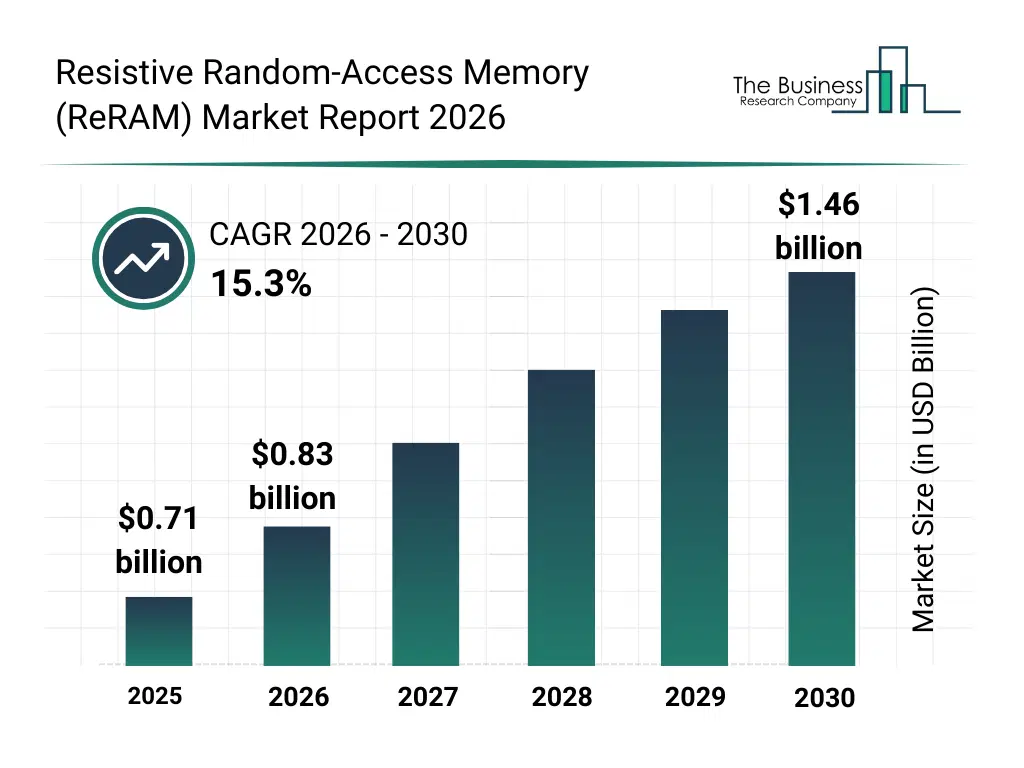
What Is The Resistive Random-Access Memory (ReRAM) Market Size 2026 And Growth Rate?
The resistive random-access memory (reram) market size has grown rapidly in recent years. It will grow from $0.71 billion in 2025 to $0.83 billion in 2026 at a compound annual growth rate (CAGR) of 17.0%. The growth in the historic period can be attributed to scaling limitations of traditional flash memory, increasing demand for non volatile memory solutions, growth in semiconductor research and development, early adoption of emerging memory technologies, rising need for faster data access.What Is The Resistive Random-Access Memory (ReRAM) Market Growth Forecast?
The resistive random-access memory (reram) market size is expected to see rapid growth in the next few years. It will grow to $1.46 billion in 2030 at a compound annual growth rate (CAGR) of 15.3%. The growth in the forecast period can be attributed to expansion of AI and machine learning workloads, rising deployment of iot edge devices, increasing demand for low power memory architectures, growth of neuromorphic computing systems, adoption of advanced memory in automotive electronics. Major trends in the forecast period include growing adoption of reram for next generation non volatile memory, rising integration of reram in neuromorphic and AI accelerators, increasing use of embedded reram in advanced logic chips, advancements in oxide based and conductive bridging reram materials, expansion of reram applications in high speed and low power storage.
Global Resistive Random-Access Memory (ReRAM) Market Segmentation
1) By Type: Conductive Bridging, Oxide Based Resistive Random-Access Memory (ReRAM), Other Types 2) By Memory: Embedded, Standalone 3) By Solution: Non-Volatile Memory Express Solid-State Drive (NVMe SSD), Non-Volatile Dual In-line Memory Module (NVDIMM) 4) By Application: Neuromorphic Computing, Security, Data Storage, Logical 5) By End-User: Computer, Internet Of Things (IoT), Consumer Electronics, Medical, Information Technology (IT) And Telecommunications (Telecom), Aerospace And Defense, Other End-Users Subsegments: 1) By Conductive Bridging: Silver-Based Conductive Bridging ReRAM, Copper-Based Conductive Bridging ReRAM 2) By Oxide-Based Resistive Random-Access Memory (ReRAM): Titanium Dioxide (TiO2)-Based ReRAM, Hafnium Oxide (HfO2)-Based ReRAM, Nickel Oxide (NiO)-Based ReRAM 3) By Other Types: Spintronic ReRAM, Organic ReRAM, Multilayer ReRAMWhat Is The Driver Of The Resistive Random-Access Memory (ReRAM) Market?
The growing demand for consumer electronics is expected to propel the growth of the resistive random-access memory market going forward. Consumer electronics refer to electronic devices intended for everyday use by individuals, typically for entertainment, communication, and productivity purposes. The demand for consumer electronics is driven by technological advancements, increased connectivity, rising disposable income, product innovation, e-commerce growth, shorter replacement cycles, and globalization. Resistive random-access memory (ReRAM) helps consumer electronics by offering higher speed, lower power consumption, increased storage capacity, improved reliability, faster data transfer, and compatibility with emerging technologies. For instance, in May 2023, according to the Japan Electronics and Information Technology Industries Association, a Japan-based trade association, Japan’s electronic equipment output in May 2023 amounted to 771,457 units, with consumer electronics production reaching 32,099 units, marking an increase from 25,268 units in May 2022. Therefore, the growing demand for consumer electronics is driving the growth of the resistive random-access memory market.Key Players In The Global Resistive Random-Access Memory (ReRAM) Market
Major companies operating in the resistive random-access memory (reram) market are Samsung Electronics Co. Ltd., Taiwan Semiconductor Manufacturing Company Limited, Panasonic Holdings Corporation, International Business Machines Corporation, SK Hynix Inc., Micron Technology Inc., Hewlett Packard Enterprise, Fujitsu Limited, Toshiba Corporation, Texas Instruments Incorporated, Western Digital Corporation, NXP Semiconductors, United Microelectronics Corporation, Macronix International Co. Ltd., Gigadevice Semiconductor Inc., Rambus Inc., Adesto Technologies Corporation, Weebit Nano, Crossbar Inc., 4DS Memory Limited, Interuniversity Microelectronics Centre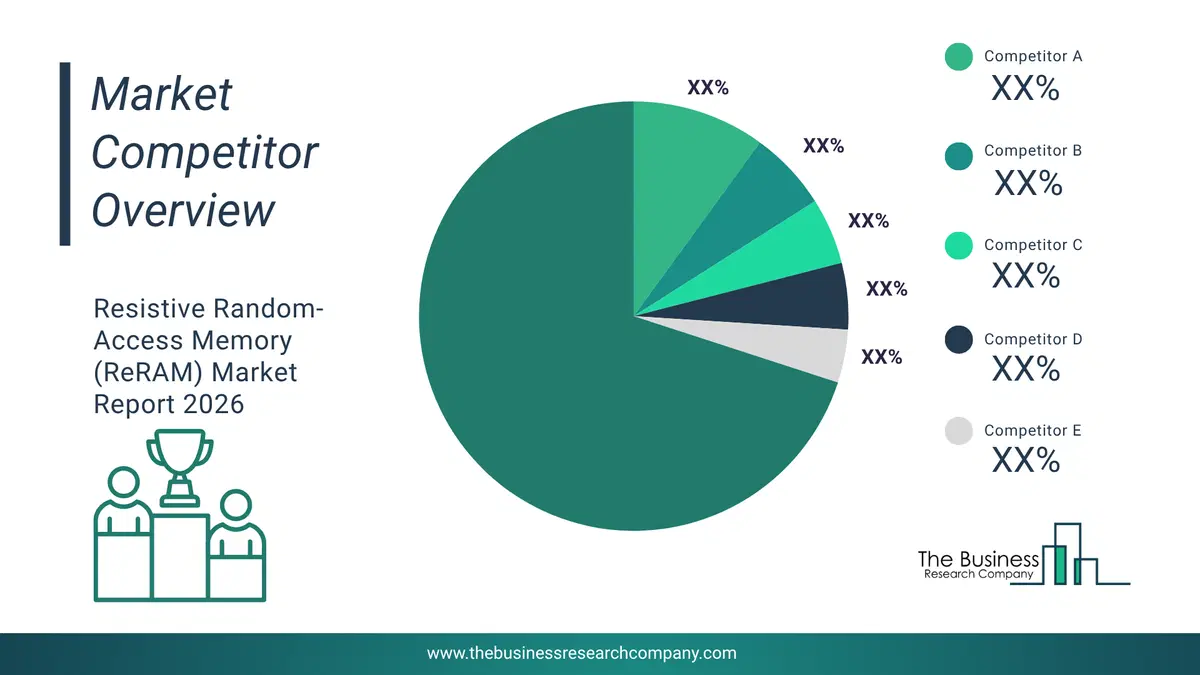
This chart is for illustrative purposes; the full report includes a detailed competitor analysis and comprehensive overview of the top 10 companies in the market.
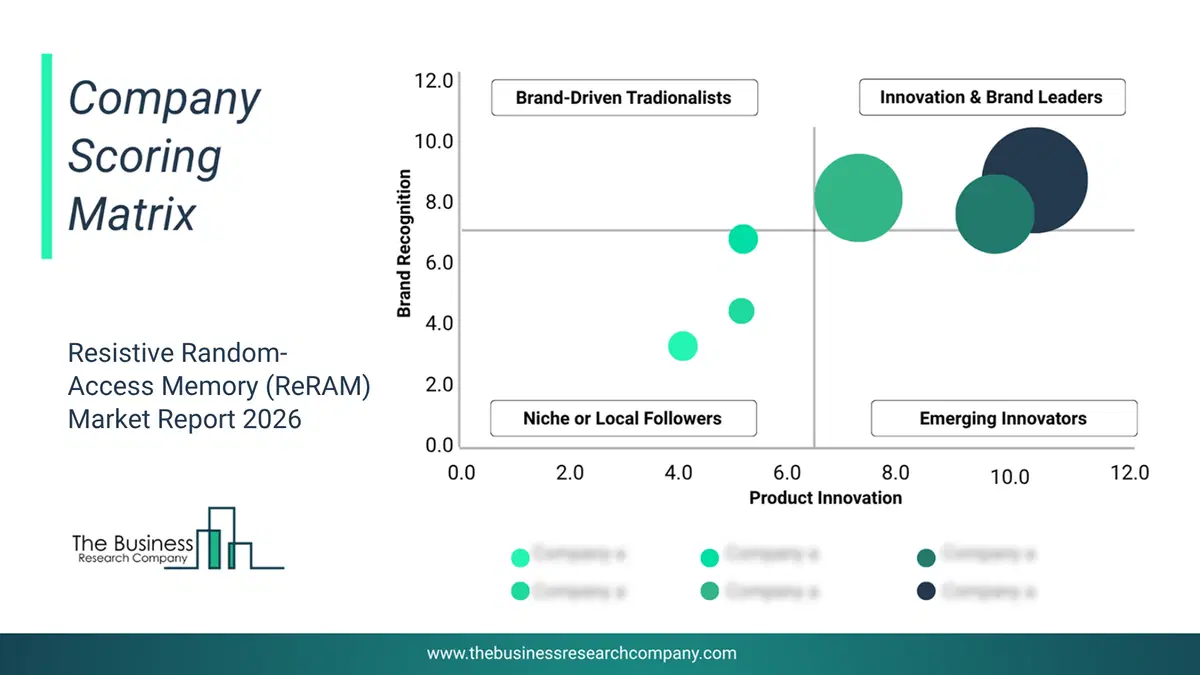
This chart maps companies by product innovation and brand strength, with bubble size indicating relative revenue, helping identify market leaders, challengers, and niche players. This is an illustrative chart; the full report provides a complete and accurate competitive analysis.
Global Resistive Random-Access Memory (ReRAM) Market Trends and Insights
Major companies operating in the resistive random-access memory market are developing innovative products with advanced technologies, such as non-volatile memory technology, to enhance the performance and reliability of consumer electronics devices. Non-volatile memory technology is used in ReRAM (resistive random-access memory) to store data even when power is turned off or interrupted. ReRAM stores data by changing the resistance of a material, offering high density and low power consumption. For instance, in November 2023, Infineon Technologies, a Germany-based semiconductor manufacturing company, launched PSoC Edge microcontrollers using non-volatile memory technology. PSoC Edge microcontrollers blend high-performance computing with machine learning capabilities for intelligent user experiences. They feature non-volatile RRAM for reliable data storage, which is ideal for IoT applications requiring efficient and secure memory solutions.What Are Latest Mergers And Acquisitions In The Resistive Random-Access Memory (ReRAM) Market?
In February 2023, GlobalFoundries, a US-based semiconductor manufacturing company, acquired Renesas Electronics Corporation for an undisclosed amount. With this acquisition, GlobalFoundries aims to enhance its memory portfolio and support the development of energy-efficient IoT applications by integrating Renesas' conductive bridging random access memory (CBRAM) technology, enabling customers to design advanced, secure, and intelligent devices. Renesas Electronics Corporation is a Japan-based semiconductor manufacturing company offering non-volatile memory solutions, including magnetoresistive random-access memory (MRAM) and resistive random-access memory (ReRAM).
Regional Outlook
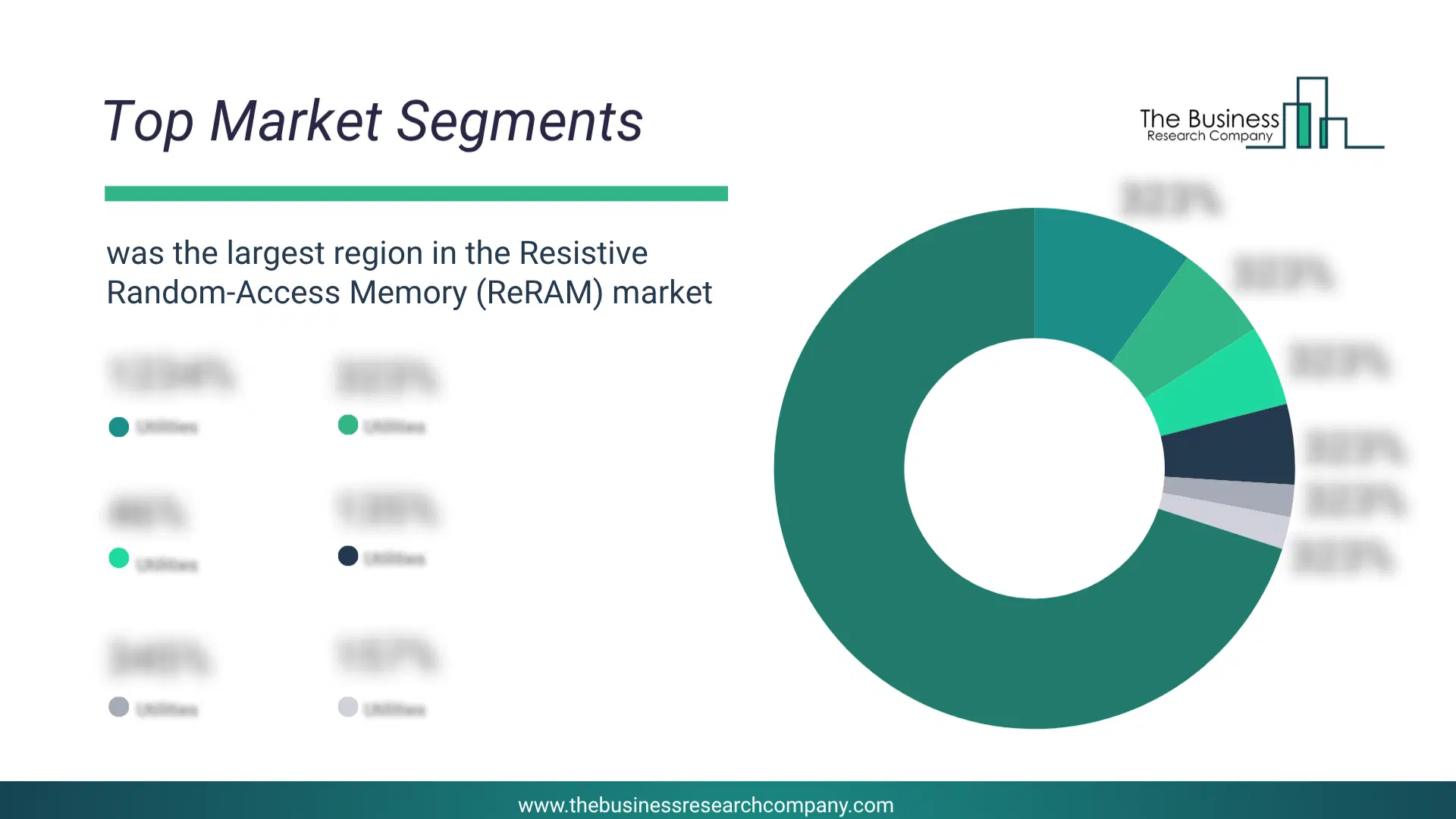
Asia-Pacific was the largest region in the resistive random-access memory (ReRAM) market in 2025. North America is expected to be the fastest-growing region in the forecast period. The regions covered in this market report are Asia-Pacific, South East Asia, Western Europe, Eastern Europe, North America, South America, Middle East, Africa. The countries covered in this market report are Australia, Brazil, China, France, Germany, India, Indonesia, Japan, Taiwan, Russia, South Korea, UK, USA, Canada, Italy, Spain.What Defines the Resistive Random-Access Memory (ReRAM) Market?
The resistive random-access memory (ReRAM) market consists of revenues earned by entities by providing services such as advanced data storage solutions, enhanced performance for computing systems, and integration support for next-generation electronic devices. The market value includes the value of related goods sold by the service provider or included within the service offering. The resistive random-access memory (ReRAM) also includes sales of high-speed memory chips, energy-efficient storage modules, memory cells, access transistors, sense amplifiers, and decoders. Values in this market are ‘factory gate’ values, that is the value of goods sold by the manufacturers or creators of the goods, whether to other entities (including downstream manufacturers, wholesalers, distributors and retailers) or directly to end customers. The value of goods in this market includes related services sold by the creators of the goods.How is Market Value Defined and Measured?
The market value is defined as the revenues that enterprises gain from the sale of goods and/or services within the specified market and geography through sales, grants, or donations in terms of the currency (in USD unless otherwise specified). The revenues for a specified geography are consumption values that are revenues generated by organizations in the specified geography within the market, irrespective of where they are produced. It does not include revenues from resales along the supply chain, either further along the supply chain or as part of other products.
This chart presents market attractiveness based on a quantitative evaluation of growth, competition, strategic alignment, and risk, offering a clear view of opportunity areas for decision-making. This chart is for illustrative purposes; the full report contains the complete analysis.

This chart highlights the Total Addressable Market (TAM) by estimating the maximum revenue opportunity using an assumption-driven approach, supporting strategic planning and opportunity sizing across markets. The chart is illustrative; the full report provides a more comprehensive analysis.
What Key Data and Analysis Are Included in the Resistive Random-Access Memory (ReRAM) Market Report 2026?
The resistive random-access memory (reram) market research report is one of a series of new reports from The Business Research Company that provides market statistics, including industry global market size, regional shares, competitors with the market share, detailed market segments, market trends and opportunities, and any further data you may need to thrive in the resistive random-access memory (reram) industry. The market research report delivers a complete perspective of everything you need, with an in-depth analysis of the current and future state of the industry.Resistive Random-Access Memory (ReRAM) Market Report Forecast Analysis
| Report Attribute | Details |
|---|---|
| Market Size Value In 2026 | $0.83 billion |
| Revenue Forecast In 2030 | $1.46 billion |
| Growth Rate | CAGR of 15.3% from 2026 to 2030 |
| Base Year For Estimation | 2025 |
| Actual Estimates/Historical Data | 2020-2025 |
| Forecast Period | 2026 - 2030 |
| Market Representation | Revenue in USD Billion and CAGR from 2026 to 2030 |
| Segments Covered | Type, Memory, Solution, Application, End-User |
| Regional Scope | Asia-Pacific, Western Europe, Eastern Europe, North America, South America, Middle East, Africa |
| Country Scope | The countries covered in the report are Australia, Brazil, China, France, Germany, India, Indonesia, Japan, Taiwan, Russia, South Korea, UK, USA, Canada, Italy, Spain. |
| Key Companies Profiled | Samsung Electronics Co. Ltd., Taiwan Semiconductor Manufacturing Company Limited, Panasonic Holdings Corporation, International Business Machines Corporation, SK Hynix Inc., Micron Technology Inc., Hewlett Packard Enterprise, Fujitsu Limited, Toshiba Corporation, Texas Instruments Incorporated, Western Digital Corporation, NXP Semiconductors, United Microelectronics Corporation, Macronix International Co. Ltd., Gigadevice Semiconductor Inc., Rambus Inc., Adesto Technologies Corporation, Weebit Nano, Crossbar Inc., 4DS Memory Limited, Interuniversity Microelectronics Centre |
| Customization Scope | Request for Customization |
| Pricing And Purchase Options | Explore Purchase Options |