
Reversible Contraceptive Device Market Report 2026
Global Outlook – By Type (Intrauterine Devices, Hormonal Contraceptive Devices, Copper Based Devices, Implants), By Mechanism Of Action (Hormonal Mechanism, Barrier Mechanism, Shifting Uterine Environment Mechanism, Combination Mechanism), By Age Group (Adolescents (13 To 19 Years), Young Adults (20 To 29 Years), Adults (30 To 39 Years), Older Adults (40 Years And Above)), By Duration Of Efficacy (Short Term Devices (Up To 3 Years), Medium Term Devices (Up To 5 Years), Long Term Devices (More Than 5 Years)), By End User (Hospitals And Clinics, Household Or Home Use) – Market Size, Trends, Strategies, and Forecast to 2030
Reversible Contraceptive Device Market Overview
• Reversible Contraceptive Device market size has reached to $14.25 billion in 2025 • Expected to grow to $22.56 billion in 2030 at a compound annual growth rate (CAGR) of 9.7% • Growth Driver: Increasing Female Workforce Participation Fueling The Growth Of The Market Due To Rising Need For Family Planning And Career Continuity • Market Trend: Emerging Copper-Based Solutions Driving Growth In Reversible Contraception • North America was the largest region in 2025 and Asia-Pacific is the fastest growing region.What Is Covered Under Reversible Contraceptive Device Market?
A reversible contraceptive device is a medical device used to temporarily prevent pregnancy and can be discontinued at any time to restore fertility. These devices work through hormonal, physical, or chemical mechanisms to stop fertilization or implantation. It’s primary use is to provide safe, effective, and temporary birth control while allowing future pregnancy when desired. The main types of reversible contraceptive devices include intrauterine devices, hormonal contraceptive devices, copper based devices, and implants. Intrauterine devices refer to long-acting reversible contraceptive devices inserted into the uterus to prevent pregnancy through hormonal or non-hormonal mechanisms. These devices operate through mechanisms including hormonal mechanism, barrier mechanism, shifting uterine environment mechanism, and combination mechanism and are used across age groups such as adolescents (13 to 19 years), young adults (20 to 29 years), adults (30 to 39 years), and older adults (40 years and above). They are available with durations of efficacy including short term devices (up to 3 years), medium term devices (up to 5 years), and long term devices (more than 5 years) and they are utilized by end users including hospitals and clinics and household or home use.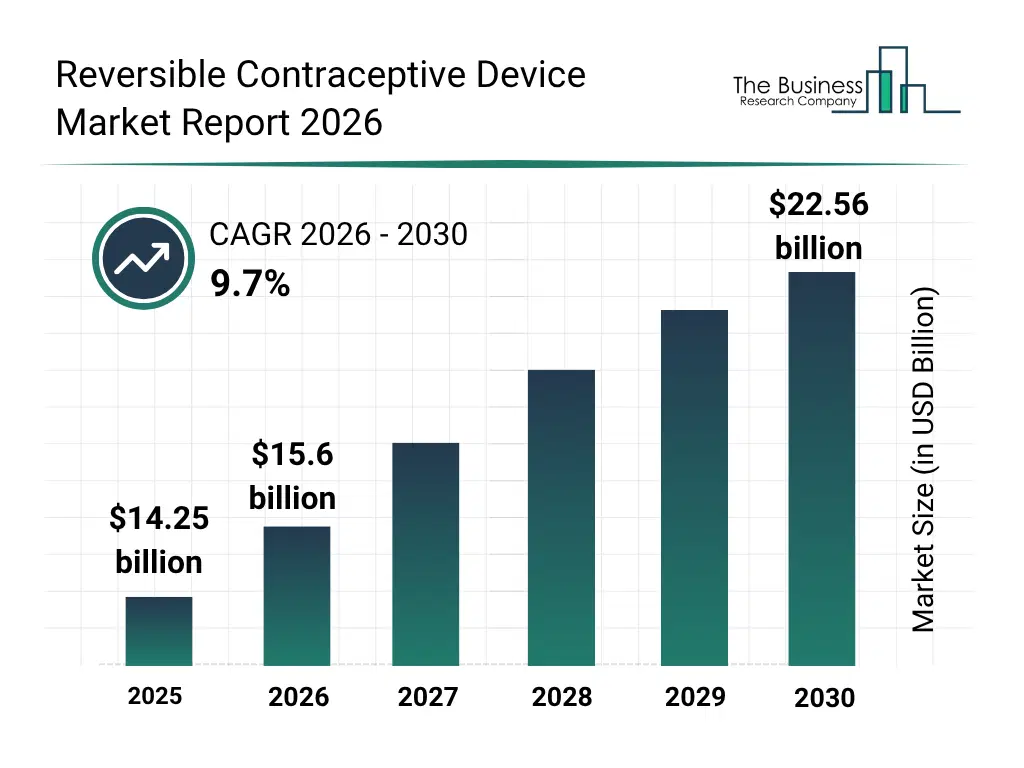
What Is The Reversible Contraceptive Device Market Size and Share 2026?
The reversible contraceptive device market size has grown strongly in recent years. It will grow from $14.25 billion in 2025 to $15.6 billion in 2026 at a compound annual growth rate (CAGR) of 9.4%. The growth in the historic period can be attributed to rising awareness of family planning methods, increasing availability of contraceptive services, growth in women’s reproductive healthcare programs, expanding access to healthcare facilities, increasing use of long acting reversible contraception.What Is The Reversible Contraceptive Device Market Growth Forecast?
The reversible contraceptive device market size is expected to see strong growth in the next few years. It will grow to $22.56 billion in 2030 at a compound annual growth rate (CAGR) of 9.7%. The growth in the forecast period can be attributed to growing demand for personalized contraceptive solutions, increasing adoption of advanced implant technologies, rising investment in reproductive health innovation, expanding access to contraception in emerging markets, increasing preference for highly effective reversible birth control methods. Major trends in the forecast period include increasing adoption of long acting reversible contraceptive devices, growing preference for hormone releasing intrauterine devices, rising demand for minimally invasive contraceptive solutions, expansion of self administered contraceptive device options, increasing focus on improved comfort and user friendly contraceptive designs.
Global Reversible Contraceptive Device Market Segmentation
1) By Type: Intrauterine Devices, Hormonal Contraceptive Devices, Copper Based Devices, Implants 2) By Mechanism Of Action: Hormonal Mechanism, Barrier Mechanism, Shifting Uterine Environment Mechanism, Combination Mechanism 3) By Age Group: Adolescents (13 To 19 Years), Young Adults (20 To 29 Years), Adults (30 To 39 Years), Older Adults (40 Years And Above) 4) By Duration Of Efficacy: Short Term Devices (Up To 3 Years), Medium Term Devices (Up To 5 Years), Long Term Devices (More Than 5 Years) 5) By End User: Hospitals And Clinics, Household Or Home Use Subsegments: 1) By Intrauterine Devices: Flexible Frame Intrauterine Devices, Copper Intrauterine Devices, Hormone Releasing Intrauterine Devices, Frameless Intrauterine Devices 2) By Hormonal Contraceptive Devices: Injectable Contraceptive Devices, Vaginal Rings, Contraceptive Implants, Transdermal Contraceptive Patches 3) By Copper Based Devices: Copper Barrier Contraceptive Devices, Copper Intrauterine Devices, Copper Contraceptive Implants 4) By Implants: Single Rod Implants, Two Rod Implants, Multi Rod Implants, Biodegradable Implants, Non Biodegradable ImplantsWhat Is The Driver Of The Reversible Contraceptive Device Market?
The increasing female workforce participation is expected to propel the growth of the reversible contraceptive device market going forward. Female workforce participation refers to the proportion of women of working age who are actively employed or seeking employment within the labor market. The increasing female workforce participation is due to improved access to education, as higher education levels enable more women to qualify for diverse employment opportunities and enter the labor market. Reversible contraceptive devices help female workforce participation by enabling women to effectively plan and space pregnancies, thereby supporting career continuity, financial stability, and long-term employment opportunities. For instance, in 2025, according to the World Bank, an US-based government-backed data source, in Brazil, female labor force participation increased from 43.32% in 2023 to 43.34% in 2024. Therefore, the increasing female workforce participation is driving the growth of reversible contraceptive device industry.Key Players In The Global Reversible Contraceptive Device Market
Major companies operating in the reversible contraceptive device market are Bayer AG, Organon & Co., Merck & Co. Inc., Reckitt Benckiser Group plc, Church & Dwight Co. Inc., CooperCompanies Inc., Gedeon Richter Plc., HLL Lifecare Limited, DKT International, MSI Reproductive Choices, Medicines360, Pregna International Limited, Sebela Pharmaceuticals Inc., Shanghai Dahua Pharmaceutical Co. Ltd., SMB Corporation of India, Eurogine S.L., Veru Inc., Kessel medintim GmbH, OCON Medical Ltd., Daré Bioscience Inc., NEXT Life Sciences Inc., Gynocare Services Private LimitedGlobal Reversible Contraceptive Device Market Trends and Insights
Major companies operating in the reversible contraceptive device market are focusing on developing advanced solutions, such as low-dose copper intrauterine systems, to improve user comfort, reduce side effects, and enhance contraceptive effectiveness. Low-dose copper intrauterine systems refer to next-generation devices that use a smaller amount of copper while maintaining high efficacy, thereby minimizing adverse effects such as heavy bleeding and discomfort. For instance, in February 2025, Sebela Womens Health Inc., a US-based pharmaceutical company, received approval for MIUDELLA, a novel hormone-free copper intrauterine device designed for pregnancy prevention. The device features a flexible frame and reduced copper surface area, aiming to improve tolerability while maintaining long-term contraceptive protection.What Are Latest Mergers And Acquisitions In The Reversible Contraceptive Device Market?
In February 2026, Organon & Co., a US-based pharmaceutical company focused on women’s health, partnered with Sebela Pharmaceuticals Inc. for MIUDELLA, a hormone-free copper intrauterine device (IUD). Through this agreement, Organon expanded its reversible contraceptive device portfolio by strengthening its long-acting reversible contraception (LARC) offerings and enhancing access to non-hormonal contraceptive solutions. Sebela Pharmaceuticals Inc. is a US-based specialty pharmaceutical company involved in women’s health products, contributing to the reversible contraceptive device market through the development of intrauterine contraceptive technologies.Regional Outlook
North America was the largest region in the reversible contraceptive device market in 2025. Asia-Pacific is expected to be the fastest growing region in the forecast period. The regions covered in this market report are Australia, Brazil, China, France, Germany, India, Indonesia, Japan, Taiwan, Russia, South Korea, UK, USA, Canada, Italy, Spain. The countries covered in this market report are Australia, Brazil, China, France, Germany, India, Indonesia, Japan, Taiwan, Russia, South Korea, UK, USA, Canada, Italy, Spain.What Defines the Reversible Contraceptive Device Market?
The reversible contraceptive device market consists of sales of vaginal rings, transdermal contraceptive patches, injectable contraceptive devices, and barrier contraceptive devices. Values in this market are ‘factory gate’ values, that is the value of goods sold by the manufacturers or creators of the goods, whether to other entities (including downstream manufacturers, wholesalers, distributors and retailers) or directly to end customers. The value of goods in this market includes related services sold by the creators of the goods.How is Market Value Defined and Measured?
The market value is defined as the revenues that enterprises gain from the sale of goods and/or services within the specified market and geography through sales, grants, or donations in terms of the currency (in USD unless otherwise specified). The revenues for a specified geography are consumption values that are revenues generated by organizations in the specified geography within the market, irrespective of where they are produced. It does not include revenues from resales along the supply chain, either further along the supply chain or as part of other products.What Key Data and Analysis Are Included in the Reversible Contraceptive Device Market Report 2026?
The reversible contraceptive device market research report is one of a series of new reports from The Business Research Company that provides reversible contraceptive device market statistics, including reversible contraceptive device industry global market size, regional shares, competitors with a reversible contraceptive device market share, detailed reversible contraceptive device market segments, market trends and opportunities, and any further data you may need to thrive in the reversible contraceptive device industry. This reversible contraceptive device market research report delivers a complete perspective of everything you need, with an in-depth analysis of the current and future scenario of the industry.Reversible Contraceptive Device Market Report Forecast Analysis
| Report Attribute | Details |
|---|---|
| Market Size Value In 2026 | $15.6 billion |
| Revenue Forecast In 2030 | $22.56 billion |
| Growth Rate | CAGR of 9.7% from 2026 to 2030 |
| Base Year For Estimation | 2025 |
| Actual Estimates/Historical Data | 2020-2025 |
| Forecast Period | 2026 - 2030 |
| Market Representation | Revenue in USD Billion and CAGR from 2026 to 2030 |
| Segments Covered | Type, Mechanism Of Action, Age Group, Duration Of Efficacy, End User |
| Regional Scope | Asia-Pacific, Western Europe, Eastern Europe, North America, South America, Middle East, Africa |
| Country Scope | The countries covered in the reversible contraceptive device market report are Australia, Brazil, China, France, Germany, India, Indonesia, Japan, Taiwan, Russia, South Korea, UK, USA, Canada, Italy, Spain. |
| Key Companies Profiled | Bayer AG, Organon & Co., Merck & Co. Inc., Reckitt Benckiser Group plc, Church & Dwight Co. Inc., CooperCompanies Inc., Gedeon Richter Plc., HLL Lifecare Limited, DKT International, MSI Reproductive Choices, Medicines360, Pregna International Limited, Sebela Pharmaceuticals Inc., Shanghai Dahua Pharmaceutical Co. Ltd., SMB Corporation of India, Eurogine S.L., Veru Inc., Kessel medintim GmbH, OCON Medical Ltd., Daré Bioscience Inc., NEXT Life Sciences Inc., Gynocare Services Private Limited |
| Customization Scope | Request for Customization |
| Pricing And Purchase Options | Explore Purchase Options |