

Rheolytic Thrombectomy Market Report 2026
Global Outlook – By Product Type (Rheolytic Thrombectomy Devices, Aspiration Thrombectomy Devices, Mechanical Thrombectomy Devices, Ultrasonic Thrombectomy Devices), By Procedure Type (Acute Limb Ischemia, Chronic Limb Ischemia, Coronary Thrombectomy, Pulmonary Embolism), By Patient Demographics (Adults, Geriatrics, Pediatrics), By Application (Cardiovascular Applications, Peripheral Vascular Applications, Neurovascular Applications, Pulmonary Embolism Applications), By End User (Hospitals, Ambulatory Surgical Centers, Specialized Clinics, Research Institutions) – Market Size, Trends, Strategies, and Forecast to 2030
Rheolytic Thrombectomy Market Overview
• Rheolytic Thrombectomy market size has reached to $1.14 billion in 2025 • Expected to grow to $1.9 billion in 2030 at a compound annual growth rate (CAGR) of 10.9% • Growth Driver: The Rise In Cardiovascular Diseases Driving The Growth Of The Market Due To Unhealthy Lifestyles • North America was the largest region in 2025 and Asia-Pacific is the fastest growing region.What Is Covered Under Rheolytic Thrombectomy Market?
Rheolytic thrombectomy is a minimally invasive medical procedure used to remove blood clots (thrombi) from blood vessels using a high-velocity saline jet system. The pressurized saline stream fragments the clot and simultaneously aspirates the debris, helping to restore normal blood flow. It is commonly used in conditions such as deep vein thrombosis and pulmonary embolism when rapid clot removal is required. The main product types of rheolytic thrombectomy include rheolytic thrombectomy devices, aspiration thrombectomy devices, mechanical thrombectomy devices, and ultrasonic thrombectomy devices. Rheolytic thrombectomy devices refer to catheter-based systems that use high-velocity saline jets to fragment and remove blood clots from blood vessels. These devices are used across procedure types including acute limb ischemia, chronic limb ischemia, coronary thrombectomy, and pulmonary embolism and serve patient demographics such as adults, geriatrics, and pediatrics. The various applications involved are cardiovascular applications, peripheral vascular applications, neurovascular applications, and pulmonary embolism applications, and they are used by several end users such as hospitals, ambulatory surgical centers, specialized clinics, and research institutions.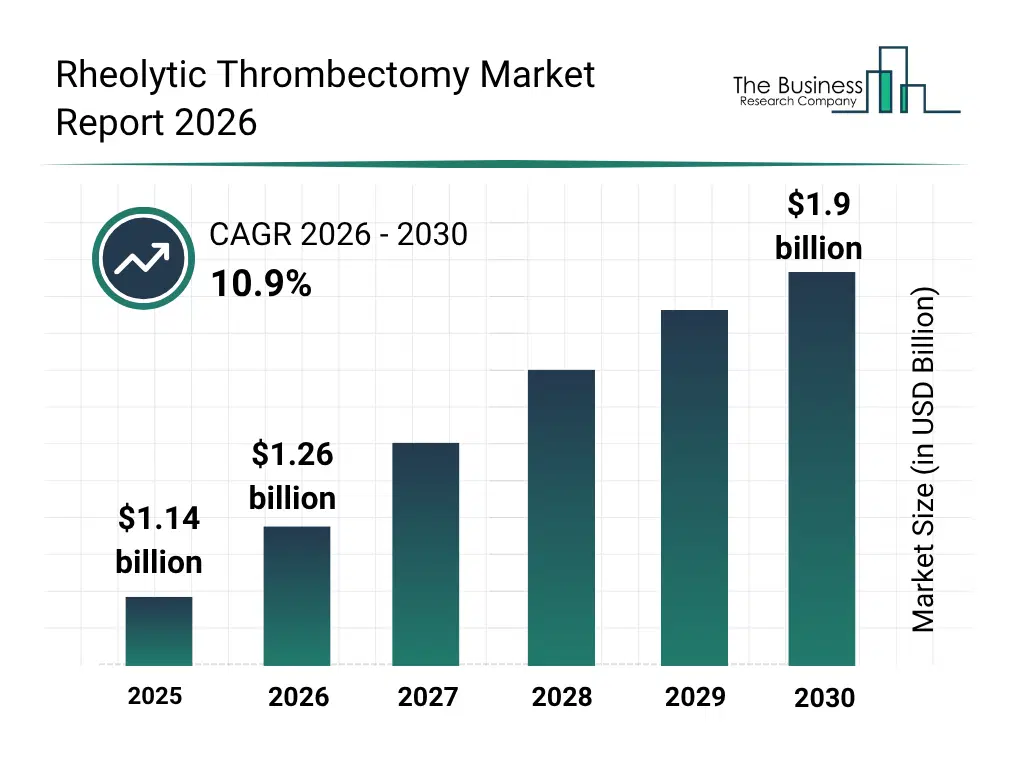
What Is The Rheolytic Thrombectomy Market Size and Share 2026?
The rheolytic thrombectomy market size has grown rapidly in recent years. It will grow from $1.14 billion in 2025 to $1.26 billion in 2026 at a compound annual growth rate (CAGR) of 10.6%. The growth in the historic period can be attributed to rising incidence of thrombotic disorders, increasing prevalence of cardiovascular diseases, growing adoption of minimally invasive procedures, advancements in interventional vascular technologies, expanding availability of specialized vascular treatment centers.What Is The Rheolytic Thrombectomy Market Growth Forecast?
The rheolytic thrombectomy market size is expected to see rapid growth in the next few years. It will grow to $1.9 billion in 2030 at a compound annual growth rate (CAGR) of 10.9%. The growth in the forecast period can be attributed to growing burden of deep vein thrombosis and pulmonary embolism, increasing demand for rapid clot removal procedures, technological innovations in thrombectomy devices, rising healthcare infrastructure investments, expanding utilization of image-guided vascular interventions. Major trends in the forecast period include advancements in catheter-based clot removal technologies, increasing preference for minimally invasive thrombectomy procedures, development of high-efficiency saline jet systems, growing adoption of rapid revascularization techniques, expansion of thrombectomy applications in peripheral vascular interventions.
Global Rheolytic Thrombectomy Market Segmentation
1) By Product Type: Rheolytic Thrombectomy Devices, Aspiration Thrombectomy Devices, Mechanical Thrombectomy Devices, Ultrasonic Thrombectomy Devices 2) By Procedure Type: Acute Limb Ischemia, Chronic Limb Ischemia, Coronary Thrombectomy, Pulmonary Embolism 3) By Patient Demographics: Adults, Geriatrics, Pediatrics 4) By Application: Cardiovascular Applications, Peripheral Vascular Applications, Neurovascular Applications, Pulmonary Embolism Applications 5) By End User: Hospitals, Ambulatory Surgical Centers, Specialized Clinics, Research Institutions Subsegments: 1) By Rheolytic Thrombectomy Devices: High Pressure Saline Jet Devices, Catheter Based Rheolytic Devices, Angled Tip Rheolytic Devices, Multi Lumen Rheolytic Systems 2) By Aspiration Thrombectomy Devices: Manual Aspiration Devices, Vacuum Assisted Aspiration Devices, Continuous Aspiration Systems, Large Bore Aspiration Catheters 3) By Mechanical Thrombectomy Devices: Rotational Thrombectomy Devices, Fragmentation Thrombectomy Devices, Basket Retrieval Devices, Clot Maceration Systems 4) By Ultrasonic Thrombectomy Devices: Ultrasound Assisted Catheter Devices, High Frequency Ultrasonic Systems, Acoustic Pulse Thrombectomy Devices, Combined Ultrasonic Aspiration DevicesWhat Are The Drivers Of The Rheolytic Thrombectomy Market?
The rising prevalence of cardiovascular diseases is expected to propel the growth of the rheolytic thrombectomy market going forward. Cardiovascular diseases (CVDs) refer to a group of disorders affecting the heart and blood vessels, including conditions such as coronary artery disease, stroke, heart failure, and hypertension. The rising prevalence of cardiovascular diseases is primarily due to unhealthy lifestyles, which negatively affect heart health and increase the risk of developing heart-related disorders. Rheolytic thrombectomy contributes to the management of cardiovascular diseases by rapidly dissolving and removing blood clots from occluded vessels using high-velocity saline jets and suction, thereby restoring normal blood flow, reducing ischemic damage, and improving patient outcomes in acute thrombotic conditions. For instance, in March 2025, according to the Joint Strategic Needs Assessment, a UK-based community health center, the number of deaths caused by cardiovascular disease (CVD) was 185 in 2023, compared to 178 recorded in 2022. Therefore, the increasing prevalence of cardiovascular diseases is driving the growth of the rheolytic thrombectomy industry. The rising burden of thrombotic conditions is expected to propel the growth of the rheolytic thrombectomy market going forward. Thrombotic disorders refer to medical conditions in which abnormal blood clots form inside blood vessels, disrupting normal blood flow. The burden of thrombotic conditions is growing due to an aging population, as older individuals are more prone to reduced blood flow, vascular damage, and underlying conditions that increase the risk of abnormal blood clot. Rheolytic thrombectomy enhances the management of thrombotic conditions by rapidly fragmenting and aspirating blood clots to restore vessel patency and improve downstream blood flow in acute vascular occlusions. For instance, in December 2025, according to the National Health Service (NHS) England, a UK-based government department, venous thromboembolism (VTE) risk assessment coverage in England reached 92% in Quarter 3 (October to December 2025) of 2025/26, with 3.4 million out of 3.7 million admitted patients being assessed on admission. Therefore, the rising prevalence of thrombotic disorders is driving the growth of the rheolytic thrombectomy industry. The increasing aging population is expected to propel the growth of the rheolytic thrombectomy market going forward. An aging population refers to a population in which the share of elderly people is higher than the share of younger people. An increasing aging population is primarily due to rising life expectancy, as people are living longer and more individuals are reaching older age groups. Rheolytic thrombectomy enables rapid mechanical and pharmacomechanical removal of blood clots to restore vascular flow, addressing the growing burden of age-related thrombotic disorders in the aging population. For instance, in February 2025, according to the World Health Organization, a Switzerland-based intergovernmental organization, the number of people aged 60 years and older worldwide is projected to increase from 1.1 billion in 2023 to 1.4 billion by 2030. Therefore, the increasing aging population is driving the growth of the rheolytic thrombectomy industry.Key Players In The Global Rheolytic Thrombectomy Market
Major companies operating in the rheolytic thrombectomy market are Johnson & Johnson, Abbott Laboratories, Medtronic plc, Koninklijke Philips N.V., Stryker Corporation, Becton Dickinson and Company, Boston Scientific Corporation, Terumo Corporation, Edwards Lifesciences, Teleflex Incorporated, Penumbra Inc., Inari Medical Inc., AngioDynamics Inc., Surmodics Inc., LeMaitre Vascular Inc., Imperative Care Inc., Argon Medical Devices Inc., Acandis GmbH & Co. KG, Vesalio LLCRegional Outlook
North America was the largest region in the rheolytic thrombectomy market in 2025. Asia-Pacific is expected to be the fastest-growing region in the forecast period. The regions covered in this market report are Australia, Brazil, China, France, Germany, India, Indonesia, Japan, Taiwan, Russia, South Korea, UK, USA, Canada, Italy, Spain. The countries covered in this market report are Australia, Brazil, China, France, Germany, India, Indonesia, Japan, Taiwan, Russia, South Korea, UK, USA, Canada, Italy, Spain.What Defines the Rheolytic Thrombectomy Market?
The rheolytic thrombectomy market consists of revenues earned by entities by providing services such as catheter-based clot removal, emergency thrombectomy procedures, treatment of deep vein thrombosis and pulmonary embolism, peripheral arterial clot extraction, and post-procedure vascular care. The market value includes the value of related goods sold by the service provider or included within the service offering. The rheolytic thrombectomy market also includes sales of thrombectomy console systems, pump and power pulse delivery systems, aspiration and collection systems, and accessory kits and disposables. Values in this market are ‘factory gate’ values, that is the value of goods sold by the manufacturers or creators of the goods, whether to other entities (including downstream manufacturers, wholesalers, distributors and retailers) or directly to end customers. The value of goods in this market includes related services sold by the creators of the goods.How is Market Value Defined and Measured?
The market value is defined as the revenues that enterprises gain from the sale of goods and/or services within the specified market and geography through sales, grants, or donations in terms of the currency (in USD unless otherwise specified). The revenues for a specified geography are consumption values that are revenues generated by organizations in the specified geography within the market, irrespective of where they are produced. It does not include revenues from resales along the supply chain, either further along the supply chain or as part of other products.What Key Data and Analysis Are Included in the Rheolytic Thrombectomy Market Report 2026?
The rheolytic thrombectomy market research report is one of a series of new reports from The Business Research Company that provides rheolytic thrombectomy market statistics, including rheolytic thrombectomy industry global market size, regional shares, competitors with a rheolytic thrombectomy market share, detailed rheolytic thrombectomy market segments, market trends and opportunities, and any further data you may need to thrive in the rheolytic thrombectomy industry. This rheolytic thrombectomy market research report delivers a complete perspective of everything you need, with an in-depth analysis of the current and future scenario of the industry.Rheolytic Thrombectomy Market Report Forecast Analysis
| Report Attribute | Details |
|---|---|
| Market Size Value In 2026 | $1.26 billion |
| Revenue Forecast In 2030 | $1.9 billion |
| Growth Rate | CAGR of 10.9% from 2026 to 2030 |
| Base Year For Estimation | 2025 |
| Actual Estimates/Historical Data | 2020-2025 |
| Forecast Period | 2026 - 2030 |
| Market Representation | Revenue in USD Billion and CAGR from 2026 to 2030 |
| Segments Covered | Product Type, Procedure Type, Patient Demographics, Application, End User |
| Regional Scope | Asia-Pacific, Western Europe, Eastern Europe, North America, South America, Middle East, Africa |
| Country Scope | The countries covered in the rheolytic thrombectomy market report are Australia, Brazil, China, France, Germany, India, Indonesia, Japan, Taiwan, Russia, South Korea, UK, USA, Canada, Italy, Spain. |
| Key Companies Profiled | Johnson & Johnson, Abbott Laboratories, Medtronic plc, Koninklijke Philips N.V., Stryker Corporation, Becton Dickinson and Company, Boston Scientific Corporation, Terumo Corporation, Edwards Lifesciences, Teleflex Incorporated, Penumbra Inc., Inari Medical Inc., AngioDynamics Inc., Surmodics Inc., LeMaitre Vascular Inc., Imperative Care Inc., Argon Medical Devices Inc., Acandis GmbH & Co. KG, Vesalio LLC |
| Customization Scope | Request for Customization |
| Pricing And Purchase Options | Explore Purchase Options |