
Robotic Steel Beam Welding Market Report 2026
Global Outlook – By Component (Robots, Welding Equipment, Controllers, Sensors, Software, Other Components), By Welding Technology (Arc Welding, Laser Welding, Resistance Welding, Other Welding Technologies), By Automation Level (Fully Automated, Semi-Automated), By End-User (Construction, Manufacturing, Shipbuilding, Oil And Gas, Other End-Users) – Market Size, Trends, Strategies, and Forecast to 2030
Robotic Steel Beam Welding Market Overview
• Robotic Steel Beam Welding market size has reached to $1.52 billion in 2025 • Expected to grow to $2.62 billion in 2030 at a compound annual growth rate (CAGR) of 11.4% • Growth Driver: Rising Demand For Construction Projects Driving The Growth Of The Market Due To Urbanization And Infrastructure Development • Market Trend: Advancements In Automated Welding Systems Boost Precision, Efficiency, And Safety In Structural Steel Fabrication • Asia-Pacific was the largest region in 2025.What Is Covered Under Robotic Steel Beam Welding Market?
Robotic steel beam welding is an automated process where robots perform welding on steel beams with high accuracy and consistency. These robots are programmed to control welding parameters, ensuring uniform and precise joints while minimizing errors. The system can manage heavy materials and complex beam structures efficiently, operating safely in industrial environments. The main components of robotic steel beam welding include robots, welding equipment, controllers, sensors, software, and others. Robotic steel beam welding robots are advanced automated systems designed to deliver precise and consistent welding of structural steel beams, thereby enhancing efficiency, accuracy, and workplace safety in construction and heavy fabrication industries. These systems employ various welding technologies, such as arc welding, laser welding, resistance welding, and others, and are available at different automation levels, including fully automated and semi-automated solutions. Key end-user industries include construction, manufacturing, shipbuilding, oil and gas, and others.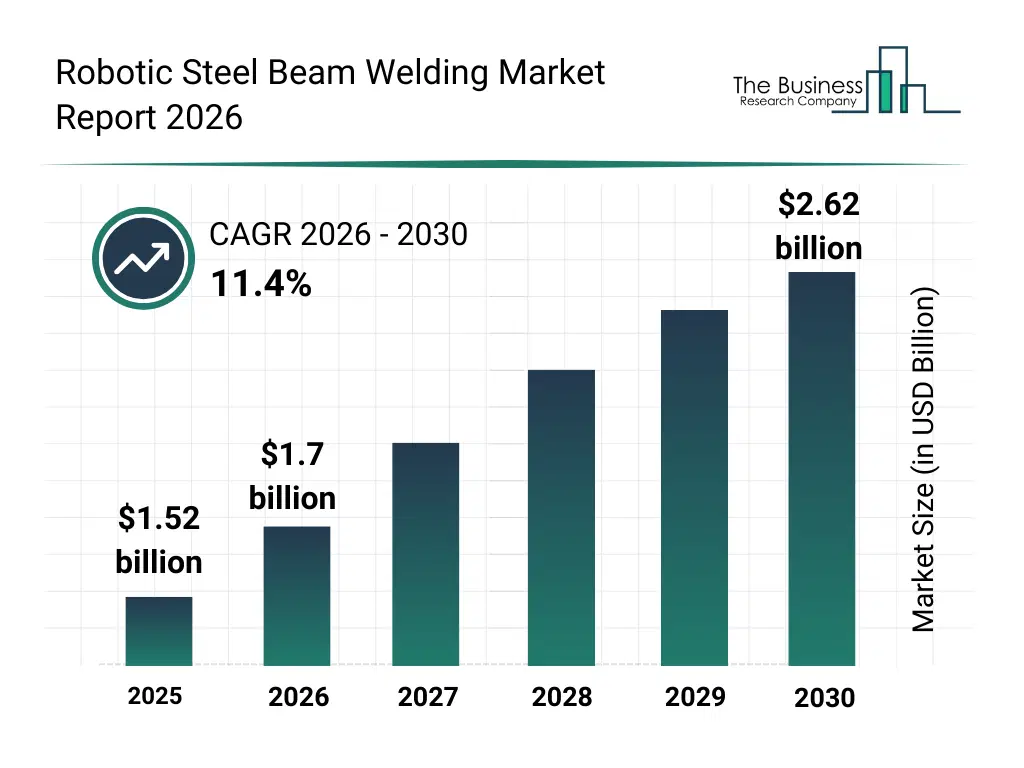
What Is The Robotic Steel Beam Welding Market Size and Share 2026?
The robotic steel beam welding market size has grown rapidly in recent years. It will grow from $1.52 billion in 2025 to $1.7 billion in 2026 at a compound annual growth rate (CAGR) of 11.8%. The growth in the historic period can be attributed to growth in infrastructure construction, demand for consistent weld quality, shortage of skilled welders, expansion of shipbuilding activities, safety requirements in heavy fabrication.What Is The Robotic Steel Beam Welding Market Growth Forecast?
The robotic steel beam welding market size is expected to see rapid growth in the next few years. It will grow to $2.62 billion in 2030 at a compound annual growth rate (CAGR) of 11.4%. The growth in the forecast period can be attributed to large scale infrastructure projects, adoption of smart welding systems, automation in steel fabrication plants, demand for faster project execution, growth in industrial digital twins. Major trends in the forecast period include growing adoption of fully automated welding lines, increased use of vision and sensor guided welding, rising demand for high strength structural welding, integration of welding simulation software, expansion of robotic welding in heavy industries.Tariff Impact On Robotic Steel Beam Welding Market
Tariffs have influenced the robotic steel beam welding market by increasing prices of welding robots, sensors, and control systems. These impacts are strongest in North America and Europe. Higher capital costs affect adoption rates. At the same time, tariffs are driving domestic robot integration and localized welding system manufacturing.
Global Robotic Steel Beam Welding Market Segmentation
1) By Component: Robots, Welding Equipment, Controllers, Sensors, Software, Other Components 2) By Welding Technology: Arc Welding, Laser Welding, Resistance Welding, Other Welding Technologies 3) By Automation Level: Fully Automated, Semi-Automated 4) By End-User: Construction, Manufacturing, Shipbuilding, Oil And Gas, Other End-Users Subsegments: 1) By Robots: Articulated Robots, Gantry Robots, Cartesian Robots, Collaborative Robots, Parallel Robots 2) By Welding Equipment: Arc Welding Machines, Resistance Welding Machines, Laser Welding Machines, Plasma Welding Machines, Hybrid Welding Machines 3) By Controllers: Programmable Logic Controllers, Industrial PCs, Motion Controllers, Distributed Control Systems 4) By Sensors: Laser Sensors, Vision Sensors, Proximity Sensors, Force Torque Sensors, Temperature Sensors 5) By Software: Welding Simulation Software, Robot Programming Software, Quality Inspection Software, Production Planning Software 6) By Other Components: Welding Torches, Wire Feeders, Cooling Systems, Protective EnclosuresWhat Is The Driver Of The Robotic Steel Beam Welding Market?
The rising demand for construction projects is expected to propel the growth of the robotic steel beam welding market going forward. Construction projects refer to planned initiatives that involve the design, development, and building of infrastructure, residential, commercial, or industrial facilities to meet societal and economic needs. The demand for construction projects is increasing due to rapid urbanization and the growing need for modern infrastructure in expanding cities. Robotic steel beam welding benefits construction projects by delivering precise and uniform welds, improving structural strength, and minimizing the likelihood of construction flaws. For instance, in November 2024, according to the Office for National Statistics, a UK-based government statistics authority, the value of construction new work in current prices in Great Britain in 2023 increased by 4.2% to a record high of £139,029 million (USD 173 billion); this was caused by growth in both private sector work of £2,050 million (USD 2.55 billion) and in the public sector of £3,578 million (USD 4.45 billion). Therefore, the rising demand for construction projects is driving the growth of the robotic steel beam welding industry.Key Players In The Global Robotic Steel Beam Welding Market
Major companies operating in the robotic steel beam welding market are Asea Brown Boveri Ltd., Fanuc Corporation, Yaskawa Electric Corporation, Lincoln Electric Holdings Inc., KUKA AG, Osaka Transformer Company Daihen Inc., Comau S.p.A., Lexicon Inc., Ficep Group, GMT Corp., Pemamek Oy, Path Robotics Inc., AGT Robotics, Hyundai Doosan Robotics Inc., Nanjing Auto Electric Co. Ltd., Primo Automation Systems Pvt. Ltd., Robologic India Pvt. Ltd., Inatoz Robotics automation Pvt. Ltd., AutoaWeld, HUZHOU XIZHANG WELDING ROBOTICS CO. LTD.
This chart is for illustrative purposes; the full report includes a detailed competitor analysis and comprehensive overview of the top 10 companies in the market.
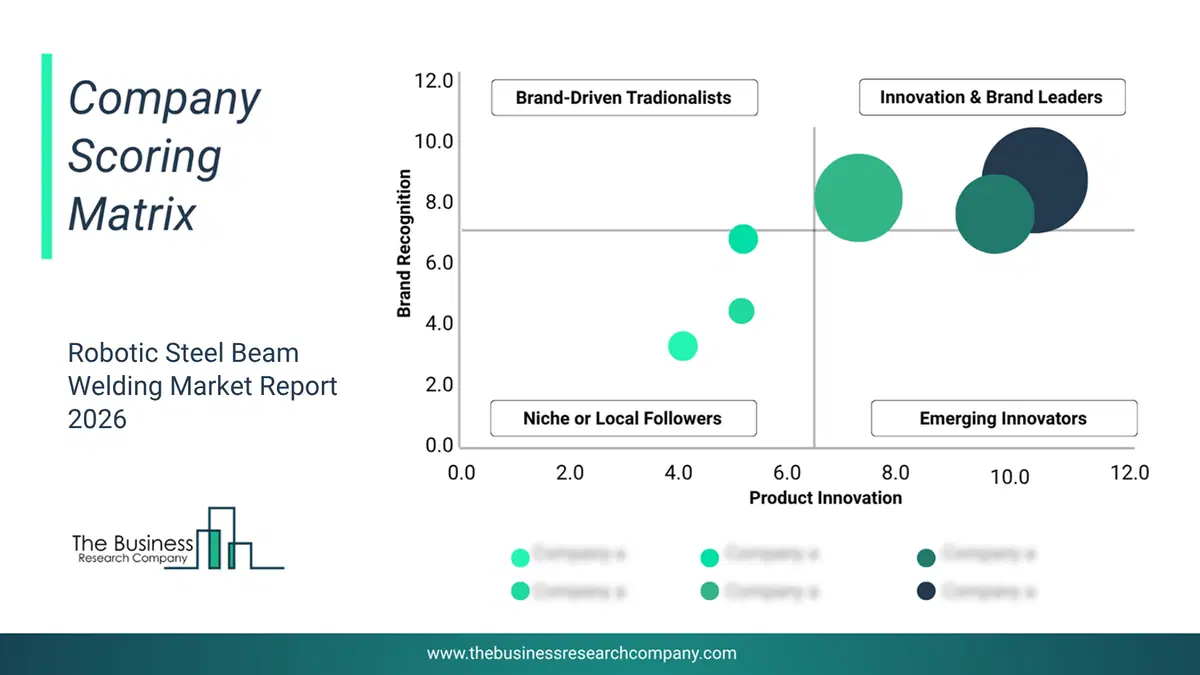
This chart maps companies by product innovation and brand strength, with bubble size indicating relative revenue, helping identify market leaders, challengers, and niche players. This is an illustrative chart; the full report provides a complete and accurate competitive analysis.
Global Robotic Steel Beam Welding Market Trends and Insights
Major companies operating in the robotic steel beam welding market are focusing on developing advanced solutions, such as automated welding systems, to enhance welding precision, increase production efficiency, and reduce human intervention in complex structural steel fabrication processes. Automated welding systems refer to welding processes that are performed with minimal human intervention using robotic arms, sensors, control software, and other advanced technologies. For instance, in April 2023, Kemppi Oy, a Finland-based technology company, launched the AX MIG Welder. The AX MIG Welder offers advanced welding performance through high-precision control and automated functionality. It ensures consistent weld quality, even in complex or large-scale steel structures. The system integrates intelligent arc control, real-time monitoring, and adaptive parameters. It supports both manual and robotic welding applications with excellent arc stability. The AX MIG Welder enhances productivity, safety, and energy efficiency in industrial welding operations.What Are Latest Mergers And Acquisitions In The Robotic Steel Beam Welding Market?
In June 2024, Lincoln Electric Holdings Inc., a US-based provider of welding equipment, consumables, and automation solutions, acquired Inrotech A/S for an undisclosed amount. With this acquisition, Lincoln Electric aims to strengthen its position in automated welding solutions by integrating Inrotech’s advanced robotic welding technologies, thereby expanding its capabilities in structural steel fabrication and enhancing its offerings to serve growing demand in the construction and heavy industry sectors. Inrotech A/S is a Denmark-based provider of robotic steel beam welding solutions.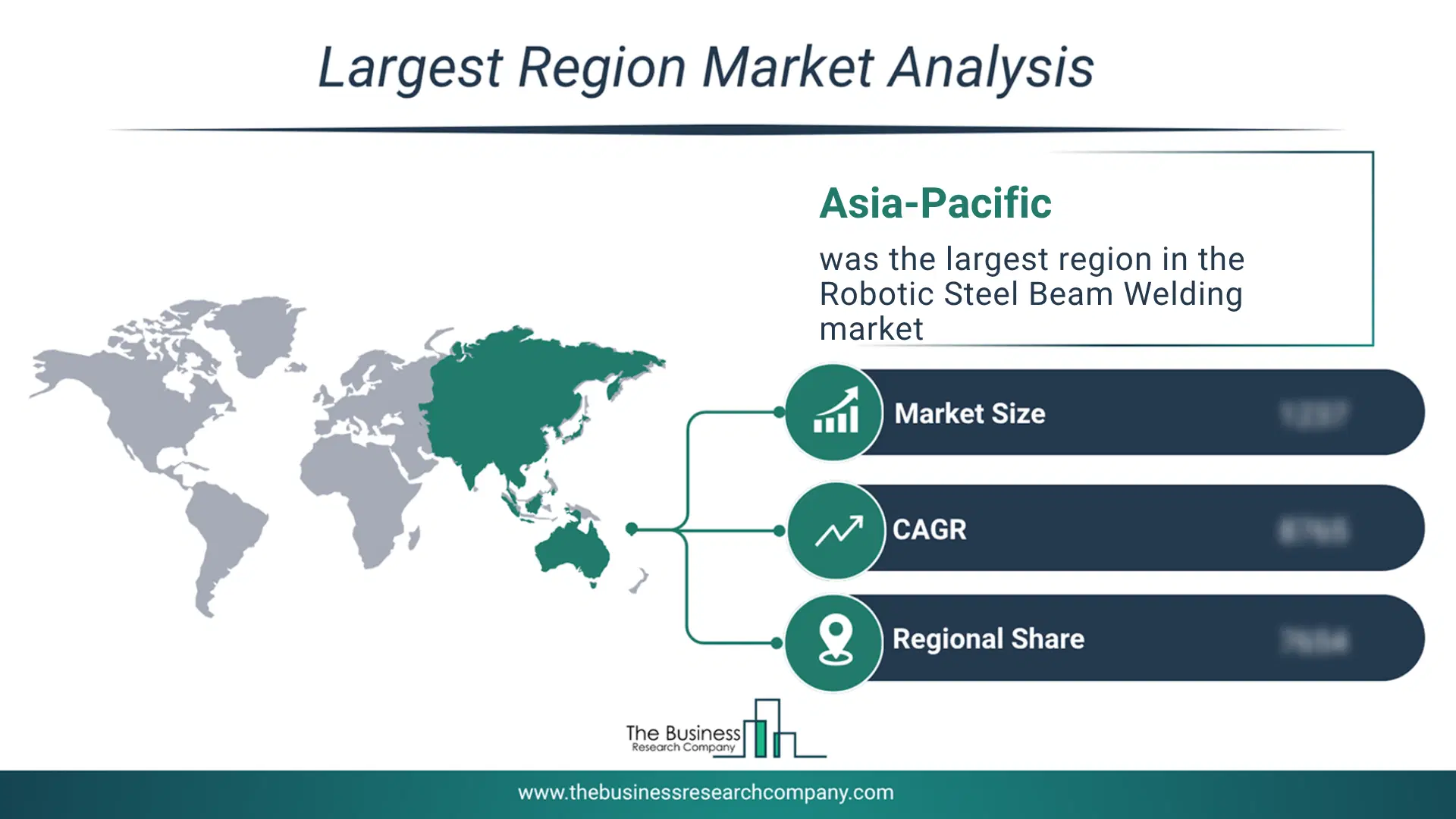
Regional Outlook
Asia-Pacific was the largest region in the robotic steel beam welding market in 2025. The regions covered in this market report are Asia-Pacific, South East Asia, Western Europe, Eastern Europe, North America, South America, Middle East, Africa The countries covered in this market report are Australia, Brazil, China, France, Germany, India, Indonesia, Japan, Taiwan, Russia, South Korea, UK, USA, Canada, Italy, Spain.What Defines the Robotic Steel Beam Welding Market?
The robotic steel beam welding market consists of revenues earned by entities by providing services such as automated welding programming, robotic system installation, weld quality inspection, and process optimization. The market value includes the value of related goods sold by the service provider or included within the service offering. The robotic steel beam welding market also includes sales of wire feeders, welding torches, safety enclosures, and control panels. Values in this market are ‘factory gate’ values, that is the value of goods sold by the manufacturers or creators of the goods, whether to other entities (including downstream manufacturers, wholesalers, distributors and retailers) or directly to end customers. The value of goods in this market includes related services sold by the creators of the goods.How is Market Value Defined and Measured?
The market value is defined as the revenues that enterprises gain from the sale of goods and/or services within the specified market and geography through sales, grants, or donations in terms of the currency (in USD unless otherwise specified). The revenues for a specified geography are consumption values that are revenues generated by organizations in the specified geography within the market, irrespective of where they are produced. It does not include revenues from resales along the supply chain, either further along the supply chain or as part of other products.
This chart presents market attractiveness based on a quantitative evaluation of growth, competition, strategic alignment, and risk, offering a clear view of opportunity areas for decision-making. This chart is for illustrative purposes; the full report contains the complete analysis.

This chart highlights the Total Addressable Market (TAM) by estimating the maximum revenue opportunity using an assumption-driven approach, supporting strategic planning and opportunity sizing across markets. The chart is illustrative; the full report provides a more comprehensive analysis.
What Key Data and Analysis Are Included in the Robotic Steel Beam Welding Market Report 2026?
The robotic steel beam welding market research report is one of a series of new reports from The Business Research Company that provides market statistics, including industry global market size, regional shares, competitors with the market share, detailed market segments, market trends and opportunities, and any further data you may need to thrive in the robotic steel beam welding industry. The market research report delivers a complete perspective of everything you need, with an in-depth analysis of the current and future state of the industry.Robotic Steel Beam Welding Market Report Forecast Analysis
| Report Attribute | Details |
|---|---|
| Market Size Value In 2026 | $1.7 billion |
| Revenue Forecast In 2030 | $2.62 billion |
| Growth Rate | CAGR of 11.4% from 2026 to 2030 |
| Base Year For Estimation | 2025 |
| Actual Estimates/Historical Data | 2020-2025 |
| Forecast Period | 2026 - 2030 |
| Market Representation | Revenue in USD Billion and CAGR from 2026 to 2030 |
| Segments Covered | Component, Welding Technology, Automation Level, End-User |
| Regional Scope | Asia-Pacific, Western Europe, Eastern Europe, North America, South America, Middle East, Africa |
| Key Companies Profiled | Asea Brown Boveri Ltd., Fanuc Corporation, Yaskawa Electric Corporation, Lincoln Electric Holdings Inc., KUKA AG, Osaka Transformer Company Daihen Inc., Comau S.p.A., Lexicon Inc., Ficep Group, GMT Corp., Pemamek Oy, Path Robotics Inc., AGT Robotics, Hyundai Doosan Robotics Inc., Nanjing Auto Electric Co. Ltd., Primo Automation Systems Pvt. Ltd., Robologic India Pvt. Ltd., Inatoz Robotics automation Pvt. Ltd., AutoaWeld, HUZHOU XIZHANG WELDING ROBOTICS CO. LTD. |
| Customization Scope | Request for Customization |
| Pricing And Purchase Options | Explore Purchase Options |