
Rocket Component Heat Exchangers Market Report 2026
Global Outlook – By Type (Plate-Fin, Tube-Fin, Shell And Tube, Other Types), By Material (Aluminum, Stainless Steel, Titanium, Other Materials), By Application (Propulsion Systems, Thermal Management Systems, Other Applications), By End-User (Commercial Space, Military And Defense, Other End Users) – Market Size, Trends, Strategies, and Forecast to 2030
Rocket Component Heat Exchangers Market Overview
• Rocket Component Heat Exchangers market size has reached to $1.23 billion in 2025 • Expected to grow to $1.8 billion in 2030 at a compound annual growth rate (CAGR) of 7.9% • Growth Driver: Rising Number Of Commercial Space Missions Fueling The Growth Of The Market Due To Increasing Demand For Thermal Regulation In Spacecraft Systems • Market Trend: Partnerships Boost Reliability And Efficiency In Space Missions • North America was the largest region in 2025.What Is Covered Under Rocket Component Heat Exchangers Market?
Rocket component heat exchangers are devices built into rocket engines or subsystems that transmit surplus heat from hot engine components or working fluids to a coolant, minimizing overheating and ensuring structural integrity. They help regulate temperatures by either cooling hot engine components, such as combustion chambers and nozzles, or by preheating propellants such as liquid oxygen or liquid hydrogen to improve combustion efficiency and performance. The main types of rocket component heat exchangers are plate-fin, tube-fin, shell and tube, and others. A plate-fin heat exchanger is a device that transfers heat between fluids, usually gases or liquids, by arranging thin metal plates and fins in layers. These exchangers are manufactured using different materials such as aluminum, stainless steel, titanium, and others and are utilized across various applications such as propulsion systems, thermal management systems, and others. They serve a broad range of end users, including commercial space, military and defense, and others.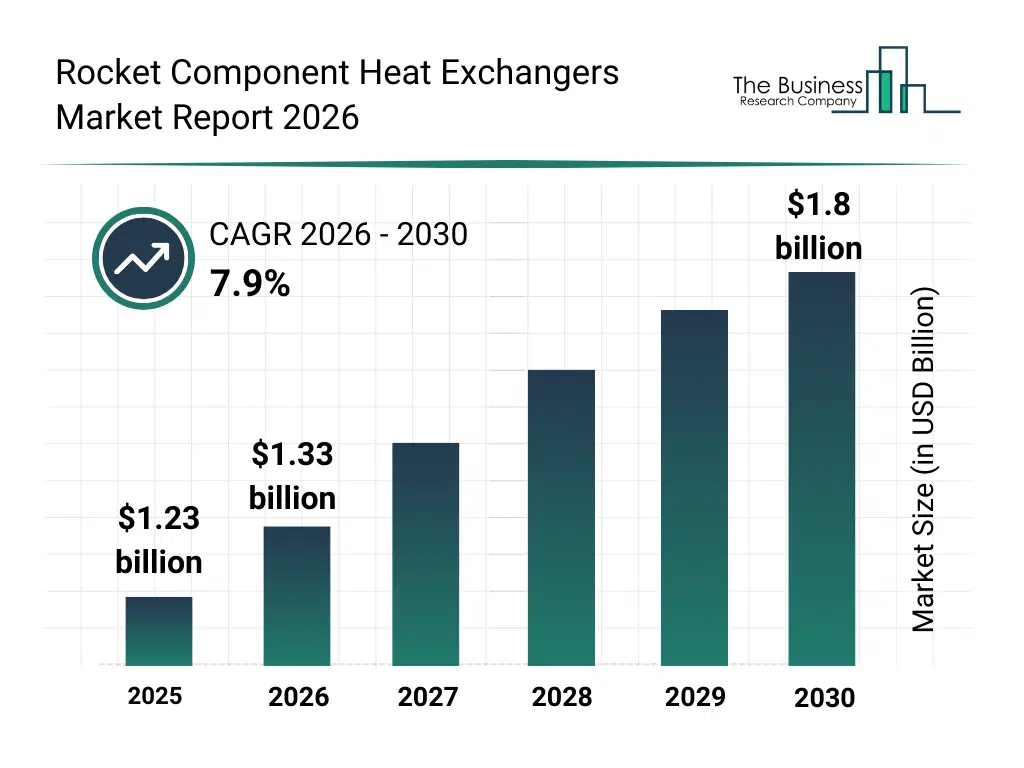
What Is The Rocket Component Heat Exchangers Market Size and Share 2026?
The rocket component heat exchangers market size has grown strongly in recent years. It will grow from $1.23 billion in 2025 to $1.33 billion in 2026 at a compound annual growth rate (CAGR) of 8.1%. The growth in the historic period can be attributed to growing adoption of regenerative heat exchangers to preheat propellants and improve combustion efficiency, increasing deployment of microchannel heat exchangers enabling compact and lightweight thermal management solutions, rising use of printed circuit heat exchangers for high-pressure, high-temperature rocket engine environments, early utilization of double pipe heat exchangers in legacy propulsion systems, expansion of spiral heat exchanger applications supporting enhanced heat transfer performance in engine components.What Is The Rocket Component Heat Exchangers Market Growth Forecast?
The rocket component heat exchangers market size is expected to see strong growth in the next few years. It will grow to $1.8 billion in 2030 at a compound annual growth rate (CAGR) of 7.9%. The growth in the forecast period can be attributed to rising demand for advanced thermal management systems to support reusable and high-thrust rocket engines, increasing adoption of additive-manufactured heat exchangers enabling complex geometries and improved efficiency, growing integration of microchannel and printed circuit heat exchangers in next-generation cryogenic propulsion systems, expansion of commercial launch providers requiring durable, high-performance heat exchangers, technological advancements improving heat exchanger materials, pressure resistance, and thermal cycling durability. Major trends in the forecast period include increasing adoption of additive-manufactured heat exchanger geometries, growing use of cryogenic-compatible materials for high-efficiency cooling, rising demand for compact high-pressure pche and microchannel designs, enhanced integration of propellant pre-conditioning systems in engines, expansion of thermal management requirements for reusable launch vehicles.
Global Rocket Component Heat Exchangers Market Segmentation
1) By Type: Plate-Fin, Tube-Fin, Shell And Tube, Other Types 2) By Material: Aluminum, Stainless Steel, Titanium, Other Materials 3) By Application: Propulsion Systems, Thermal Management Systems, Other Applications 4) By End-User: Commercial Space, Military And Defense, Other End Users Subsegments: 1) By Plate-Fin: Aluminum Plate-Fin, Stainless Steel Plate-Fin, Compact Plate-Fin Heat Exchangers 2) By Tube-Fin: Straight Tube-Fin, Helical Tube-Fin, Multi-Pass Tube-Fin Designs 3) By Shell And Tube: Single-Pass Shell And Tube, Multi-Pass Shell And Tube, Double Pipe Heat Exchangers 4) By Other Types: Printed Circuit Heat Exchangers (PCHE), Spiral Heat Exchangers, Microchannel Heat ExchangersWhat Is Driver Of The Rocket Component Heat Exchangers Market?
The rising number of commercial space missions is expected to propel the growth of the rocket component heat exchangers market going forward. Commercial space missions refer to privately funded and operated spaceflights conducted by companies to provide services such as satellite deployment, space tourism, cargo transport, and scientific research for commercial gain. The commercial space missions are rising due to increasing private sector investment in satellite-based communication and Earth observation, driving companies to schedule more frequent missions. Rocket component heat exchangers support commercial space missions by ensuring efficient thermal regulation, which enhances engine performance and reliability. They enable longer mission durations by managing extreme temperatures, contributing to the success of modern aerospace operations. For instance, in November 2024, according to the Federal Aviation Administration, a US-based federal agency, commercial space operations rose by over 30% in 2023 to reach 148 launches, with projections indicating they will more than double by 2028. Therefore, the rising number of commercial space missions is driving the growth of the rocket component heat exchangers industry.Key Players In The Global Rocket Component Heat Exchangers Market
Major companies operating in the rocket component heat exchangers market are RTX Corporation, Boeing Company, Lockheed Martin Corporation, Northrop Grumman Corporation, Honeywell International Inc., BAE Systems plc, Safran SA, Parker Hannifin Corporation, Air Products and Chemicals Inc., IHI Corporation, AMETEK Inc., Alfa Laval AB, Blue Origin LLC, Boyd Corporation, Meggitt PLC, Chart Industries Inc., Triumph Group, SGL Carbon SE, ERG Aerospace, Nammo Westcott, Rocket Lab USA Inc., TAT Technologies Ltd., Wall Colmonoy Corporation, Senior Flexonics, Advanced Cooling Technologies Inc., Conflux Technology, Brayton Energy, Space Engine Systems Inc.
This chart is for illustrative purposes; the full report includes a detailed competitor analysis and comprehensive overview of the top 10 companies in the market.
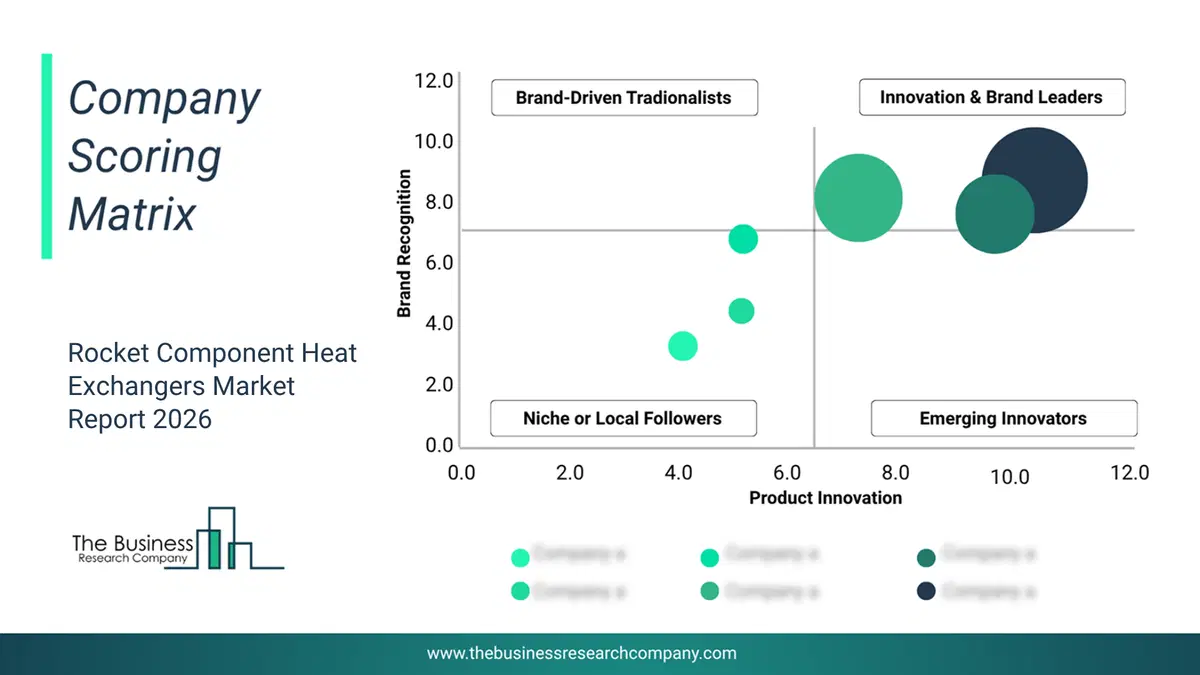
This chart maps companies by product innovation and brand strength, with bubble size indicating relative revenue, helping identify market leaders, challengers, and niche players. This is an illustrative chart; the full report provides a complete and accurate competitive analysis.
Global Rocket Component Heat Exchangers Market Trends and Insights
Major companies operating in the rocket component heat exchangers market are focusing on developing innovative solutions through strategic collaborations to enhance thermal efficiency, reduce weight, and improve the overall performance and reliability of rocket systems. Strategic collaborations refer to formal partnerships between companies that aim to combine their expertise, resources, and technologies to develop advanced solutions and improve the performance of rocket component heat exchangers. For instance, in April 2023, Conflux Technology, an Australia-based additive manufacturing company, partnered with Rocket Factory Augsburg (RFA), a Germany-based aerospace company, to develop and manufacture advanced 3D-printed aerospace heat exchangers for use in orbital rockets. The heat exchanger is manufactured using Conflux’s proprietary metal additive manufacturing techniques, specifically utilizing the nickel-copper alloy Monel K 500, and is produced on the EOS M300-4 Direct Metal Laser Sintering (DMLS) platform. This collaboration aims to strengthen Australia’s space supply chain, support NASA’s Moon and Mars missions, and demonstrate the growing role of innovative thermal management solutions in the rapidly expanding space industry.What Are Latest Mergers And Acquisitions In The Rocket Component Heat Exchangers Market? L3Harris Acquires Aerojet Rocketdyne To Boost Propulsion Capabilities
In July 2023, L3Harris Technologies Inc., a US-based aerospace and defense technology company, acquired Aerojet Rocketdyne Holdings Inc. for $4.7 billion. With this acquisition, L3Harris aims to enhance its propulsion capabilities by integrating Aerojet Rocketdyne’s expertise in rocket engines and energetics, strengthening its position in missile defense, hypersonic, and space propulsion. Aerojet Rocketdyne Holdings Inc. is a US-based aerospace company specializing in rocket propulsion and advanced heat exchangers for engine thermal management.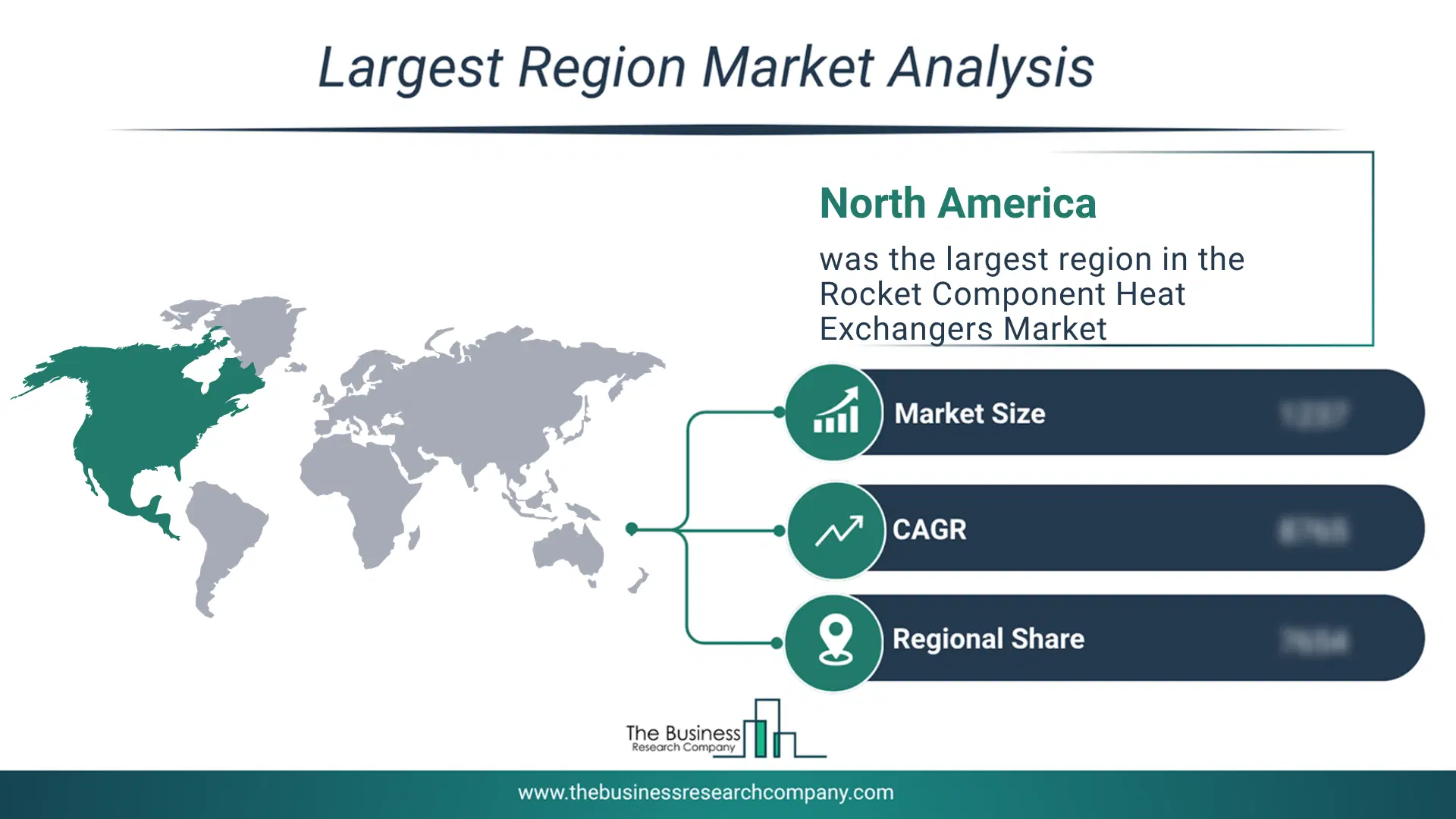
Regional Insights
North America was the largest region in the rocket component heat exchangers market in 2025. The regions covered in this market report are Asia-Pacific, South East Asia, Western Europe, Eastern Europe, North America, South America, Middle East, Africa. The countries covered in this market report are Australia, Brazil, China, France, Germany, India, Indonesia, Japan, Taiwan, Russia, South Korea, UK, USA, Canada, Italy, SpainWhat Defines the Rocket Component Heat Exchangers Market?
The rocket component heat exchangers market consists of sales of printed circuit heat exchangers, microchannel heat exchangers, spiral heat exchangers, regenerative heat exchangers, and double pipe heat exchangers. Values in this market are ‘factory gate’ values, that is the value of goods sold by the manufacturers or creators of the goods, whether to other entities (including downstream manufacturers, wholesalers, distributors and retailers) or directly to end customers. The value of goods in this market includes related services sold by the creators of the goods.How is Market Value Defined and Measured?
The market value is defined as the revenues that enterprises gain from the sale of goods and/or services within the specified market and geography through sales, grants, or donations in terms of the currency (in USD unless otherwise specified). The revenues for a specified geography are consumption values that are revenues generated by organizations in the specified geography within the market, irrespective of where they are produced. It does not include revenues from resales along the supply chain, either further along the supply chain or as part of other products.
This chart presents market attractiveness based on a quantitative evaluation of growth, competition, strategic alignment, and risk, offering a clear view of opportunity areas for decision-making. This chart is for illustrative purposes; the full report contains the complete analysis.

This chart highlights the Total Addressable Market (TAM) by estimating the maximum revenue opportunity using an assumption-driven approach, supporting strategic planning and opportunity sizing across markets. The chart is illustrative; the full report provides a more comprehensive analysis.
What Key Data and Analysis Are Included in the Rocket Component Heat Exchangers Market Report 2026?
The rocket component heat exchangers market research report is one of a series of new reports from The Business Research Company that provides market statistics, including industry global market size, regional shares, competitors with the market share, detailed market segments, market trends and opportunities, and any further data you may need to thrive in the rocket component heat exchangers industry. The market research report delivers a complete perspective of everything you need, with an in-depth analysis of the current and future state of the industry.Rocket Component Heat Exchangers Market Report Forecast Analysis
| Report Attribute | Details |
|---|---|
| Market Size Value In 2026 | $1.33 billion |
| Revenue Forecast In 2030 | $1.8 billion |
| Growth Rate | CAGR of 7.9% from 2026 to 2030 |
| Base Year For Estimation | 2025 |
| Actual Estimates/Historical Data | 2020-2025 |
| Forecast Period | 2026 - 2030 |
| Market Representation | Revenue in USD Billion and CAGR from 2026 to 2030 |
| Segments Covered | Type, Material, Application, End-User |
| Regional Scope | Asia-Pacific, Western Europe, Eastern Europe, North America, South America, Middle East, Africa |
| Country Scope | The countries covered in the rocket component heat exchangers market report are Australia, Brazil, China, France, Germany, India, Indonesia, Japan, Taiwan, Russia, South Korea, UK, USA, Canada, Italy, Spain |
| Key Companies Profiled | RTX Corporation, Boeing Company, Lockheed Martin Corporation, Northrop Grumman Corporation, Honeywell International Inc., BAE Systems plc, Safran SA, Parker Hannifin Corporation, Air Products and Chemicals Inc., IHI Corporation, AMETEK Inc., Alfa Laval AB, Blue Origin LLC, Boyd Corporation, Meggitt PLC, Chart Industries Inc., Triumph Group, SGL Carbon SE, ERG Aerospace, Nammo Westcott, Rocket Lab USA Inc., TAT Technologies Ltd., Wall Colmonoy Corporation, Senior Flexonics, Advanced Cooling Technologies Inc., Conflux Technology, Brayton Energy, Space Engine Systems Inc. |
| Customization Scope | Request for Customization |
| Pricing And Purchase Options | Explore Purchase Options |