
Rocket Component Miniaturization Market Report 2026
Global Outlook – By Component Type (Micro Thrusters, Miniature Sensors, Microelectronics, Miniature Propulsion Systems, Other Component Types), By Material (Metals, Polymers, Ceramics, Composites), By Application (Satellites, Launch Vehicles, Space Probes, Other Applications), By End-User (Commercial, Military, Government) – Market Size, Trends, Strategies, and Forecast to 2030
Rocket Component Miniaturization Market Overview
• Rocket Component Miniaturization market size has reached to $2.55 billion in 2025 • Expected to grow to $4.07 billion in 2030 at a compound annual growth rate (CAGR) of 9.7% • Growth Driver: Rising Small Satellite Deployments Fueling The Growth Of The Market Due To Demand For Lightweight, Cost-Effective Solutions • Market Trend: 3D Printing Advances Enable Lightweight And Custom Rocket Components • North America was the largest region in 2025.What Is Covered Under Rocket Component Miniaturization Market?
Rocket component miniaturization refers to the process of designing and developing smaller, lighter, and more compact rocket components without compromising functionality or performance. The main purpose is to reduce overall rocket mass, lower launch costs, and increase payload capacity, enabling more efficient and cost-effective space missions. The main component types of rocket component miniaturization are micro thrusters, miniature sensors, microelectronics, miniature propulsion systems, and others. Microthrusters refer to small-scale propulsion devices designed to generate precise, low-thrust forces for controlling the position and orientation of miniaturized spacecraft such as small satellites and CubeSats. The materials used in these components include metals, polymers, ceramics, and composites. These miniaturized technologies are applied across a range of platforms, such as satellites, launch vehicles, space probes, and others, serving end-users such as commercial, military, and government sectors.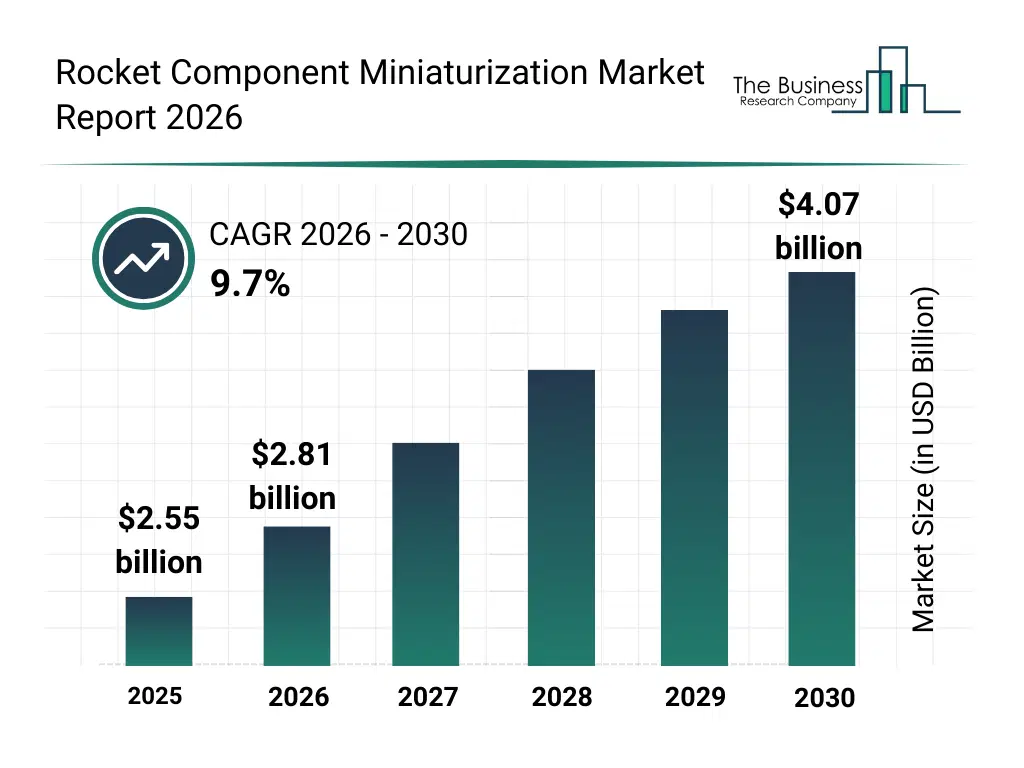
What Is The Rocket Component Miniaturization Market Size and Share 2026?
The rocket component miniaturization market size has grown rapidly in recent years. It will grow from $2.55 billion in 2025 to $2.81 billion in 2026 at a compound annual growth rate (CAGR) of 10.2%. The growth in the historic period can be attributed to growing adoption of miniaturized guidance systems to reduce rocket mass and improve efficiency, increasing development of compact propulsion units for small launch vehicles, rising use of micro thrusters in nanosatellite deployment missions, expansion of microfabrication services enabling downsizing of rocket electronics, early integration of lightweight telemetry modules to enhance mission data transmission.What Is The Rocket Component Miniaturization Market Growth Forecast?
The rocket component miniaturization market size is expected to see strong growth in the next few years. It will grow to $4.07 billion in 2030 at a compound annual growth rate (CAGR) of 9.7%. The growth in the forecast period can be attributed to rising demand for nanoscale power systems to support next-generation lightweight rocket architectures, increasing adoption of thermal and structural optimization services to enable further component downsizing, growing use of miniaturized electronics integration for autonomous and reusable rocket systems, expansion of custom design and prototyping for commercial small-launch providers, technological advancements enabling higher-performance mini components with improved durability and precision. Major trends in the forecast period include increased adoption of additive manufacturing for miniaturized components, rising demand for high-density, low-power microelectronics, growing integration of micropropulsion for precise maneuvering, expansion of system-level miniaturization for cubesats and smallsats, enhanced thermal and structural optimization for ultra-compact parts.
Global Rocket Component Miniaturization Market Segmentation
1) By Component Type: Micro Thrusters, Miniature Sensors, Microelectronics, Miniature Propulsion Systems, Other Component Types 2) By Material: Metals, Polymers, Ceramics, Composites 3) By Application: Satellites, Launch Vehicles, Space Probes, Other Applications 4) By End-User: Commercial, Military, Government Subsegments: 1) By Micro Thrusters: Cold Gas Micro Thrusters, Micro-Electro-Mechanical Systems-Based Micro Thrusters, Electric Micro Thrusters 2) By Miniature Sensors: Pressure Sensors, Temperature Sensors, Inertial Measurement Units (IMUs) 3) By Microelectronics: Microcontrollers, Miniature Power Amplifiers, Signal Processors 4) By Miniature Propulsion Systems: Solid Micro Propulsion, Liquid Micro Propulsion, Hybrid Micro Propulsion 5) By Other Component Types: Miniature Actuators, Compact Communication Modules, Nanoscale Energy Storage SystemsWhat Is Driver Of The Rocket Component Miniaturization Market?
The growing demand for small satellites is expected to propel the growth of the rocket component miniaturization market going forward. Small satellites are lightweight, compact spacecraft, usually under 500 kilograms, designed for missions such as Earth monitoring, communications, or testing new technologies. The growing demand for small satellites is rising due to their cost-effectiveness and versatility, as they enable faster deployment and easier customization for diverse applications. Rocket component miniaturization enhances small satellite missions by enabling lighter, compact designs that fit within limited payload capacities. It improves performance efficiency while reducing launch costs, supporting the growing demand for agile and cost-effective space solutions. For instance, in December 2024, according to Aerospace America, a US-based technical society dedicated to aerospace professionals, a total of 475 small satellites were deployed across 55 launches, with certain missions carrying up to 120 spacecraft in a single flight, marking the highest deployment rate compared to 2023. Therefore, the growing demand for small satellites is driving the growth of the rocket component miniaturization industry.Key Players In The Global Rocket Component Miniaturization Market
Major companies operating in the rocket component miniaturization market are Northrop Grumman Corporation, Space Exploration Technologies Corp, Cadence Design Systems Inc., Moog Inc., RUAG Space AG, Rocket Lab USA Inc., NMG Aerospace LLC, Ursa Major Technologies Inc., Phase Four Inc., ÅAC Microtec AB, Benchmark Lark RF Technology, QuesTek Innovations LLC, Tethers Unlimited Inc, GAUSS Srl, Beehive Industries LLC, Bellatrix Aerospace Pvt. Ltd., Elementum 3D Inc, Romar Engineering Pty Ltd, Space Engine Systems Inc., Mynaric AG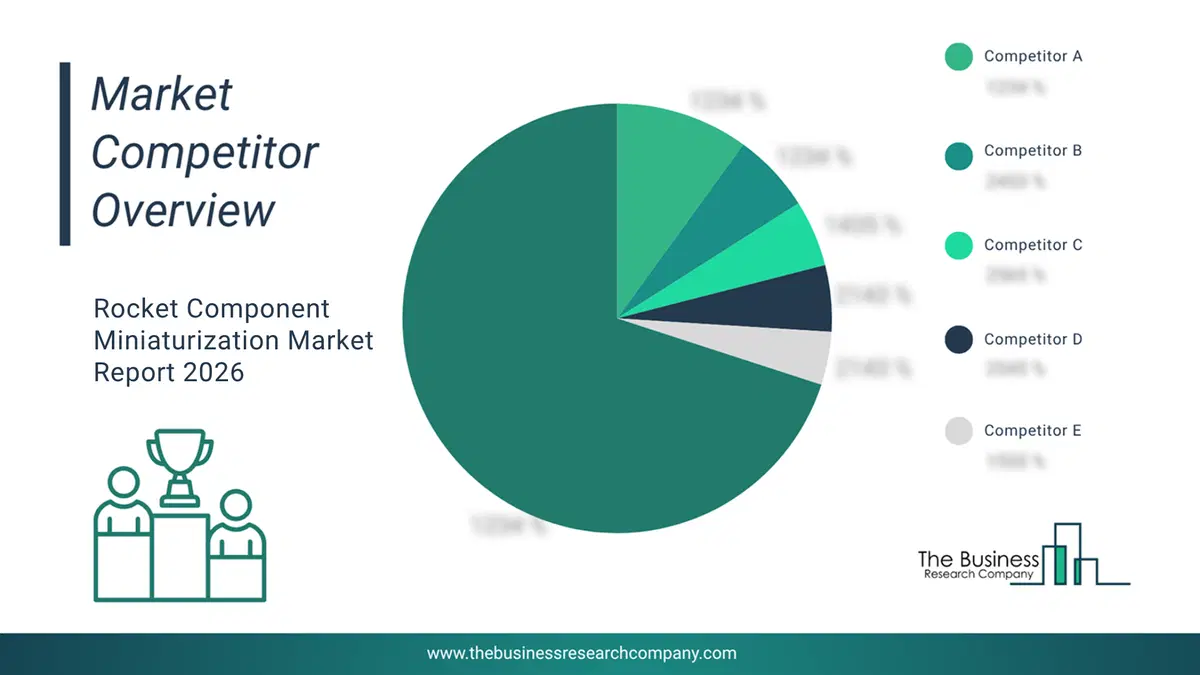
This chart is for illustrative purposes; the full report includes a detailed competitor analysis and comprehensive overview of the top 10 companies in the market.
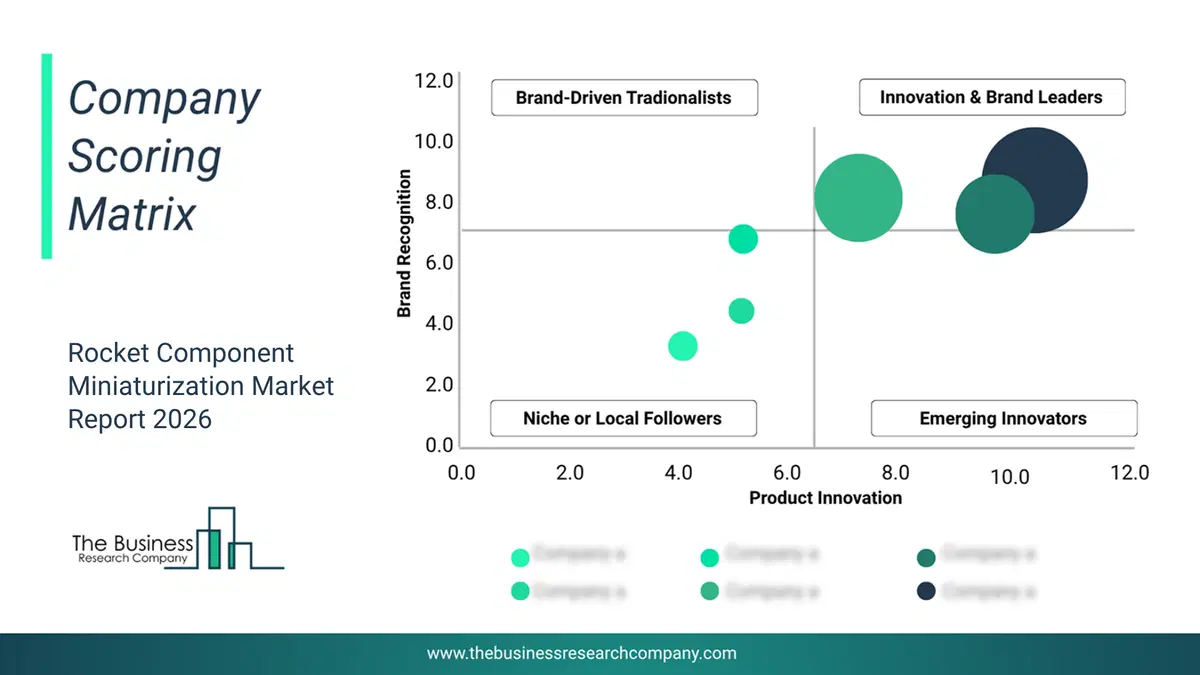
This chart maps companies by product innovation and brand strength, with bubble size indicating relative revenue, helping identify market leaders, challengers, and niche players. This is an illustrative chart; the full report provides a complete and accurate competitive analysis.
Global Rocket Component Miniaturization Market Trends and Insights
Major companies operating in the rocket component miniaturization market are focusing on developing technologically advanced solutions, such as 3D printing, to produce lighter, complex, and highly customized rocket parts with reduced production time and cost. 3D printing is an advanced fabrication technique that builds components layer by layer directly from digital models, enabling the creation of intricate, lightweight structures with enhanced design flexibility, reduced material usage, and faster production cycles. For instance, in March 2023, Relativity Space Inc., a US-based aerospace manufacturing company, launched its Terran 1 rocket, the first test vehicle made entirely from 3D-printed parts. The vehicle incorporated GRCop-42 copper alloy combustion chambers, a high-performance material developed by NASA’s Glenn Research Center under its Game-Changing Development program. This milestone, achieved at Cape Canaveral, demonstrated the viability of additive manufacturing for producing flight-ready rocket engines, marking a significant leap in cost-effective and rapid aerospace manufacturing.What Are Latest Mergers And Acquisitions In The Rocket Component Miniaturization Market? L3Harris Acquires Aerojet Rocketdyne To Boost Propulsion Capabilities
In July 2023, L3Harris Technologies Inc., a US-based aerospace and defense technology company, acquired Aerojet Rocketdyne Holdings Inc. for $4.7 billion. With this acquisition, L3Harris aims to enhance its propulsion capabilities by integrating Aerojet Rocketdyne’s expertise in rocket engines and energetics, strengthening its position in missile defense, hypersonic, and space propulsion. Aerojet Rocketdyne Holdings Inc. is a US-based aerospace and defense company involved in rocket component miniaturization.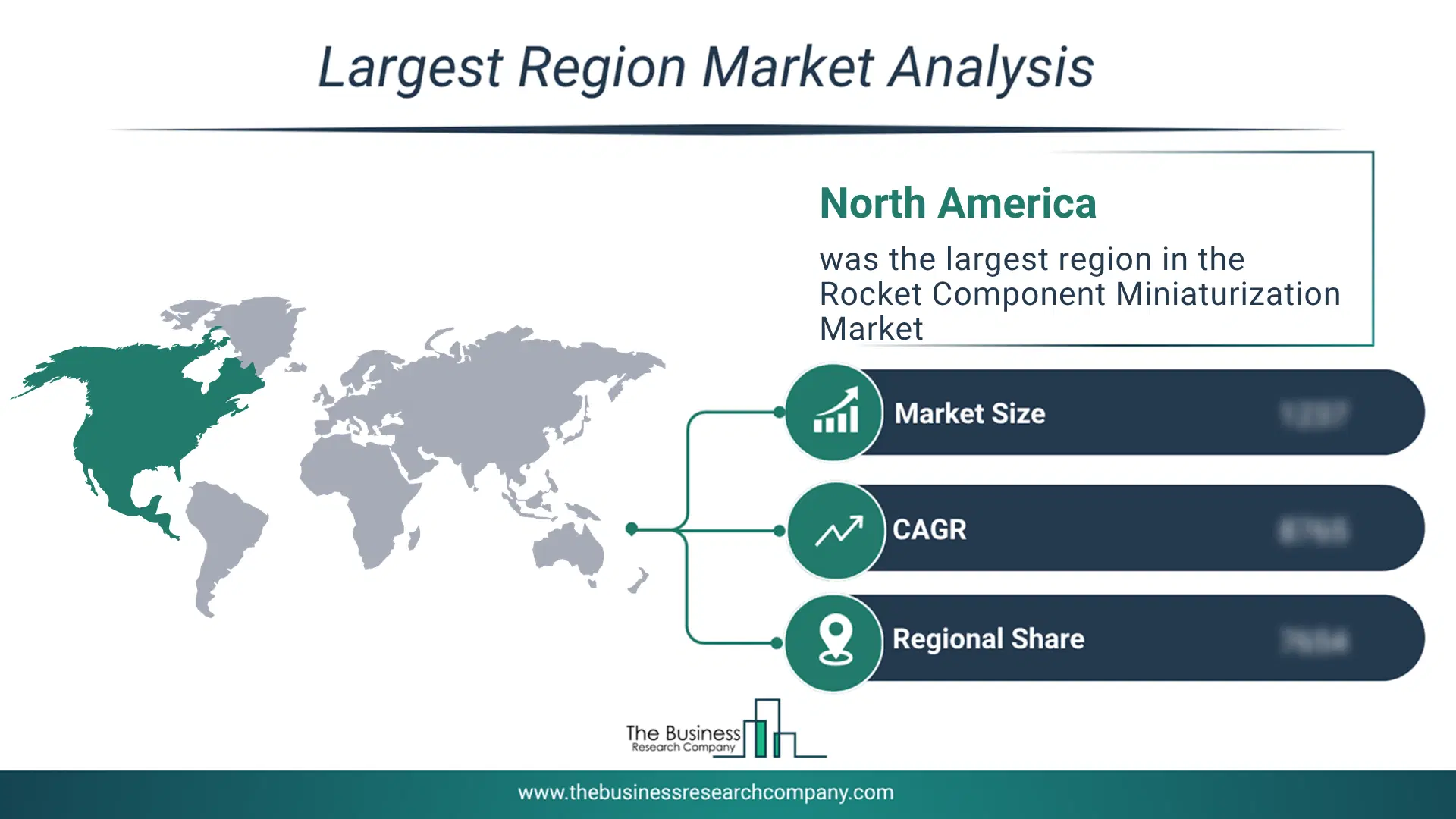
Regional Insights
North America was the largest region in the rocket component miniaturization market in 2025. The regions covered in this market report are Asia-Pacific, South East Asia, Western Europe, Eastern Europe, North America, South America, Middle East, Africa. The countries covered in this market report are Australia, Brazil, China, France, Germany, India, Indonesia, Japan, Taiwan, Russia, South Korea, UK, USA, Canada, Italy, SpainWhat Defines the Rocket Component Miniaturization Market?
The rocket component miniaturization market consists of revenues earned by entities by providing services such as microfabrication services, miniaturized electronics integration, custom design and prototyping, thermal and structural optimization services, and testing and validation services. The market value includes the value of related goods sold by the service provider or included within the service offering. The rocket component miniaturization market includes sales of compact propulsion units, miniaturized guidance systems, micro thrusters, lightweight telemetry modules, and nanoscale power systems. Values in this market are ‘factory gate’ values, that is, the value of goods sold by the manufacturers or creators of the goods, whether to other entities (including downstream manufacturers, wholesalers, distributors, and retailers) or directly to end customers. The value of goods in this market includes related services sold by the creators of the goods.How is Market Value Defined and Measured?
The market value is defined as the revenues that enterprises gain from the sale of goods and/or services within the specified market and geography through sales, grants, or donations in terms of the currency (in USD unless otherwise specified). The revenues for a specified geography are consumption values that are revenues generated by organizations in the specified geography within the market, irrespective of where they are produced. It does not include revenues from resales along the supply chain, either further along the supply chain or as part of other products.
This chart presents market attractiveness based on a quantitative evaluation of growth, competition, strategic alignment, and risk, offering a clear view of opportunity areas for decision-making. This chart is for illustrative purposes; the full report contains the complete analysis.

This chart highlights the Total Addressable Market (TAM) by estimating the maximum revenue opportunity using an assumption-driven approach, supporting strategic planning and opportunity sizing across markets. The chart is illustrative; the full report provides a more comprehensive analysis.
What Key Data and Analysis Are Included in the Rocket Component Miniaturization Market Report 2026?
The rocket component miniaturization market research report is one of a series of new reports from The Business Research Company that provides market statistics, including industry global market size, regional shares, competitors with the market share, detailed market segments, market trends and opportunities, and any further data you may need to thrive in the rocket component miniaturization industry. The market research report delivers a complete perspective of everything you need, with an in-depth analysis of the current and future state of the industry.Rocket Component Miniaturization Market Report Forecast Analysis
| Report Attribute | Details |
|---|---|
| Market Size Value In 2026 | $2.81 billion |
| Revenue Forecast In 2030 | $4.07 billion |
| Growth Rate | CAGR of 9.7% from 2026 to 2030 |
| Base Year For Estimation | 2025 |
| Actual Estimates/Historical Data | 2020-2025 |
| Forecast Period | 2026 - 2030 |
| Market Representation | Revenue in USD Billion and CAGR from 2026 to 2030 |
| Segments Covered | Component Type, Material, Application, End-User |
| Regional Scope | Asia-Pacific, Western Europe, Eastern Europe, North America, South America, Middle East, Africa |
| Country Scope | The countries covered in the rocket component miniaturization market report are Australia, Brazil, China, France, Germany, India, Indonesia, Japan, Taiwan, Russia, South Korea, UK, USA, Canada, Italy, Spain |
| Key Companies Profiled | Northrop Grumman Corporation, Space Exploration Technologies Corp, Cadence Design Systems Inc., Moog Inc., RUAG Space AG, Rocket Lab USA Inc., NMG Aerospace LLC, Ursa Major Technologies Inc., Phase Four Inc., ÅAC Microtec AB, Benchmark Lark RF Technology, QuesTek Innovations LLC, Tethers Unlimited Inc, GAUSS Srl, Beehive Industries LLC, Bellatrix Aerospace Pvt. Ltd., Elementum 3D Inc, Romar Engineering Pty Ltd, Space Engine Systems Inc., Mynaric AG |
| Customization Scope | Request for Customization |
| Pricing And Purchase Options | Explore Purchase Options |