
Rocket Contamination Control Market Report 2026
Global Outlook – By Product Type (Cleanroom Consumables, Contamination Monitoring Instruments, Decontamination Equipment, Other Product Types), By Contaminant Type (Particulate, Molecular, Biological, Other Contaminant Types), By Application (Aerospace, Defense, Space Exploration, Other Applications) – Market Size, Trends, Strategies, and Forecast to 2030
Rocket Contamination Control Market Overview
• Rocket Contamination Control market size has reached to $1.59 billion in 2025 • Expected to grow to $2.34 billion in 2030 at a compound annual growth rate (CAGR) of 8% • Growth Driver: Increasing Space Exploration Activities Fueling Market Growth Due To Record Launch Rates And Payload Sensitivity Requirements • North America was the largest region in 2025 and Asia-Pacific is the fastest growing region.What Is Covered Under Rocket Contamination Control Market?
Rocket contamination control refers to the techniques and procedures used to avoid and reduce the presence of foreign matter, both particulate (dust, debris) and molecular (films, greases), on rocket components during all mission stages. This management is critical to minimize impairment of rocket and spaceship performance, as even minute levels of contamination can influence sensitive components such as optics, thermal surfaces, and propulsion systems. The main product types of rocket contamination control are cleanroom consumables, contamination monitoring instruments, decontamination equipment, and others. Cleanroom consumables are disposable or reusable items such as gloves, masks, wipes, and gowns used to maintain cleanliness in controlled environments. It is used to control varied contaminants such as particulate, molecular, biological, and others for various applications, which include aerospace, defense, space exploration, and others.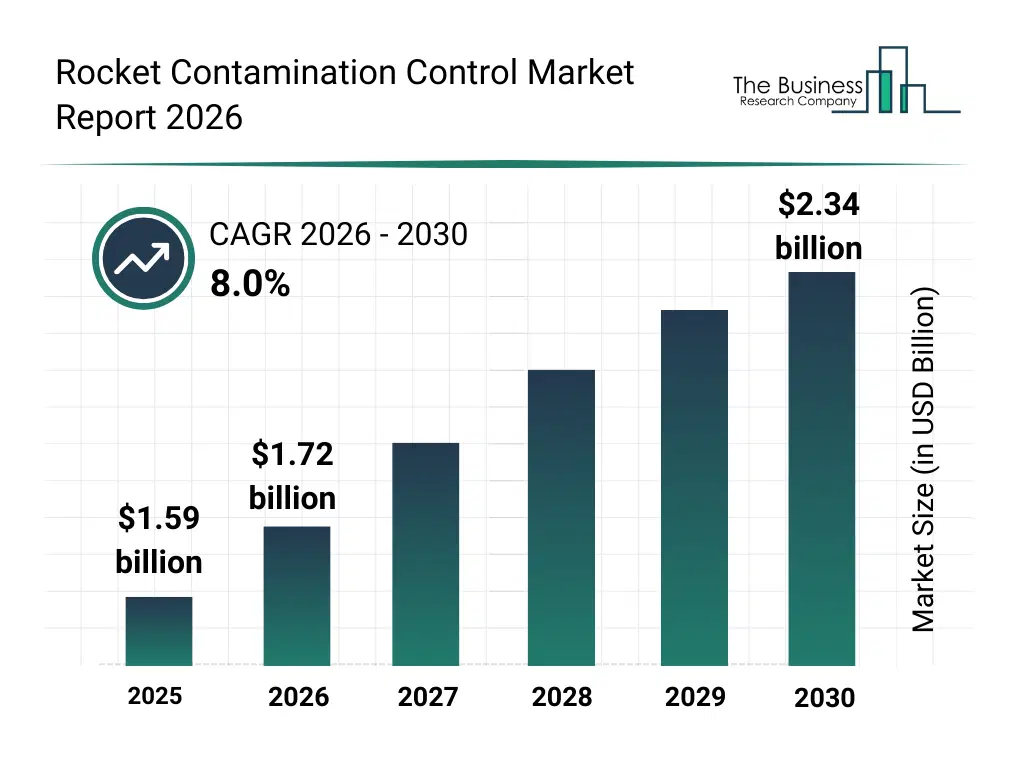
What Is The Rocket Contamination Control Market Size and Share 2026?
The rocket contamination control market size has grown strongly in recent years. It will grow from $1.59 billion in 2025 to $1.72 billion in 2026 at a compound annual growth rate (CAGR) of 8.2%. The growth in the historic period can be attributed to growing adoption of cleanroom apparel and packaging materials to protect sensitive rocket components, increasing deployment of air filtration systems to control particulate contamination in assembly environments, rising use of electrostatic discharge control products to safeguard electronic subsystems, early integration of surface particle detectors to ensure compliance with contamination thresholds, expansion of vacuum systems and cleanroom furniture supporting controlled manufacturing spaces.What Is The Rocket Contamination Control Market Growth Forecast?
The rocket contamination control market size is expected to see strong growth in the next few years. It will grow to $2.34 billion in 2030 at a compound annual growth rate (CAGR) of 8.0%. The growth in the forecast period can be attributed to rising demand for advanced environmental control systems to maintain ultra-clean conditions for next-generation rockets, increasing adoption of automated contamination monitoring tools for real-time quality assurance, growing use of specialized cleanroom materials to support reusable and high-performance propulsion systems, expansion of contamination control services as commercial launch activity accelerates, technological advancements enabling higher-efficiency filtration, detection accuracy, and contamination mitigation across rocket production cycles. Major trends in the forecast period include increased adoption of iso-classified cleanroom environments for assembly, growing use of real-time particle and molecular contamination monitoring, rising demand for cryogenic-compatible clean handling and packaging, expansion of esd and electrostatic control protocols for sensitive optics, integration of automated robotic cleaning and vacuum retrieval systems.
Global Rocket Contamination Control Market Segmentation
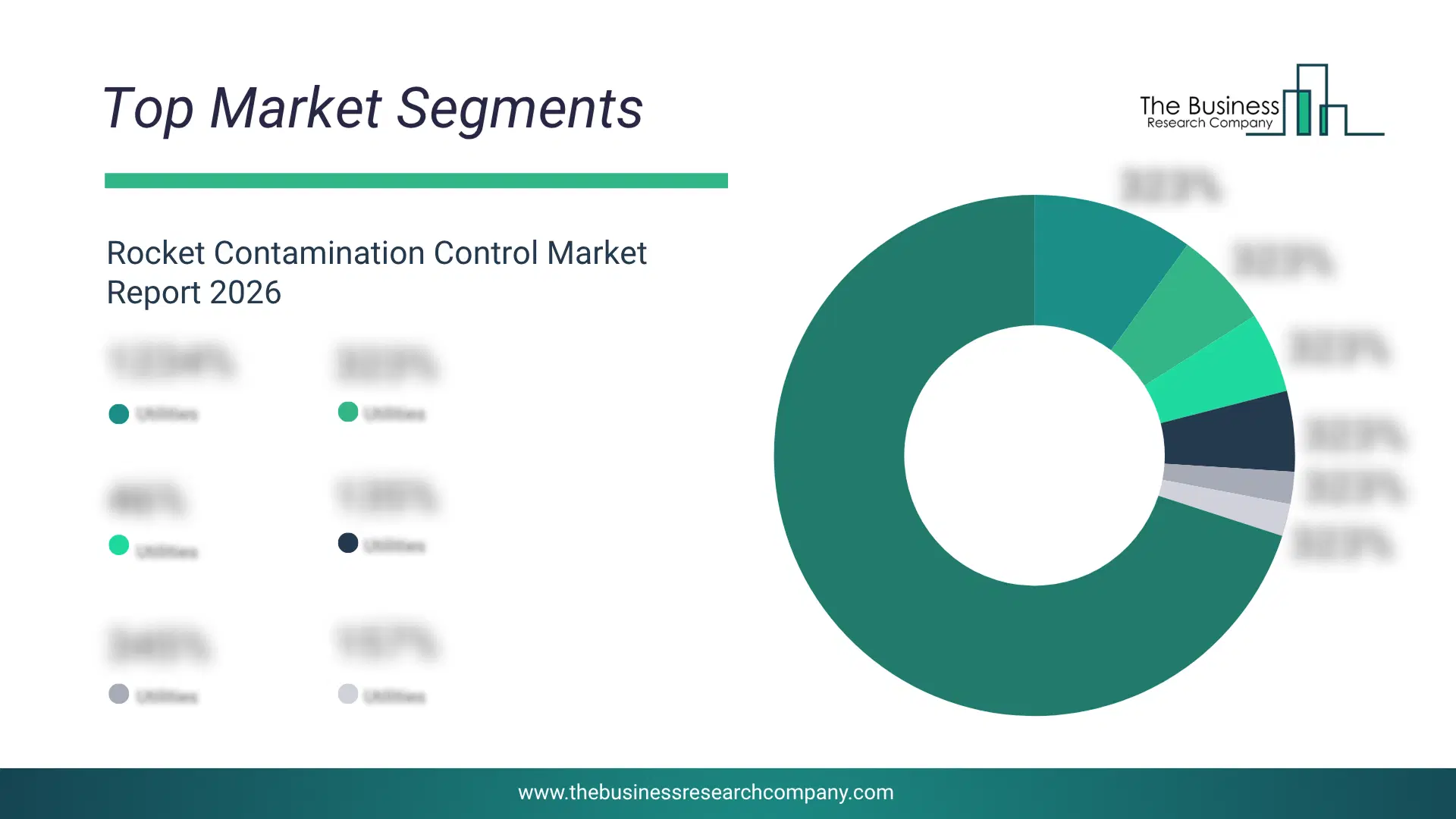
1) By Product Type: Cleanroom Consumables, Contamination Monitoring Instruments, Decontamination Equipment, Other Product Types 2) By Contaminant Type: Particulate, Molecular, Biological, Other Contaminant Types 3) By Application: Aerospace, Defense, Space Exploration, Other Applications Subsegments: 1) By Cleanroom Consumables: Cleanroom Apparel, Cleanroom Gloves, Cleanroom Wipes, Cleanroom Swabs, Face Masks, Shoe Covers 2) By Contamination Monitoring Instruments: Airborne Particle Counters, Microbial Air Samplers, Surface Monitoring Equipment, Liquid Particle Counters, Molecular Contamination Monitors 3) By Decontamination Equipment: UV-C Decontamination Systems, Vaporized Hydrogen Peroxide Systems, Dry Heat Sterilizers, Ultrasonic Cleaners, Gas Plasma Sterilizers 4) By Other Product Types: Cleaning Agents, Sterile Packaging Materials, Waste Disposal Systems, Sticky Mats, Disinfectant SpraysWhat Is Driver Of The Rocket Contamination Control Market?
The rise in investments in the space industry is expected to propel the growth of the rocket contamination control market going forward. Space industry investments refer to the allocation of financial resources to companies and technologies involved in space exploration, satellite development, and related infrastructure. The space industry investments are growing due to the demand for satellite-based services such as global communications, navigation, and Earth observation, which are essential for both commercial and government operations. Rising funding supports improvements in rocket contamination control by enabling advanced research and development of cleanroom technologies and precision assembly practices, which help maintain the integrity of spacecraft components. For instance, in June 2024, according to the Ministry of Foreign Affairs and Trade, a New Zealand-based government department, the UK committed to investing $12.5 billion (£10 billion) in space activities over the decade beginning in 2023, with $3.75 billion (£3 billion) earmarked in the 2023 spending review. Therefore, the rise in investments in the space industry is driving growth in the rocket contamination control market.Key Players In The Global Rocket Contamination Control Market
Major companies operating in the rocket contamination control market are RTX Corporation, The Boeing Company, Lockheed Martin Corporation, General Dynamics Corporation, Northrop Grumman Corporation, Honeywell International Inc., Parker-Hannifin Corporation, BAE Systems plc, L3Harris Technologies Inc., Ball Aerospace & Technologies Corp., IHI Corporation, Teledyne Technologies Incorporated, Donaldson Company Inc., QinetiQ Group plc, Sierra Nevada Corporation, OHB SE, RUAG Space AG, Terra Universal Inc., Atec Inc., G-CON LLC, Airbus Defence and Space SAS, Angstrom Technology Inc., Sub-Zero Engineering LLC, QleanAir AB, ACH Solutions Ltd, Clean-Tek Reinraumtechnik GmbH, CE Cleanrooms Ltd.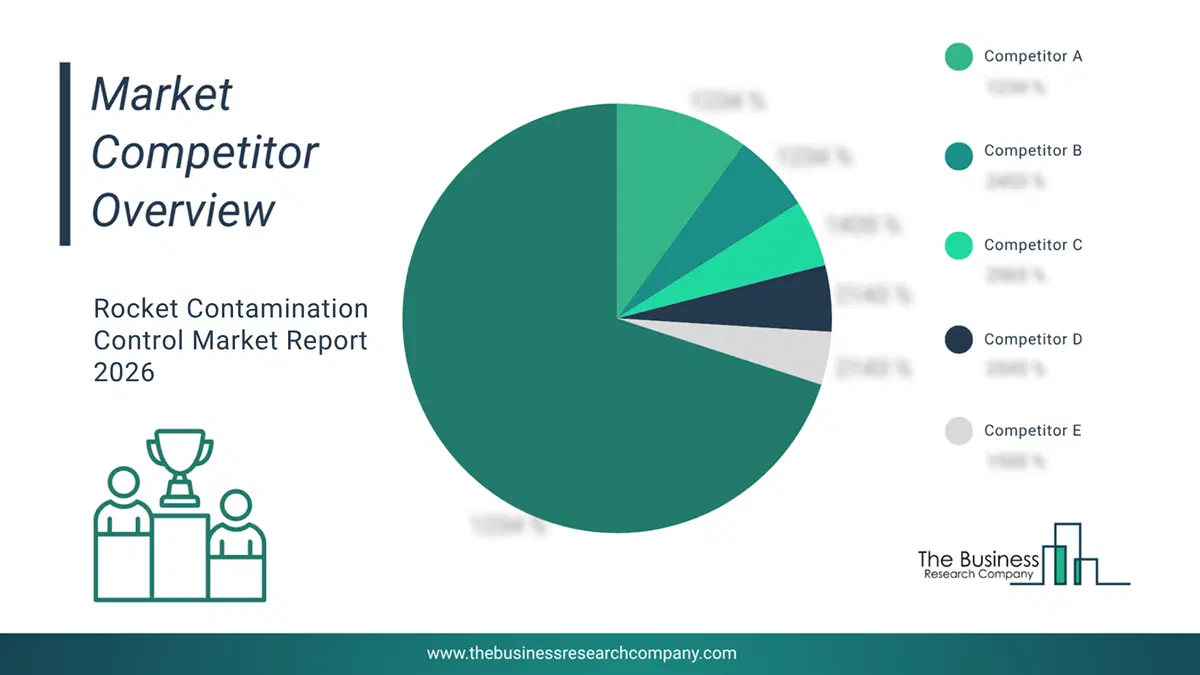
This chart is for illustrative purposes; the full report includes a detailed competitor analysis and comprehensive overview of the top 10 companies in the market.
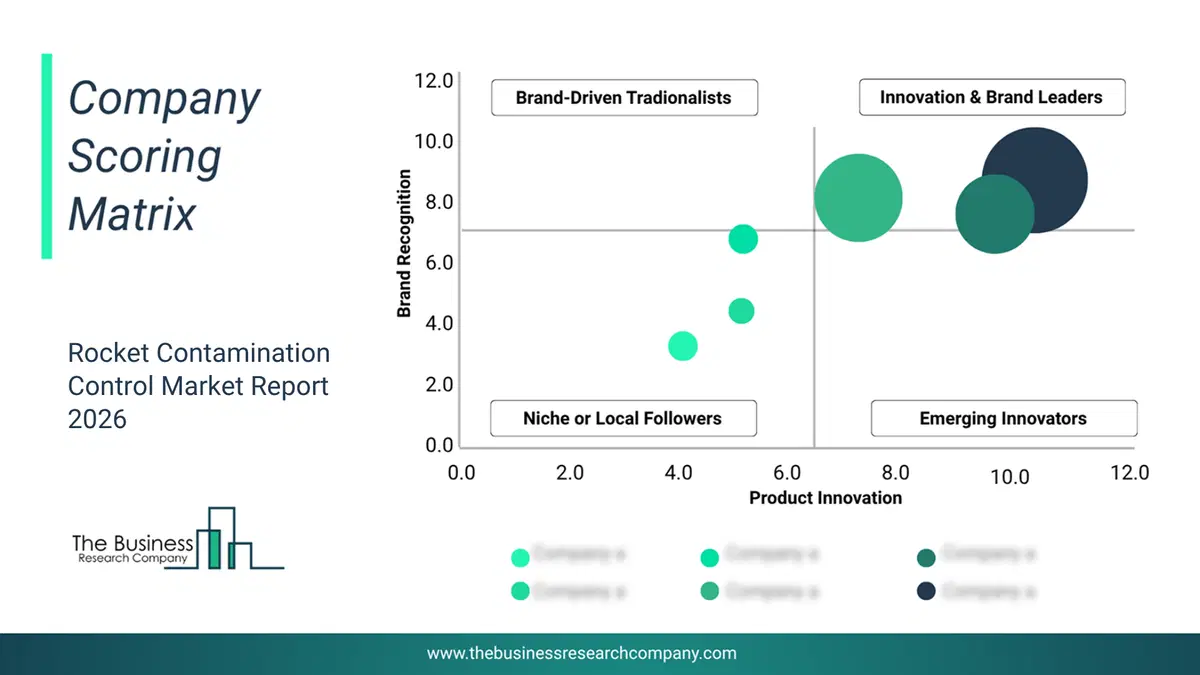
This chart maps companies by product innovation and brand strength, with bubble size indicating relative revenue, helping identify market leaders, challengers, and niche players. This is an illustrative chart; the full report provides a complete and accurate competitive analysis.
What Are Latest Mergers And Acquisitions In The Rocket Contamination Control Market? Smiths Group Partnered With ESA And ArianeGroup To Support Ariane 6 Launch
In July 2024, Smiths Group, a UK-based industrial technology company, partnered with the European Space Agency (ESA) and ArianeGroup to support the successful launch of Ariane 6 by providing high-reliability components critical to rocket performance and mission safety. Through its John Crane business, Smiths Group supplied advanced filtration and sieve technologies that enhanced contamination control, protecting Ariane 6’s propulsion and auxiliary systems from particulate and fluid impurities. The European Space Agency (ESA) is a France-based space agency specializing in space exploration, satellite missions, and launch vehicle development, and ArianeGroup is a France-based aerospace company specializing in the design and manufacture of launch vehicles.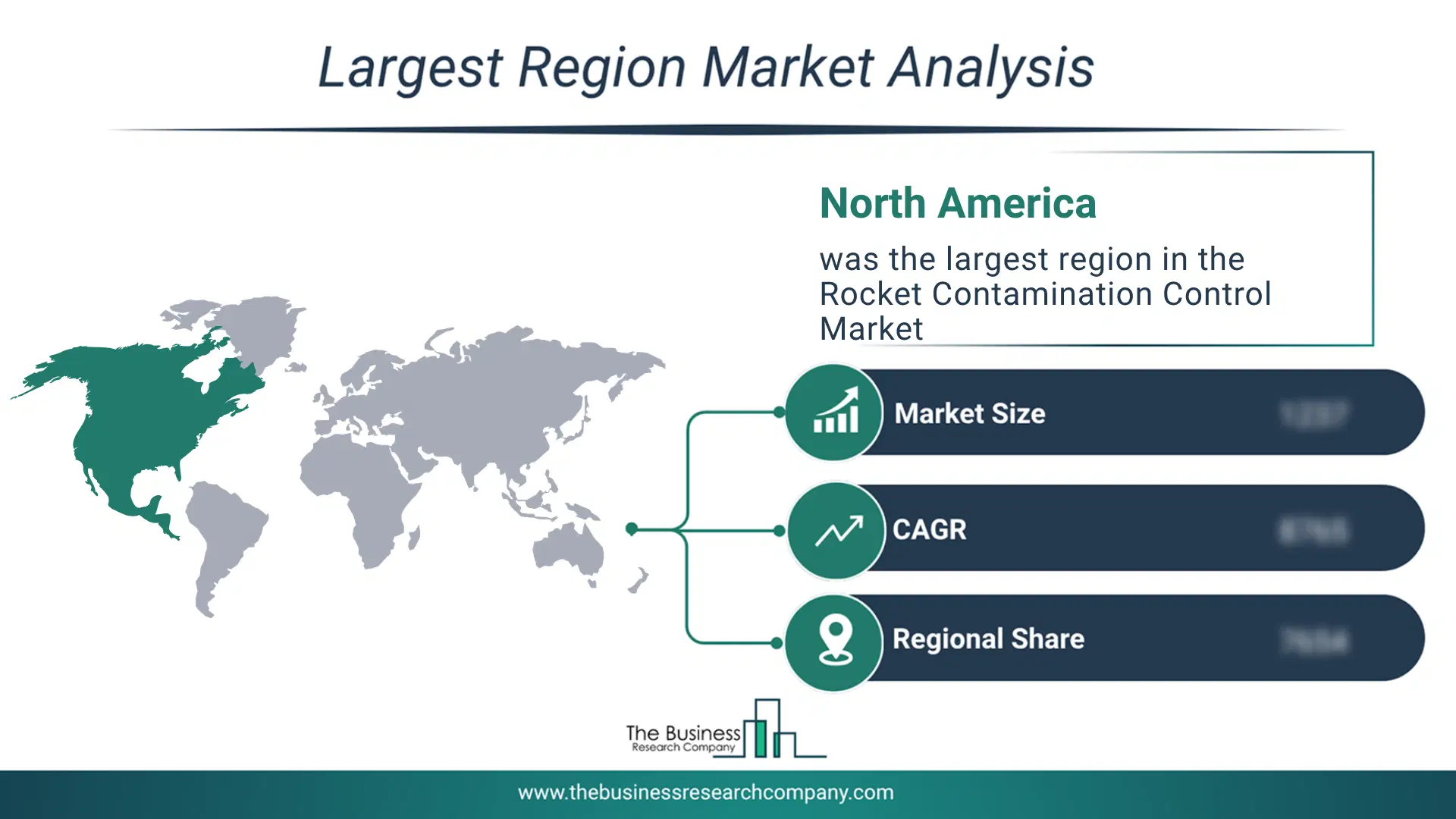
Regional Insights
North America was the largest region in the rocket contamination control market in 2025. Asia-Pacific is expected to be the fastest-growing region in the forecast period. The regions covered in this market report are Asia-Pacific, South East Asia, Western Europe, Eastern Europe, North America, South America, Middle East, Africa. The countries covered in this market report are Australia, Brazil, China, France, Germany, India, Indonesia, Japan, Taiwan, Russia, South Korea, UK, USA, Canada, Italy, SpainWhat Defines the Rocket Contamination Control Market?
The rocket contamination control market consists of sales of cleanroom apparel, air filtration systems, electrostatic discharge (ESD) control products, surface particle detectors, vacuum systems, cleanroom furniture, environmental control systems, and cleanroom packaging materials. Values in this market are ‘factory gate’ values, that is, the value of goods sold by the manufacturers or creators of the goods, whether to other entities (including downstream manufacturers, wholesalers, distributors, and retailers) or directly to end customers. The value of goods in this market includes related services sold by the creators of the goods.How is Market Value Defined and Measured?
The market value is defined as the revenues that enterprises gain from the sale of goods and/or services within the specified market and geography through sales, grants, or donations in terms of the currency (in USD unless otherwise specified). The revenues for a specified geography are consumption values that are revenues generated by organizations in the specified geography within the market, irrespective of where they are produced. It does not include revenues from resales along the supply chain, either further along the supply chain or as part of other products.
This chart presents market attractiveness based on a quantitative evaluation of growth, competition, strategic alignment, and risk, offering a clear view of opportunity areas for decision-making. This chart is for illustrative purposes; the full report contains the complete analysis.

This chart highlights the Total Addressable Market (TAM) by estimating the maximum revenue opportunity using an assumption-driven approach, supporting strategic planning and opportunity sizing across markets. The chart is illustrative; the full report provides a more comprehensive analysis.
What Key Data and Analysis Are Included in the Rocket Contamination Control Market Report 2026?
The rocket contamination control market research report is one of a series of new reports from The Business Research Company that provides market statistics, including industry global market size, regional shares, competitors with the market share, detailed market segments, market trends and opportunities, and any further data you may need to thrive in the rocket contamination control industry. The market research report delivers a complete perspective of everything you need, with an in-depth analysis of the current and future state of the industry.Rocket Contamination Control Market Report Forecast Analysis
| Report Attribute | Details |
|---|---|
| Market Size Value In 2026 | $1.72 billion |
| Revenue Forecast In 2030 | $2.34 billion |
| Growth Rate | CAGR of 8% from 2026 to 2030 |
| Base Year For Estimation | 2025 |
| Actual Estimates/Historical Data | 2020-2025 |
| Forecast Period | 2026 - 2030 |
| Market Representation | Revenue in USD Billion and CAGR from 2026 to 2030 |
| Segments Covered | Product Type, Contaminant Type, Application |
| Regional Scope | Asia-Pacific, Western Europe, Eastern Europe, North America, South America, Middle East, Africa |
| Country Scope | The countries covered in the rocket contamination control market report are Australia, Brazil, China, France, Germany, India, Indonesia, Japan, Taiwan, Russia, South Korea, UK, USA, Canada, Italy, Spain |
| Key Companies Profiled | RTX Corporation, The Boeing Company, Lockheed Martin Corporation, General Dynamics Corporation, Northrop Grumman Corporation, Honeywell International Inc., Parker-Hannifin Corporation, BAE Systems plc, L3Harris Technologies Inc., Ball Aerospace & Technologies Corp., IHI Corporation, Teledyne Technologies Incorporated, Donaldson Company Inc., QinetiQ Group plc, Sierra Nevada Corporation, OHB SE, RUAG Space AG, Terra Universal Inc., Atec Inc., G-CON LLC, Airbus Defence and Space SAS, Angstrom Technology Inc., Sub-Zero Engineering LLC, QleanAir AB, ACH Solutions Ltd, Clean-Tek Reinraumtechnik GmbH, CE Cleanrooms Ltd. |
| Customization Scope | Request for Customization |
| Pricing And Purchase Options | Explore Purchase Options |