
Rocket Deorbiting Systems Market Report 2026
Global Outlook – By Type (Active Deorbiting Systems, Passive Deorbiting Systems), By Technology (Chemical Propulsion, Electric Propulsion, Hybrid Propulsion, Other Technologies), By Application (Commercial, Military, Government, Other Applications), By End-User (Satellite Operators, Space Agencies, Defense Organizations, Other End-Users) – Market Size, Trends, Strategies, and Forecast to 2030
Rocket Deorbiting Systems Market Overview
• Rocket Deorbiting Systems market size has reached to $2.62 billion in 2025 • Expected to grow to $4.15 billion in 2030 at a compound annual growth rate (CAGR) of 9.6% • Growth Driver: The Rise In Space Debris Is Fueling The Growth Of The Market Due To Increasing Collision Risks And The Need For Sustainable Orbital Management • Market Trend: Advancements In Propulsion-Based Systems Drive Safer And More Controlled Rocket Deorbiting • North America was the largest region in 2025 and Asia-Pacific is the fastest growing region.What Is Covered Under Rocket Deorbiting Systems Market?
Rocket deorbiting systems are advanced solutions developed to safely return rockets or their parts from orbit once a mission ends. They enable controlled descent into Earth's atmosphere or transfer to a graveyard orbit. Rocket deorbiting systems aim to prevent space debris, lower the risk of in-orbit collisions, and promote long-term sustainability in space activities. The main types of rocket deorbiting systems are active deorbiting systems and passive deorbiting systems. Active deorbiting systems use controlled methods to safely and precisely remove spacecraft from orbit, reducing space debris. It utilizes various technologies, such as chemical propulsion, electric propulsion, hybrid propulsion, and others, for several applications, including commercial, military, governmental, and others, and is used by various end users, such as satellite operators, space agencies, defense organizations, and others.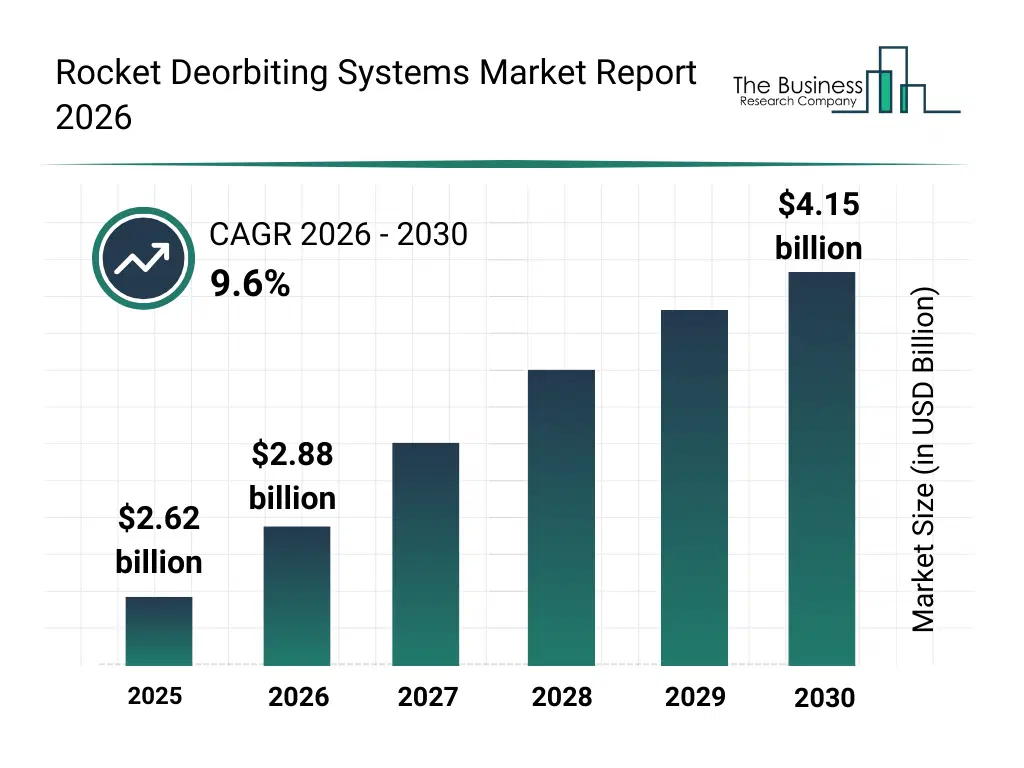
What Is The Rocket Deorbiting Systems Market Size and Share 2026?
The rocket deorbiting systems market size has grown strongly in recent years. It will grow from $2.62 billion in 2025 to $2.88 billion in 2026 at a compound annual growth rate (CAGR) of 9.9%. The growth in the historic period can be attributed to increasing satellite launches driving early demand for post-mission disposal solutions, rising concerns over orbital debris following major fragmentation events, initial regulatory actions encouraging responsible end-of-life procedures, technological advancements in small satellite propulsion enabling basic deorbit capabilities, early adoption of deorbit kits by government-led space missions to minimize long-term debris risks.What Is The Rocket Deorbiting Systems Market Growth Forecast?
The rocket deorbiting systems market size is expected to see strong growth in the next few years. It will grow to $4.15 billion in 2030 at a compound annual growth rate (CAGR) of 9.6%. The growth in the forecast period can be attributed to expansion of commercial constellations requiring scalable deorbiting solutions, tightening global space sustainability regulations mandating end-of-life compliance, growing integration of autonomous deorbiting technologies to reduce mission costs, rising demand for retrofitting hardware for legacy satellites nearing end of life, increased collaboration between space agencies and private firms to standardize deorbiting frameworks. Major trends in the forecast period include increasing use of autonomous end-of-life deorbiting kits, growing adoption of electrodynamic tethers for passive deorbiting, expansion of in-orbit servicing and active removal partnerships, standardization of deorbiting protocols and regulatory compliance, development of low-mass retrofits for legacy satellites.
Global Rocket Deorbiting Systems Market Segmentation
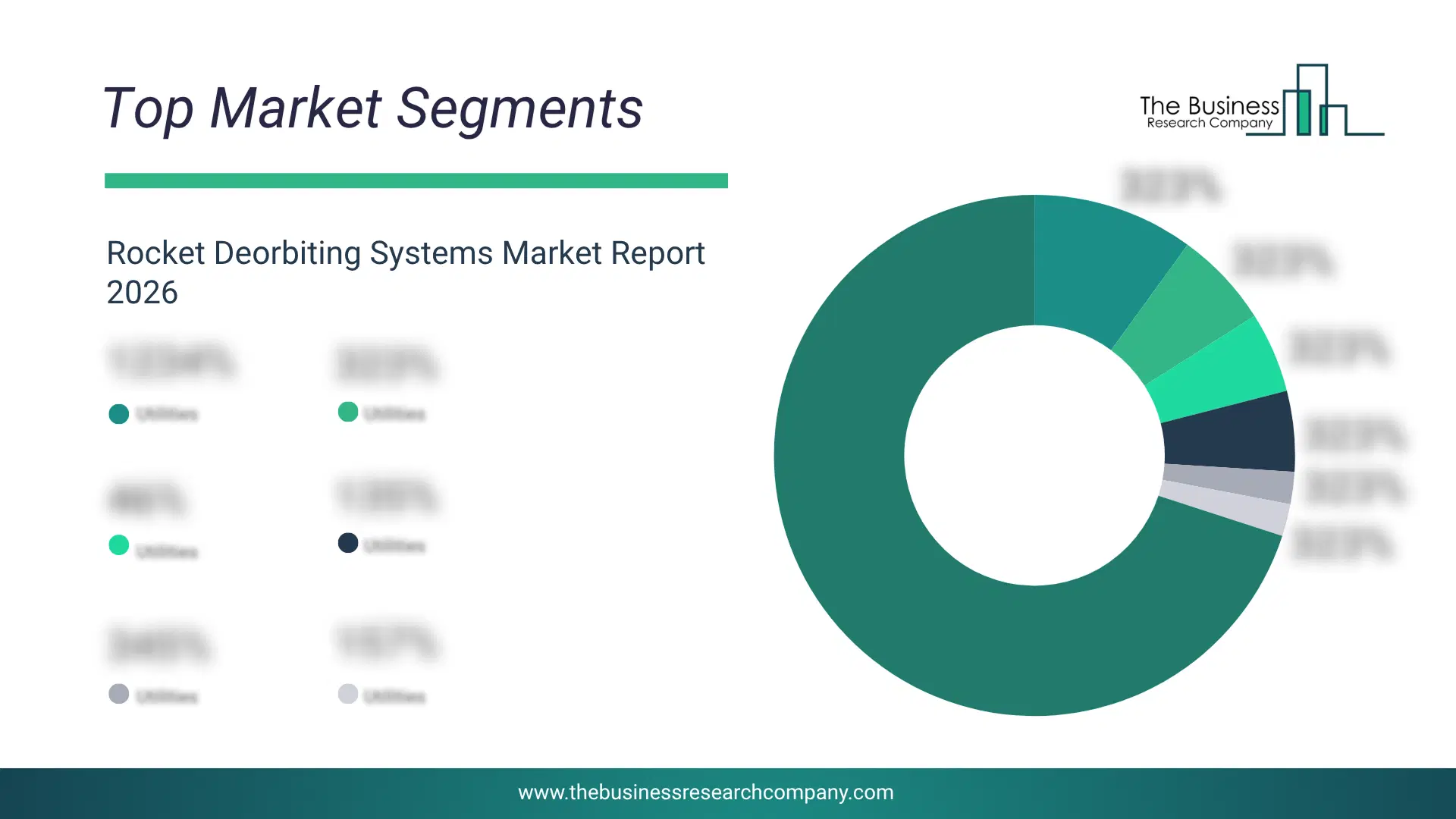
1) By Type: Active Deorbiting Systems, Passive Deorbiting Systems 2) By Technology: Chemical Propulsion, Electric Propulsion, Hybrid Propulsion, Other Technologies 3) By Application: Commercial, Military, Government, Other Applications 5) By End-User: Satellite Operators, Space Agencies, Defense Organizations, Other End-Users Subsegments: 1) By Active Deorbiting Systems: Propulsion-Based Systems, Electrodynamic Tethers, Laser Ablation Systems, Robotic Arm Capture Systems 2) By Passive Deorbiting Systems: Drag Augmentation Devices, Aerodynamic Stabilizers, Sublimating Materials, Shape-Memory PolymersWhat Is Driver Of The Rocket Deorbiting Systems Market?
The rise in space debris is expected to propel the growth of the rocket deorbiting systems market going forward. Space debris, also known as orbital debris or space junk, refers to non-functional, human-made objects orbiting Earth that no longer serve any useful purpose. It includes defunct satellites, spent rocket stages, and fragments resulting from collisions, explosions, or disintegration of spacecraft. The increase in space debris is due to the surge in satellite constellations, as companies are rapidly launching large numbers of small satellites to provide global coverage for services such as broadband internet. Rocket deorbiting systems minimize space debris by ensuring defunct rockets and spacecraft are safely deorbited or moved to graveyard orbits. It reduces collision risks and promotes a cleaner, more sustainable space environment. For instance, in May 2025, according to the European Space Agency, a France-based organization devoted to space exploration, there are approximately 1.2 million space debris objects measuring between 1 cm and 10 cm and 140 million smaller fragments ranging from 1 mm to 1 cm. Therefore, the rise in space debris is driving the growth of the rocket deorbiting systems industry.Key Players In The Global Rocket Deorbiting Systems Market
Major companies operating in the rocket deorbiting systems market are Kawasaki Heavy Industries Ltd., Space Exploration Technologies Corp. (SpaceX), Astroscale, Firefly Aerospace Inc., Surrey Satellite Technology Limited, ClearSpace SA, Space Flight Laboratory, MMA Design LLC, ThrustMe S.A.S., High Performance Space Structure Systems GmbH, D-Orbit S.p.A., Motiv Space Systems Inc., Orbotic Systems Inc., Kall Morris Inc. (KMI), Kurs Orbital Inc., CU Aerospace L.L.C., OrbitGuardians Inc., Skyrora Limited, Spaceo Inc., Vestigo Aerospace LLC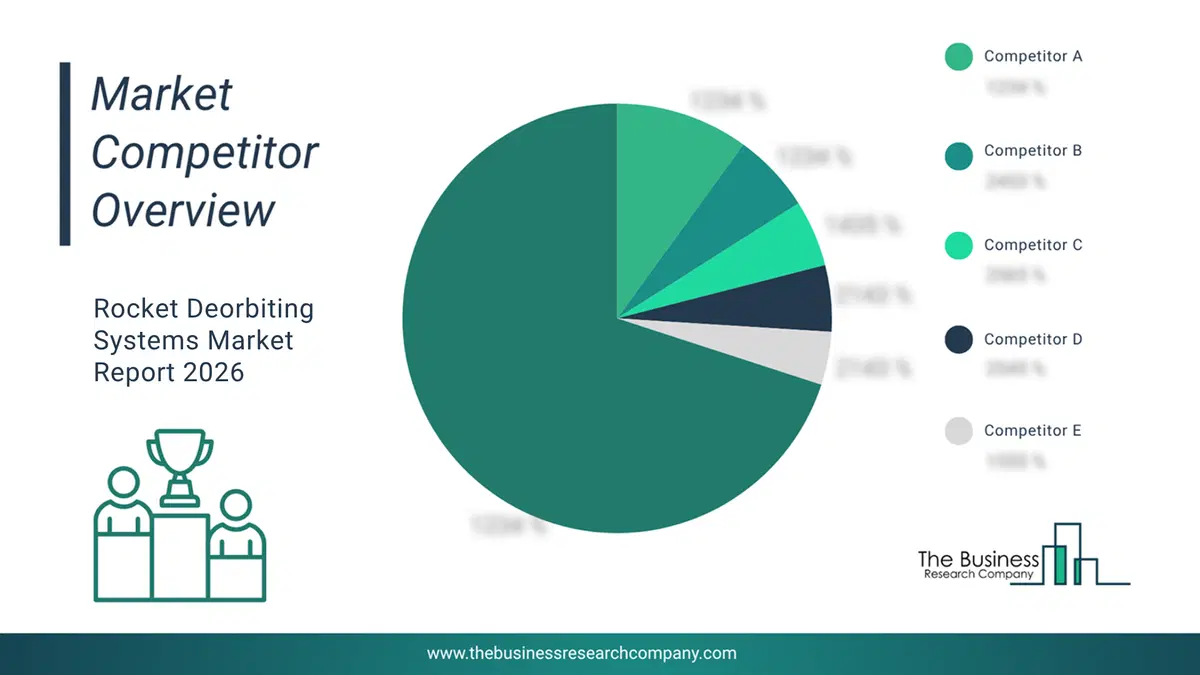
This chart is for illustrative purposes; the full report includes a detailed competitor analysis and comprehensive overview of the top 10 companies in the market.
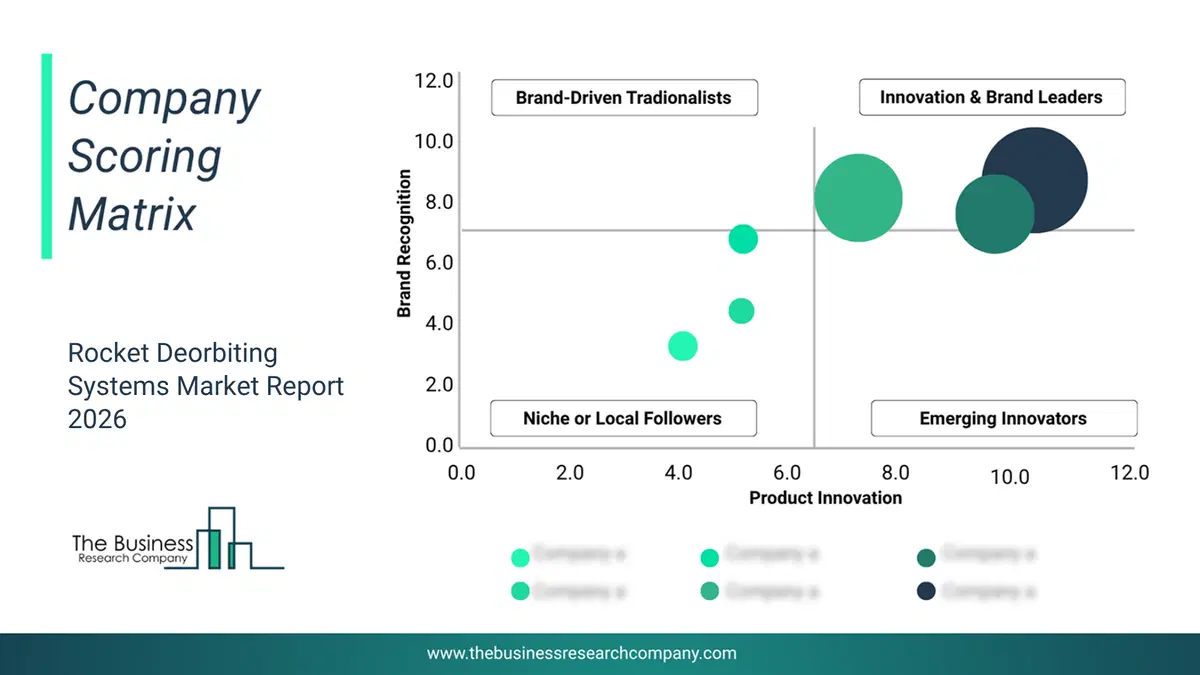
This chart maps companies by product innovation and brand strength, with bubble size indicating relative revenue, helping identify market leaders, challengers, and niche players. This is an illustrative chart; the full report provides a complete and accurate competitive analysis.
Global Rocket Deorbiting Systems Market Trends and Insights
Major companies operating in the rocket deorbiting systems market are focusing on developing advanced solutions, such as propulsion-based deorbiting systems, to ensure precise and controlled reentry and reduce orbital debris. Propulsion-based deorbiting systems use onboard engines to actively guide rockets or spacecraft out of orbit by reducing their velocity. This precise and reliable method is ideal for safely deorbiting large or high-altitude objects. For instance, in June 2024, The Aerospace Corporation, a US-based nonprofit space research and development organization, developed a new prototype deorbit motor. It enables small spacecraft such as CubeSats to safely and efficiently deorbit at the end of their missions. This innovative motor uses a commercial off-the-shelf solid-propellant rocket with a unique deflector plate and nozzle design, creating spin-stabilized axial thrust for controlled reentry, even for satellites that have lost some attitude control. The technology addresses new regulatory requirements, such as the FCC’s five-year deorbit rule. It helps mitigate the growing risk of space debris by allowing operators to retire satellites on demand, improving sustainability in space operations.What Are Latest Mergers And Acquisitions In The Rocket Deorbiting Systems Market? Astroscale Partnered With Digantara And Bellatrix Aerospace To Boost Sustainable Orbital Services In Asia-Pacific
In March 2025, Astroscale, a Japan-based provider of orbital debris removal and satellite life-extension services, partnered with Digantara and Bellatrix Aerospace to enhance orbital services across the Asia-Pacific region. With this partnership, Astroscale aims to combine its end-of-life servicing expertise with Digantara’s space situational awareness and Bellatrix’s in-space mobility systems to support safer and more sustainable satellite operations. Digantara is an India-based space tech startup at the forefront of space situational awareness (SSA) and space traffic management. Bellatrix Aerospace is an India-based space firm focused on orbital data infrastructure.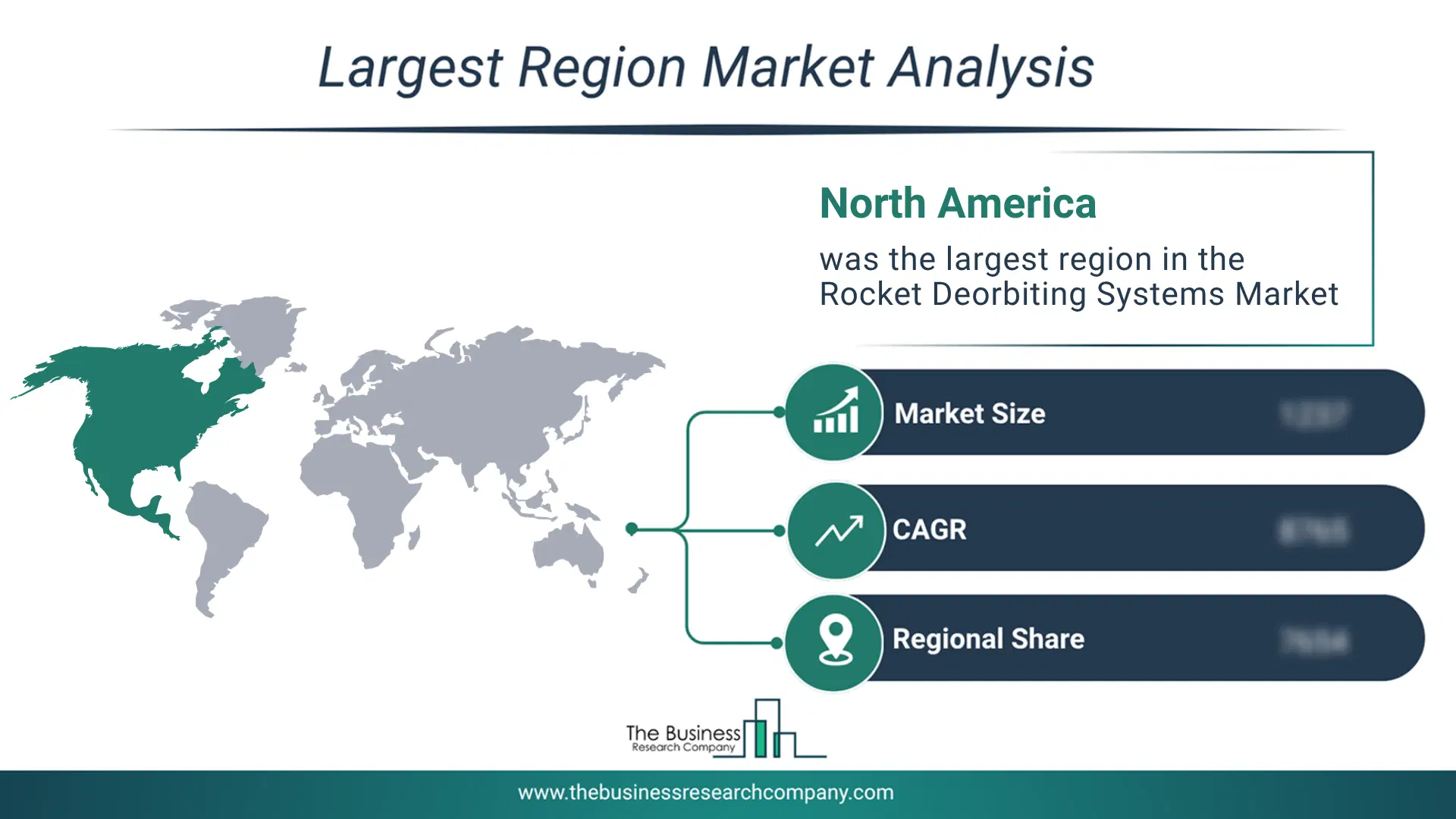
Regional Insights
North America was the largest region in the rocket deorbiting systems market in 2025. Asia-Pacific is expected to be the fastest-growing region in the forecast period. The regions covered in this market report are Asia-Pacific, South East Asia, Western Europe, Eastern Europe, North America, South America, Middle East, Africa. The countries covered in this market report are Australia, Brazil, China, France, Germany, India, Indonesia, Japan, Taiwan, Russia, South Korea, UK, USA, Canada, Italy, SpainWhat Defines the Rocket Deorbiting Systems Market?
The rocket deorbiting systems market consists of revenues earned by entities by providing services such as orbital path correction, end-of-life satellite disposal, deorbit planning consultancy, and mission assurance support. The market value includes the value of related goods sold by the service provider or included within the service offering. The rocket deorbiting systems market includes sales of thruster modules, autonomous deorbit kits, integrated satellite components, and retrofitting hardware. Values in this market are ‘factory gate’ values, that is, the value of goods sold by the manufacturers or creators of the goods, whether to other entities (including downstream manufacturers, wholesalers, distributors, and retailers) or directly to end customers. The value of goods in this market includes related services sold by the creators of the goods.How is Market Value Defined and Measured?
The market value is defined as the revenues that enterprises gain from the sale of goods and/or services within the specified market and geography through sales, grants, or donations in terms of the currency (in USD unless otherwise specified). The revenues for a specified geography are consumption values that are revenues generated by organizations in the specified geography within the market, irrespective of where they are produced. It does not include revenues from resales along the supply chain, either further along the supply chain or as part of other products.
This chart presents market attractiveness based on a quantitative evaluation of growth, competition, strategic alignment, and risk, offering a clear view of opportunity areas for decision-making. This chart is for illustrative purposes; the full report contains the complete analysis.

This chart highlights the Total Addressable Market (TAM) by estimating the maximum revenue opportunity using an assumption-driven approach, supporting strategic planning and opportunity sizing across markets. The chart is illustrative; the full report provides a more comprehensive analysis.
What Key Data and Analysis Are Included in the Rocket Deorbiting Systems Market Report 2026?
The rocket deorbiting systems market research report is one of a series of new reports from The Business Research Company that provides market statistics, including industry global market size, regional shares, competitors with the market share, detailed market segments, market trends and opportunities, and any further data you may need to thrive in the rocket deorbiting systems industry. The market research report delivers a complete perspective of everything you need, with an in-depth analysis of the current and future state of the industry.Rocket Deorbiting Systems Market Report Forecast Analysis
| Report Attribute | Details |
|---|---|
| Market Size Value In 2026 | $2.88 billion |
| Revenue Forecast In 2030 | $4.15 billion |
| Growth Rate | CAGR of 9.6% from 2026 to 2030 |
| Base Year For Estimation | 2025 |
| Actual Estimates/Historical Data | 2020-2025 |
| Forecast Period | 2026 - 2030 |
| Market Representation | Revenue in USD Billion and CAGR from 2026 to 2030 |
| Segments Covered | Type, Technology, Application, End-User |
| Regional Scope | Asia-Pacific, Western Europe, Eastern Europe, North America, South America, Middle East, Africa |
| Country Scope | The countries covered in the rocket deorbiting systems market report are Australia, Brazil, China, France, Germany, India, Indonesia, Japan, Taiwan, Russia, South Korea, UK, USA, Canada, Italy, Spain |
| Key Companies Profiled | Kawasaki Heavy Industries Ltd., Space Exploration Technologies Corp. (SpaceX), Astroscale, Firefly Aerospace Inc., Surrey Satellite Technology Limited, ClearSpace SA, Space Flight Laboratory, MMA Design LLC, ThrustMe S.A.S., High Performance Space Structure Systems GmbH, D-Orbit S.p.A., Motiv Space Systems Inc., Orbotic Systems Inc., Kall Morris Inc. (KMI), Kurs Orbital Inc., CU Aerospace L.L.C., OrbitGuardians Inc., Skyrora Limited, Spaceo Inc., Vestigo Aerospace LLC |
| Customization Scope | Request for Customization |
| Pricing And Purchase Options | Explore Purchase Options |