
Rocket Exhaust Plume Management Market Report 2026
Global Outlook – By Component (Nozzles, Plume Deflectors, Exhaust Systems), By Technology (Active Control, Passive Control), By Application (Space Launch Vehicles, Military Missiles, Commercial Rockets), By End-User (Government, Commercial, Defense) – Market Size, Trends, Strategies, and Forecast to 2030
Rocket Exhaust Plume Management Market Overview
• Rocket Exhaust Plume Management market size has reached to $1.24 billion in 2025 • Expected to grow to $1.86 billion in 2030 at a compound annual growth rate (CAGR) of 8.3% • Growth Driver: Rising Satellite Launches Fueling The Growth Of The Market Due To Expanding Demand For High-Speed Internet Connectivity • Market Trend: Integration Of Advanced Thermal Protection Systems Enhancing Launch Pad Efficiency And Reusability • North America was the largest region in 2025.What Is Covered Under Rocket Exhaust Plume Management Market?
Rocket exhaust plume management refers to the processes and strategies used to monitor, control, and mitigate the effects of high-temperature, high-velocity gases expelled from a rocket during launch or flight. These plumes, composed of various gases and particulates, can influence both the rocket’s structural components and the surrounding environment. Effective management ensures the safe dissipation of thermal energy and pressure, minimizes structural erosion or contamination, and reduces interference with onboard systems or ground-based facilities. The main components of rocket exhaust plume management include nozzles, plume deflectors, and exhaust systems. Nozzles are the parts of a rocket engine that direct and accelerate the exhaust gases out of the engine. It uses various technologies such as active control and passive control and is applied for space launch vehicles, military missiles, and commercial rockets. It is used by several end-users, including government, commercial, and defense.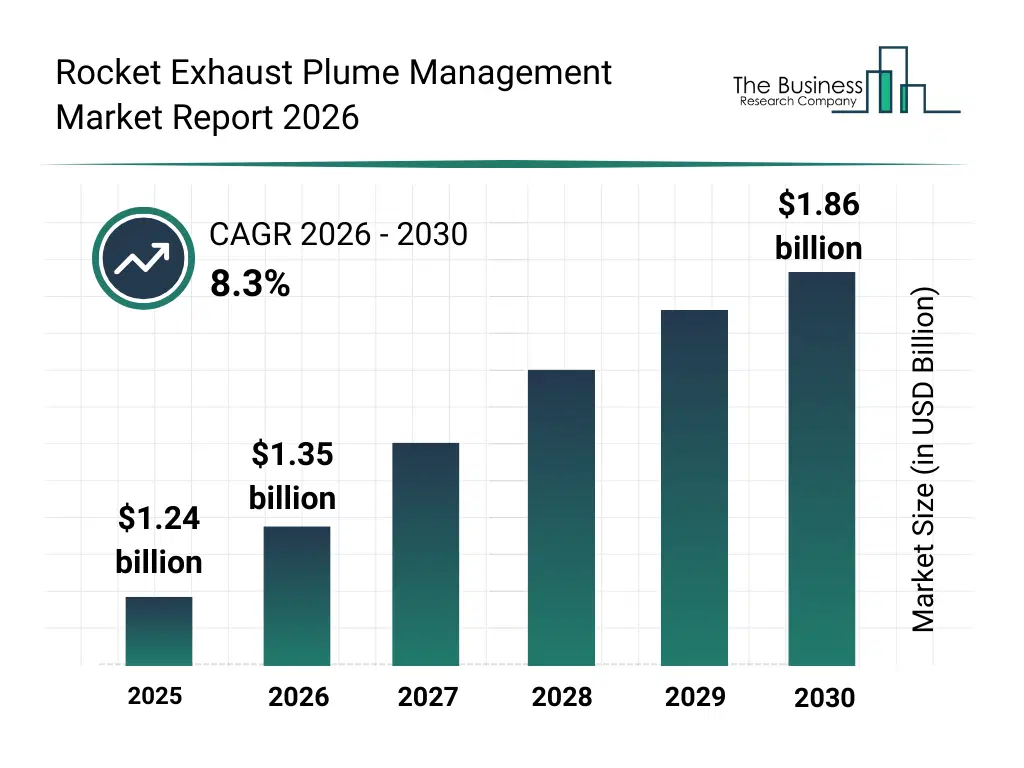
What Is The Rocket Exhaust Plume Management Market Size and Share 2026?
The rocket exhaust plume management market size has grown strongly in recent years. It will grow from $1.24 billion in 2025 to $1.35 billion in 2026 at a compound annual growth rate (CAGR) of 8.9%. The growth in the historic period can be attributed to increasing launch vehicle thrust levels driving demand for advanced plume pressure modeling, early adoption of acoustic mitigation systems to protect launch infrastructure, development of thermal protection materials to reduce erosion from high-temperature exhaust, growth in government space programs requiring plume signature and environmental assessments, advancements in computational fluid dynamics enabling more accurate exhaust flow analysis.What Is The Rocket Exhaust Plume Management Market Growth Forecast?
The rocket exhaust plume management market size is expected to see strong growth in the next few years. It will grow to $1.86 billion in 2030 at a compound annual growth rate (CAGR) of 8.3%. The growth in the forecast period can be attributed to rising commercial launch frequency increasing demand for scalable plume diagnostic and suppression systems, stricter environmental regulations driving adoption of advanced plume impact consulting services, innovation in particle analysis technologies improving plume monitoring accuracy, expansion of reusable launch platforms requiring enhanced protection of ground facilities and vehicle structures, increasing investment in high-energy propulsion systems necessitating more sophisticated plume behavior modeling. Major trends in the forecast period include advanced plume simulation and modeling tools, next-generation sound suppression system development, high-temperature thermal protection material innovation, enhanced plume signature reduction technologies, integrated launch pad exhaust flow optimization.
Global Rocket Exhaust Plume Management Market Segmentation
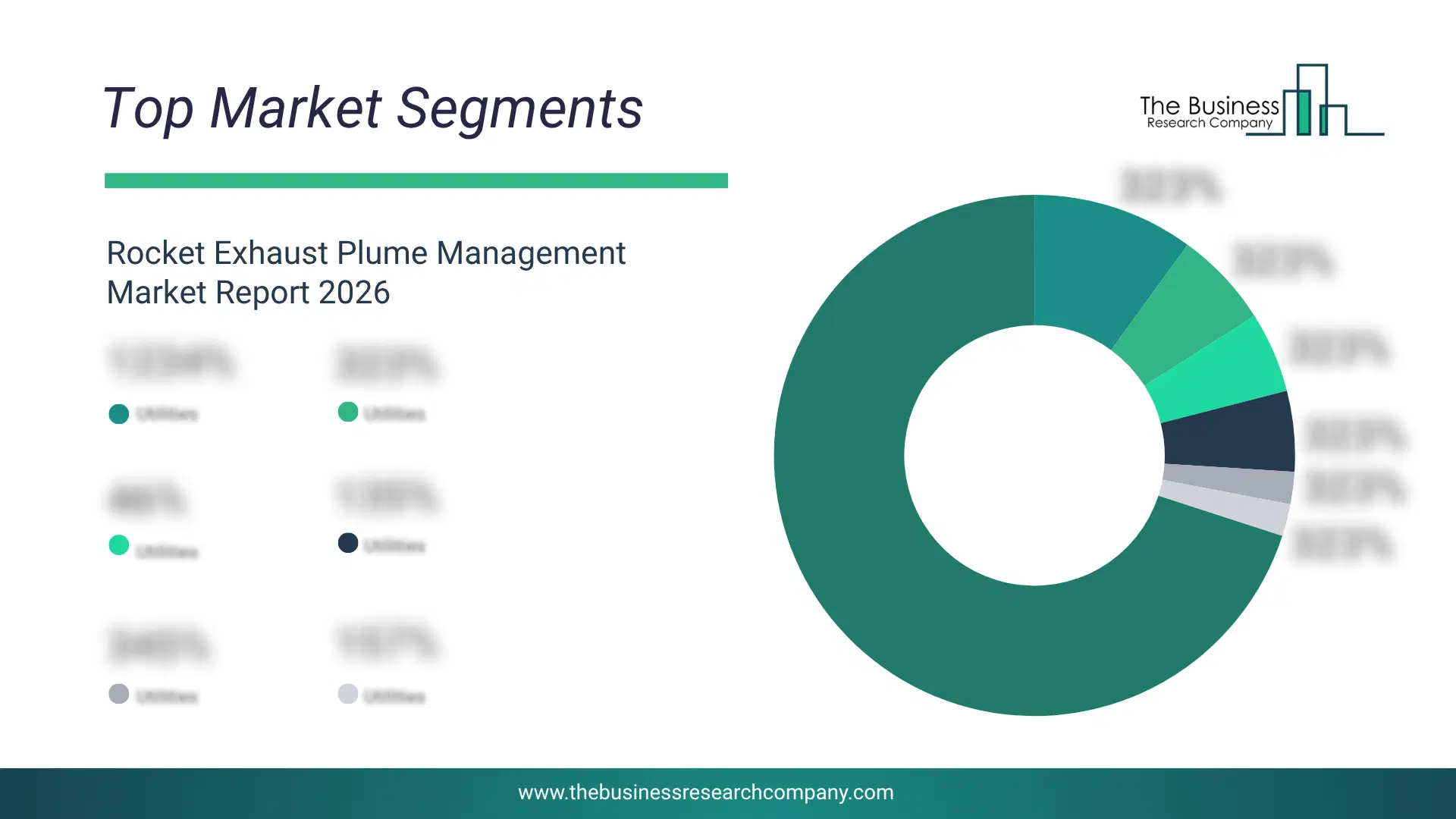
1) By Component: Nozzles, Plume Deflectors, Exhaust Systems 2) By Technology: Active Control, Passive Control 3) By Application: Space Launch Vehicles, Military Missiles, Commercial Rockets 4) By End-User: Government, Commercial, Defense Subsegments: 1) By Nozzles: Convergent-Divergent Nozzles, Aerospike Nozzles, Plug Nozzles, Expansion-Deflection Nozzles 2) By Plume Deflectors: Water-Cooled Deflectors, Steel Plate Deflectors, Flame Trenches, Movable Deflection Systems 3) By Exhaust Systems: Ducted Exhaust Systems, Open Flame Exhaust Systems, Subterranean Exhaust Systems, Refractory-Lined Exhaust SystemsWhat Is Driver Of The Rocket Exhaust Plume Management Market?
The increasing number of satellite deployments is anticipated to fuel the growth of the rocket exhaust plume management market in the coming years. A satellite is an object placed in orbit around a celestial body to revolve around it due to gravitational forces. The number of satellite deployments is rising due to growing demand for high-speed internet, prompting launches of large constellations for broader and more reliable coverage. This rise supports the demand for rocket exhaust plume management, as more frequent launches require precise control and analysis of exhaust plumes to prevent damage to onboard instruments, ensure flight safety, and maintain environmental compliance. For instance, in May 2024, according to the National Space Operations Centre (NSpOC), a UK-based organization focused on space surveillance and protection, there were more than 9,000 active satellites in orbit by April 2024, and estimates suggest this number could grow to over 60,000 by the year 2030. Therefore, the increasing number of satellite deployments will boost the growth of the rocket exhaust plume management industry.Key Players In The Global Rocket Exhaust Plume Management Market
Major companies operating in the rocket exhaust plume management market are Lockheed Martin Corp., Northrop Grumman Corporation, Mitsubishi Heavy Industries Ltd., IHI Corp., Blue Origin LLC, ArianeGroup, Aerojet Rocketdyne Holdings Inc., Nammo Inc., Tecomet Inc., The Lee Company, Relativity Space Inc., Firefly Aerospace Inc., Weldaloy Products Co., Delta Centrifugal Corp., Advanced Structural Technologies Inc., PMF Industries Inc., Reaction Engines Ltd., NACCO Aerospace, Monterey Machine Products, Impact Innovations GmbH.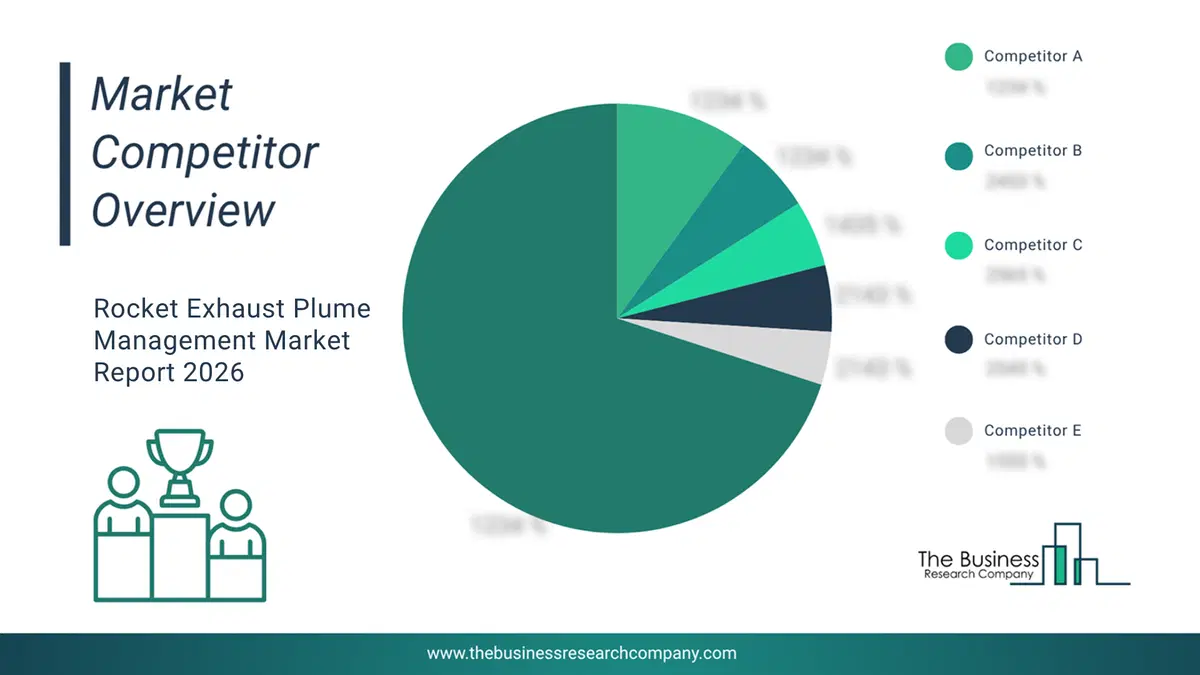
This chart is for illustrative purposes; the full report includes a detailed competitor analysis and comprehensive overview of the top 10 companies in the market.
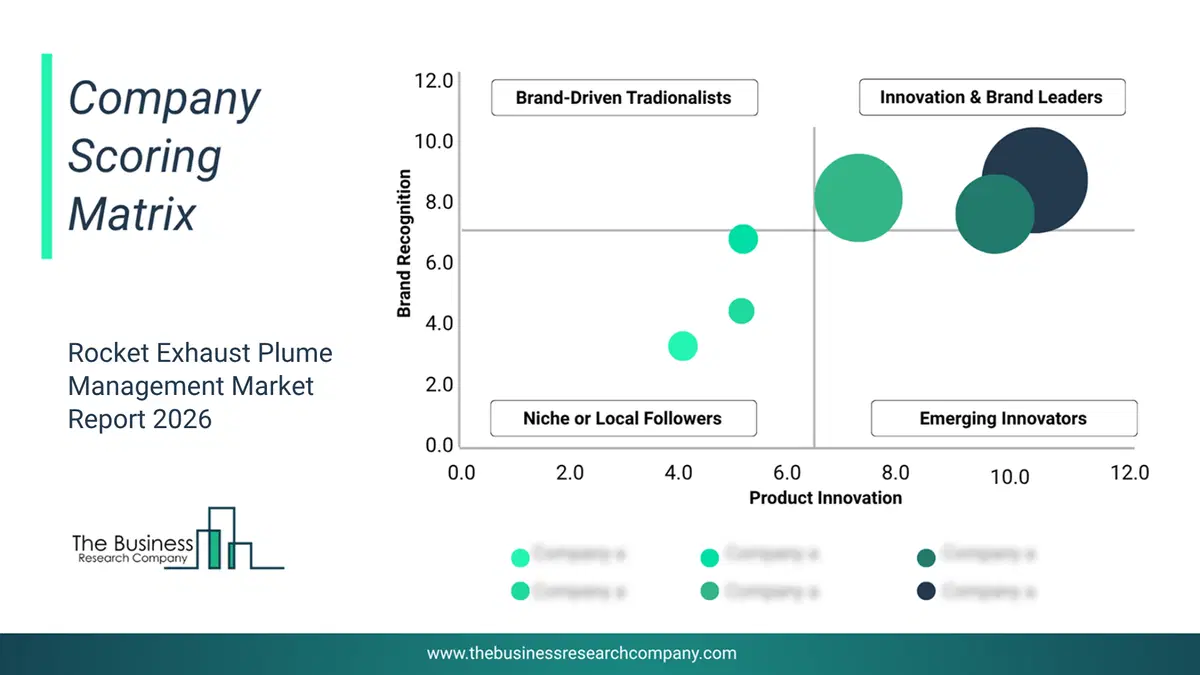
This chart maps companies by product innovation and brand strength, with bubble size indicating relative revenue, helping identify market leaders, challengers, and niche players. This is an illustrative chart; the full report provides a complete and accurate competitive analysis.
Global Rocket Exhaust Plume Management Market Trends and Insights
Major companies operating in the rocket exhaust plume management market are focusing on developing advanced solutions, such as thermally protected launchpads, to enhance the longevity and reliability of launch facilities. Thermally protected launchpads are structures designed to resist and manage intense heat and thermal stress produced during rocket liftoff. For instance, in December 2023, Equatorial Launch Australia (ELA), an Australia-based provider of space launch and related services, launched the Arnhem Space Centre Advanced Launch Pad (ASCALP). The pads are specifically built to support current NewSpace small launch vehicles with launch weights up to around 450,000 kg and payloads up to 3,000 kg. A key feature is the advanced plume deflector made from multiple layers of steel, heat-resistant concrete, and specialized ablative coatings, which helps control and direct rocket exhaust while reducing wear, allowing repeated launches without major repairs. The structure includes a 12-meter vertical clearance from the rocket base to the plume system, significantly aiding in the control of heat and noise during liftoff. This design takes advantage of the site’s natural terrain by placing the pads close to the escarpment’s edge, enhancing both safety and performance.What Are Latest Mergers And Acquisitions In The Rocket Exhaust Plume Management Market? NASA, Elementum 3D, And RPM Innovations Partner To Advance Rocket Plume Technology
In July 2024, Elementum 3D, a US-based manufacturing company, and RPM Innovations Inc., a US-based aerospace component manufacturing firm, partnered with NASA to enhance rocket propulsion efficiency and design optimization. As a result of the partnership, a 36-inch aerospike rocket nozzle was successfully developed and tested using Elementum 3D’s advanced aluminum alloy and RPM Innovations’ LP-DED additive manufacturing process, enabling the creation of a lightweight, high-performance nozzle with integrated channels. The nozzle’s design enhances plume control and propulsion efficiency, and its successful hot-fire testing confirms its durability under extreme conditions, marking a major step forward in producing large-scale, additively manufactured components for future deep space missions. NASA is a US-based provider of rocket exhaust plume management.
Regional Insights
North America was the largest region in the rocket exhaust plume management market in 2025. The regions covered in this market report are Asia-Pacific, South East Asia, Western Europe, Eastern Europe, North America, South America, Middle East, Africa. The countries covered in this market report are Australia, Brazil, China, France, Germany, India, Indonesia, Japan, Taiwan, Russia, South Korea, UK, USA, Canada, Italy, SpainWhat Defines the Rocket Exhaust Plume Management Market?
The rocket exhaust plume management market consists of revenues earned by entities by providing services such as pressure modeling, computational fluid dynamics analysis, acoustic impact assessment, plume signature analysis, and environmental impact consulting. The market value includes the value of related goods sold by the service provider or included within the service offering. The rocket exhaust plume management market also includes sales of sound suppression systems, thermal protection materials, exhaust trench linings, plume diagnostic sensors, and particle analyzers. Values in this market are ‘factory gate’ values, that is the value of goods sold by the manufacturers or creators of the goods, whether to other entities (including downstream manufacturers, wholesalers, distributors and retailers) or directly to end customers. The value of goods in this market includes related services sold by the creators of the goods.How is Market Value Defined and Measured?
The market value is defined as the revenues that enterprises gain from the sale of goods and/or services within the specified market and geography through sales, grants, or donations in terms of the currency (in USD unless otherwise specified). The revenues for a specified geography are consumption values that are revenues generated by organizations in the specified geography within the market, irrespective of where they are produced. It does not include revenues from resales along the supply chain, either further along the supply chain or as part of other products.
This chart presents market attractiveness based on a quantitative evaluation of growth, competition, strategic alignment, and risk, offering a clear view of opportunity areas for decision-making. This chart is for illustrative purposes; the full report contains the complete analysis.

This chart highlights the Total Addressable Market (TAM) by estimating the maximum revenue opportunity using an assumption-driven approach, supporting strategic planning and opportunity sizing across markets. The chart is illustrative; the full report provides a more comprehensive analysis.
What Key Data and Analysis Are Included in the Rocket Exhaust Plume Management Market Report 2026?
The rocket exhaust plume management market research report is one of a series of new reports from The Business Research Company that provides market statistics, including industry global market size, regional shares, competitors with the market share, detailed market segments, market trends and opportunities, and any further data you may need to thrive in the rocket exhaust plume management industry. The market research report delivers a complete perspective of everything you need, with an in-depth analysis of the current and future state of the industry.Rocket Exhaust Plume Management Market Report Forecast Analysis
| Report Attribute | Details |
|---|---|
| Market Size Value In 2026 | $1.35 billion |
| Revenue Forecast In 2030 | $1.86 billion |
| Growth Rate | CAGR of 8.3% from 2026 to 2030 |
| Base Year For Estimation | 2025 |
| Actual Estimates/Historical Data | 2020-2025 |
| Forecast Period | 2026 - 2030 |
| Market Representation | Revenue in USD Billion and CAGR from 2026 to 2030 |
| Segments Covered | Component, Technology, Application, End-User |
| Regional Scope | Asia-Pacific, Western Europe, Eastern Europe, North America, South America, Middle East, Africa |
| Country Scope | The countries covered in the rocket exhaust plume management market report are Australia, Brazil, China, France, Germany, India, Indonesia, Japan, Taiwan, Russia, South Korea, UK, USA, Canada, Italy, Spain |
| Key Companies Profiled | Lockheed Martin Corp., Northrop Grumman Corporation, Mitsubishi Heavy Industries Ltd., IHI Corp., Blue Origin LLC, ArianeGroup, Aerojet Rocketdyne Holdings Inc., Nammo Inc., Tecomet Inc., The Lee Company, Relativity Space Inc., Firefly Aerospace Inc., Weldaloy Products Co., Delta Centrifugal Corp., Advanced Structural Technologies Inc., PMF Industries Inc., Reaction Engines Ltd., NACCO Aerospace, Monterey Machine Products, Impact Innovations GmbH. |
| Customization Scope | Request for Customization |
| Pricing And Purchase Options | Explore Purchase Options |