
Rocket Fuel Efficiency Systems Market Report 2026
Global Outlook – By Component (Propulsion Systems, Fuel Management Systems, Monitoring Systems, Other Components), By Fuel Type (Liquid Propellants, Solid Propellants, Hybrid Propellants), By Application (Commercial Space, Military And Defense, Research And Development, Other Applications), By End-User (Aerospace, Defense, Space Exploration, Other End-Users) – Market Size, Trends, Strategies, and Forecast to 2030
Rocket Fuel Efficiency Systems Market Overview
• Rocket Fuel Efficiency Systems market size has reached to $9.28 billion in 2025 • Expected to grow to $12.88 billion in 2030 at a compound annual growth rate (CAGR) of 6.7% • Growth Driver: Surge In Space Missions Fueling The Growth Of The Market Due To Rising Demand For Longer Cost-Effective And Technologically Advanced Missions • Market Trend: Electric Propulsion Advancements Driving Efficient And Sustainable Satellite Operations • North America was the largest region in 2025.What Is Covered Under Rocket Fuel Efficiency Systems Market?
Rocket fuel efficiency systems refer to technologies and engineering methods designed to optimize the consumption of propellants during a rocket’s flight, maximizing thrust while minimizing fuel usage. These systems improve overall mission performance by enhancing engine combustion processes, reducing weight, and managing fuel flow precisely, which leads to longer flight durations, increased payload capacity, and cost-effective space launches. The main components of rocket fuel efficiency systems are propulsion systems, fuel management systems, monitoring systems, and others. Propulsion systems are at the core of thrust generation and encompass technologies such as chemical, electric, hybrid, and advanced thermal propulsion methods that aim to maximize fuel performance and mission longevity. It utilizes various fuel types, such as liquid propellants, solid propellants, and hybrid propellants. Various applications involve commercial space missions, military and defense launches, research and development, and others, and they are used by several end users, such as aerospace, defense, space exploration agencies, and others.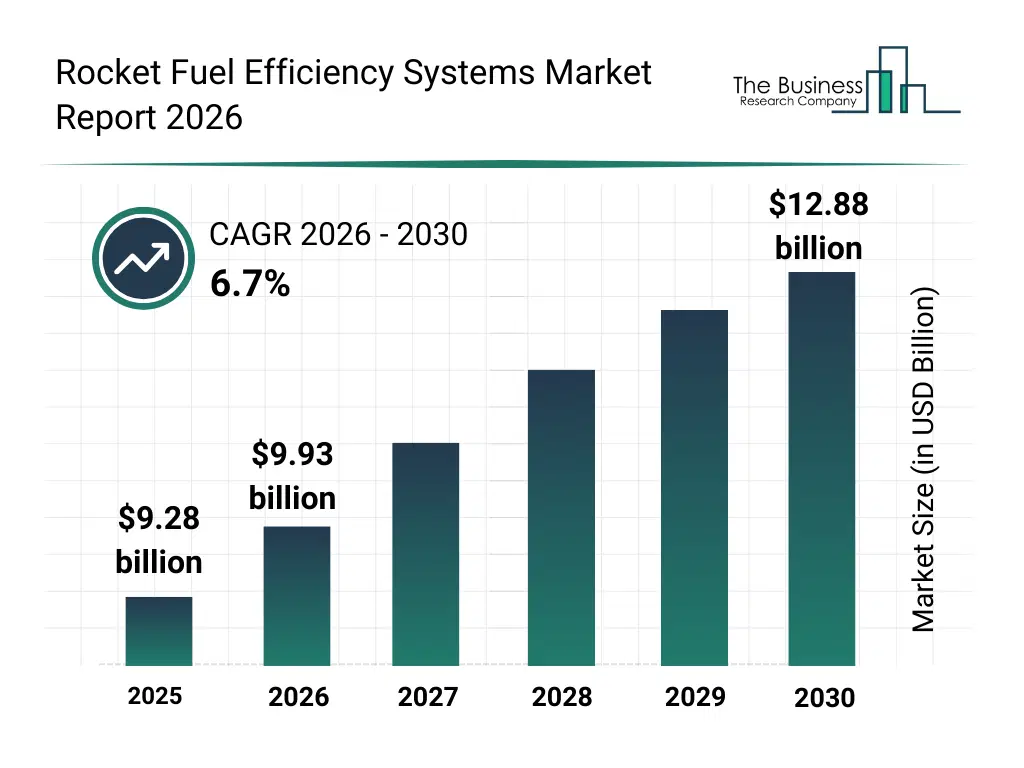
What Is The Rocket Fuel Efficiency Systems Market Size and Share 2026?
The rocket fuel efficiency systems market size has grown strongly in recent years. It will grow from $9.28 billion in 2025 to $9.93 billion in 2026 at a compound annual growth rate (CAGR) of 7.0%. The growth in the historic period can be attributed to growing need for improved mission performance driving early adoption of fuel-efficient propulsion components, development of advanced fuel injection systems enhancing combustion precision, increased integration of turbopumps and electric pump-fed systems to optimize propellant delivery, advancements in propellant management devices reducing fuel slosh and improving stability, rising use of lightweight cryogenic fuel tanks to lower launch mass and improve efficiency.What Is The Rocket Fuel Efficiency Systems Market Growth Forecast?
The rocket fuel efficiency systems market size is expected to see strong growth in the next few years. It will grow to $12.88 billion in 2030 at a compound annual growth rate (CAGR) of 6.7%. The growth in the forecast period can be attributed to expansion of commercial launch operations increasing demand for cost-efficient fuel technologies, innovation in thrust vector control systems improving maneuverability and reducing unnecessary fuel consumption, advancements in real-time fuel flow monitoring enabling higher optimization accuracy, growing adoption of reusable rockets requiring more efficient propellant utilization across multiple flights, increased investment in high-energy missions driving development of next-generation fuel efficiency architectures. Major trends in the forecast period include high-efficiency turbopump development, advanced propellant flow optimization, lightweight fuel system materials adoption, enhanced thrust vector control technologies, precision fuel injection and metering advancements.
Global Rocket Fuel Efficiency Systems Market Segmentation
1) By Component: Propulsion Systems, Fuel Management Systems, Monitoring Systems, Other Components 2) By Fuel Type: Liquid Propellants, Solid Propellants, Hybrid Propellants 3) By Application: Commercial Space, Military And Defense, Research And Development, Other Applications 4) By End-User: Aerospace, Defense, Space Exploration, Other End-Users Subsegments: 1) By Propulsion Systems: Chemical Propulsion, Electric Propulsion, Hybrid Propulsion, Nuclear Thermal Propulsion, Solar Thermal Propulsion 2) By Fuel Management Systems: Fuel Storage Units, Fuel Injection Systems, Pressurization Systems, Flow Control Valves, Thermal Control Units 3) By Monitoring Systems: Fuel Level Sensors, Thrust Measurement Systems, Combustion Monitoring Sensors, System Diagnostics Modules, Telemetry And Data Logging Systems 4) By Other Components: Ignition Systems, Power Supply Units, Structural Support Components, Cooling Systems, Software And Control AlgorithmsWhat Is Driver Of The Rocket Fuel Efficiency Systems Market?
The increasing number of space missions is expected to propel the growth of the rocket fuel efficiency systems market going forward. Space missions refer to planned journeys or operations conducted beyond Earth's atmosphere, typically involving spacecraft or satellites, with objectives such as exploration, research, communication, or national security. The rise in the number of space missions is due to the growing demand for satellite connectivity, which requires frequent launches to expand global communication networks and provide reliable internet access worldwide. Rocket fuel efficiency systems help space missions by reducing propellant consumption, extending mission duration, and enabling the launch of lighter, more cost-effective payloads. For instance, in March 2024, according to the Global Change Data Lab, a UK-based non-profit research organization, 2,895 objects were launched into orbit in 2023, compared to 2,477 in 2022. Therefore, the increasing number of space missions is driving the growth of the rocket fuel efficiency systems industry.Key Players In The Global Rocket Fuel Efficiency Systems Market
Major companies operating in the rocket fuel efficiency systems market are The Boeing Company, Lockheed Martin Corporation, Airbus Defence and Space GmbH, Northrop Grumman Corporation, IHI Corporation, Blue Origin LLC, ArianeGroup SAS, Sierra Space Corporation, Japan Aerospace Exploration Agency, Rocket Lab USA Inc., Avio S.p.A., Isar Aerospace Technologies GmbH, Vaya Space Inc., Busek Co. Inc., Space Exploration Technologies Corp., HyImpulse Technologies GmbH, Payload Aerospace S.L., Skyrora Limited, Exos Aerospace Systems And Technologies Inc., Indian Space Research Organisation.
This chart is for illustrative purposes; the full report includes a detailed competitor analysis and comprehensive overview of the top 10 companies in the market.
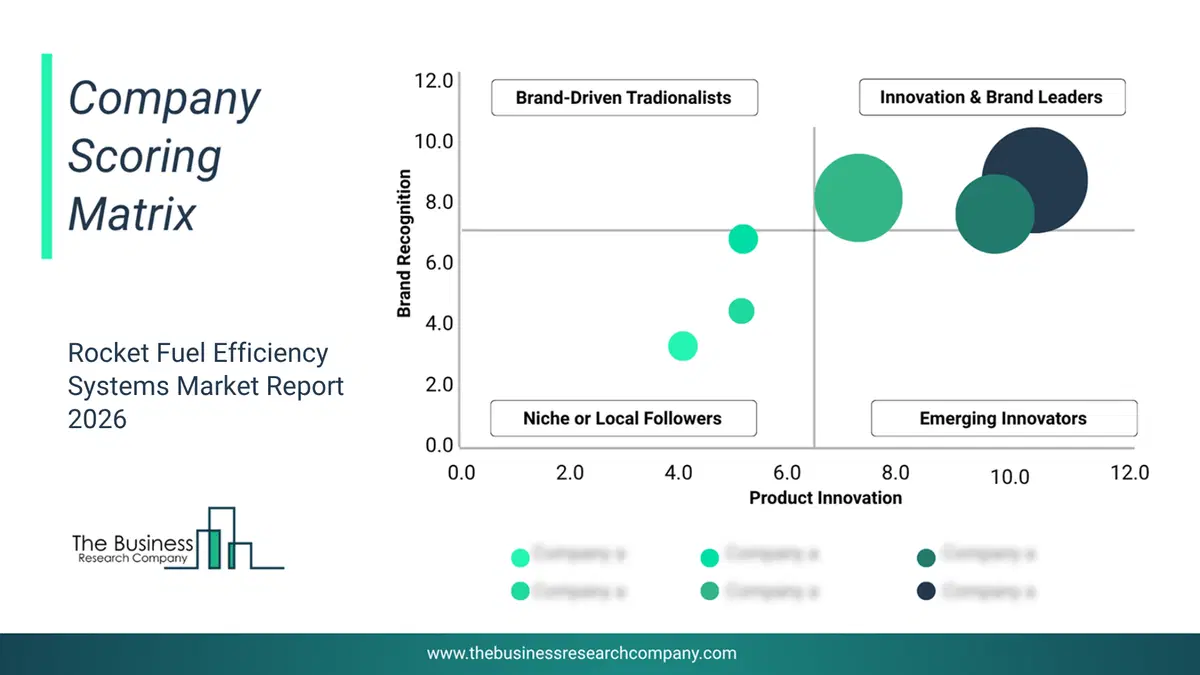
This chart maps companies by product innovation and brand strength, with bubble size indicating relative revenue, helping identify market leaders, challengers, and niche players. This is an illustrative chart; the full report provides a complete and accurate competitive analysis.
Global Rocket Fuel Efficiency Systems Market Trends and Insights
Major companies operating in the rocket fuel efficiency systems market are focusing on developing advanced innovations such as electric propulsion systems to reduce propellant consumption, extend satellite mission life, and enable cost-effective, sustainable space operations. Electric propulsion systems refer to space propulsion technologies that use electrical energy to accelerate propellant at high speeds, generating thrust. For instance, in March 2025, the Indian Space Research Organisation, an India-based government space agency, announced a significant advancement in satellite propulsion technology, successfully completing a 1,000-hour life test of its 300-milliNewton Stationary Plasma Thruster designed for electric propulsion systems. By replacing traditional chemical propulsion, this electric propulsion system enables more efficient orbit raising and station keeping for satellites, leading to substantial mass savings and enhanced communication capabilities through increased transponder capacity.What Are Latest Mergers And Acquisitions In The Rocket Fuel Efficiency Systems Market? Anduril Industries Acquires Adranos to Expand U.S. Solid Rocket Motor Supply and Defense Capabilities
In June 2023, Anduril Industries, a US-based defense technology company, acquired Adranos for an undisclosed amount. With this acquisition, Anduril aims to become a merchant supplier of solid rocket motors to prime contractors delivering missiles, hypersonics, and other propulsion systems for key Department of Defense programs. Adranos is a US-based manufacturing company that offers Rocket Fuel Efficiency Systems.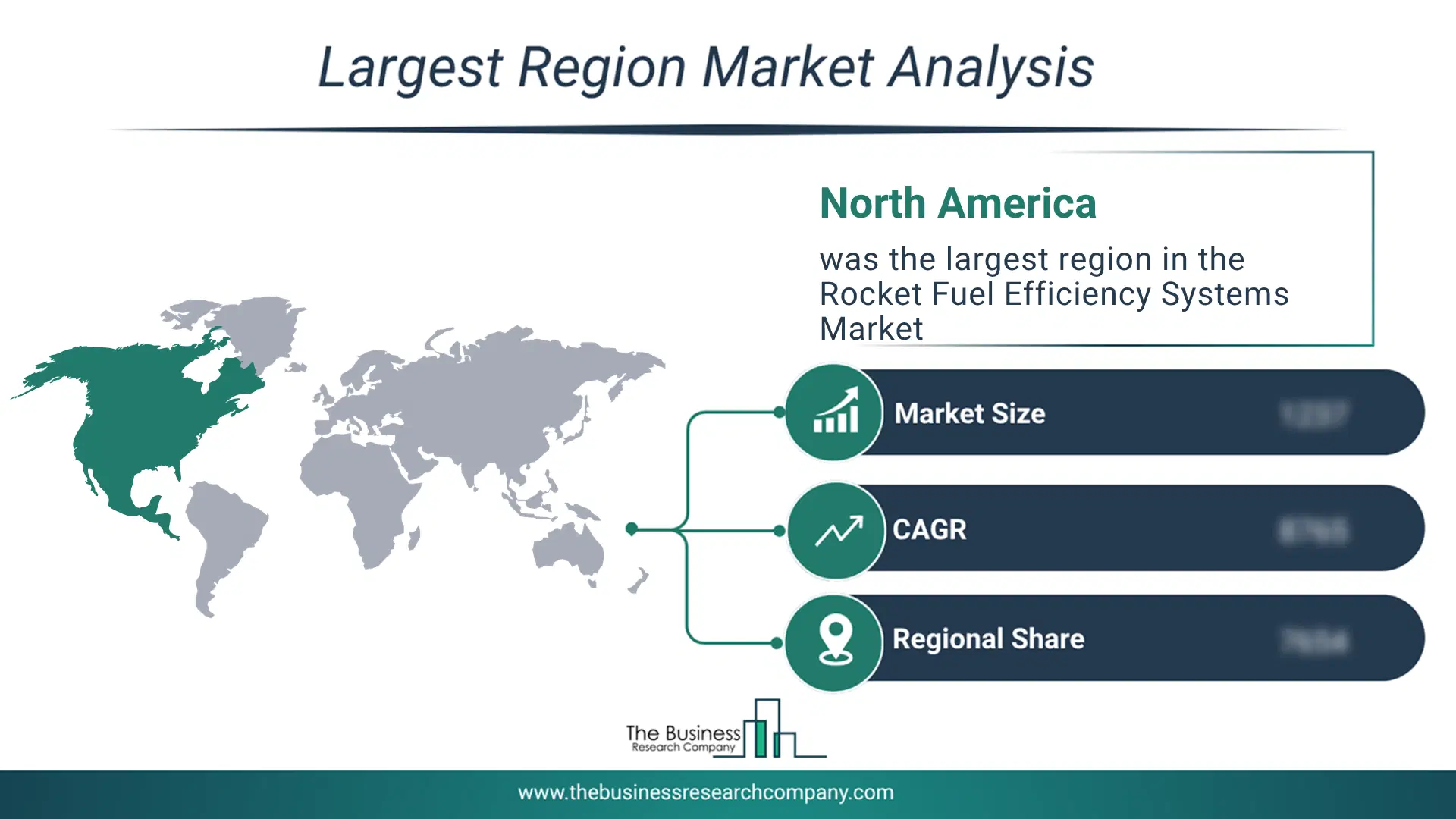
Regional Insights
North America was the largest region in the rocket fuel efficiency systems market in 2025. The regions covered in this market report are Asia-Pacific, South East Asia, Western Europe, Eastern Europe, North America, South America, Middle East, Africa. The countries covered in this market report are Australia, Brazil, China, France, Germany, India, Indonesia, Japan, Taiwan, Russia, South Korea, UK, USA, Canada, Italy, SpainWhat Defines the Rocket Fuel Efficiency Systems Market?
The rocket fuel efficiency systems market consists of sales of cryogenic fuel tanks, propellant management devices, electric pump-fed systems, turbopumps, thrust vector control systems, and fuel injection systems. Values in this market are ‘factory gate’ values, that is, the value of goods sold by the manufacturers or creators of the goods, whether to other entities (including downstream manufacturers, wholesalers, distributors, and retailers) or directly to end customers. The value of goods in this market includes related services sold by the creators of the goods.How is Market Value Defined and Measured?
The market value is defined as the revenues that enterprises gain from the sale of goods and/or services within the specified market and geography through sales, grants, or donations in terms of the currency (in USD unless otherwise specified). The revenues for a specified geography are consumption values that are revenues generated by organizations in the specified geography within the market, irrespective of where they are produced. It does not include revenues from resales along the supply chain, either further along the supply chain or as part of other products.
This chart presents market attractiveness based on a quantitative evaluation of growth, competition, strategic alignment, and risk, offering a clear view of opportunity areas for decision-making. This chart is for illustrative purposes; the full report contains the complete analysis.

This chart highlights the Total Addressable Market (TAM) by estimating the maximum revenue opportunity using an assumption-driven approach, supporting strategic planning and opportunity sizing across markets. The chart is illustrative; the full report provides a more comprehensive analysis.
What Key Data and Analysis Are Included in the Rocket Fuel Efficiency Systems Market Report 2026?
The rocket fuel efficiency systems market research report is one of a series of new reports from The Business Research Company that provides market statistics, including industry global market size, regional shares, competitors with the market share, detailed market segments, market trends and opportunities, and any further data you may need to thrive in the rocket fuel efficiency systems industry. The market research report delivers a complete perspective of everything you need, with an in-depth analysis of the current and future state of the industry.Rocket Fuel Efficiency Systems Market Report Forecast Analysis
| Report Attribute | Details |
|---|---|
| Market Size Value In 2026 | $9.93 billion |
| Revenue Forecast In 2030 | $12.88 billion |
| Growth Rate | CAGR of 6.7% from 2026 to 2030 |
| Base Year For Estimation | 2025 |
| Actual Estimates/Historical Data | 2020-2025 |
| Forecast Period | 2026 - 2030 |
| Market Representation | Revenue in USD Billion and CAGR from 2026 to 2030 |
| Segments Covered | Component, Fuel Type, Application, End-User |
| Regional Scope | Asia-Pacific, Western Europe, Eastern Europe, North America, South America, Middle East, Africa |
| Country Scope | The countries covered in the rocket fuel efficiency systems market report are Australia, Brazil, China, France, Germany, India, Indonesia, Japan, Taiwan, Russia, South Korea, UK, USA, Canada, Italy, Spain |
| Key Companies Profiled | The Boeing Company, Lockheed Martin Corporation, Airbus Defence and Space GmbH, Northrop Grumman Corporation, IHI Corporation, Blue Origin LLC, ArianeGroup SAS, Sierra Space Corporation, Japan Aerospace Exploration Agency, Rocket Lab USA Inc., Avio S.p.A., Isar Aerospace Technologies GmbH, Vaya Space Inc., Busek Co. Inc., Space Exploration Technologies Corp., HyImpulse Technologies GmbH, Payload Aerospace S.L., Skyrora Limited, Exos Aerospace Systems And Technologies Inc., Indian Space Research Organisation. |
| Customization Scope | Request for Customization |
| Pricing And Purchase Options | Explore Purchase Options |