
Rocket Hybrid Propulsion Market Report 2026
Global Outlook – By Type (Rocket Motor, Rocket Engine), By Component (Motor Casing, Nozzle, Igniter Hardware, Turbo Pump, Propellant, Other Components), By Fuel Type (Solid Fuel, Liquid Fuel, Gel Fuel), By Application (Space Launch Vehicles, Launchers For Small Satellites, Satellite Maneuvering And Attitude Control, Upper Stages For Rockets, Tactical And Interceptor Missiles), By End Use (Military And Government, Commercial) – Market Size, Trends, Strategies, and Forecast to 2030
Rocket Hybrid Propulsion Market Overview
• Rocket Hybrid Propulsion market size has reached to $1.64 billion in 2025 • Expected to grow to $2.45 billion in 2030 at a compound annual growth rate (CAGR) of 8.3% • Growth Driver: Growing Interest In Space Tourism Fueling The Growth Of The Market Due To Increasing Accessibility And Sustainability • Market Trend: Reusable Hybrid Rocket RHUMI-1 A Breakthrough In Sustainable Propulsion For Climate Research • North America was the largest region in 2025 and Asia-Pacific is the fastest growing region.What Is Covered Under Rocket Hybrid Propulsion Market?
Rocket hybrid propulsion refers to a type of rocket engine that combines features of both solid and liquid propulsion systems. It typically uses a solid fuel and a liquid or gaseous oxidizer. This design offers better safety and control compared to traditional solid rockets. Hybrid engines are often explored for their potential in reusable and cost-effective space missions. The main types of hybrid rocket propulsion are rocket motors and rocket engines. A hybrid rocket motor is a type of rocket engine that uses a solid fuel and a liquid or gaseous oxidizer, combining features of both solid and liquid propulsion systems for greater safety and controllability. These systems consist of various components such as motor casings, nozzles, igniter hardware, turbopumps, propellants, and other parts. The various fuel types include solid fuel, liquid fuel, and gel fuel. These are used in various applications such as space launch vehicles, launchers for small satellites, satellite maneuvering and attitude control, upper stages for rockets, and tactical and interceptor missiles. The key end users are military and government agencies, as well as commercial entities.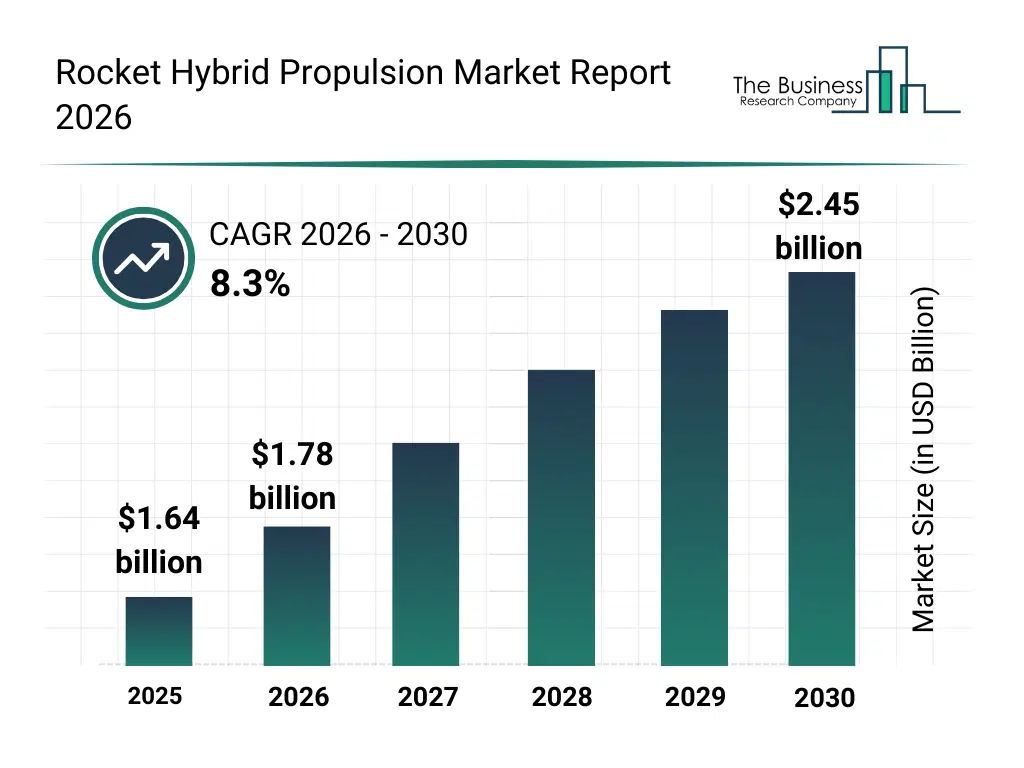
What Is The Rocket Hybrid Propulsion Market Size and Share 2026?
The rocket hybrid propulsion market size has grown strongly in recent years. It will grow from $1.64 billion in 2025 to $1.78 billion in 2026 at a compound annual growth rate (CAGR) of 8.4%. The growth in the historic period can be attributed to early adoption of hybrid propulsion technology in experimental rockets, advancements in solid fuel and liquid oxidizer chemistry, increasing investment in space research programs, development of reusable launch vehicle prototypes, rising collaboration between aerospace manufacturers and defense agencies.What Is The Rocket Hybrid Propulsion Market Growth Forecast?
The rocket hybrid propulsion market size is expected to see strong growth in the next few years. It will grow to $2.45 billion in 2030 at a compound annual growth rate (CAGR) of 8.3%. The growth in the forecast period can be attributed to growing demand for cost-effective and reusable hybrid rocket engines, integration of advanced control and telemetry systems, focus on higher efficiency and thrust-to-weight ratio, expansion of commercial space missions utilizing hybrid propulsion, development of environmentally safer propellant formulations. Major trends in the forecast period include increased investment in reusable hybrid rocket engines, growing commercial launch demand for small satellites, advancements in non-toxic and safer oxidizer combinations, miniaturization of propulsion systems for cubesats, expansion of test facilities and private launch infrastructure.
Global Rocket Hybrid Propulsion Market Segmentation
1) By Type: Rocket Motor, Rocket Engine 2) By Component: Motor Casing, Nozzle, Igniter Hardware, Turbo Pump, Propellant, Other Components 3) By Fuel Type: Solid Fuel, Liquid Fuel, Gel Fuel 4) By Application: Space Launch Vehicles, Launchers For Small Satellites, Satellite Maneuvering And Attitude Control, Upper Stages For Rockets, Tactical And Interceptor Missiles 5) By End Use: Military And Government, Commercial Subsegments: 1) By Rocket Motor: Suborbital Rocket Motors, Sounding Rocket Motors, Tactical Missile Motors, Upper-Stage Motors 2) By Rocket Engine: Launch Vehicle Main Engines, Satellite Propulsion Engines, Maneuvering and Attitude Control Engines, Testbed Or Demonstrator EnginesWhat Is Driver Of The Rocket Hybrid Propulsion Market?
The growing interest in space tourism is expected to propel the growth of the rocket hybrid propulsion market going forward. Space tourism refers to the commercial activity of traveling into space for recreational, leisure, or adventure purposes. Rising interest in space tourism is driven by increasing private sector investment, making space travel more accessible and commercially viable. Rocket hybrid propulsion enhances space tourism by offering a safer, more cost-effective, and environmentally friendly alternative to traditional rocket engines, making suborbital and orbital travel more accessible and sustainable. For instance, in September 2024, Electro IQ, a US-based technology company, It is estimated that space tourism will generate $1.8 billion in revenue in 2024, marking a robust year-over-year growth of approximately 50% compared to 2023. Therefore, the growing interest in space tourism is driven by the growth of the rocket hybrid propulsion industry.Key Players In The Global Rocket Hybrid Propulsion Market
Major companies operating in the rocket hybrid propulsion market are Northrop Grumman, General Electric Aviation, Sierra Nevada Corporation, Nammo AS, Gilmour Space Technologies, VAYA Space, TiSPACE (Taiwan Innovative Space Inc.), Equatorial Space Systems, HyImpulse Technologies, Firehawk Aerospace, Reaction Dynamics, BluShift Aerospace, Southern Launch, Novart Space Technologies, T4i, MJOLNIR Spaceworks, HyPrSpace, Pulsar Fusion, DeltaV Uzay Teknolojileri, Environmental Aeroscience Corporation (eAc)
This chart is for illustrative purposes; the full report includes a detailed competitor analysis and comprehensive overview of the top 10 companies in the market.
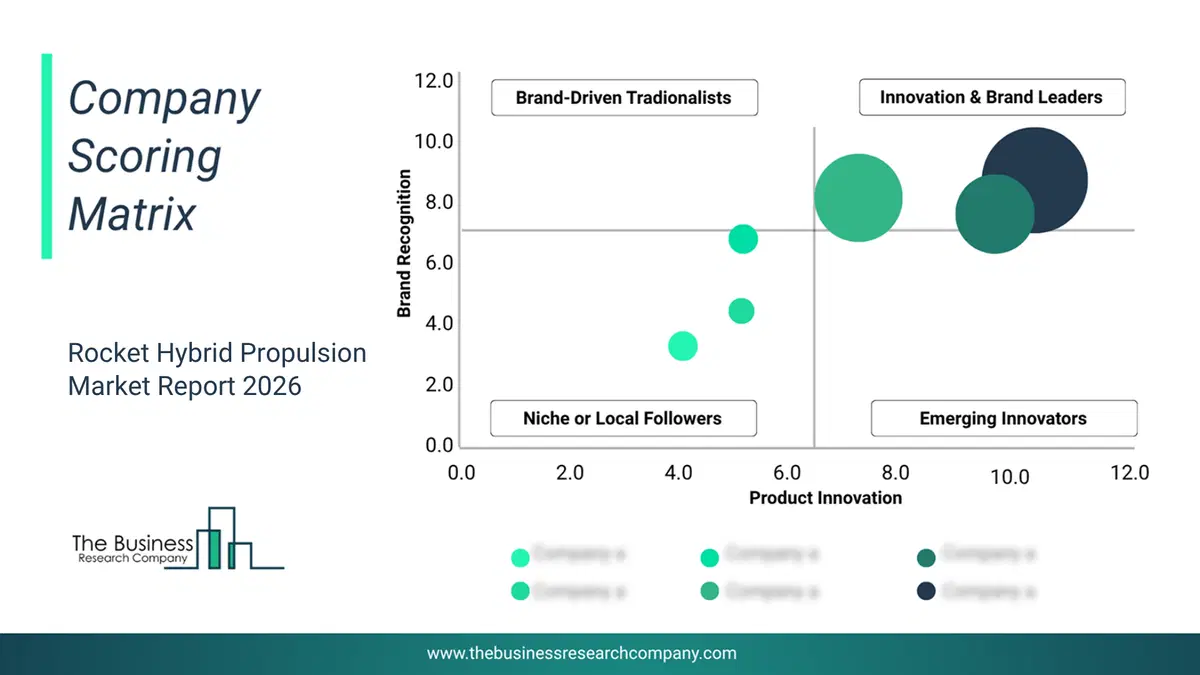
This chart maps companies by product innovation and brand strength, with bubble size indicating relative revenue, helping identify market leaders, challengers, and niche players. This is an illustrative chart; the full report provides a complete and accurate competitive analysis.
Global Rocket Hybrid Propulsion Market Trends and Insights
Major companies operating in the rocket hybrid propulsion market are adopting advanced technology solutions, such as reusable hybrid rocket, to enhance cost-efficiency, improve sustainability, and reduce environmental impact while increasing the reliability and reusability of launch systems for both commercial and space exploration missions. A reusable hybrid rocket is a launch system that combines solid fuel with a liquid or gaseous oxidizer and is designed to withstand multiple launches and landings, reducing costs and enabling rapid reusability. For instance, in August 2024, Space Zone India, an India-based aerospace company, launched its first reusable hybrid rocket, RHUMI-1. This eco-friendly rocket utilizes both solid and liquid propellants, features a reusable design, and includes a CO2-powered parachute for safe recovery, significantly lowering launch costs and environmental impact. RHUMI-1 carried multiple small satellites to collect essential data on climate change and atmospheric conditions, marking a significant milestone for India's private space sector while demonstrating the potential of sustainable space technology for research, education, and environmental monitoring.What Are Latest Mergers And Acquisitions In The Rocket Hybrid Propulsion Market? RocketStar Acquires Miles Space, Expands Expertise with Mitch Simpler Board Appointment
In January 2024, RocketStar, Inc, a US_based aerospace company acquired Miles Space for an undisclosed amount. With this acquisition, RocketStar appointed Mitch Simpler to its board, adding extensive engineering and industry expertise to support product development and commercialization. Miles Space is a US-based manufacturer of electric thrusters including a nuclear-fusion-enhanced version under development.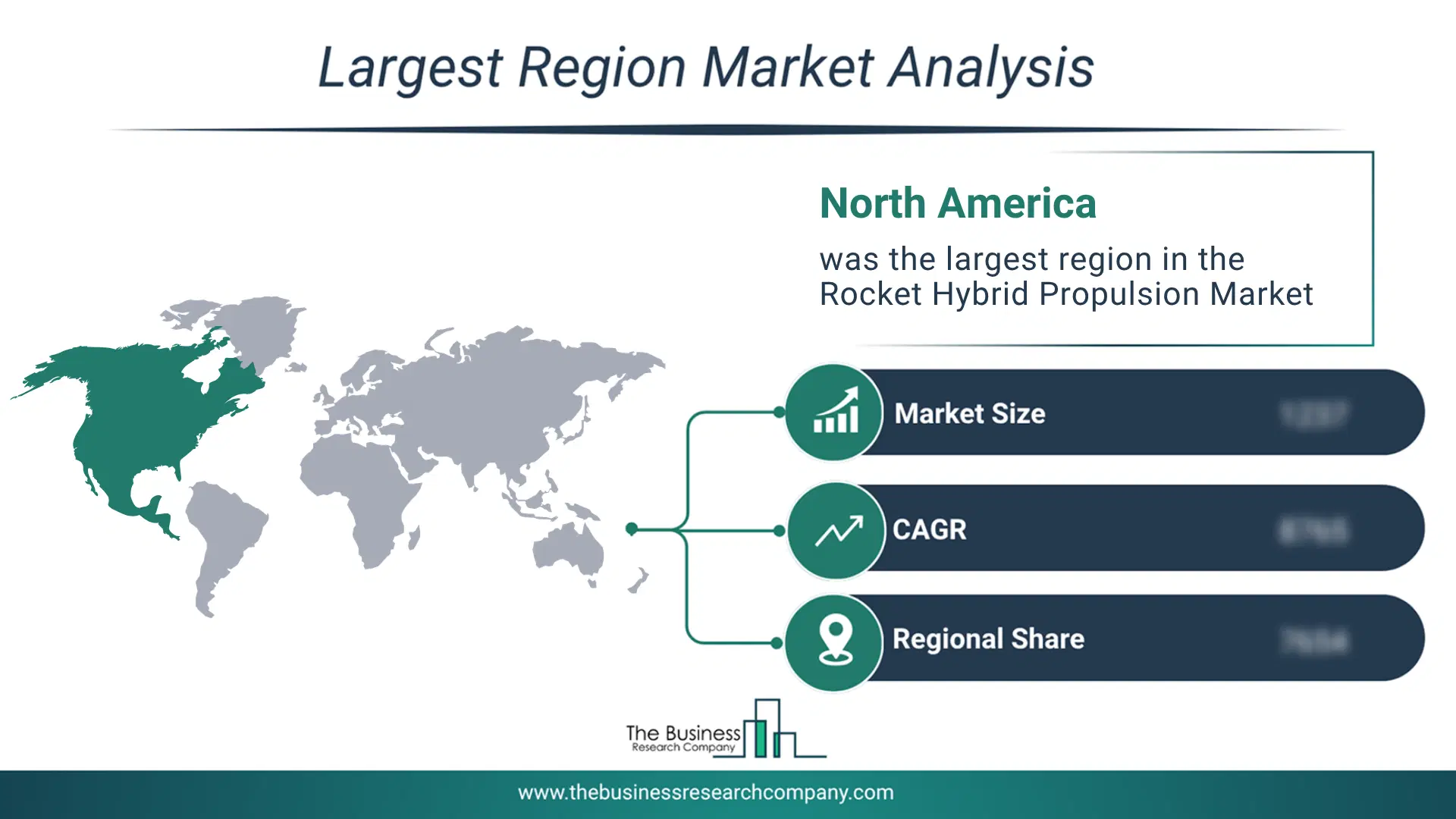
Regional Insights
North America was the largest region in the rocket hybrid propulsion market in 2025. Asia-Pacific is expected to be the fastest-growing region in the forecast period. The regions covered in this market report are Asia-Pacific, South East Asia, Western Europe, Eastern Europe, North America, South America, Middle East, Africa. The countries covered in this market report are Australia, Brazil, China, France, Germany, India, Indonesia, Japan, Taiwan, Russia, South Korea, UK, USA, Canada, Italy, SpainWhat Defines the Rocket Hybrid Propulsion Market?
The rocket hybrid propulsion market consists of revenues earned by entities by providing services such as design, development, testing, and maintenance of hybrid propulsion systems. The market value includes the value of related goods sold by the service provider or included within the service offering. The rocket hybrid propulsion market also consists of sales of products including control systems, combustion chambers, valves and regulators, sensors, and telemetry units. Values in this market are ‘factory gate’ values, that is, the value of goods sold by the manufacturers or creators of the goods, whether to other entities (including downstream manufacturers, wholesalers, distributors, and retailers) or directly to end customers. The value of goods in this market includes related services sold by the creators of the goods.How is Market Value Defined and Measured?
The market value is defined as the revenues that enterprises gain from the sale of goods and/or services within the specified market and geography through sales, grants, or donations in terms of the currency (in USD unless otherwise specified). The revenues for a specified geography are consumption values that are revenues generated by organizations in the specified geography within the market, irrespective of where they are produced. It does not include revenues from resales along the supply chain, either further along the supply chain or as part of other products.
This chart presents market attractiveness based on a quantitative evaluation of growth, competition, strategic alignment, and risk, offering a clear view of opportunity areas for decision-making. This chart is for illustrative purposes; the full report contains the complete analysis.

This chart highlights the Total Addressable Market (TAM) by estimating the maximum revenue opportunity using an assumption-driven approach, supporting strategic planning and opportunity sizing across markets. The chart is illustrative; the full report provides a more comprehensive analysis.
What Key Data and Analysis Are Included in the Rocket Hybrid Propulsion Market Report 2026?
The rocket hybrid propulsion market research report is one of a series of new reports from The Business Research Company that provides market statistics, including industry global market size, regional shares, competitors with the market share, detailed market segments, market trends and opportunities, and any further data you may need to thrive in the rocket hybrid propulsion industry. The market research report delivers a complete perspective of everything you need, with an in-depth analysis of the current and future state of the industry.Rocket Hybrid Propulsion Market Report Forecast Analysis
| Report Attribute | Details |
|---|---|
| Market Size Value In 2026 | $1.78 billion |
| Revenue Forecast In 2030 | $2.45 billion |
| Growth Rate | CAGR of 8.3% from 2026 to 2030 |
| Base Year For Estimation | 2025 |
| Actual Estimates/Historical Data | 2020-2025 |
| Forecast Period | 2026 - 2030 |
| Market Representation | Revenue in USD Billion and CAGR from 2026 to 2030 |
| Segments Covered | Type, Component, Fuel Type, Application, End Use |
| Regional Scope | Asia-Pacific, Western Europe, Eastern Europe, North America, South America, Middle East, Africa |
| Country Scope | The countries covered in the rocket hybrid propulsion market report are Australia, Brazil, China, France, Germany, India, Indonesia, Japan, Taiwan, Russia, South Korea, UK, USA, Canada, Italy, Spain |
| Key Companies Profiled | Northrop Grumman, General Electric Aviation, Sierra Nevada Corporation, Nammo AS, Gilmour Space Technologies, VAYA Space, TiSPACE (Taiwan Innovative Space Inc.), Equatorial Space Systems, HyImpulse Technologies, Firehawk Aerospace, Reaction Dynamics, BluShift Aerospace, Southern Launch, Novart Space Technologies, T4i, MJOLNIR Spaceworks, HyPrSpace, Pulsar Fusion, DeltaV Uzay Teknolojileri, Environmental Aeroscience Corporation (eAc) |
| Customization Scope | Request for Customization |
| Pricing And Purchase Options | Explore Purchase Options |