
Rocket Landing Accuracy Market Report 2026
Global Outlook – By Component (Hardware, Software, Services), By Technology (Global Positioning System (GPS), Inertial Navigation Systems, Radio Detection And Ranging (Radar), Light Detection And Ranging (Lidar), Other Technologies), By Application (Commercial Space, Military, Research), By End-User (Space Agencies, Private Space Companies, Defense Organizations, Other End-Users) – Market Size, Trends, Strategies, and Forecast to 2030
Rocket Landing Accuracy Market Overview
• Rocket Landing Accuracy market size has reached to $1.25 billion in 2025 • Expected to grow to $2.12 billion in 2030 at a compound annual growth rate (CAGR) of 11.1% • Growth Driver: Increasing Investments In Space Exploration Fueling The Growth Of The Market Due To Advancements In Guidance And Control Technologies • Market Trend: Advanced Precision Landing Systems Enable Safe Lunar Touchdowns • North America was the largest region in 2025.What Is Covered Under Rocket Landing Accuracy Market?
Rocket landing accuracy refers to the precision with which a rocket or its reusable stage returns and lands at a predetermined target location, either on Earth or another celestial body. The primary purpose is to enable safe recovery and reuse of rocket components, reducing launch costs and supporting sustainable space missions. The main components of rocket landing accuracy are hardware, software, and services. Hardware refers to components such as landing legs, grid fins, thrust vector systems, sensors, and guidance computers that control and stabilize the rocket for precise, safe landings. It utilizes various technologies such as global positioning systems (GPS), inertial navigation systems, radio detection and ranging (radar), light detection and ranging (lidar), and others for several applications, including commercial space, military, and research, serving end-users such as space agencies, private space companies, defense organizations, and others.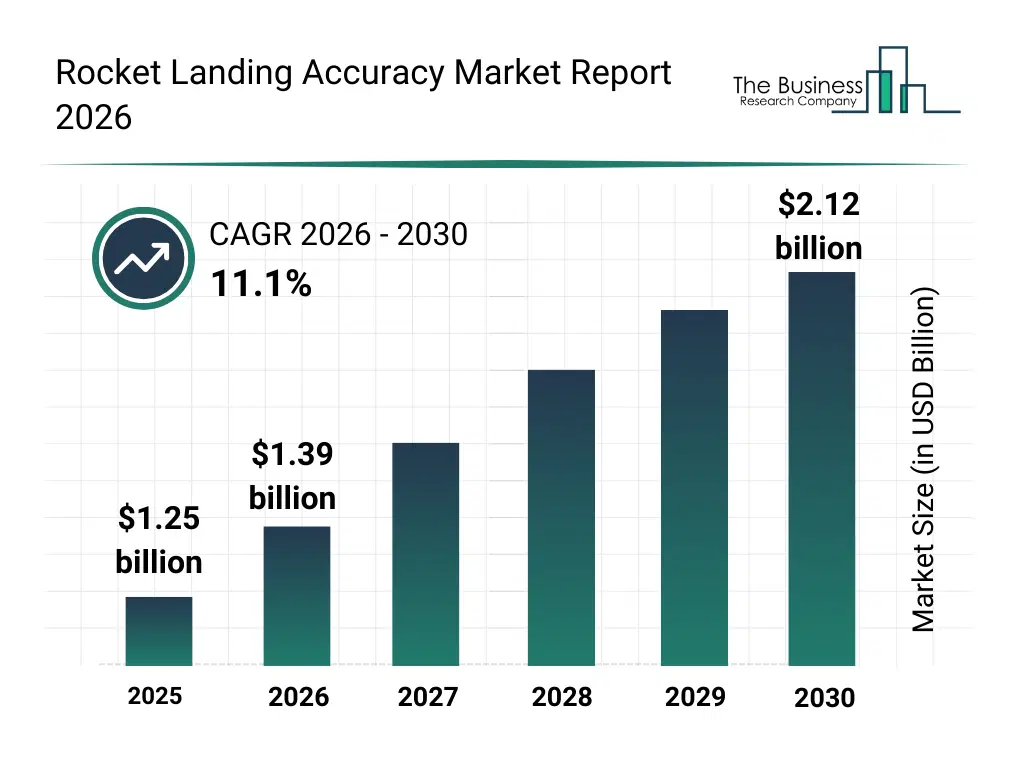
What Is The Rocket Landing Accuracy Market Size and Share 2026?
The rocket landing accuracy market size has grown rapidly in recent years. It will grow from $1.25 billion in 2025 to $1.39 billion in 2026 at a compound annual growth rate (CAGR) of 11.2%. The growth in the historic period can be attributed to early development of thrust vector control systems enabling improved descent path correction, introduction of grid fins to enhance aerodynamic steering during booster reentry, advancements in autonomous flight control computers improving real-time landing guidance, adoption of landing legs and shock absorption systems to support safe booster recovery, increased experimentation with reusable launch operations driving demand for precision landing technologies.What Is The Rocket Landing Accuracy Market Growth Forecast?
The rocket landing accuracy market size is expected to see rapid growth in the next few years. It will grow to $2.12 billion in 2030 at a compound annual growth rate (CAGR) of 11.1%. The growth in the forecast period can be attributed to expansion of reusable rocket fleets increasing need for highly accurate landing solutions, advancements in sensor fusion and onboard navigation improving landing precision, growing commercial launch cadence driving optimization of launch site efficiency and turnaround services, innovation in adaptive control algorithms enabling more reliable landings under variable conditions, rising investment in lunar and planetary landing missions requiring enhanced precision landing systems. Major trends in the forecast period include increasing deployment of ultra-precise landing leg and shock absorption systems, use of enhanced thrust vector control mechanisms for landing precision, integration of high-fidelity autonomous flight control computers, growing adoption of aerodynamic optimization features such as advanced grid fins, expansion of reusable booster landing infrastructure and rapid turnaround systems.
Global Rocket Landing Accuracy Market Segmentation
1) By Component: Hardware, Software, Services 2) By Technology: Global Positioning System (GPS), Inertial Navigation Systems, Radio Detection And Ranging (Radar), Light Detection And Ranging (Lidar), Other Technologies 3) By Application: Commercial Space, Military, Research 4) By End-User: Space Agencies, Private Space Companies, Defense Organizations, Other End-Users Subsegments: 1) By Hardware: Inertial Navigation Systems, Global Positioning System (GPS) Modules, Grid Fins, Landing Legs, Thrust Vector Control Systems, Radar Altimeters, Sensors 2) By Software: Landing Trajectory Prediction Algorithms, Guidance And Navigation Software, Real-Time Flight Control Systems, Data Processing And Telemetry Software, Simulation And Modeling Tools 3) By Services: System Integration Services, Calibration And Testing Services, Maintenance And Upgrades, Software Support And Updates, Consulting And Customization ServicesWhat Is Driver Of The Rocket Landing Accuracy Market?
The increasing defense spending is expected to propel the growth of the rocket landing accuracy market going forward. Defense spending refers to the government’s expenditure on maintaining, equipping, and advancing its military and national security capabilities. Defense spending is increasing to enhance national security by modernizing military capabilities and addressing emerging threats such as cyber warfare and advanced weapon systems. Increasing defense spending supports rocket landing accuracy by enabling greater investment in advanced guidance systems, precision sensors, and real-time navigation technologies. For instance, in April 2024, according to the Stockholm International Peace Research Institute (SIPRI), a Sweden-based independent resource on global security, total global military expenditure reached $2,443 billion in 2023, reflecting a 6.8% increase in real terms compared to 2022. Therefore, increasing defense spending is driving the growth of the rocket landing accuracy industry.Key Players In The Global Rocket Landing Accuracy Market
Major companies operating in the rocket landing accuracy market are Safran S.A., Space Exploration Technologies Corp., Blue Origin LLC, Indian Space Research Organisation, Japan Aerospace Exploration Agency, Relativity Space Inc., Firefly Aerospace Inc., Astrobotic Technology Inc., Agnikul Cosmos Private Limited, Deep Blue Aerospace Technology Co. Ltd., ABL Space Systems Inc., LandSpace Technology Corporation Ltd., Ramon.Space Inc., ispace Inc., PLD Space S.L., OneSpace Technology Group Co. Ltd., Skyrora Ltd., KinetX Aerospace Inc., China National Space Administration, Lulav Space Ltd., Space Epoch Co. Ltd.
This chart is for illustrative purposes; the full report includes a detailed competitor analysis and comprehensive overview of the top 10 companies in the market.
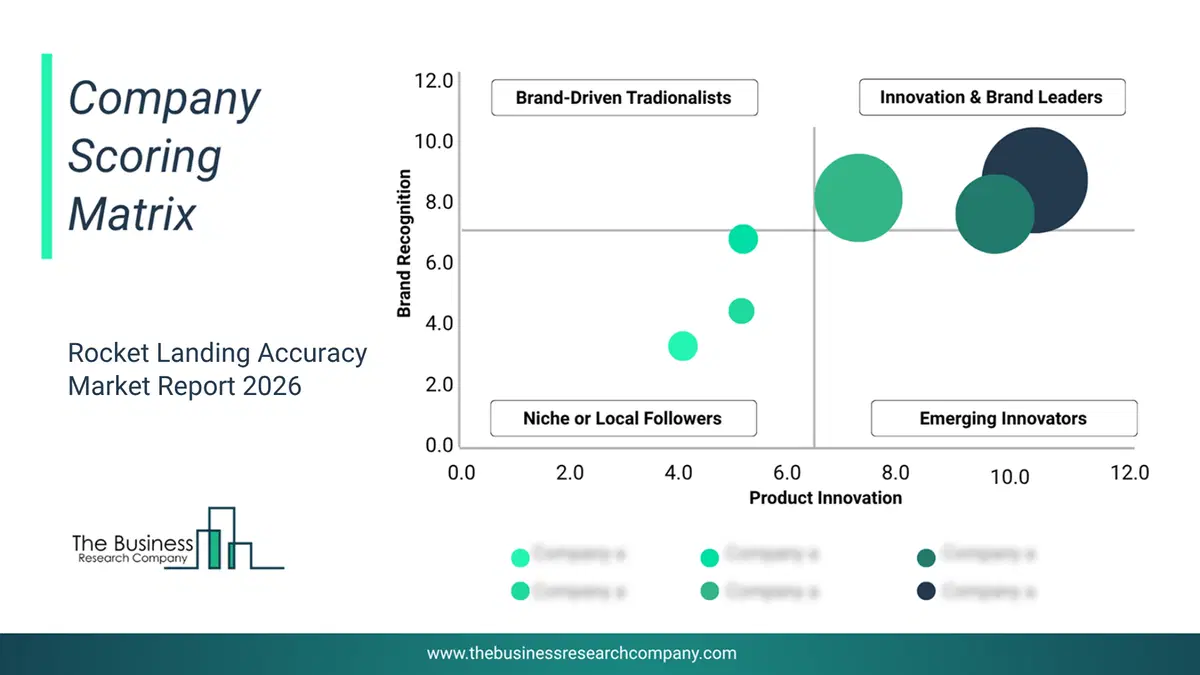
This chart maps companies by product innovation and brand strength, with bubble size indicating relative revenue, helping identify market leaders, challengers, and niche players. This is an illustrative chart; the full report provides a complete and accurate competitive analysis.
Global Rocket Landing Accuracy Market Trends and Insights
Major companies operating in the rocket landing accuracy market are focusing on developing advanced solutions, such as precision landing systems, to enhance safety, improve accuracy, and ensure successful lunar and planetary landings. Precision landing systems refer to sophisticated guidance and navigation technologies that enable spacecraft to land autonomously within meters of a targeted location, even in challenging extraterrestrial terrains. For instance, in April 2025, Astrobotic Technology Inc., a US-based space robotics company, completed a critical terrestrial flight test campaign for its lunar landing Guidance, Navigation, and Control (GNC) systems. These tests, using both helicopter and suborbital rocket flights, validated the systems' ability to autonomously detect and avoid lunar surface hazards as small as 15 cm, ensuring safe and precise landings by integrating real-time sensor data to select the safest landing sites within a targeted zone. This technology is crucial for future lunar missions, enabling spacecraft to land safely near resource-rich areas or pre-deployed infrastructure, and its successful tests mark a significant milestone in advancing reliable and autonomous landing capabilities for upcoming Moon and Mars missions.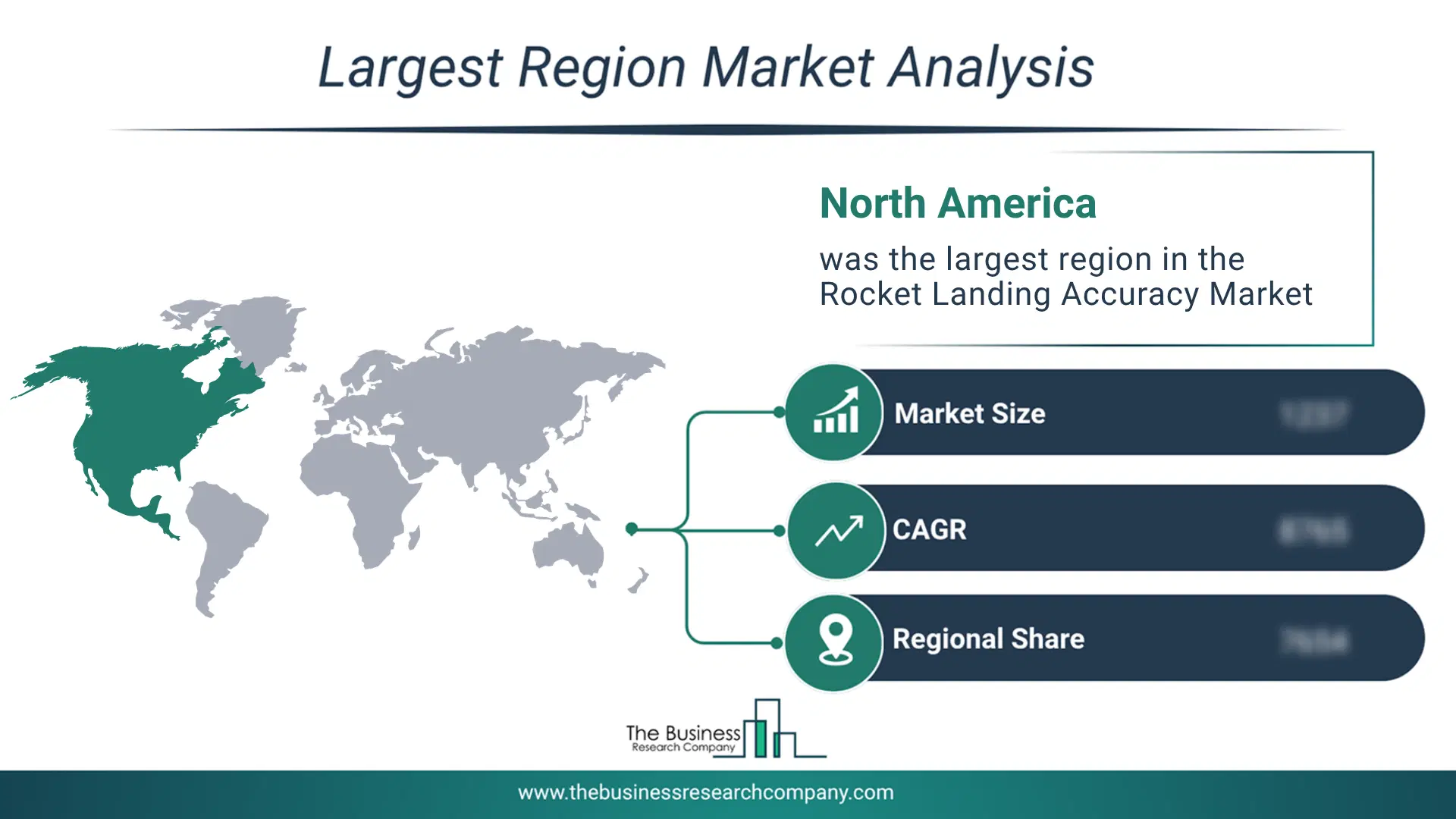
Regional Insights
North America was the largest region in the rocket landing accuracy market in 2025. The regions covered in this market report are Asia-Pacific, South East Asia, Western Europe, Eastern Europe, North America, South America, Middle East, Africa. The countries covered in this market report are Australia, Brazil, China, France, Germany, India, Indonesia, Japan, Taiwan, Russia, South Korea, UK, USA, Canada, Italy, SpainWhat Defines the Rocket Landing Accuracy Market?
The rocket landing accuracy market consists of revenues earned by entities by providing services such as reusable launch operations, launch site efficiency, payload delivery optimization, and rapid turnaround support. The market value includes the value of related goods sold by the service provider or included within the service offering. The rocket landing accuracy market includes sales of grid fins, thrust vector control (TVC) systems, landing legs and shock absorption systems, and autonomous flight control computers. Values in this market are ‘factory gate’ values, that is, the value of goods sold by the manufacturers or creators of the goods, whether to other entities (including downstream manufacturers, wholesalers, distributors, and retailers) or directly to end customers. The value of goods in this market includes related services sold by the creators of the goods.How is Market Value Defined and Measured?
The market value is defined as the revenues that enterprises gain from the sale of goods and/or services within the specified market and geography through sales, grants, or donations in terms of the currency (in USD unless otherwise specified). The revenues for a specified geography are consumption values that are revenues generated by organizations in the specified geography within the market, irrespective of where they are produced. It does not include revenues from resales along the supply chain, either further along the supply chain or as part of other products.
This chart presents market attractiveness based on a quantitative evaluation of growth, competition, strategic alignment, and risk, offering a clear view of opportunity areas for decision-making. This chart is for illustrative purposes; the full report contains the complete analysis.

This chart highlights the Total Addressable Market (TAM) by estimating the maximum revenue opportunity using an assumption-driven approach, supporting strategic planning and opportunity sizing across markets. The chart is illustrative; the full report provides a more comprehensive analysis.
What Key Data and Analysis Are Included in the Rocket Landing Accuracy Market Report 2026?
The rocket landing accuracy market research report is one of a series of new reports from The Business Research Company that provides market statistics, including industry global market size, regional shares, competitors with the market share, detailed market segments, market trends and opportunities, and any further data you may need to thrive in the rocket landing accuracy industry. The market research report delivers a complete perspective of everything you need, with an in-depth analysis of the current and future state of the industry.Rocket Landing Accuracy Market Report Forecast Analysis
| Report Attribute | Details |
|---|---|
| Market Size Value In 2026 | $1.39 billion |
| Revenue Forecast In 2030 | $2.12 billion |
| Growth Rate | CAGR of 11.1% from 2026 to 2030 |
| Base Year For Estimation | 2025 |
| Actual Estimates/Historical Data | 2020-2025 |
| Forecast Period | 2026 - 2030 |
| Market Representation | Revenue in USD Billion and CAGR from 2026 to 2030 |
| Segments Covered | Component, Technology, Application, End-User |
| Regional Scope | Asia-Pacific, Western Europe, Eastern Europe, North America, South America, Middle East, Africa |
| Country Scope | The countries covered in the rocket landing accuracy market report are Australia, Brazil, China, France, Germany, India, Indonesia, Japan, Taiwan, Russia, South Korea, UK, USA, Canada, Italy, Spain |
| Key Companies Profiled | Safran S.A., Space Exploration Technologies Corp., Blue Origin LLC, Indian Space Research Organisation, Japan Aerospace Exploration Agency, Relativity Space Inc., Firefly Aerospace Inc., Astrobotic Technology Inc., Agnikul Cosmos Private Limited, Deep Blue Aerospace Technology Co. Ltd., ABL Space Systems Inc., LandSpace Technology Corporation Ltd., Ramon.Space Inc., ispace Inc., PLD Space S.L., OneSpace Technology Group Co. Ltd., Skyrora Ltd., KinetX Aerospace Inc., China National Space Administration, Lulav Space Ltd., Space Epoch Co. Ltd. |
| Customization Scope | Request for Customization |
| Pricing And Purchase Options | Explore Purchase Options |