
Rocket Materials Recycling Market Report 2026
Global Outlook – By Material Type (Metals, Composites, Polymers, Ceramics, Other Material Types), By Recycling Process (Mechanical Recycling, Chemical Recycling, Thermal Recycling, Other Recycling Processes), By Application (Aerospace, Defense, Space Exploration, Other Applications), By End-User (Government Agencies, Private Space Companies, Research Institutions, Other End-Users) – Market Size, Trends, Strategies, and Forecast to 2030
Rocket Materials Recycling Market Overview
• Rocket Materials Recycling market size has reached to $1.26 billion in 2025 • Expected to grow to $2.29 billion in 2030 at a compound annual growth rate (CAGR) of 12.5% • Growth Driver: Surge In Commercial Space Operations Fueling The Growth Of The Market Due To Increasing Demand For Cost-Effective And Sustainable Recovery Solutions • Market Trend: Advancements In Sustainable Technologies For Orbital Debris Removal And Recycling • North America was the largest region in 2025 and Asia-Pacific is the fastest growing region.What Is Covered Under Rocket Materials Recycling Market?
Rocket materials recycling refers to the strategic recovery and reprocessing of structural and functional components from expended launch systems. This approach aims to reduce waste, lower production costs, and enhance sustainability within the aerospace industry. The main material types in rocket materials recycling include metals, composites, polymers, ceramics, and others. Metals are solid elements like aluminum, steel, and titanium that are strong, durable, and excellent conductors of heat and electricity. It uses various recycling processes such as mechanical recycling, chemical recycling, thermal recycling, and others and is applied for aerospace, defense, space exploration, and others. It is used by several end-users, including government agencies, private space companies, research institutions, and others.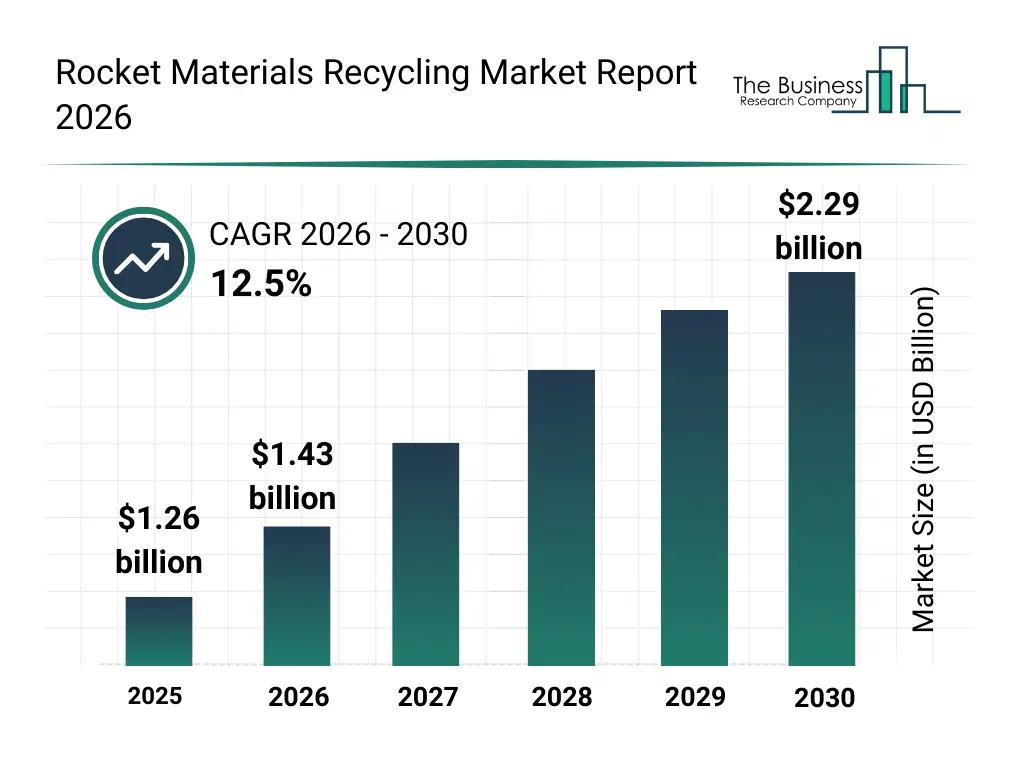
What Is The Rocket Materials Recycling Market Size and Share 2026?
The rocket materials recycling market size has grown rapidly in recent years. It will grow from $1.26 billion in 2025 to $1.43 billion in 2026 at a compound annual growth rate (CAGR) of 13.5%. The growth in the historic period can be attributed to increasing cost pressures in launch vehicle manufacturing driving interest in material recovery, early adoption of structural disassembly processes to reclaim reusable components, development of material sorting and cleaning techniques enabling higher recycling yields, expansion of non-destructive testing to evaluate recovered components for secondary use, rising government and industry focus on reducing aerospace waste through component recovery assessments.What Is The Rocket Materials Recycling Market Growth Forecast?
The rocket materials recycling market size is expected to see rapid growth in the next few years. It will grow to $2.29 billion in 2030 at a compound annual growth rate (CAGR) of 12.5%. The growth in the forecast period can be attributed to growth of reusable launch systems increasing demand for systematic materials recycling workflows, advancements in automated disassembly and sorting technologies improving recycling efficiency, rising sustainability requirements driving broader adoption of aerospace material circularity programs, innovation in surface cleaning methods enabling higher-quality reclaimed materials, expansion of commercial launch activities creating a larger volume of recoverable rocket components. Major trends in the forecast period include growth in high-value alloy recovery programs, expansion of composite material reclamation techniques, increased adoption of automated rocket disassembly lines, rising use of non-destructive testing for material requalification, integration of closed-loop recycling models in launch operations.
Global Rocket Materials Recycling Market Segmentation
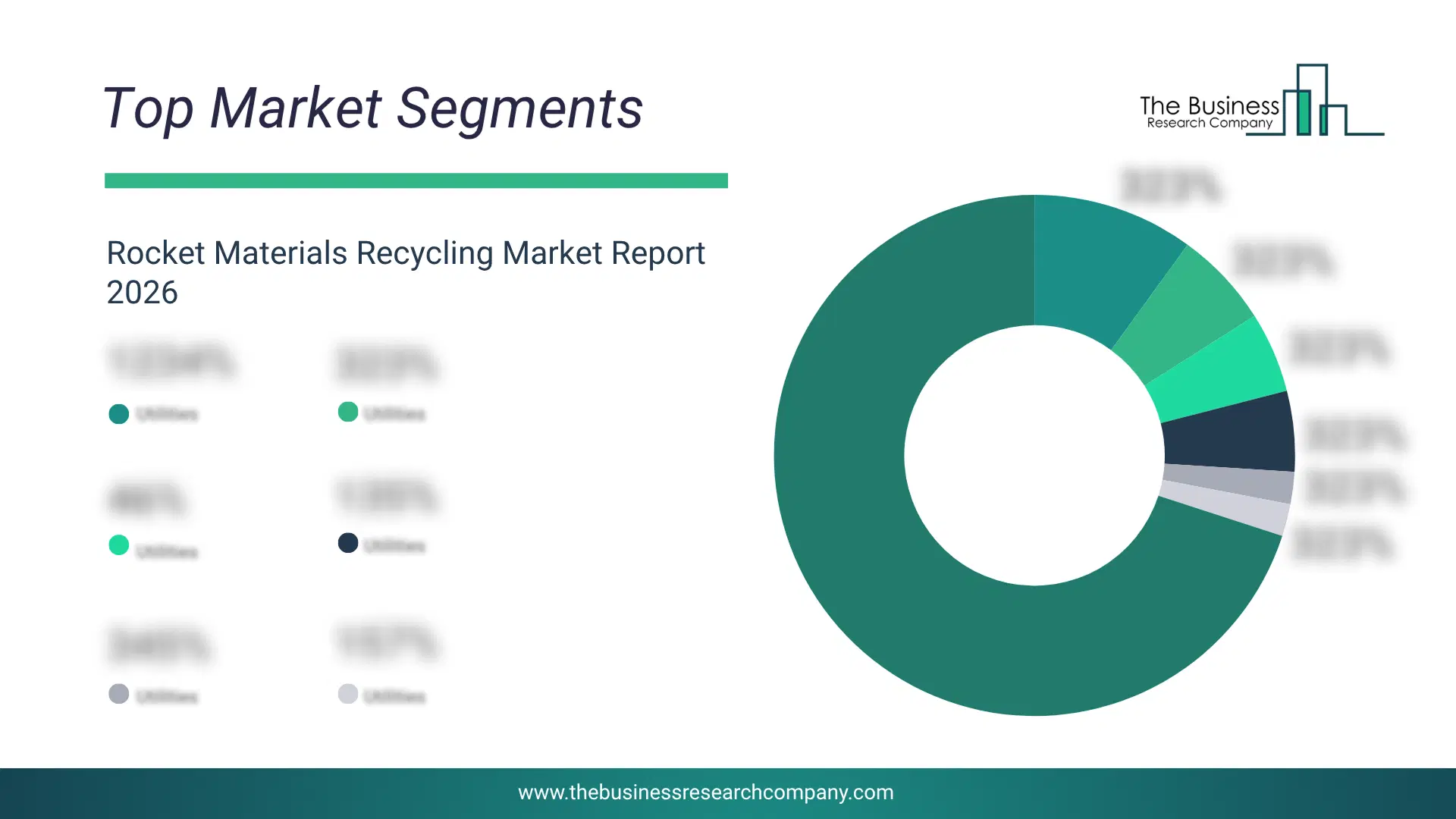
1) By Material Type: Metals, Composites, Polymers, Ceramics, Other Material Types 2) By Recycling Process: Mechanical Recycling, Chemical Recycling, Thermal Recycling, Other Recycling Processes 3) By Application: Aerospace, Defense, Space Exploration, Other Applications 4) By End-User: Government Agencies, Private Space Companies, Research Institutions, Other End-Users Subsegments: 1) By Metals: Aluminum Alloys, Titanium Alloys, Stainless Steel, Inconel, Copper Alloys 2) By Composites: Carbon Fiber Composites, Glass Fiber Composites, Aramid Fiber Composites, Ceramic Matrix Composites, Hybrid Composites 3) By Polymers: Polyetheretherketone (PEEK), Polytetrafluoroethylene (PTFE), Polyimide (PI), Polyphenylene Sulfide (PPS), Polyamide-imide (PAI) 4) By Ceramics: Silicon Carbide (SiC), Aluminum Oxide (Al2O3), Zirconium Dioxide (ZrO2), Boron Carbide (B4C), Silicon Nitride (Si3N4) 5) By Other Material Types: Elastomers, Foams, Thermal Insulation Materials, Paints and Coatings, Ablative MaterialsWhat Is Driver Of The Rocket Materials Recycling Market?
The growing interest in commercial space operations is expected to fuel the growth of the rocket materials recycling market in the coming years. Commercial space activities refer to space-related operations and services conducted by private or non-governmental entities for profit, including satellite launches, space tourism, and resource exploration. Commercial space activities are rising due to increasing private sector investment, which is accelerating innovation and reducing costs in space technologies and services. Rocket materials recycling in space operations involves recovering and reusing components from rockets and spacecraft to reduce waste, lower costs, and support sustainable space activities. Recyclable materials, such as metals and composites from used rocket stages or satellites, can be repurposed for repairs, construction, or manufacturing in orbit.For instance, in April 2024, according to the Organisation for Economic Co-operation and Development, a France-based international organization, as of early 2024, U.S.-based SpaceX and U.K.-based OneWeb operated constellations of over 5,000 and 600 satellites respectively, collectively making up more than half of all active satellites orbiting Earth .Therefore, the growing interest in commercial space operations will boost the growth of the rocket materials recycling industry.Key Players In The Global Rocket Materials Recycling Market
Major companies operating in the rocket materials recycling market are Veolia, Umicore, Aurubis, Sims Metal Management, Remondis, TOMRA, APChemi, JB Ecotex, Banyan Nation, Loop Industries, SpaceX, Blue Origin, ArianeGroup, United Launch Alliance, Sierra Space, Rocket Lab, Skyrora, Relativity Space, Firefly Aerospace, HyImpulse Technologies, Vaya Space, Astroscale, Redwire Space, Masten Space Systems, Resonac Holdings Corporation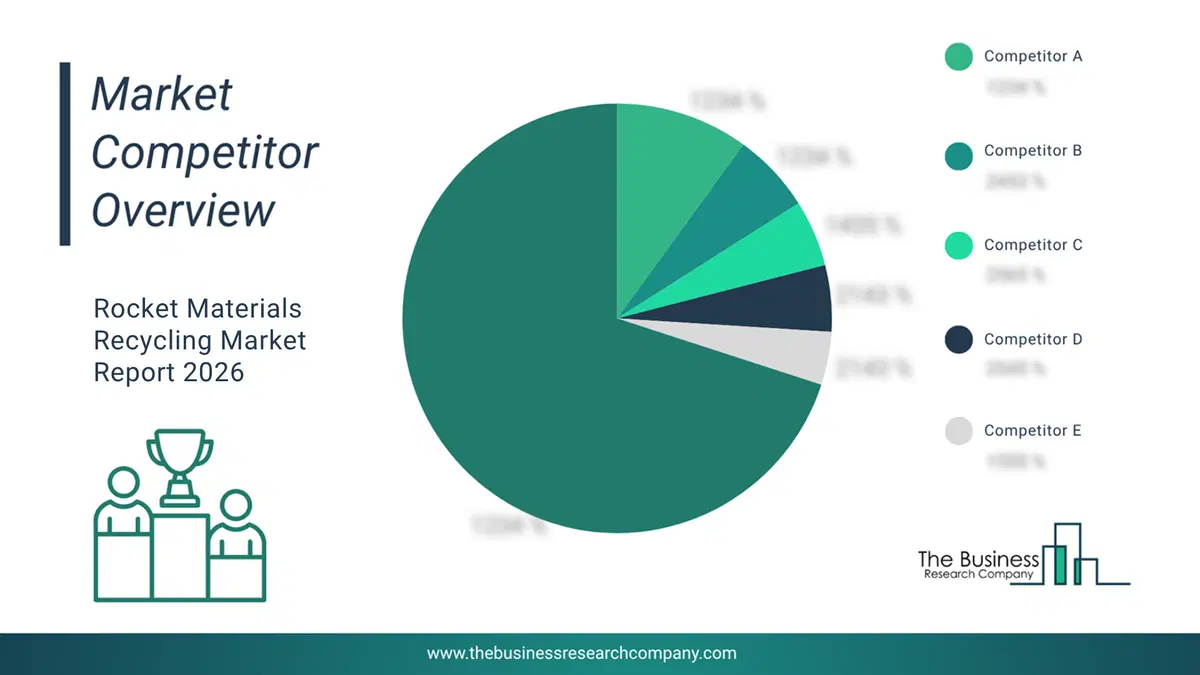
This chart is for illustrative purposes; the full report includes a detailed competitor analysis and comprehensive overview of the top 10 companies in the market.
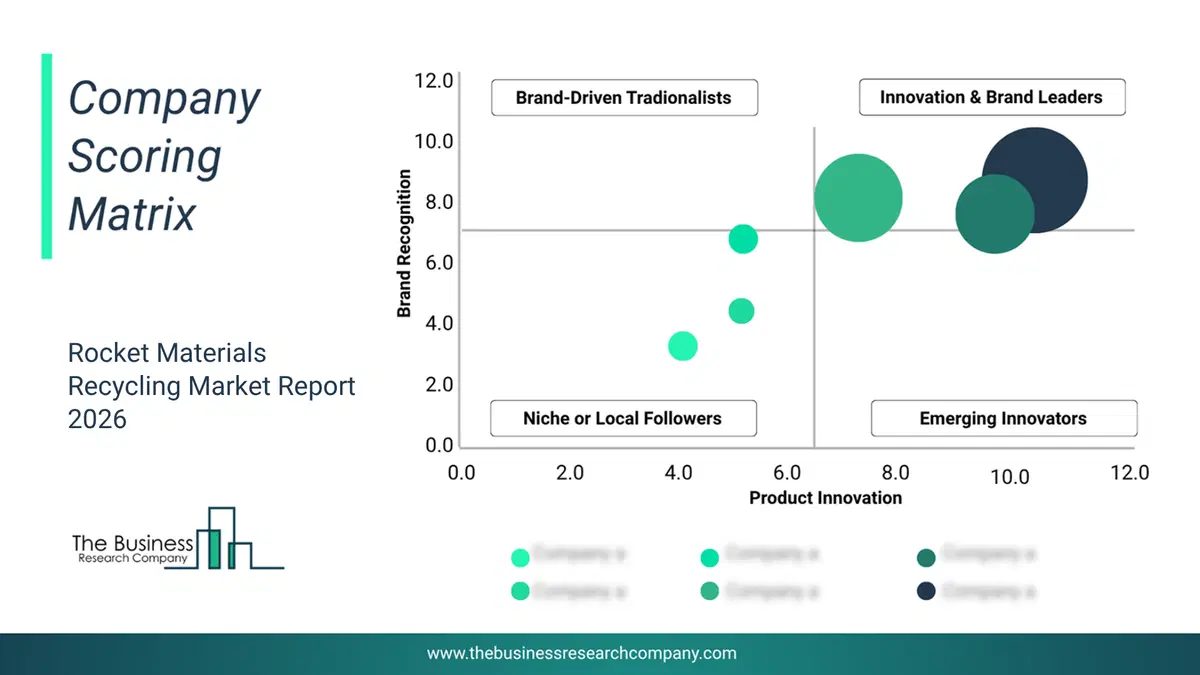
This chart maps companies by product innovation and brand strength, with bubble size indicating relative revenue, helping identify market leaders, challengers, and niche players. This is an illustrative chart; the full report provides a complete and accurate competitive analysis.
Global Rocket Materials Recycling Market Trends and Insights
Major companies operating in the rocket materials recycling market are focusing on developing advanced solutions, such as space debris recycling systems, to reduce the cost and need for launching new materials. Space debris recycling systems are technologies designed to capture, process, and repurpose defunct satellites and other orbital waste to reduce space clutter and support sustainable space operations. For instance, in May 2025, Paladin Space, an Australia-based aerospace company, launched Triton, a recoverable payload designed to collect space debris and securely eliminate it from orbit. It is a specialized payload developed to collect multiple pieces of space debris during a single mission, featuring a reusable capture system and an onboard unit for containment. It is engineered to work with orbital recycling hubs, promoting the reuse of valuable materials gathered in space. The system can release collected debris onto designated targets, contributing to in-orbit recycling efforts. Designed for long-term use, Triton remains in space after each operation, making future debris removal missions more efficient and economical.What Are Latest Mergers And Acquisitions In The Rocket Materials Recycling Market? 6K Additive Partnered With Agile Space Industries To Strengthen Sustainable Solutions In Rocket Materials Recycling And Lunar Propulsion
In August 2023, 6K Additive, a US-based provider of rocket materials recycling, partnered with Agile Space Industries to advance the future of lunar propulsion systems. The collaboration will lead to the development of advanced, eco-friendly metal powders, including copper alloys, for use in 3D-printed propulsion parts designed for lunar exploration. It also supports sustainability goals by utilizing high-grade powders produced through 6K Additive’s recycling-based manufacturing process. Agile Space Industries is a US-based aerospace company specializing in designing and producing engines for spacecraft.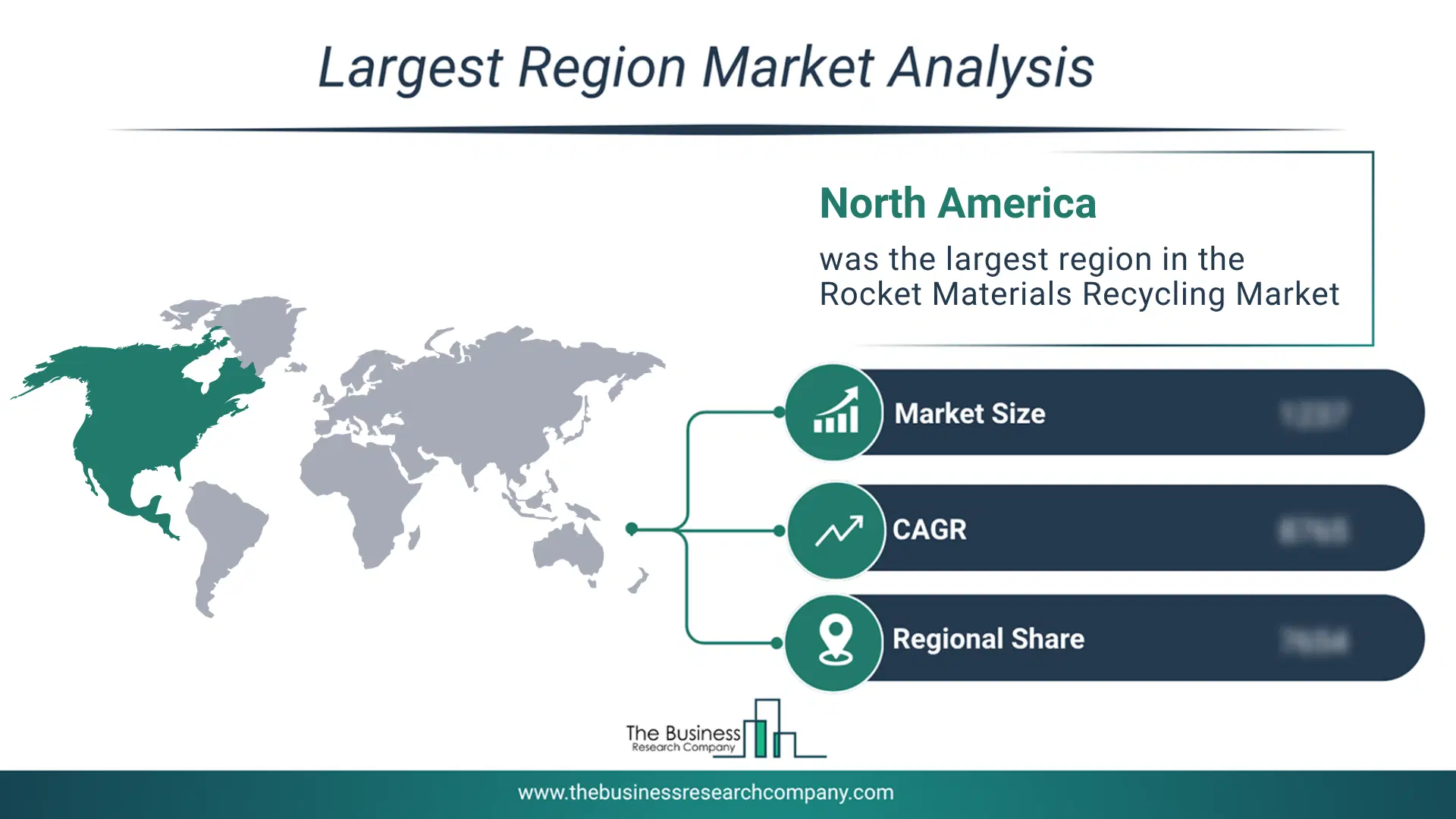
Regional Insights
North America was the largest region in the rocket materials recycling market in 2025. Asia-Pacific is expected to be the fastest-growing region in the forecast period. The regions covered in this market report are Asia-Pacific, South East Asia, Western Europe, Eastern Europe, North America, South America, Middle East, Africa. The countries covered in this market report are Australia, Brazil, China, France, Germany, India, Indonesia, Japan, Taiwan, Russia, South Korea, UK, USA, Canada, Italy, SpainWhat Defines the Rocket Materials Recycling Market?
The rocket materials recycling market includes revenues earned by entities by component recovery assessment, structural disassembly, material sorting, surface cleaning, and non-destructive testing. The market value includes the value of related goods sold by the service provider or included within the service offering. Only goods and services traded between entities or sold to end consumers are included.How is Market Value Defined and Measured?
The market value is defined as the revenues that enterprises gain from the sale of goods and/or services within the specified market and geography through sales, grants, or donations in terms of the currency (in USD unless otherwise specified). The revenues for a specified geography are consumption values that are revenues generated by organizations in the specified geography within the market, irrespective of where they are produced. It does not include revenues from resales along the supply chain, either further along the supply chain or as part of other products.
This chart presents market attractiveness based on a quantitative evaluation of growth, competition, strategic alignment, and risk, offering a clear view of opportunity areas for decision-making. This chart is for illustrative purposes; the full report contains the complete analysis.

This chart highlights the Total Addressable Market (TAM) by estimating the maximum revenue opportunity using an assumption-driven approach, supporting strategic planning and opportunity sizing across markets. The chart is illustrative; the full report provides a more comprehensive analysis.
What Key Data and Analysis Are Included in the Rocket Materials Recycling Market Report 2026?
The rocket materials recycling market research report is one of a series of new reports from The Business Research Company that provides market statistics, including industry global market size, regional shares, competitors with the market share, detailed market segments, market trends and opportunities, and any further data you may need to thrive in the rocket materials recycling industry. The market research report delivers a complete perspective of everything you need, with an in-depth analysis of the current and future state of the industry.Rocket Materials Recycling Market Report Forecast Analysis
| Report Attribute | Details |
|---|---|
| Market Size Value In 2026 | $1.43 billion |
| Revenue Forecast In 2030 | $2.29 billion |
| Growth Rate | CAGR of 12.5% from 2026 to 2030 |
| Base Year For Estimation | 2025 |
| Actual Estimates/Historical Data | 2020-2025 |
| Forecast Period | 2026 - 2030 |
| Market Representation | Revenue in USD Billion and CAGR from 2026 to 2030 |
| Segments Covered | Material Type, Recycling Process, Application, End-User |
| Regional Scope | Asia-Pacific, Western Europe, Eastern Europe, North America, South America, Middle East, Africa |
| Country Scope | The countries covered in the rocket materials recycling market report are Australia, Brazil, China, France, Germany, India, Indonesia, Japan, Taiwan, Russia, South Korea, UK, USA, Canada, Italy, Spain |
| Key Companies Profiled | Veolia, Umicore, Aurubis, Sims Metal Management, Remondis, TOMRA, APChemi, JB Ecotex, Banyan Nation, Loop Industries, SpaceX, Blue Origin, ArianeGroup, United Launch Alliance, Sierra Space, Rocket Lab, Skyrora, Relativity Space, Firefly Aerospace, HyImpulse Technologies, Vaya Space, Astroscale, Redwire Space, Masten Space Systems, Resonac Holdings Corporation |
| Customization Scope | Request for Customization |
| Pricing And Purchase Options | Explore Purchase Options |