
Rocket Payload Vibration Control Market Report 2026
Global Outlook – By Type (Passive Control, Active Control, Semi-Active Control), By Payload Type (Satellites, Space Probes, Manned Spacecraft, Cargo), By Application (Commercial, Military, Scientific Research), By End-User (Aerospace, Defense, Research Institutions) – Market Size, Trends, Strategies, and Forecast to 2030
Rocket Payload Vibration Control Market Overview
• Rocket Payload Vibration Control market size has reached to $1.59 billion in 2025 • Expected to grow to $2.31 billion in 2030 at a compound annual growth rate (CAGR) of 7.7% • Growth Driver: Surge In Number Of Satellite Launches Fueling The Growth Of The Market Due To Expanding Demand For Global Connectivity And Satellite Constellations • North America was the largest region in 2025 and Asia-Pacific is the fastest growing region.What Is Covered Under Rocket Payload Vibration Control Market?
Rocket payload vibration control refers to the technologies and systems designed to minimize or eliminate vibrations experienced by payloads during rocket launch, flight, and separation. These solutions ensure the structural integrity and functional reliability of sensitive instruments and equipment by mitigating mechanical stresses caused by acoustic, aerodynamic, and propulsion-induced forces. The main types of rocket payload vibration control include passive control, active control and semi-active control. Passive control refers to vibration mitigation methods that do not require external power, using components like dampers, isolators, and mounts to absorb or reduce vibrations. The payload types are satellites, space probes, manned spacecraft and cargo. The various applications involved are commercial, military and scientific research. And are used by end-users such as aerospace, defense and research institutions.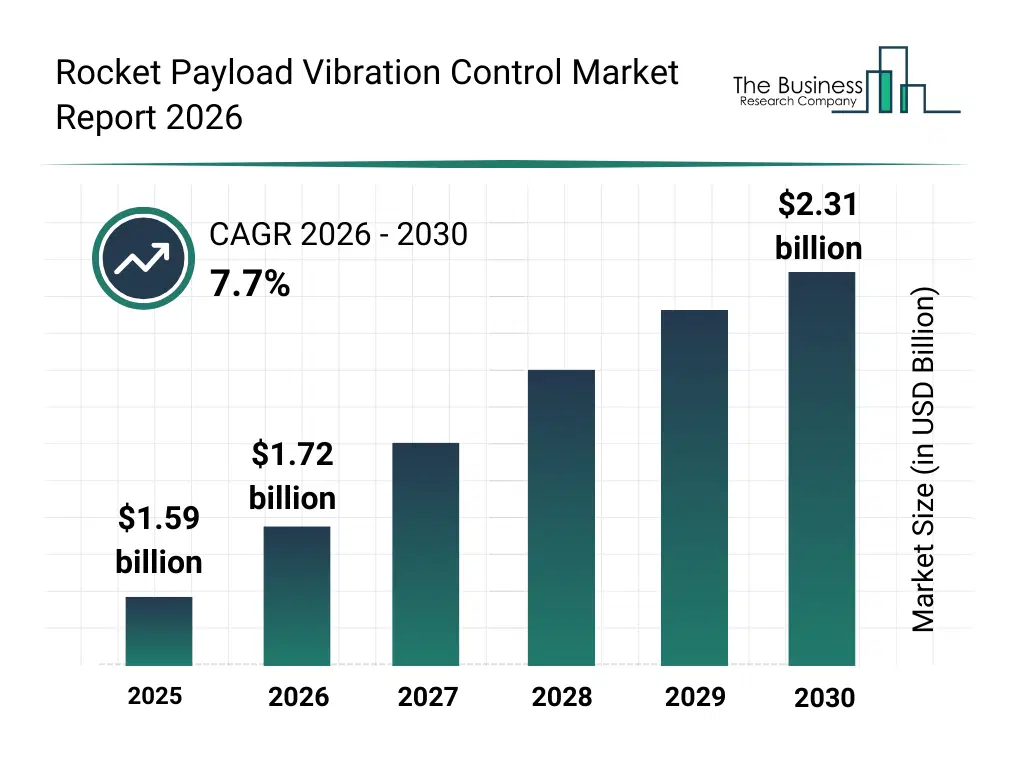
What Is The Rocket Payload Vibration Control Market Size and Share 2026?
The rocket payload vibration control market size has grown strongly in recent years. It will grow from $1.59 billion in 2025 to $1.72 billion in 2026 at a compound annual growth rate (CAGR) of 8.2%. The growth in the historic period can be attributed to increasing sensitivity of scientific and commercial payloads driving demand for vibration mitigation solutions, development of viscoelastic dampers to reduce launch-induced mechanical stresses, early adoption of vibration testing and simulation services to validate payload survivability, integration of electromagnetic damping technologies to improve isolation performance, expansion of government and commercial launch programs requiring post-flight vibration analysis.What Is The Rocket Payload Vibration Control Market Growth Forecast?
The rocket payload vibration control market size is expected to see strong growth in the next few years. It will grow to $2.31 billion in 2030 at a compound annual growth rate (CAGR) of 7.7%. The growth in the forecast period can be attributed to growth of commercial satellite constellations increasing demand for scalable vibration control systems, innovation in hybrid isolation technologies enabling higher attenuation across broader frequency ranges, rising adoption of rapid prototyping and custom fabrication to tailor vibration solutions to payload needs, advancements in predictive modeling improving vibration environment forecasting, expansion of reusable rockets necessitating vibration control systems compatible with repeated launch cycles. Major trends in the forecast period include increasing use of hybrid vibration isolation systems, rising demand for high-fidelity vibration testing and simulation services, growth of custom-engineered dampers for small and modular payloads, expansion of advanced materials in passive vibration dampers, greater adoption of non-contact electromagnetic isolation technologies.
Global Rocket Payload Vibration Control Market Segmentation
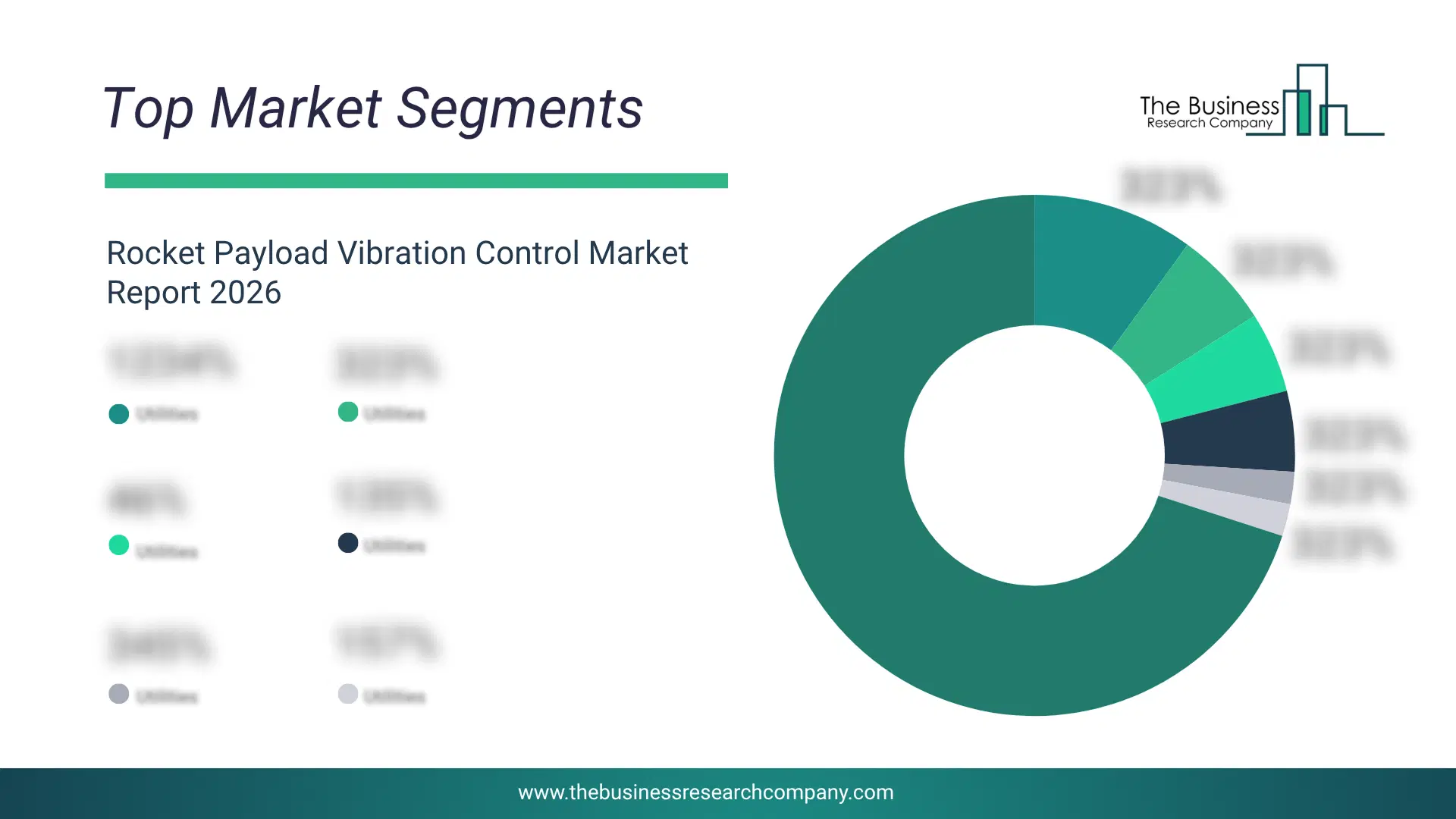
1) By Type: Passive Control, Active Control, Semi-Active Control 2) By Payload Type: Satellites, Space Probes, Manned Spacecraft, Cargo 3) By Application: Commercial, Military, Scientific Research 4) By End-User: Aerospace, Defense, Research Institutions Subsegments: 1) By Passive Control: Tuned Mass Dampers (TMD), Base Isolation Systems, Elastomeric Mounts, Shock Absorbers, Damping Pads 2) By Active Control: Electromagnetic Actuators, Piezoelectric Actuators, Hydraulic Actuators, Servo-Controlled Systems, Feedback Sensor Systems 3) By Semi-Active Control: Magnetorheological Dampers, Electro-Rheological Dampers, Variable Orifice Dampers, Smart Material-Based Dampers, Semi-Active Tuned Mass DampersWhat Is Driver Of The Rocket Payload Vibration Control Market?
The increasing investment in space exploration is expected to propel the growth of the rocket payload vibration control market going forward. Investment in space exploration refers to funding directed toward developing technologies, missions, and infrastructure that enable the discovery, utilization, and commercialization of outer space. Investment in space exploration is increasing due to the growing commercialization of space, which offers new economic opportunities in satellite services, space tourism, and resource utilization. Investment in space exploration helps advance rocket payload vibration control by funding research and development of advanced damping materials, sensors, and active control systems that protect sensitive payloads from launch-induced vibrations. For instance, in June 2024, according to the Ministry of Foreign Affairs and Trade, a New Zealand-based government department, the UK committed to investing $12.5 billion (£10 billion) in space activities over the decade beginning in 2023, with $3.75 billion (£3 billion) earmarked in the 2023 spending review. Therefore, The Increasing Investment In Space Exploration is driving the growth of the Rocket Payload Vibration Control market.Key Players In The Global Rocket Payload Vibration Control Market
Major companies operating in the rocket payload vibration control market are The Boeing Company, Lockheed Martin Corporation, Airbus SE, General Dynamics Corporation, Northrop Grumman Corporation, Honeywell International Inc., L3Harris Technologies Inc., Parker Hannifin Corporation, Trelleborg AB, Moog Inc., ITT Inc., Curtiss-Wright Corporation, Thales Group, Kaman Corporation, Beyond Gravity AG, Hutchinson Group, Crystal Instruments Inc., VibraSystems Inc., Technical Manufacturing Corporation, Minus K Technology Inc.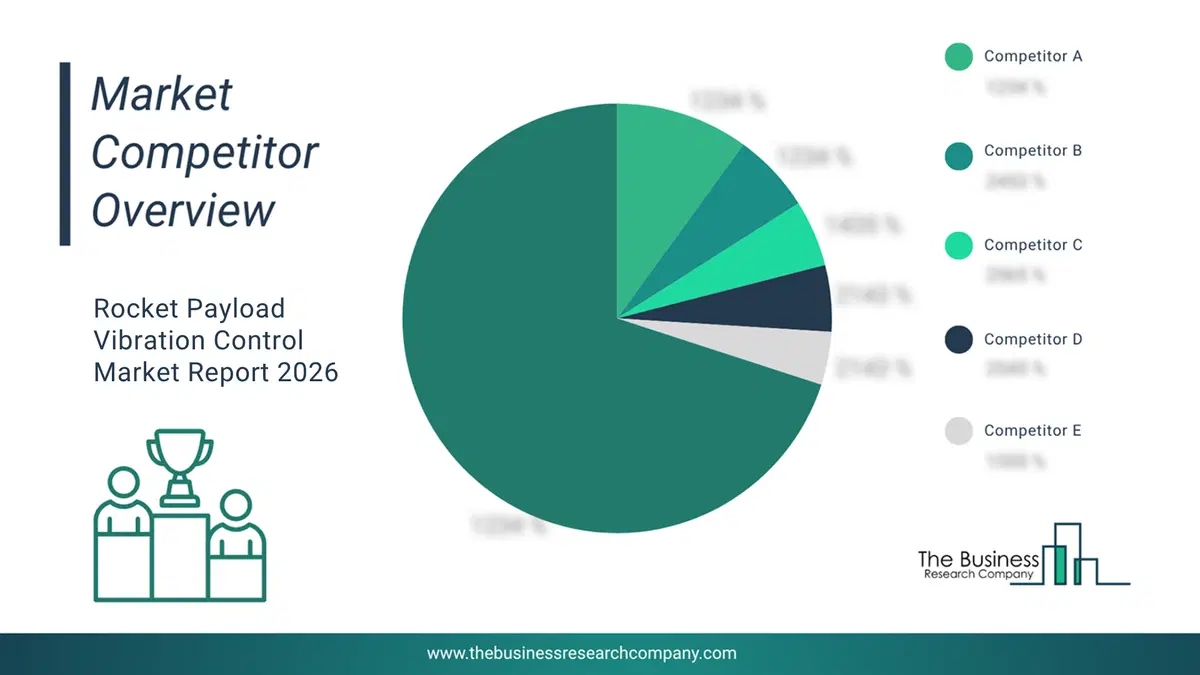
This chart is for illustrative purposes; the full report includes a detailed competitor analysis and comprehensive overview of the top 10 companies in the market.
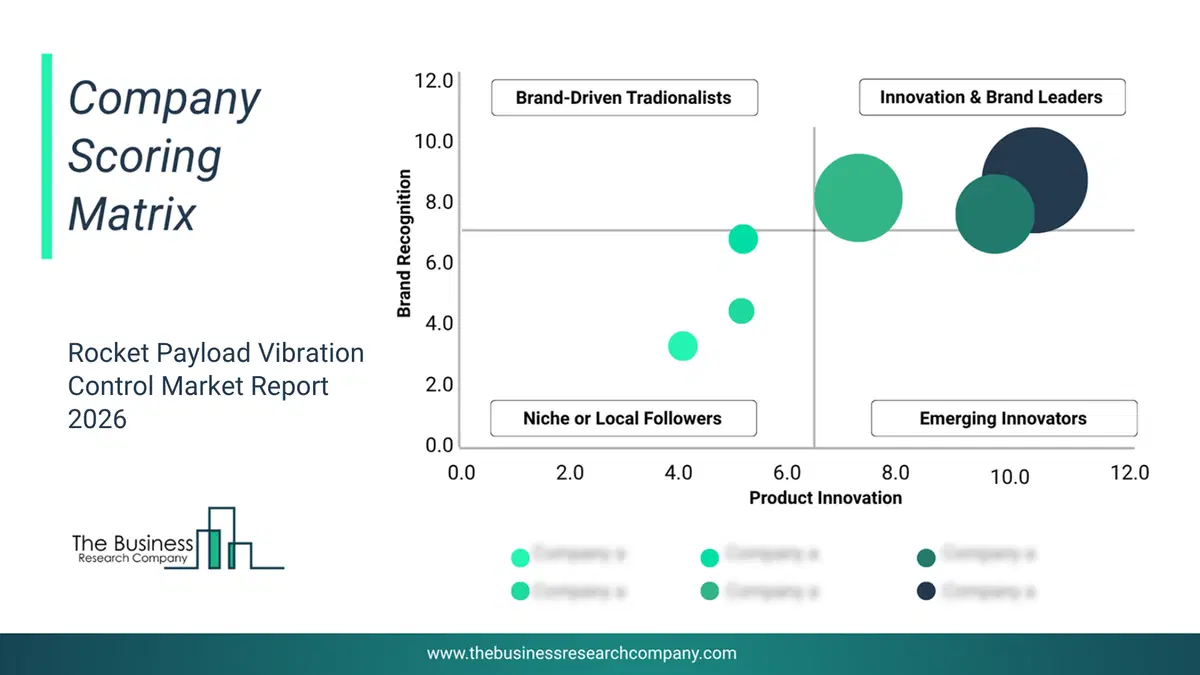
This chart maps companies by product innovation and brand strength, with bubble size indicating relative revenue, helping identify market leaders, challengers, and niche players. This is an illustrative chart; the full report provides a complete and accurate competitive analysis.
What Are Latest Mergers And Acquisitions In The Rocket Payload Vibration Control Market? INNOSPACE Partners With STEP Lab To Enhance Launch Precision And Global Market Reach
In July 2025, INNOSPACE, a South Korea-based aerospace company, partnered with STEP Lab to enhance launch precision and advance vibration control technologies for rocket payloads. With this partnership aims to combine advanced hybrid rocket technology with cutting-edge vibration control to provide precise, reliable, and cost-effective satellite launch services to the global market. STEP Lab is a South Korea-based technology company that offers rocket payload vibration control.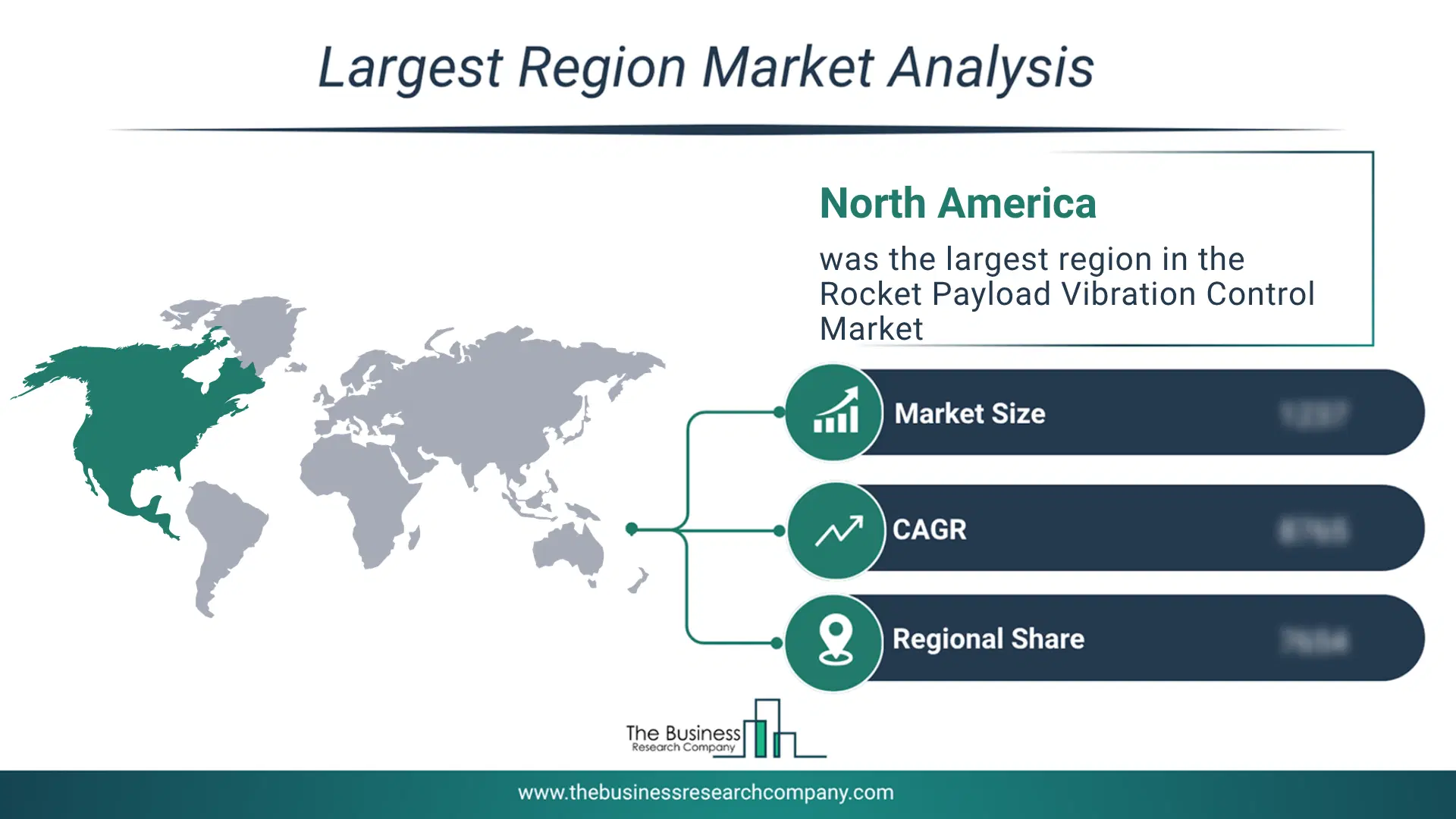
Regional Insights
North America was the largest region in the rocket payload vibration control market in 2025. Asia-Pacific is expected to be the fastest-growing region in the forecast period. The regions covered in this market report are Asia-Pacific, South East Asia, Western Europe, Eastern Europe, North America, South America, Middle East, Africa. The countries covered in this market report are Australia, Brazil, China, France, Germany, India, Indonesia, Japan, Taiwan, Russia, South Korea, UK, USA, Canada, Italy, SpainWhat Defines the Rocket Payload Vibration Control Market?
The rocket payload vibration control market consists of revenues earned by entities by providing services such as vibration testing and simulation services, post-flight vibration analysis, rapid prototyping and custom fabrication. The market value includes the value of related goods sold by the service provider or included within the service offering. The rocket payload vibration control market includes sales of viscoelastic dampers, electromagnetic dampers, hybrid isolation systems. Values in this market are ‘factory gate’ values, that is, the value of goods sold by the manufacturers or creators of the goods, whether to other entities (including downstream manufacturers, wholesalers, distributors, and retailers) or directly to end customers. The value of goods in this market includes related services sold by the creators of the goods.How is Market Value Defined and Measured?
The market value is defined as the revenues that enterprises gain from the sale of goods and/or services within the specified market and geography through sales, grants, or donations in terms of the currency (in USD unless otherwise specified). The revenues for a specified geography are consumption values that are revenues generated by organizations in the specified geography within the market, irrespective of where they are produced. It does not include revenues from resales along the supply chain, either further along the supply chain or as part of other products.
This chart presents market attractiveness based on a quantitative evaluation of growth, competition, strategic alignment, and risk, offering a clear view of opportunity areas for decision-making. This chart is for illustrative purposes; the full report contains the complete analysis.

This chart highlights the Total Addressable Market (TAM) by estimating the maximum revenue opportunity using an assumption-driven approach, supporting strategic planning and opportunity sizing across markets. The chart is illustrative; the full report provides a more comprehensive analysis.
What Key Data and Analysis Are Included in the Rocket Payload Vibration Control Market Report 2026?
The rocket payload vibration control market research report is one of a series of new reports from The Business Research Company that provides market statistics, including industry global market size, regional shares, competitors with the market share, detailed market segments, market trends and opportunities, and any further data you may need to thrive in the rocket payload vibration control industry. The market research report delivers a complete perspective of everything you need, with an in-depth analysis of the current and future state of the industry.Rocket Payload Vibration Control Market Report Forecast Analysis
| Report Attribute | Details |
|---|---|
| Market Size Value In 2026 | $1.72 billion |
| Revenue Forecast In 2030 | $2.31 billion |
| Growth Rate | CAGR of 7.7% from 2026 to 2030 |
| Base Year For Estimation | 2025 |
| Actual Estimates/Historical Data | 2020-2025 |
| Forecast Period | 2026 - 2030 |
| Market Representation | Revenue in USD Billion and CAGR from 2026 to 2030 |
| Segments Covered | Type, Payload Type, Application, End-User |
| Regional Scope | Asia-Pacific, Western Europe, Eastern Europe, North America, South America, Middle East, Africa |
| Country Scope | The countries covered in the rocket payload vibration control market report are Australia, Brazil, China, France, Germany, India, Indonesia, Japan, Taiwan, Russia, South Korea, UK, USA, Canada, Italy, Spain |
| Key Companies Profiled | The Boeing Company, Lockheed Martin Corporation, Airbus SE, General Dynamics Corporation, Northrop Grumman Corporation, Honeywell International Inc., L3Harris Technologies Inc., Parker Hannifin Corporation, Trelleborg AB, Moog Inc., ITT Inc., Curtiss-Wright Corporation, Thales Group, Kaman Corporation, Beyond Gravity AG, Hutchinson Group, Crystal Instruments Inc., VibraSystems Inc., Technical Manufacturing Corporation, Minus K Technology Inc. |
| Customization Scope | Request for Customization |
| Pricing And Purchase Options | Explore Purchase Options |