
Military Satellites Market Report 2026
Global Outlook – By Satellite Type (Small Satellite, Medium-To-Heavy Satellite), By Payload Type (Communication Payload, Navigation Payload, Imaging Payload, Others), By Application (Intelligence, Surveillance, And Reconnaissance (ISR), Communication, Navigation) – Market Size, Trends, Strategies, and Forecast to 2030
Military Satellites Market Overview
• Military Satellites market size has reached to $62.68 billion in 2025 • Expected to grow to $82.75 billion in 2030 at a compound annual growth rate (CAGR) of 5.9% • Growth Driver: Rising Terrorism Concerns Drive Growth In The Military Satellite Market • Market Trend: Innovation In The Military Satellite Market • North America was the largest region in 2025 and Asia-Pacific is the fastest growing region.What Is Covered Under Military Satellites Market?
A military satellite is an artificial earth satellite used for military missions such as intelligence gathering, navigation, and military communications. The capabilities of military satellites include secure in-theater communications, weather and navigational data for ground, air, and fleet operations, as well as threat warning. The main types of military satellites are small satellites and medium-to-heavy satellites. The various types of payloads include communication payload, navigation payload, imaging payload, and others that are used for intelligence, surveillance, and reconnaissance (ISR), communication, and navigation. A satellite payload refers to the components of a spacecraft that are specifically dedicated to producing mission data and relaying that data back to Earth.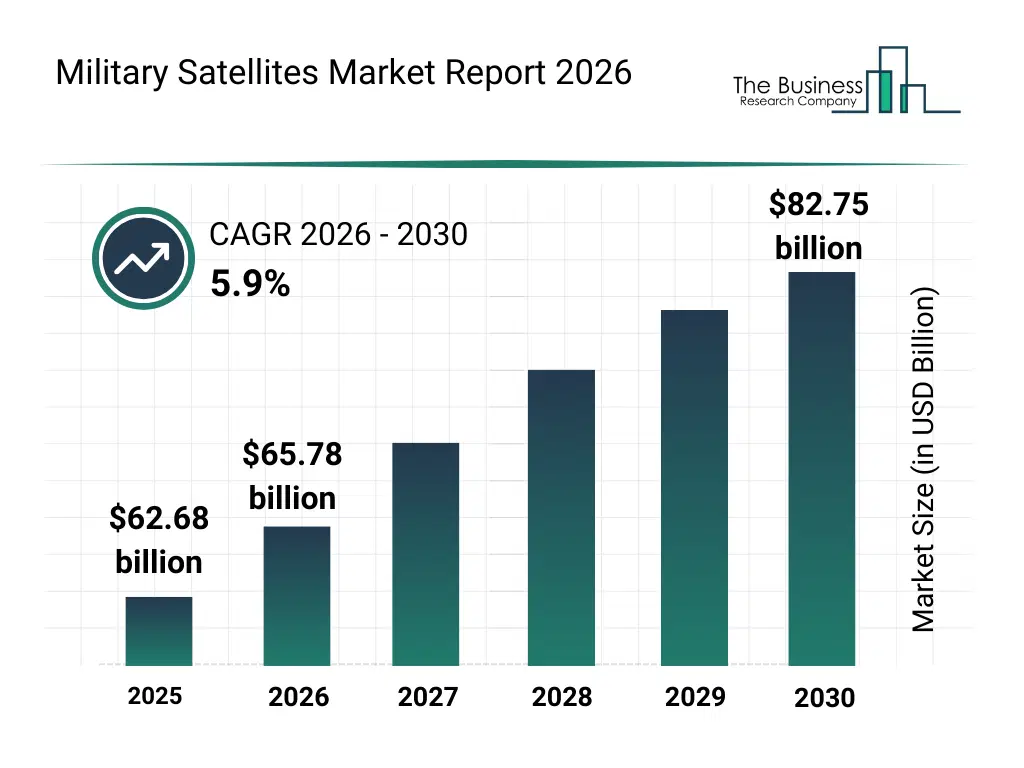
What Is The Military Satellites Market Size and Share 2026?
The military satellites market size has grown steadily in recent years. It will grow from $62.68 billion in 2025 to $65.78 billion in 2026 at a compound annual growth rate (CAGR) of 4.9%. The growth in the historic period can be attributed to deployment of early military reconnaissance and communication satellites, advancements in satellite navigation and positioning technologies, growth in defense budgets for space-based military programs, development of secure military communication satellite networks, integration of satellites for weather and threat intelligence in military operations.What Is The Military Satellites Market Growth Forecast?
The military satellites market size is expected to see strong growth in the next few years. It will grow to $82.75 billion in 2030 at a compound annual growth rate (CAGR) of 5.9%. The growth in the forecast period can be attributed to rising demand for high-resolution reconnaissance and surveillance satellites, growth in secure military communication and navigation satellite systems, advancements in satellite defense and anti-jamming technologies, increasing investment in satellite constellations for real-time military intelligence, integration of AI and data analytics for enhanced satellite-based military operations. Major trends in the forecast period include enhanced satellite encryption and secure communication systems, miniaturization and development of small satellites for tactical missions, integration of advanced imaging and sensor technologies, real-time satellite-based battlefield intelligence and monitoring, use of satellites for precision navigation and guidance in military operations.
Global Military Satellites Market Segmentation
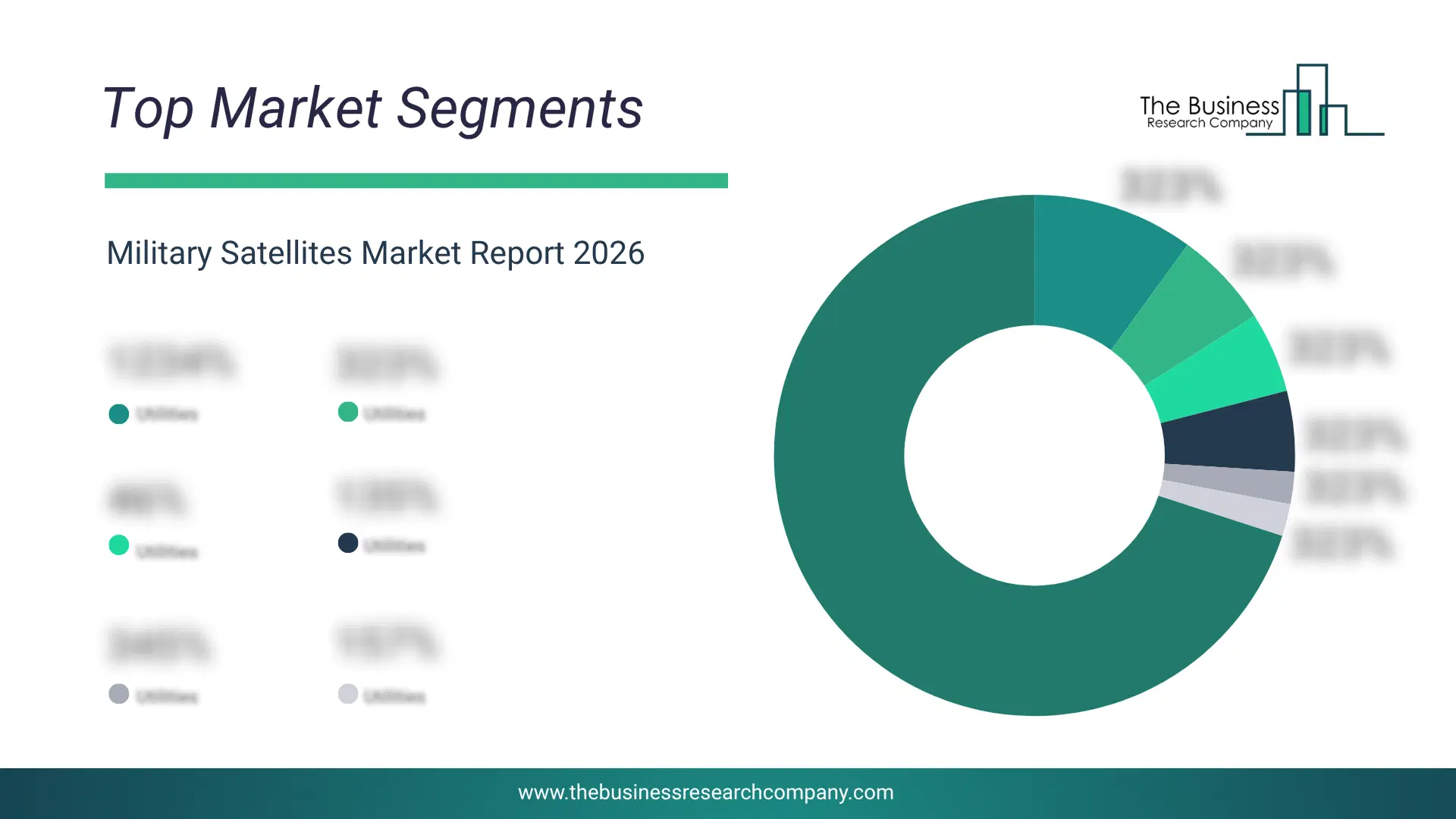
1) By Satellite Type: Small Satellite, Medium-To-Heavy Satellite 2) By Payload Type: Communication Payload, Navigation Payload, Imaging Payload, Others 3) By Application: Intelligence, Surveillance, And Reconnaissance (ISR), Communication, Navigation Subsegments: 1) By Small Satellite: Nano Satellite, Pico Satellite, Micro Satellite, Mini Satellite 2) By Medium-to-Heavy Satellite: Medium Satellite, Large Satellite, Very Large SatelliteWhat Is Driver Of The Military Satellites Market?
The increasing concern about terrorism is expected to fuel the growth of the military satellite market. Terrorism refers to the use of violence or threats to create fear, often targeting civilians, in order to achieve political, religious, or ideological goals. The growing concern about terrorism has motivated the need for military forces around the world to deploy better military communication systems. Military satellites are an important part of modern military communication networks. For instance, in September 2025, according to the Home Office, a UK government department, in the year ending 30 June 2025, 83 people were tried for terrorism-related offences, which is five more than the number in the year ending 30 June 2024. Therefore, the increasing concern about terrorism drives the growth of the military satellite industry.Key Players In The Global Military Satellites Market
Major companies operating in the military satellites market are The Boeing Company, Israel Aerospace Industries, Northrop Grumman Corporation, ISS-Reshetnev, Space Exploration Technologies Corp., Lockheed Martin Corporation, Raytheon Company, Thales Group, Mitsubishi Electric Corporation, Airbus SE, Indian Space Research Organisation, OHB SE, Elbit System Ltd., Orbital ATK Inc., Cobham Limited, Viasat Inc., Safran Electronics & Defense, Selex ES Inc., Harris Corporation, L3Harris Technologies Inc., Terma A/S, BAE Systems plc, QinetiQ Group PLC, Reutech Radar Systems, Easat Radar Systems Limited, Indra Company, Bharat Electronics Limited, Saab AB, China Aerospace Science and Technology Corporation, NEC Corporation, Orbital Sciences Corporation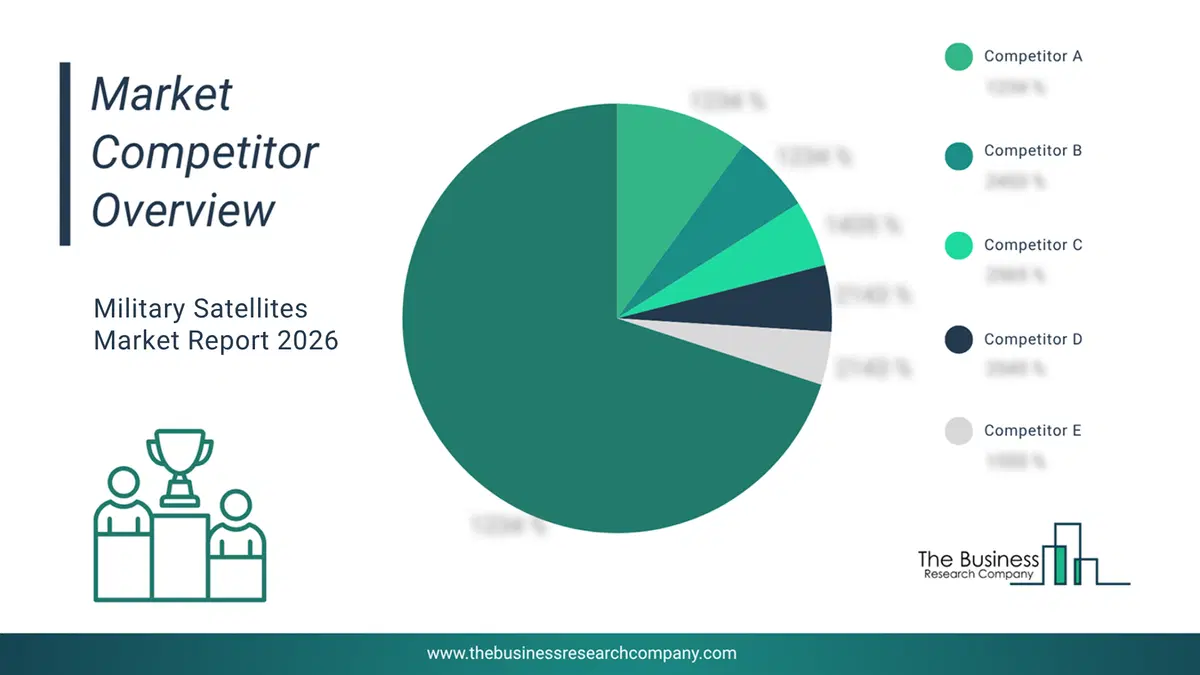
This chart is for illustrative purposes; the full report includes a detailed competitor analysis and comprehensive overview of the top 10 companies in the market.
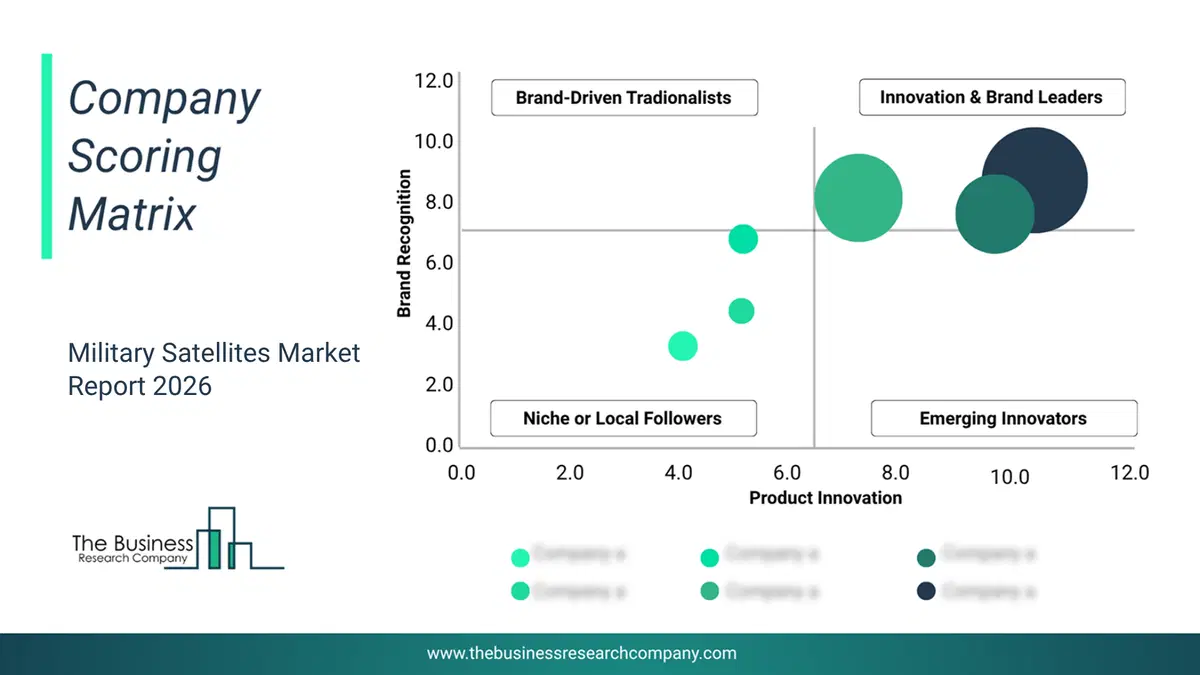
This chart maps companies by product innovation and brand strength, with bubble size indicating relative revenue, helping identify market leaders, challengers, and niche players. This is an illustrative chart; the full report provides a complete and accurate competitive analysis.
Global Military Satellites Market Trends and Insights
Major companies operating in the military satellite market are focusing on developing innovative products, such as anti-jam payload, to provide reliable services to customers. An anti-jam payload is a device that is used to protect satellite communications from jamming. For instance, in April 2023, Boeing Co, a US-based provider of commercial airplanes, defense, space, and security systems, launched a Protected Tactical SATCOM Prototype (PTS-P) payload. The PTS-P design features automated anti-jam capabilities, including jammer geolocation, real-time adaptive nulling, frequency hopping, and other techniques, harnessing the power of the U.S. military's Protected Tactical Waveform (PTW) to ensure the warfighter can stay connected in a contested environment.What Are Latest Mergers And Acquisitions In The Military Satellites Market? Gilat Satellite Networks Ltd Acquisition Of DataPath Inc
In November 2023, Gilat Satellite Networks Ltd., an Israel-based telecom company, acquired DataPath Inc. for an undisclosed amount. Through this acquisition, Gilat Satellite Networks Ltd. aims to advance its solutions in the rapidly evolving satellite communication market. The collaboration will enhance both companies’ strengths in the global defense sector, opening up new opportunities for advanced technologies and resources. DataPath Inc. is a UK-based company dedicated to delivering innovative communication solutions for military satellites and defense operations.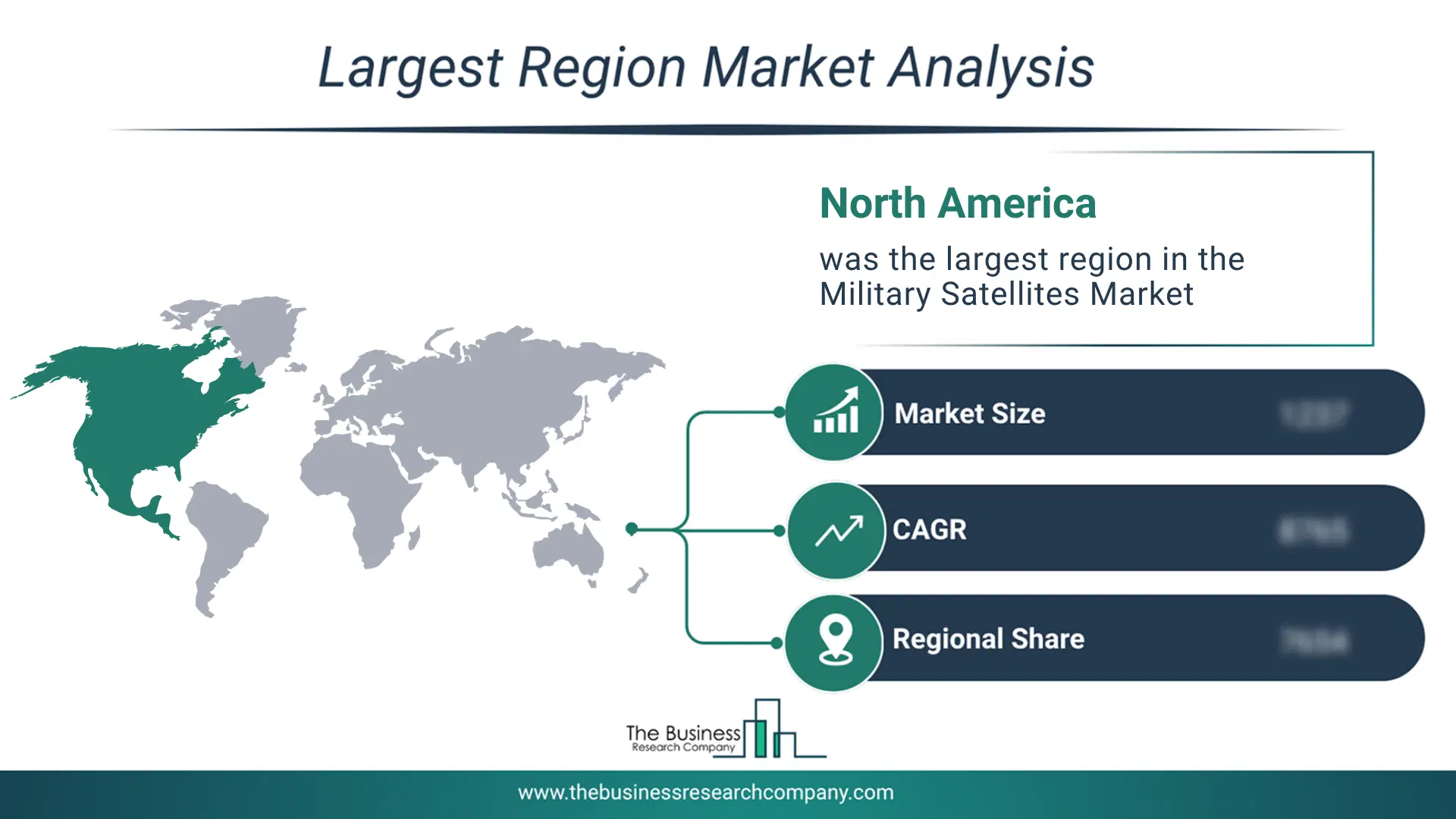
Regional Insights
North America was the largest region in the military satellites market in 2025. Asia-Pacific is expected to be the fastest-growing region in the military satellites market during the forecast period. The regions covered in this market report are Asia-Pacific, South East Asia, Western Europe, Eastern Europe, North America, South America, Middle East, Africa. The countries covered in this market report are Australia, Brazil, China, France, Germany, India, Indonesia, Japan, Taiwan, Russia, South Korea, UK, USA, Canada, Italy, SpainWhat Defines the Military Satellites Market?
The military satellite market consists of sales of various satellites for military applications such as military reconnaissance satellites, navigation satellites, early warning systems, and military communication satellites. Values in this market are factory gate values, that is the value of goods sold by the manufacturers or creators of the goods, whether to other entities (including downstream manufacturers, wholesalers, distributors, and retailers) or directly to end customers. The value of goods in this market includes related services sold by the creators of the goods.How is Market Value Defined and Measured?
The market value is defined as the revenues that enterprises gain from the sale of goods and/or services within the specified market and geography through sales, grants, or donations in terms of the currency (in USD unless otherwise specified). The revenues for a specified geography are consumption values that are revenues generated by organizations in the specified geography within the market, irrespective of where they are produced. It does not include revenues from resales along the supply chain, either further along the supply chain or as part of other products.
This chart presents market attractiveness based on a quantitative evaluation of growth, competition, strategic alignment, and risk, offering a clear view of opportunity areas for decision-making. This chart is for illustrative purposes; the full report contains the complete analysis.

This chart highlights the Total Addressable Market (TAM) by estimating the maximum revenue opportunity using an assumption-driven approach, supporting strategic planning and opportunity sizing across markets. The chart is illustrative; the full report provides a more comprehensive analysis.
What Key Data and Analysis Are Included in the Military Satellites Market Report 2026?
The military satellites market research report is one of a series of new reports from The Business Research Company that provides market statistics, including industry global market size, regional shares, competitors with the market share, detailed market segments, market trends and opportunities, and any further data you may need to thrive in the military satellites industry. The market research report delivers a complete perspective of everything you need, with an in-depth analysis of the current and future state of the industry.Military Satellites Market Report Forecast Analysis
| Report Attribute | Details |
|---|---|
| Market Size Value In 2026 | $65.78 billion |
| Revenue Forecast In 2030 | $82.75 billion |
| Growth Rate | CAGR of 5.9% from 2026 to 2030 |
| Base Year For Estimation | 2025 |
| Actual Estimates/Historical Data | 2020-2025 |
| Forecast Period | 2026 - 2030 |
| Market Representation | Revenue in USD Billion and CAGR from 2026 to 2030 |
| Segments Covered | Satellite Type, Payload Type, Application |
| Regional Scope | Asia-Pacific, Western Europe, Eastern Europe, North America, South America, Middle East, Africa |
| Country Scope | The countries covered in the military satellites market report are Australia, Brazil, China, France, Germany, India, Indonesia, Japan, Taiwan, Russia, South Korea, UK, USA, Canada, Italy, Spain |
| Key Companies Profiled | The Boeing Company, Israel Aerospace Industries, Northrop Grumman Corporation, ISS-Reshetnev, Space Exploration Technologies Corp., Lockheed Martin Corporation, Raytheon Company, Thales Group, Mitsubishi Electric Corporation, Airbus SE, Indian Space Research Organisation, OHB SE, Elbit System Ltd., Orbital ATK Inc., Cobham Limited, Viasat Inc., Safran Electronics & Defense, Selex ES Inc., Harris Corporation, L3Harris Technologies Inc., Terma A/S, BAE Systems plc, QinetiQ Group PLC, Reutech Radar Systems, Easat Radar Systems Limited, Indra Company, Bharat Electronics Limited, Saab AB, China Aerospace Science and Technology Corporation, NEC Corporation, Orbital Sciences Corporation |
| Customization Scope | Request for Customization |
| Pricing And Purchase Options | Explore Purchase Options |