
Rocket Propellant Additives Market Report 2026
Global Outlook – By Type (Metallic Additives, Non-Metallic Additives), By Propellant Type (Solid Propellant, Liquid Propellant, Hybrid Propellant), By Application (Military And Defense, Space Exploration, Commercial) – Market Size, Trends, Strategies, and Forecast to 2030
Rocket Propellant Additives Market Overview
• Rocket Propellant Additives market size has reached to $3.18 billion in 2025 • Expected to grow to $4.66 billion in 2030 at a compound annual growth rate (CAGR) of 7.9% • Growth Driver: The Increasing Number Of Satellite Launches Is Fueling Market Growth Due To Rising Demand For Connectivity • Market Trend: Strategic Investments Propel Advancements In High-Performance Solid Rocket Propellants • North America was the largest region in 2025.What Is Covered Under Rocket Propellant Additives Market?
Rocket propellant additives are chemical compounds incorporated into fuels or oxidizers to enhance performance, stability, or safety. They can increase energy output, prevent unwanted reactions, and improve combustion efficiency. These additives are critical for optimizing thrust, controlling burn rates, and ensuring reliable propulsion under extreme conditions. The main types of rocket propellant additives are metallic and non-metallic additives. Metallic additives are elements or compounds added to rocket propellants to boost energy output, combustion efficiency, and overall performance. They can be classified as solid, liquid, or hybrid, and these additives are used in various applications, including military and defense, space exploration, and commercial purposes.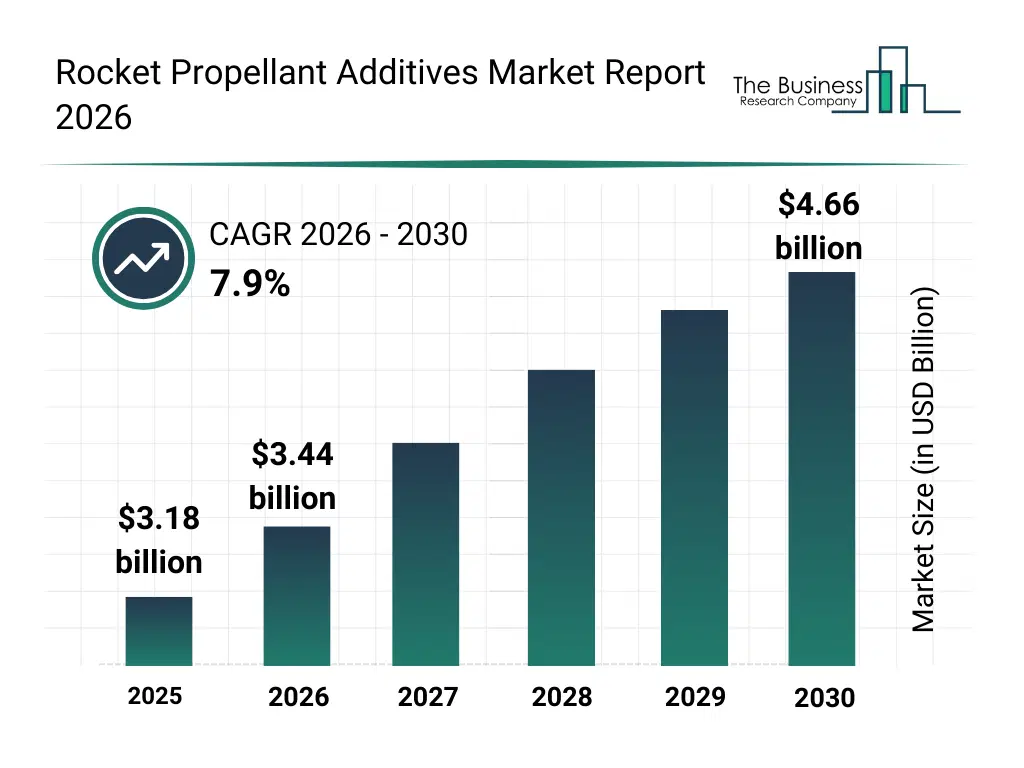
What Is The Rocket Propellant Additives Market Size and Share 2026?
The rocket propellant additives market size has grown strongly in recent years. It will grow from $3.18 billion in 2025 to $3.44 billion in 2026 at a compound annual growth rate (CAGR) of 8.2%. The growth in the historic period can be attributed to military missile development, government space programs, solid propellant usage, aerospace research funding, defense modernization.What Is The Rocket Propellant Additives Market Growth Forecast?
The rocket propellant additives market size is expected to see strong growth in the next few years. It will grow to $4.66 billion in 2030 at a compound annual growth rate (CAGR) of 7.9%. The growth in the forecast period can be attributed to commercial space exploration growth, reusable launch vehicle development, advanced propulsion research, defense spending expansion, private space company investments. Major trends in the forecast period include rising demand for high energy propellants, growing use of metallic performance additives, expansion of commercial space launches, focus on combustion stability enhancement, adoption of advanced safety additives.
Global Rocket Propellant Additives Market Segmentation
1) By Type: Metallic Additives, Non-Metallic Additives 2) By Propellant Type: Solid Propellant, Liquid Propellant, Hybrid Propellant 3) By Application: Military And Defense, Space Exploration, Commercial Subsegments: 1) By Metallic Additives: Aluminum, Magnesium, Beryllium, Titanium, Zirconium 2) By Non-Metallic Additives: Oxides, Carbon-Based Materials, Sulfur Compounds, PlasticizersWhat Is The Driver Of The Rocket Propellant Additives Market?
The increasing number of satellite launches is expected to propel the growth of the rocket propellant additives market going forward. Satellite launches refer to the process of sending satellites into orbit around the earth using rockets or other launch vehicles. The increasing number of satellite launches is largely driven by growing demand for communication, as more satellites are needed to support internet coverage, mobile networks, and data transmission services. Rocket propellant additives enhance satellite performance by improving rocket fuel efficiency, stability, and thrust, which not only enables more precise and reliable satellite launches but also reduces launch costs, extends mission lifespans, and supports the deployment of advanced communication, navigation, and observation technologies. For instance, in May 2025, according to the Satellite Industry Association, a US-based trade association for the commercial-satellite industry, during 2024 a record 259 launches deployed 2,172 tons and 2,695 satellites into Earth orbit, and at the end of 2024 a total of 11,539 satellites were operating in Earth orbit. Therefore, the increasing number of satellite launches is driving the growth of the rocket propellant additives industry.Key Players In The Global Rocket Propellant Additives Market
Major companies operating in the rocket propellant additives market are Northrop Grumman Corporation, Aerojet Rocketdyne Holdings Inc., ArianeGroup SAS, Roxel SAS, Nammo AS, Rheinmetall AG, General Dynamics Ordnance and Tactical Systems Inc., Evonik Industries AG, NOF Corporation, L3Harris Technologies Inc., Roketsan A.Ş., Ursa Major Technologies Inc., Firehawk Aerospace Inc., Island Pyrochemical Industries Inc., Ensign-Bickford Industries Inc., ATK (Alliant Techsystems), Denel Dynamics, China Aerospace Science and Technology Corporation (CASC), China Aerospace Science and Industry Corporation (CASIC), Israel Aerospace Industries Ltd.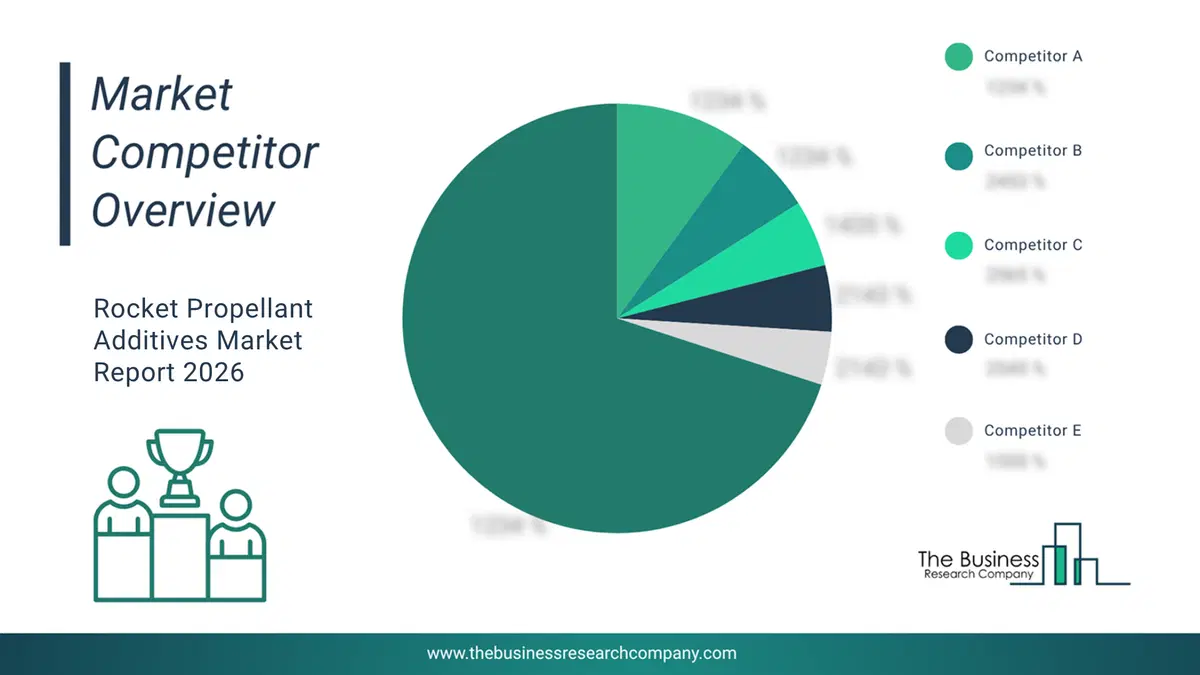
This chart is for illustrative purposes; the full report includes a detailed competitor analysis and comprehensive overview of the top 10 companies in the market.
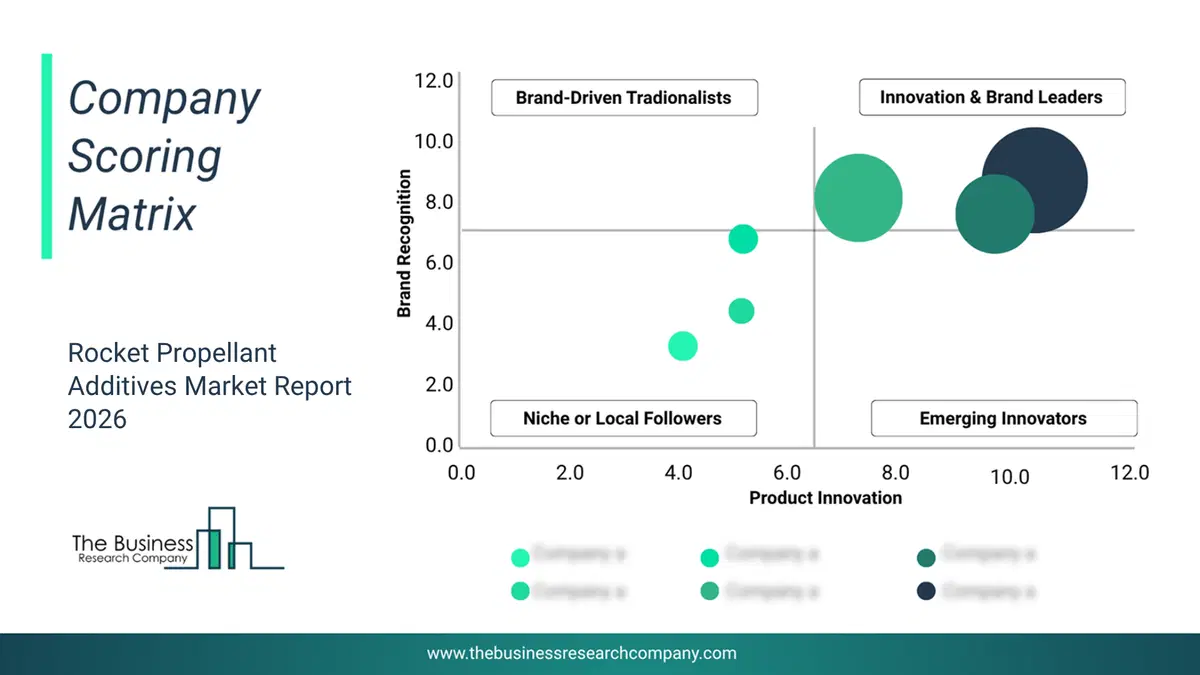
This chart maps companies by product innovation and brand strength, with bubble size indicating relative revenue, helping identify market leaders, challengers, and niche players. This is an illustrative chart; the full report provides a complete and accurate competitive analysis.
Global Rocket Propellant Additives Market Trends and Insights
Major companies operating in the rocket propellant additives market are focusing on strategic investments to enhance the production of high-performance solid rocket motors and advanced energetic materials. Strategic investments drive the growth of the rocket propellant additives market by boosting funding for research and development, allowing manufacturers to develop more efficient and advanced propellant formulations and manufacturing techniques, accelerate the adoption of cutting-edge technologies such as additive manufacturing and 3D printing, improve the performance, reliability, and safety of solid rocket motors, and expand production capacity to meet rising global defense and aerospace demands. For instance, in August 2025, X-Bow Systems, a US-based aerospace and defense company, invested $13.9M with the US Army to develop and test advanced solid rocket motors for the GMLRS. The aim of this investment is to leverage high-performance propellant additives to strengthen and diversify the U.S. SRM supply chain, establish a reliable alternative production source, enhance the efficiency, consistency, and overall performance of missile systems, reduce production bottlenecks, improve safety and handling of energetic materials, and modernize propellant formulations to meet evolving defense requirements and future operational demands.What Are Latest Mergers And Acquisitions In The Rocket Propellant Additives Market?
In June 2023, Anduril Industries Inc., a US-based defense technology company, acquired Adranos Inc. for an undisclosed amount. With this acquisition, Anduril Industries, Inc. aims to expand the U.S. solid rocket motor supply base, accelerate the development of advanced propulsion systems such as ALITEC, and enhance national security by ensuring a reliable and competitive supply of critical munitions and hypersonic technologies. Adranos Inc. is a US-based company that offers rocket propellant additives.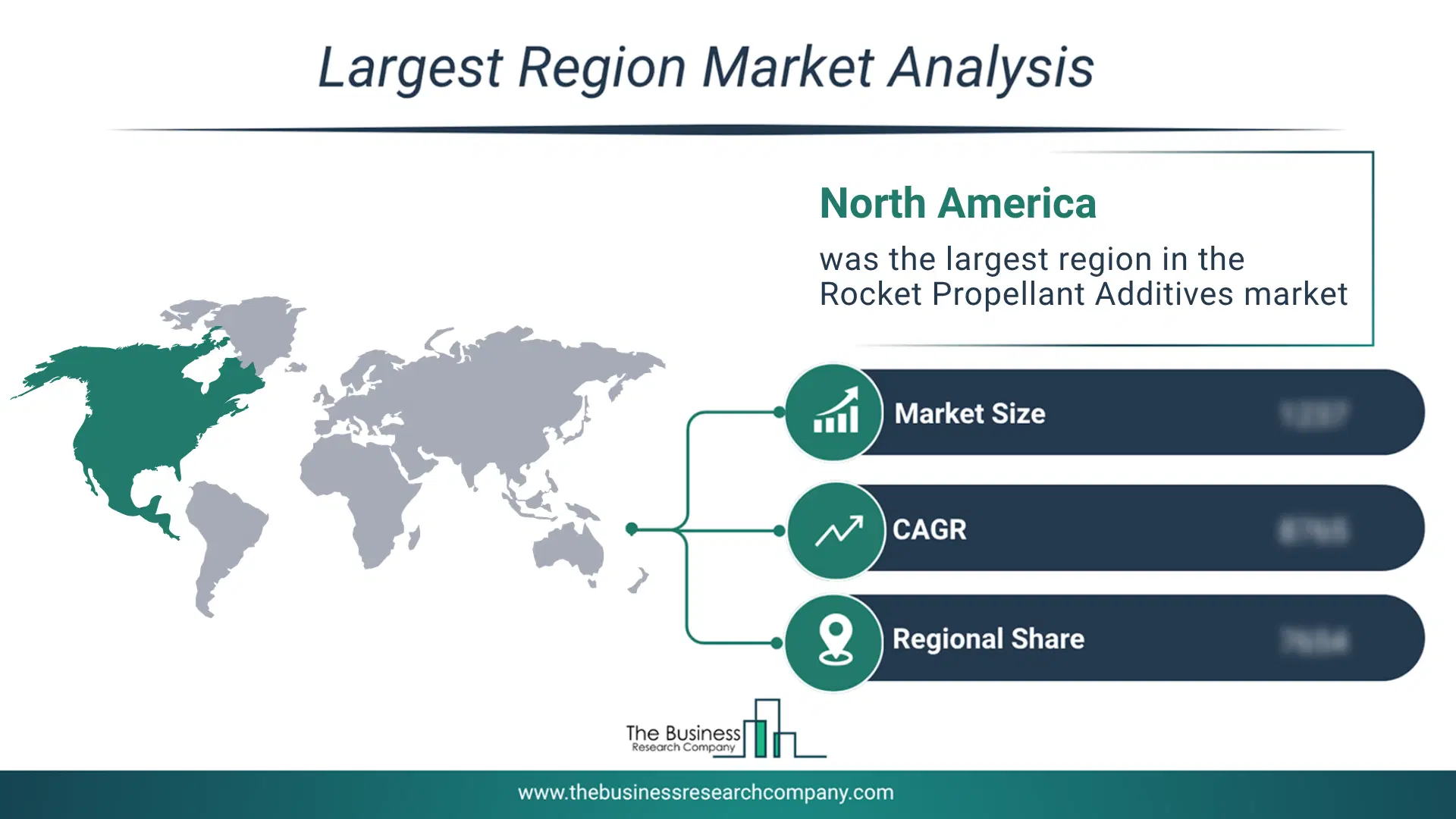
Regional Insights
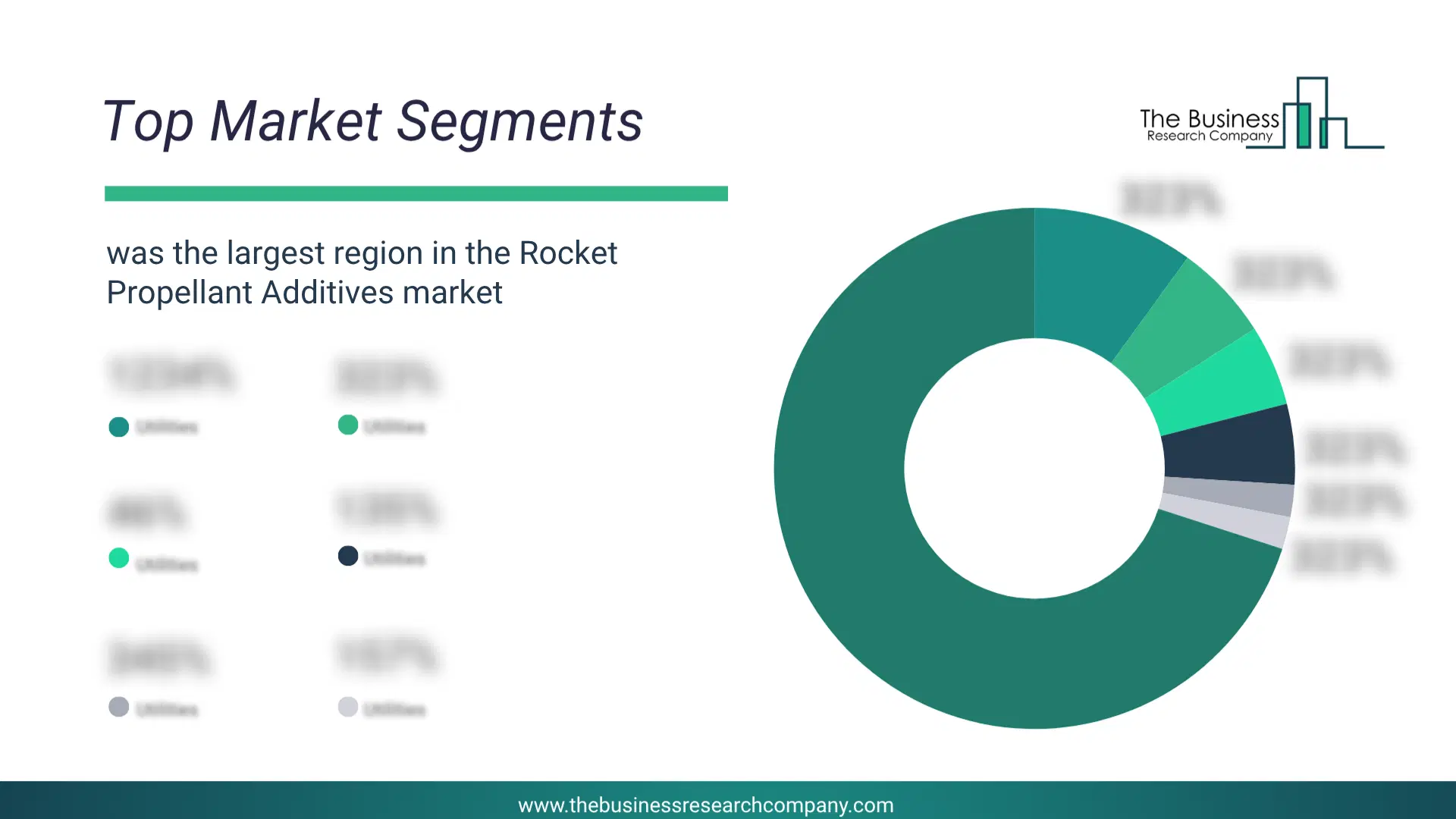
North America was the largest region in the rocket propellant additives market in 2025. The regions covered in this market report are Asia-Pacific, South East Asia, Western Europe, Eastern Europe, North America, South America, Middle East, Africa The countries covered in this market report are Australia, Brazil, China, France, Germany, India, Indonesia, Japan, Taiwan, Russia, South Korea, UK, USA, Canada, Italy, SpainWhat Defines the Rocket Propellant Additives Market?
The rocket propellant additives market consists of sales of aluminum and magnesium, burn rate modifiers, plasticizers, stabilizers, curing agents, and bonding agents. Values in this market are ‘factory gate’ values, that is, the value of goods sold by the manufacturers or creators of the goods, whether to other entities (including downstream manufacturers, wholesalers, distributors, and retailers) or directly to end customers. The value of goods in this market includes related services sold by their creators.How is Market Value Defined and Measured?
The market value is defined as the revenues that enterprises gain from the sale of goods and/or services within the specified market and geography through sales, grants, or donations in terms of the currency (in USD unless otherwise specified). The revenues for a specified geography are consumption values that are revenues generated by organizations in the specified geography within the market, irrespective of where they are produced. It does not include revenues from resales along the supply chain, either further along the supply chain or as part of other products.
This chart presents market attractiveness based on a quantitative evaluation of growth, competition, strategic alignment, and risk, offering a clear view of opportunity areas for decision-making. This chart is for illustrative purposes; the full report contains the complete analysis.

This chart highlights the Total Addressable Market (TAM) by estimating the maximum revenue opportunity using an assumption-driven approach, supporting strategic planning and opportunity sizing across markets. The chart is illustrative; the full report provides a more comprehensive analysis.
What Key Data and Analysis Are Included in the Rocket Propellant Additives Market Report 2026?
The rocket propellant additives market research report is one of a series of new reports from The Business Research Company that provides market statistics, including industry global market size, regional shares, competitors with the market share, detailed market segments, market trends and opportunities, and any further data you may need to thrive in the rocket propellant additives industry. The market research report delivers a complete perspective of everything you need, with an in-depth analysis of the current and future state of the industry.Rocket Propellant Additives Market Report Forecast Analysis
| Report Attribute | Details |
|---|---|
| Market Size Value In 2026 | $3.44 billion |
| Revenue Forecast In 2030 | $4.66 billion |
| Growth Rate | CAGR of 8.2% from 2026 to 2030 |
| Base Year For Estimation | 2025 |
| Actual Estimates/Historical Data | 2020-2025 |
| Forecast Period | 2026 - 2030 |
| Market Representation | Revenue in USD Billion and CAGR from 2026 to 2030 |
| Segments Covered | Type, Propellant Type, Application |
| Regional Scope | Asia-Pacific, Western Europe, Eastern Europe, North America, South America, Middle East, Africa |
| Country Scope | The countries covered in this market report are Australia, Brazil, China, France, Germany, India, Indonesia, Japan, Taiwan, Russia, South Korea, UK, USA, Canada, Italy, Spain |
| Key Companies Profiled | Northrop Grumman Corporation, Aerojet Rocketdyne Holdings Inc., ArianeGroup SAS, Roxel SAS, Nammo AS, Rheinmetall AG, General Dynamics Ordnance and Tactical Systems Inc., Evonik Industries AG, NOF Corporation, L3Harris Technologies Inc., Roketsan A.Ş., Ursa Major Technologies Inc., Firehawk Aerospace Inc., Island Pyrochemical Industries Inc., Ensign-Bickford Industries Inc., ATK (Alliant Techsystems), Denel Dynamics, China Aerospace Science and Technology Corporation (CASC), China Aerospace Science and Industry Corporation (CASIC), Israel Aerospace Industries Ltd. |
| Customization Scope | Request for Customization |
| Pricing And Purchase Options | Explore Purchase Options |