
Rocket Propulsion Systems (Defense) Market Report 2026
Global Outlook – By Component ( Rocket Engines, Fuel And Propellant, Control Systems, Structural Components), By Platform ( Ground-Based, Airborne, Naval, Space), By Propulsion Type ( Solid Propulsion, Liquid Propulsion, Hybrid Propulsion), By Range ( Short-Range, Medium-Range, Intermediate-Range, Long-Range), By Application ( Space Exploration, Satellite Launch, Military Applications, Space Tourism) – Market Size, Trends, Strategies, and Forecast to 2030
Rocket Propulsion Systems (Defense) Market Overview
• Rocket Propulsion Systems (Defense) market size has reached to $4.71 billion in 2025 • Expected to grow to $7.31 billion in 2030 at a compound annual growth rate (CAGR) of 9.2% • Growth Driver: Rising Geopolitical Tensions Are Fueling The Growth Of The Market Due To Increasing Military Competition And Strategic Deterrence Needs • Market Trend: Advancements In Rocket Propulsion Technologies Enhance Performance And Reliability In Defense Systems • North America was the largest region in 2025 and Asia-Pacific is the fastest growing region.What Is Covered Under Rocket Propulsion Systems (Defense) Market?
Rocket propulsion systems (defense) are specialized engines that generate thrust through controlled propellant combustion, enabling high-speed and accurate missile and rocket operations. They are used in ballistic missiles, cruise missiles, and tactical rocket systems for efficient flight performance. Rocket propulsion systems (defense) deliver payloads over varying ranges, strengthening strike capability, deterrence, and rapid military response. The main components of rocket propulsion systems (defense) include rocket engines, fuel and propellant, control systems, and structural components. Rocket engines refer to propulsion units designed to generate thrust for missiles and launch vehicles used in defense and aerospace applications. They are categorized by platform including ground-based, airborne, naval, and space and by propulsion type including solid propulsion, liquid propulsion, and hybrid propulsion. They are also classified by range including short-range, medium-range, intermediate-range, and long-range systems and the various applications involved are space exploration, satellite launch, military applications, and space tourism.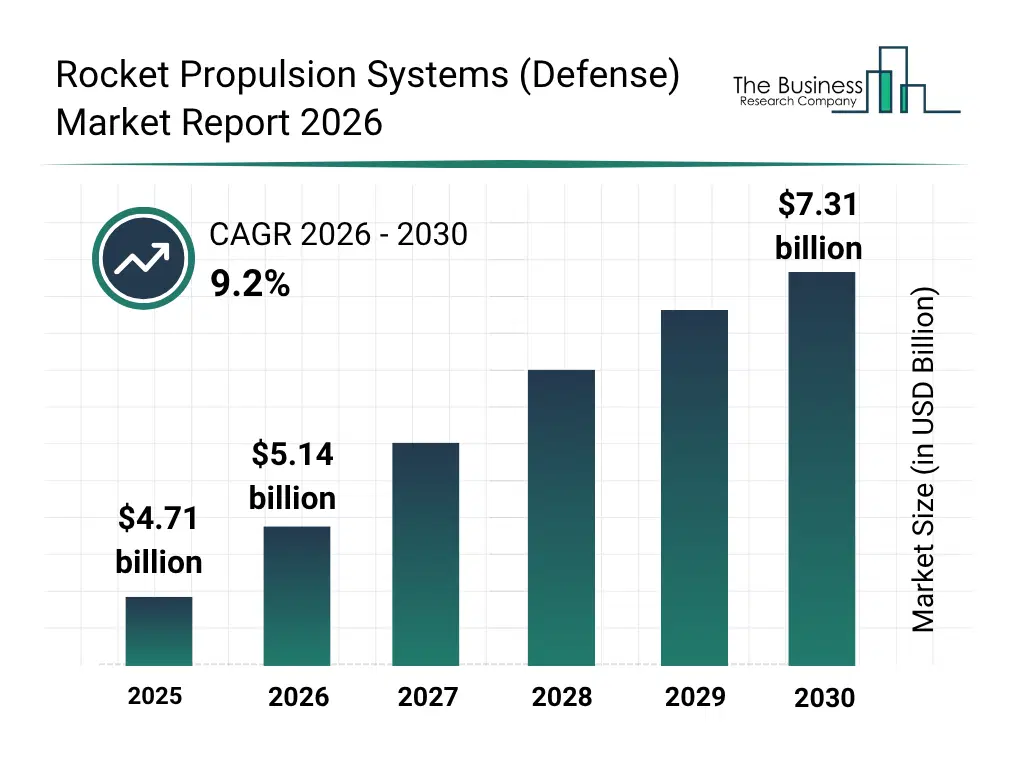
What Is The Rocket Propulsion Systems (Defense) Market Size and Share 2026?
The rocket propulsion systems (defense) market size has grown strongly in recent years. It will grow from $4.71 billion in 2025 to $5.14 billion in 2026 at a compound annual growth rate (CAGR) of 9.0%. The growth in the historic period can be attributed to cold war missile development, increasing defense budgets, space race propulsion advancements, dominance of solid rocket motor technology, ballistic missile proliferation trends.What Is The Rocket Propulsion Systems (Defense) Market Growth Forecast?
The rocket propulsion systems (defense) market size is expected to see strong growth in the next few years. It will grow to $7.31 billion in 2030 at a compound annual growth rate (CAGR) of 9.2%. The growth in the forecast period can be attributed to hypersonic weapon system demand growth, expansion of reusable propulsion technologies, shift toward green and eco-friendly propellants, Ai-enabled guidance and propulsion optimization, growth of space-based defense and surveillance systems. Major trends in the forecast period include hypersonic propulsion system advancements for next-generation missile capabilities, adoption of green propellants to reduce toxic emissions in defense rocket systems, increasing use of additive manufacturing for rocket engine components and lightweight structures, integration of scramjet and ramjet technologies for extended-range high-speed missile propulsion, development of modular and scalable propulsion architectures for multi-mission defense applications.
Global Rocket Propulsion Systems (Defense) Market Segmentation
1) By Component: Rocket Engines, Fuel And Propellant, Control Systems, Structural Components 2) By Platform: Ground-Based, Airborne, Naval, Space 3) By Propulsion Type: Solid Propulsion, Liquid Propulsion, Hybrid Propulsion 4) By Range: Short-Range, Medium-Range, Intermediate-Range, Long-Range 5) By Application: Space Exploration, Satellite Launch, Military Applications, Space Tourism Subsegments: 1) By Rocket Engines: Solid Rocket Motors, Liquid Rocket Engines, Hybrid Rocket Engines, Air-Breathing Rocket Engines, Cryogenic Rocket Engines, Hypergolic Rocket Engines, Booster Engines, Sustainer Engines, Thrust Vector Control Engines, Dual-Pulse Rocket Motors 2) By Fuel And Propellant: Solid Propellants, Liquid Propellants, Hybrid Propellants, Cryogenic Fuels, Hypergolic Fuels, Composite Propellants, Double-Base Propellants, Green Propellants, Gel Propellants, Oxidizers 3) By Control Systems: Guidance Systems, Navigation Systems, Flight Control Systems, Thrust Vector Control Systems, Attitude Control Systems, Inertial Measurement Units (IMUs), Autopilot Systems, Actuation Systems, Telemetry Systems, Mission Control Software 4) By Structural Components: Rocket Airframes, Nozzles, Combustion Chambers, Interstage Structures, Payload Fairings, Thermal Protection Systems, Engine Casings, Propellant Tanks, Mounting And Coupling Structures, Composite Structural MaterialsWhat Is The Driver Of The Rocket Propulsion Systems (Defense) Market?
The rising geopolitical tensions are expected to propel the growth of the rocket propulsion systems (defense) market going forward. Geopolitical tensions refer to strained relationships or conflicts between countries (or groups of countries) driven by political, economic, military, or territorial interests. Rising geopolitical tensions are driven by intensifying competition among major powers for economic, military, and technological dominance, leading to conflicting interests and increased global instability. Rocket propulsion systems (defense) support geopolitical tensions by strengthening a nation’s military capabilities, enabling advanced missile systems, long-range strike options, and strategic deterrence, which can heighten competition and security concerns among rival countries. For instance, in July 2024, according to The Armed Conflict Location & Event Data Project (ACLED), a US-based non-profit organization, over 165,273 political violence events were recorded worldwide, marking a 15% increase from July 2023 to June 2024. Therefore, the rising geopolitical tensions are driving the growth of the rocket propulsion systems (defense) industry.Key Players In The Global Rocket Propulsion Systems (Defense) Market
Major companies operating in the rocket propulsion systems (defense) market are RTX Corporation, Lockheed Martin Corporation, Boeing Company, Northrop Grumman Corporation, Thales Group, BAE Systems plc, China Aerospace Science and Industry Corporation, Safran S.A., Mitsubishi Heavy Industries Ltd., Israel Aerospace Industries (IAI), Hanwha Aerospace Co. Ltd., Rafael Advanced Defense Systems Ltd., IHI Corporation, Roketsan Roket Sanayii ve Ticaret A.Ş., Bharat Dynamics Limited (BDL), Kratos Defense & Security Solutions Inc., Nammo AS, Avio S.p.A., Karman Space & Defense, Ursa Major Technologies Inc., Venus Aerospace Corp., Engine Development and Production (EDePro), SpacefieldsGlobal Rocket Propulsion Systems (Defense) Market Trends and Insights
Major companies operating in the rocket propulsion systems (defense) market are focusing on developing advanced solutions, such as high-performance liquid rocket engines, to improve thrust efficiency, enable rapid testing capabilities, and support next-generation missile and hypersonic systems. High-performance liquid rocket engines refer to propulsion systems that use liquid propellants to generate controlled and efficient thrust, offering enhanced performance, scalability, and precision for defense applications. For instance, in December 2024, RTX Corporation, a US-based Aerospace and defense company, partnered with Ursa Major Technologies Inc., a US-based rocket propulsion company, to conduct a successful flight test of the Hadley liquid rocket engine. The test demonstrated the engine’s capability to support defense applications by delivering reliable performance, rapid development cycles, and scalable propulsion solutions for advanced missile systems.What Are Latest Mergers And Acquisitions In The Rocket Propulsion Systems (Defense) Market?
In January 2025, MBDA, a France-based provider of missile systems, guided weapons, and defense solutions, acquired Roxel for an undisclosed amount. With this acquisition, MBDA aims to strengthen its control over critical propulsion technologies, enhance its missile manufacturing capabilities, and secure its supply chain for solid rocket motors. Roxel is a France-based provider of solid rocket motors and propulsion systems used in tactical missiles and defense applications.Regional Outlook
North America was the largest region in the rocket propulsion systems (defense) market in 2025. Asia-Pacific is expected to be the fastest-growing region in the forecast period.The regions covered in this market report are Asia-Pacific, South East Asia, Western Europe, Eastern Europe, North America, South America, Middle East, Africa. The countries covered in this market report are Australia, Brazil, China, France, Germany, India, Indonesia, Japan, Taiwan, Russia, South Korea, UK, USA, Canada, Italy, Spain.What Defines the Rocket Propulsion Systems (Defense) Market?
The rocket propulsion systems (defense) market consists of sales of solid rocket motor, turbo pump, thrust chamber, nozzle assembly, propellant tank, ignition system, and thrust vector control system. Values in this market are ‘factory gate’ values, that is, the value of goods sold by the manufacturers or creators of the goods, whether to other entities (including downstream manufacturers, wholesalers, distributors, and retailers) or directly to end customers. The value of goods in this market includes related services sold by the creators of the goods.How is Market Value Defined and Measured?
The market value is defined as the revenues that enterprises gain from the sale of goods and/or services within the specified market and geography through sales, grants, or donations in terms of the currency (in USD unless otherwise specified). The revenues for a specified geography are consumption values that are revenues generated by organizations in the specified geography within the market, irrespective of where they are produced. It does not include revenues from resales along the supply chain, either further along the supply chain or as part of other products.What Key Data and Analysis Are Included in the Rocket Propulsion Systems (Defense) Market Report 2026?
The rocket propulsion systems (defense) market research report is one of a series of new reports from The Business Research Company that provides rocket propulsion systems (defense) market statistics, including rocket propulsion systems (defense) industry global market size, regional shares, competitors with a rocket propulsion systems (defense) market share, detailed rocket propulsion systems (defense) market segments, market trends and opportunities, and any further data you may need to thrive in the rocket propulsion systems (defense) industry. This rocket propulsion systems (defense) market research report delivers a complete perspective of everything you need, with an in-depth analysis of the current and future scenario of the industry.Rocket Propulsion Systems (Defense) Market Report Forecast Analysis
| Report Attribute | Details |
|---|---|
| Market Size Value In 2026 | $5.14 billion |
| Revenue Forecast In 2030 | $7.31 billion |
| Growth Rate | CAGR of 9.2% from 2026 to 2030 |
| Base Year For Estimation | 2025 |
| Actual Estimates/Historical Data | 2020-2025 |
| Forecast Period | 2026 - 2030 |
| Market Representation | Revenue in USD Billion and CAGR from 2026 to 2030 |
| Segments Covered | Component, Platform, Propulsion Type, Range, Application |
| Regional Scope | Asia-Pacific, Western Europe, Eastern Europe, North America, South America, Middle East, Africa |
| Country Scope | The countries covered in the rocket propulsion systems (defense) market report are Australia, Brazil, China, France, Germany, India, Indonesia, Japan, Taiwan, Russia, South Korea, UK, USA, Canada, Italy, Spain. |
| Key Companies Profiled | RTX Corporation, Lockheed Martin Corporation, Boeing Company, Northrop Grumman Corporation, Thales Group, BAE Systems plc, China Aerospace Science and Industry Corporation, Safran S.A., Mitsubishi Heavy Industries Ltd., Israel Aerospace Industries (IAI), Hanwha Aerospace Co. Ltd., Rafael Advanced Defense Systems Ltd., IHI Corporation, Roketsan Roket Sanayii ve Ticaret A.Ş., Bharat Dynamics Limited (BDL), Kratos Defense & Security Solutions Inc., Nammo AS, Avio S.p.A., Karman Space & Defense, Ursa Major Technologies Inc., Venus Aerospace Corp., Engine Development and Production (EDePro), Spacefields |
| Customization Scope | Request for Customization |
| Pricing And Purchase Options | Explore Purchase Options |