
Rocket Reaction Control Systems Market Report 2026
Global Outlook – By Component (Control Systems, Piping And Tubing, Thrusters), By Propellant (Bipropellant, Cold Gas, Electric Propulsion Systems), By Application (Satellites, Launch Vehicles, Space Probes, Other Applications), By End-User (Commercial, Military, Government) – Market Size, Trends, Strategies, and Forecast to 2030
Rocket Reaction Control Systems Market Overview
• Rocket Reaction Control Systems market size has reached to $4.72 billion in 2025 • Expected to grow to $6.6 billion in 2030 at a compound annual growth rate (CAGR) of 6.9% • Growth Driver: Increasing Investments In Space Exploration Fueling The Growth Of The Market Due To Rising Demand For Advanced Satellite Communication And Data Services • Market Trend: Next-Generation Propulsion Technologies Enhance Spacecraft Stability And Trajectory Control • North America was the largest region in 2025.What Is Covered Under Rocket Reaction Control Systems Market?
The rocket reaction control system (RCS) is a subsystem used in spacecraft and rockets to control their orientation and attitude in space. It typically uses small thrusters that expel gas or propellant to produce torque or force. The main purpose is to enable precise maneuvering and stabilization during flight, docking, or re-entry when aerodynamic control surfaces are ineffective. The main components of rocket reaction control systems are control systems, piping and tubing, and thrusters. Control systems refer to the integrated set of electronic components and software that manage and regulate the operation of thrusters to control a rocket or spacecraft’s orientation and stability. They utilize various propellants, including bipropellant, cold gas, and electric propulsion systems. Rocket reaction control systems are applied in satellites, launch vehicles, space probes, and others, serving end-users such as the commercial, military, and government sectors.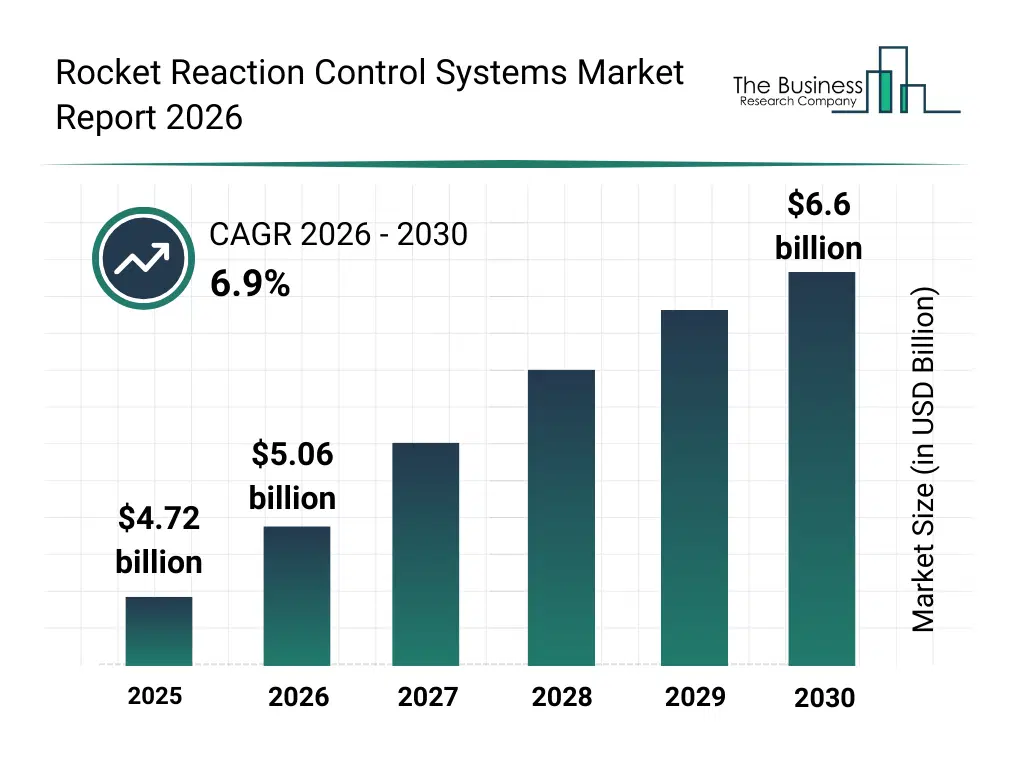
What Is The Rocket Reaction Control Systems Market Size and Share 2026?
The rocket reaction control systems market size has grown strongly in recent years. It will grow from $4.72 billion in 2025 to $5.06 billion in 2026 at a compound annual growth rate (CAGR) of 7.2%. The growth in the historic period can be attributed to increasing number of satellite launches and space missions, advancements in small thruster and nozzle technologies, rising demand for precise attitude control in spacecraft, growth of government and commercial space programs, development of reliable control electronics and actuators for maneuvering systems.What Is The Rocket Reaction Control Systems Market Growth Forecast?
The rocket reaction control systems market size is expected to see strong growth in the next few years. It will grow to $6.6 billion in 2030 at a compound annual growth rate (CAGR) of 6.9%. The growth in the forecast period can be attributed to integration of AI and autonomous control for enhanced maneuvering, development of lightweight and high-efficiency thruster systems, rising demand for rcs in reusable and modular spacecraft, expansion of commercial space exploration and satellite constellations, increasing adoption of advanced sensors and feedback systems for precision attitude control. Major trends in the forecast period include growing adoption of electric and hybrid thruster technologies, increasing demand for precise attitude control in small satellites, rising need for responsive rcs designs for reusable launch vehicles, expansion of deep space exploration missions requiring advanced maneuvering systems, higher integration of lightweight materials in rcs components.
Global Rocket Reaction Control Systems Market Segmentation
1) By Component: Control Systems, Piping And Tubing, Thrusters 2) By Propellant: Bipropellant, Cold Gas, Electric Propulsion Systems 3) By Application: Satellites, Launch Vehicles, Space Probes, Other Applications 4) By End-User: Commercial, Military, Government Subsegments: 1) By Control System: Flight Control Computers, Software and Algorithms, Sensors, Actuators, Power Supply Units 2) By Piping and Tubing: Propellant Feed Lines, High-Pressure Tubes, Valves and Fittings, Flexible Hoses, Manifolds, Insulation and Cladding 3) By Thrusters: Cold Gas Thrusters, Monopropellant Thrusters, Bipropellant Thrusters, Electric Thrusters, Resistojet Thrusters, Pulsed Plasma ThrustersWhat Is Driver Of The Rocket Reaction Control Systems Market?
The increasing investments in space exploration are expected to propel the growth of the rocket reaction control systems market going forward. Space exploration is the discovery and study of outer space through the use of spacecraft, satellites, and advanced technology. The increasing investments in space exploration are rising due to the growing demand for advanced satellite-based communication and data services, as they enable faster, more reliable communication. Investments in space exploration enhance rocket reaction control systems by driving innovation in precision and reliability, making spacecraft maneuvers more accurate and efficient. For instance, in January 2025, according to the Space Foundation, a US-based nonprofit organization, the international government spending on space programs reached $125 billion in 2023, an 11% increase compared to 2022. Therefore, the increasing investments in space exploration are driving the growth of the rocket reaction control systems industry.Key Players In The Global Rocket Reaction Control Systems Market
Major companies operating in the rocket reaction control systems market are Lockheed Martin Corporation, The Boeing Company, Northrop Grumman Corporation, Mitsubishi Heavy Industries Ltd., Safran SA, L3Harris Technologies Inc., IHI Corporation, Israel Aerospace Industries, Blue Origin LLC, Thales Alenia Space SA, Sierra Nevada Corporation, Relativity Space Inc., VACCO Industries, Phase Four Inc., Benchmark Space Systems Inc., Busek Co Inc., Enpulsion GmbH, Indian Space Research Organisation, Orbion Space Technology Inc., Skyroot Aerospace Pvt Ltd., ThrustMe SAS.
This chart is for illustrative purposes; the full report includes a detailed competitor analysis and comprehensive overview of the top 10 companies in the market.
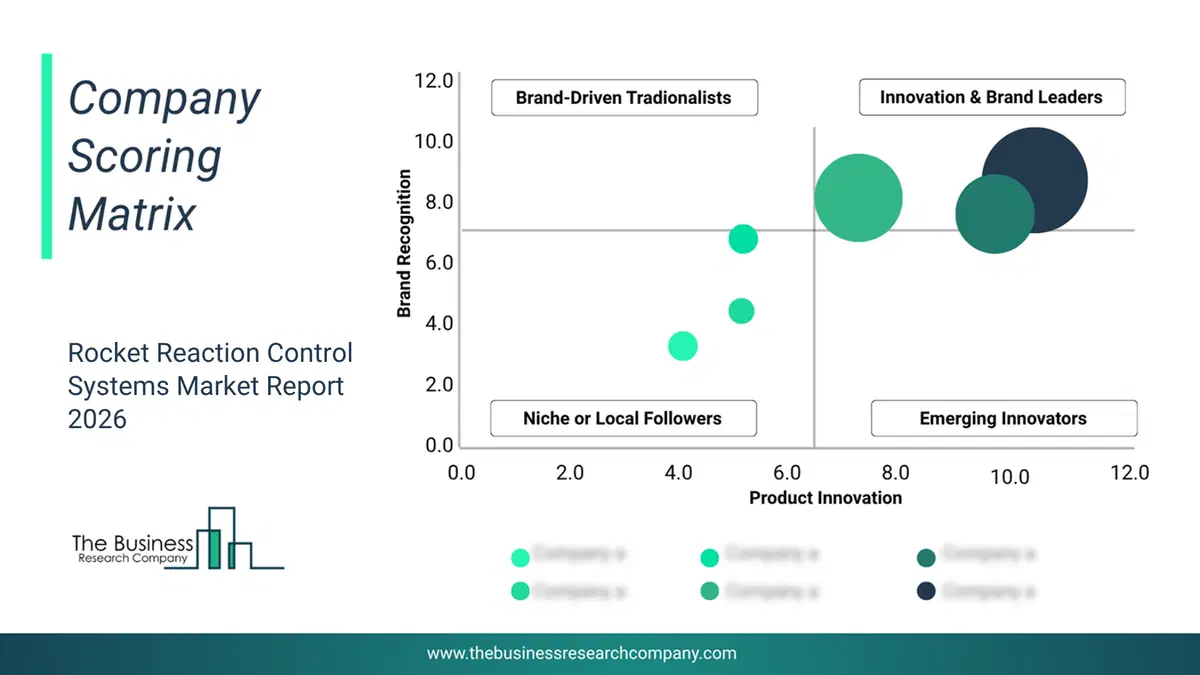
This chart maps companies by product innovation and brand strength, with bubble size indicating relative revenue, helping identify market leaders, challengers, and niche players. This is an illustrative chart; the full report provides a complete and accurate competitive analysis.
Global Rocket Reaction Control Systems Market Trends and Insights
Major companies operating in the rocket reaction control systems market are focusing on developing innovative products, such as advanced propulsion systems, to enhance maneuverability and increase thrust efficiency for space and defense missions. Advanced propulsion systems are next-generation technologies that provide thrust more efficiently or powerfully than traditional methods, especially for aerospace and space exploration. For instance, in October 2024, Skyroot Aerospace, an India-based aerospace company, successfully tested and qualified its reaction control system (RCS) for the Vikram-1 rocket, which is an essential component responsible for managing the rocket's orientation and trajectory during its flight. It utilizes small thrusters, specifically the Raman engines, to carry out precise maneuvers such as roll, pitch, and yaw adjustments, ensuring the rocket remains on course. The reaction control system is activated at crucial stages of the flight to maintain stability, correct any deviations, and ensure accurate orbital insertion.What Are Latest Mergers And Acquisitions In The Rocket Reaction Control Systems Market? L3Harris Technologies Acquired Aerojet Rocketdyne To Boost Space Innovation
In July 2023, L3Harris Technologies Inc., a US-based aerospace and defense technology company, acquired Aerojet Rocketdyne for $4.7 billion. With this acquisition, L3Harris Technologies aims to strengthen U.S. defense capabilities by integrating advanced propulsion systems and accelerating innovation across missile defense, hypersonics, and space technologies. Aerojet Rocketdyne is a US-based aerospace and defense company specializing in the design and manufacture of rocket reaction control systems.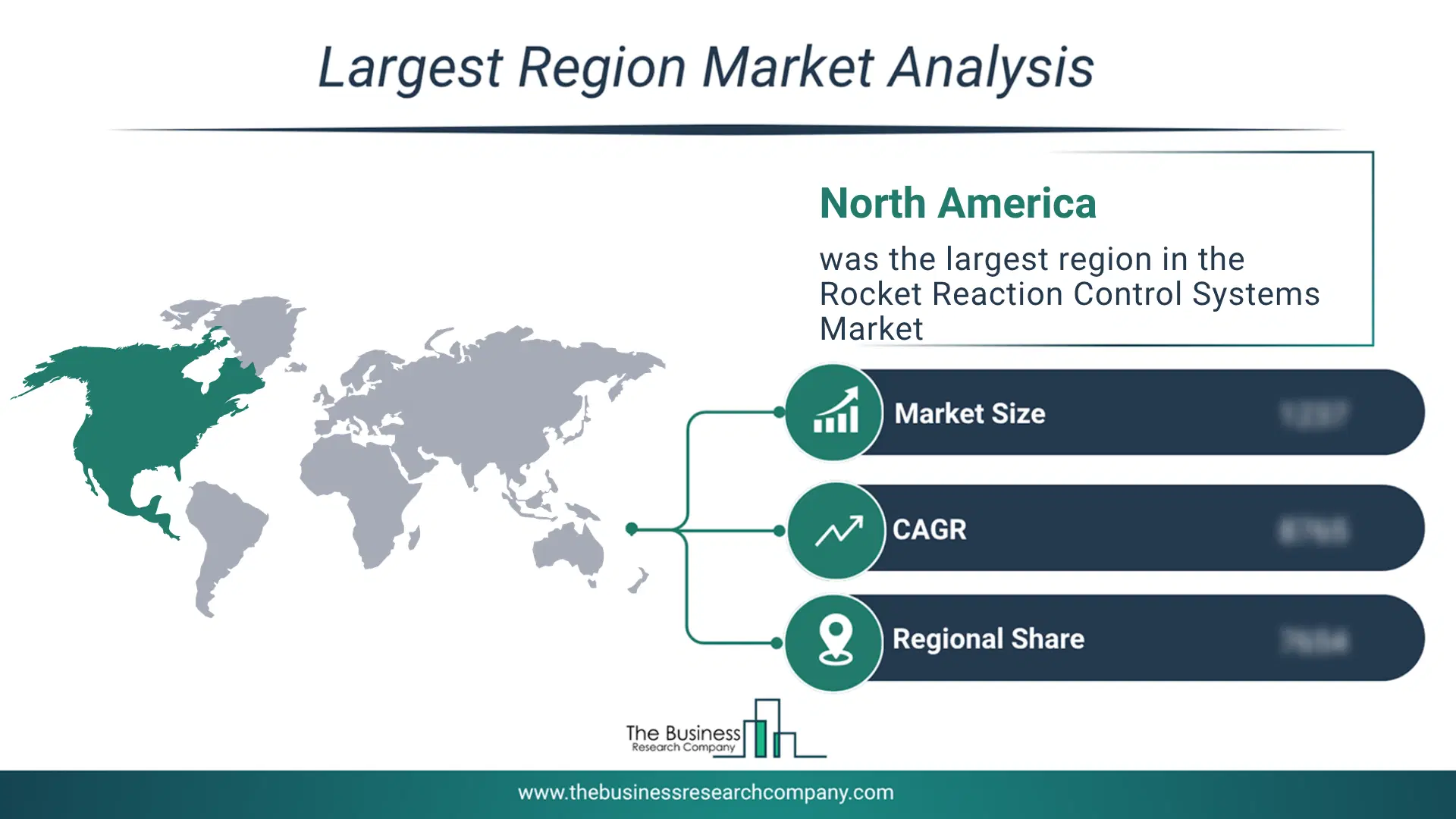
Regional Insights
North America was the largest region in the rocket reaction control systems market in 2025. The regions covered in this market report are Asia-Pacific, South East Asia, Western Europe, Eastern Europe, North America, South America, Middle East, Africa. The countries covered in this market report are Australia, Brazil, China, France, Germany, India, Indonesia, Japan, Taiwan, Russia, South Korea, UK, USA, Canada, Italy, SpainWhat Defines the Rocket Reaction Control Systems Market?
The rocket reaction control systems market consists of sales of valves, nozzles, control electronics, actuators, and associated subsystems used for attitude control and maneuvering of rockets and spacecraft. Values in this market are ‘factory gate’ values, that is the value of goods sold by the manufacturers or creators of the goods, whether to other entities (including downstream manufacturers, wholesalers, distributors and retailers) or directly to end customers. The value of goods in this market includes related services sold by the creators of the goods.How is Market Value Defined and Measured?
The market value is defined as the revenues that enterprises gain from the sale of goods and/or services within the specified market and geography through sales, grants, or donations in terms of the currency (in USD unless otherwise specified). The revenues for a specified geography are consumption values that are revenues generated by organizations in the specified geography within the market, irrespective of where they are produced. It does not include revenues from resales along the supply chain, either further along the supply chain or as part of other products.
This chart presents market attractiveness based on a quantitative evaluation of growth, competition, strategic alignment, and risk, offering a clear view of opportunity areas for decision-making. This chart is for illustrative purposes; the full report contains the complete analysis.

This chart highlights the Total Addressable Market (TAM) by estimating the maximum revenue opportunity using an assumption-driven approach, supporting strategic planning and opportunity sizing across markets. The chart is illustrative; the full report provides a more comprehensive analysis.
What Key Data and Analysis Are Included in the Rocket Reaction Control Systems Market Report 2026?
The rocket reaction control systems market research report is one of a series of new reports from The Business Research Company that provides market statistics, including industry global market size, regional shares, competitors with the market share, detailed market segments, market trends and opportunities, and any further data you may need to thrive in the rocket reaction control systems industry. The market research report delivers a complete perspective of everything you need, with an in-depth analysis of the current and future state of the industry.Rocket Reaction Control Systems Market Report Forecast Analysis
| Report Attribute | Details |
|---|---|
| Market Size Value In 2026 | $5.06 billion |
| Revenue Forecast In 2030 | $6.6 billion |
| Growth Rate | CAGR of 6.9% from 2026 to 2030 |
| Base Year For Estimation | 2025 |
| Actual Estimates/Historical Data | 2020-2025 |
| Forecast Period | 2026 - 2030 |
| Market Representation | Revenue in USD Billion and CAGR from 2026 to 2030 |
| Segments Covered | Component, Propellant, Application, End-User |
| Regional Scope | Asia-Pacific, Western Europe, Eastern Europe, North America, South America, Middle East, Africa |
| Country Scope | The countries covered in the rocket reaction control systems market report are Australia, Brazil, China, France, Germany, India, Indonesia, Japan, Taiwan, Russia, South Korea, UK, USA, Canada, Italy, Spain |
| Key Companies Profiled | Lockheed Martin Corporation, The Boeing Company, Northrop Grumman Corporation, Mitsubishi Heavy Industries Ltd., Safran SA, L3Harris Technologies Inc., IHI Corporation, Israel Aerospace Industries, Blue Origin LLC, Thales Alenia Space SA, Sierra Nevada Corporation, Relativity Space Inc., VACCO Industries, Phase Four Inc., Benchmark Space Systems Inc., Busek Co Inc., Enpulsion GmbH, Indian Space Research Organisation, Orbion Space Technology Inc., Skyroot Aerospace Pvt Ltd., ThrustMe SAS. |
| Customization Scope | Request for Customization |
| Pricing And Purchase Options | Explore Purchase Options |