
Satellite-based Augmentation System Market Report 2026
Global Outlook – By Type (Wide Area Augmentation System (WAAS), European Geostationary Navigation Overlay Service (EGNOS), Multi-functional Satellite Augmentation System (MSAS), GPS Aided GEO Augmented Navigation (GAGAN), System For Differential Corrections And Monitoring (SDCM), Other Types), By Component (Satellites, Ground Stations, Receivers, Other Components), By Application (Aviation, Maritime, Road And Rail, Surveying, Timing And Synchronization, Agriculture, Other Applications) – Market Size, Trends, Strategies, and Forecast to 2030
Satellite-based Augmentation System Market Overview
• Satellite-based Augmentation System market size has reached to $1.53 billion in 2025 • Expected to grow to $2.22 billion in 2030 at a compound annual growth rate (CAGR) of 7.7% • Growth Driver: The Rising Tide Of Air Traffic Propels SbAS Market Growth • Market Trend: Strategic Investments Driving Growth in the Satellite-Based Augmentation System Market • North America was the largest region in 2025 and Asia-Pacific is the fastest growing region.What Is Covered Under Satellite-based Augmentation System Market?
A satellite-based augmentation system is a prominent air navigation system that enhances the accuracy and integrity of a global navigation satellite system's (GNSS) navigation signal. A satellite-based augmentation system improves service availability over a large geographic area and delivers a more reliable navigation service than GNSS alone. The main types of satellite-based augmentation systems are the Wide Area Augmentation System (WAAS), the European Geostationary Navigation Overlay Service (EGNOS), the Multi-functional Satellite Augmentation System (MSAS), GPS-Assisted GEO Augmented Navigation (GAGAN), the System for Differential Corrections and Monitoring (SDCM), and others. The wide area augmentation system (WAAS) refers to a satellite-based navigation system developed by the FAA to increase the accuracy and reliability of GPS signals for aviation use and provides services to all classes of aircraft throughout all phases of flight, including en-route navigation, airport departures, and airport arrivals. The systems include components such as satellites, ground stations, receivers, and others that are used in several applications like aviation, maritime, road and rail, surveying, timing and synchronization, agriculture, and others.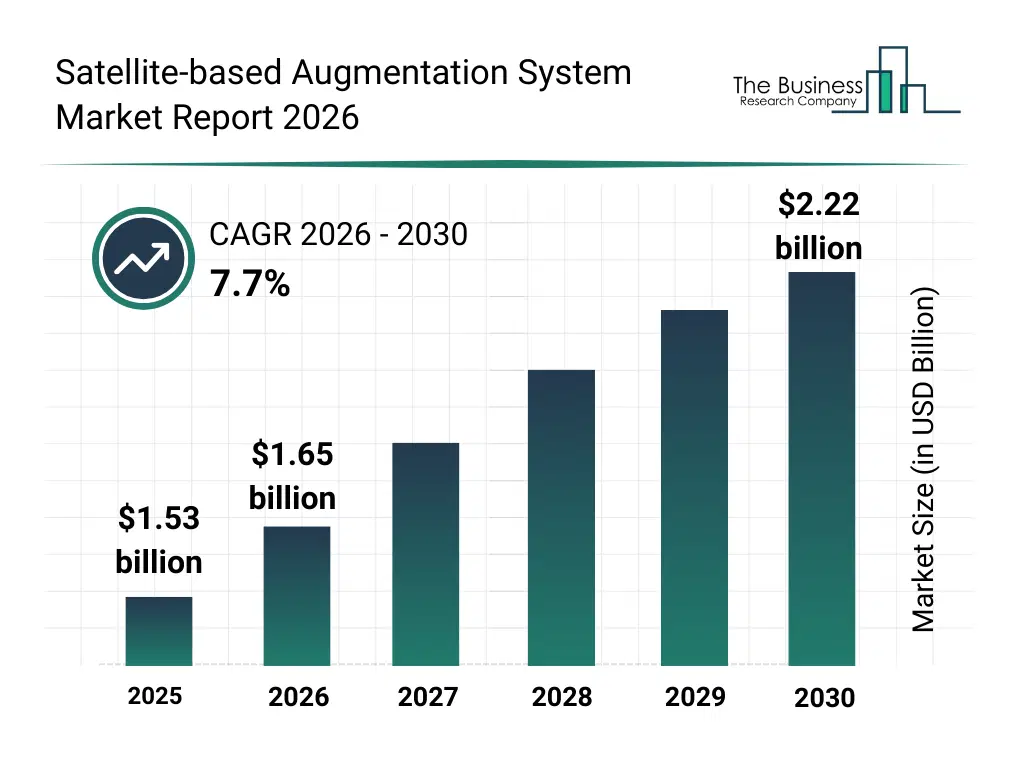
What Is The Satellite-based Augmentation System Market Size and Share 2026?
The satellite-based augmentation system market size has grown strongly in recent years. It will grow from $1.53 billion in 2025 to $1.65 billion in 2026 at a compound annual growth rate (CAGR) of 8.0%. The growth in the historic period can be attributed to increased adoption of gnss augmentation to improve navigation accuracy and integrity across aviation applications, rising use of ionospheric correction services enhancing reliability of satellite navigation signals, growth in soil condition monitoring and geo-traceability applications expanding sbas utility beyond aviation, expansion of system monitoring and maintenance services supporting long-term operational performance, advancements in regional sbas deployments improving service coverage and availability.What Is The Satellite-based Augmentation System Market Growth Forecast?
The satellite-based augmentation system market size is expected to see strong growth in the next few years. It will grow to $2.22 billion in 2030 at a compound annual growth rate (CAGR) of 7.7%. The growth in the forecast period can be attributed to development of next-generation sbas architectures enhancing precision and multi-constellation compatibility, rising demand for high-accuracy navigation in autonomous and unmanned systems driving sbas adoption, increasing integration of sbas capabilities in agriculture and infrastructure monitoring expanding market reach, growth in global modernization programs supporting deployment of new and upgraded sbas networks, advancement in real-time correction algorithms improving responsiveness and system resilience. Major trends in the forecast period include expansion of aviation navigation services, growth in maritime navigation and fleet management, increasing adoption in precision agriculture, rising use in timing and synchronization for telecom networks, development of regional and future satellite augmentation systems.
Global Satellite-based Augmentation System Market Segmentation
1) By Type: Wide Area Augmentation System (WAAS), European Geostationary Navigation Overlay Service (EGNOS), Multi-functional Satellite Augmentation System (MSAS), GPS Aided GEO Augmented Navigation (GAGAN), System For Differential Corrections And Monitoring (SDCM), Other Types 2) By Component: Satellites, Ground Stations, Receivers, Other Components 3) By Application: Aviation, Maritime, Road And Rail, Surveying, Timing And Synchronization, Agriculture, Other Applications Subsegments: 1) By Wide Area Augmentation System (WAAS): Aviation WAAS, Non-Aviation WAAS Applications 2) By European Geostationary Navigation Overlay Service (EGNOS): EGNOS For Aviation, EGNOS For Land And Sea Applications 3) By Multi-Functional Satellite Augmentation System (MSAS): MSAS For Aviation, MSAS For Land Applications 4) By GPS Aided Geo Augmented Navigation (GAGAN): GAGAN For Aviation, GAGAN For Maritime Applications 5) By System For Differential Corrections And Monitoring (SDCM): SDCM For Land Navigation, SDCM For Maritime Navigation 6) By Other Types: Regional Augmentation Systems, Future Augmentation SystemsWhat Is Driver Of The Satellite-based Augmentation System Market?
The growing air traffic is expected to propel the growth of the satellite-based augmentation system market going forward. Air traffic refers to the movement and management of airplanes in the airspace, controlled by air traffic control (ATC) services to ensure safe and effective operations. Aircraft operations and air traffic provide real-world validation, data gathering, and user input that improve the accuracy, dependability, and performance of satellite-based augmentation systems (SBAS), strengthening aviation safety and effectiveness. For instance, in January 2025, according to a report published by the International Air Transport Association, a Canada -based association that represents and supports the global airline industry, reported that total full-year traffic in 2024 (measured in revenue passenger kilometers or RPKs) rose 10.4% compared to 2023. Therefore, the growing air traffic is driving the growth of the satellite-based augmentation system industryKey Players In The Global Satellite-based Augmentation System Market
Major companies operating in the satellite-based augmentation system market are RTX Corporation (Raytheon Technologies Corporation), Lockheed Martin Corporation, Airbus SE, Northrop Grumman Corporation, Honeywell International Inc., Broadcom Corporation, Safran Group, Federal Aviation Administration (FAA), Thales Group, L3Harris Technologies Inc., STMicroelectronics N.V., Elbit Systems Ltd., Rockwell Collins Inc., Garmin Ltd., Trimble Inc., Collins Aerospace, Topcon Corporation, Inmarsat Global Limited, u-Blox Holding AG, Spirent Communications Plc, GMV Innovating Solutions S.L., NovAtel Inc., Universal Avionics Systems Corporation, Accord Software & Systems Pvt. Ltd., Swift Navigation Inc., Hemisphere GNSS, Grintex India Limited, Septentrio NV, Locosys Technology Inc., NexNav Inc., NavatechGPS
This chart is for illustrative purposes; the full report includes a detailed competitor analysis and comprehensive overview of the top 10 companies in the market.
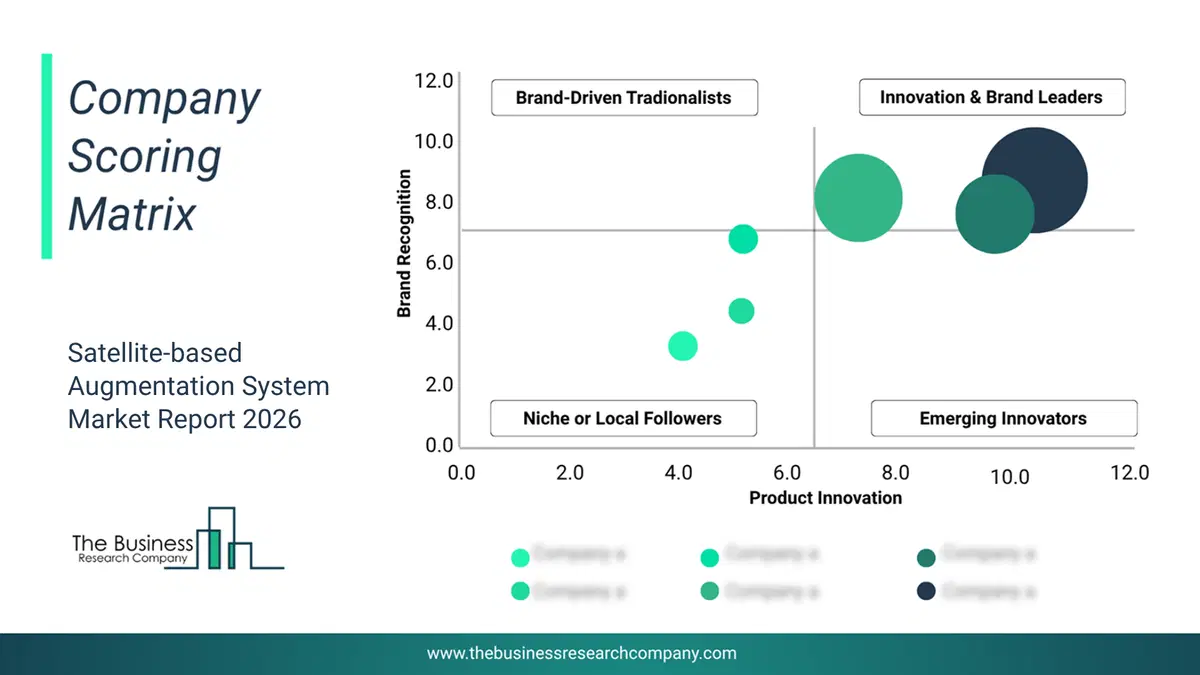
This chart maps companies by product innovation and brand strength, with bubble size indicating relative revenue, helping identify market leaders, challengers, and niche players. This is an illustrative chart; the full report provides a complete and accurate competitive analysis.
Global Satellite-based Augmentation System Market Trends and Insights
Major companies operating in the satellite-based augmentation system market are focusing on strategic investments to enhance the production of innovative satellite-based augmentation systems. Strategic investments in the satellite-based augmentation system market improve production efficiency, foster product innovation, lower operational costs, and broaden market reach. These initiatives allow companies to address increasing demand and bolster their competitive edge. For instance, in January 2024, Thales Alenia Space, a France-based aerospace company, introduced the upgraded European Geostationary Navigation Overlay Service (EGNOS) V242B, an advanced version of Europe’s satellite-based augmentation system. The new version delivers a major performance boost by integrating next-generation ground receiving stations, offering enhanced protection against ionospheric disturbances and geomagnetic storms, and providing a tenfold reduction in false alerts related to GPS corrections. This upgrade significantly improves positioning accuracy, safety, and reliability for users in aviation, maritime, and precision agriculture sectors, underscoring ongoing innovation and investment in the satellite-based augmentation system market.What Are Latest Mergers And Acquisitions In The Satellite-based Augmentation System Market? Viasat Inc. Acquires Inmarsat Global, Expanding Satellite Assets
In May 2023, Viasat Inc., a France-based communications company, acquired Inmarsat Global Limited for an undisclosed amount. With this acquisition, Viasat Inc. enhances its position in the satellite communication industry and allows the firms to combine spectrum, satellite, and terrestrial assets, including 19 satellites in space spanning the Ka, L, and S-bands. Inmarsat Global Limited is a UK-based satellite service provider company offering mobile satellite communication services such as satellite-based augmentation system (SBAS) services.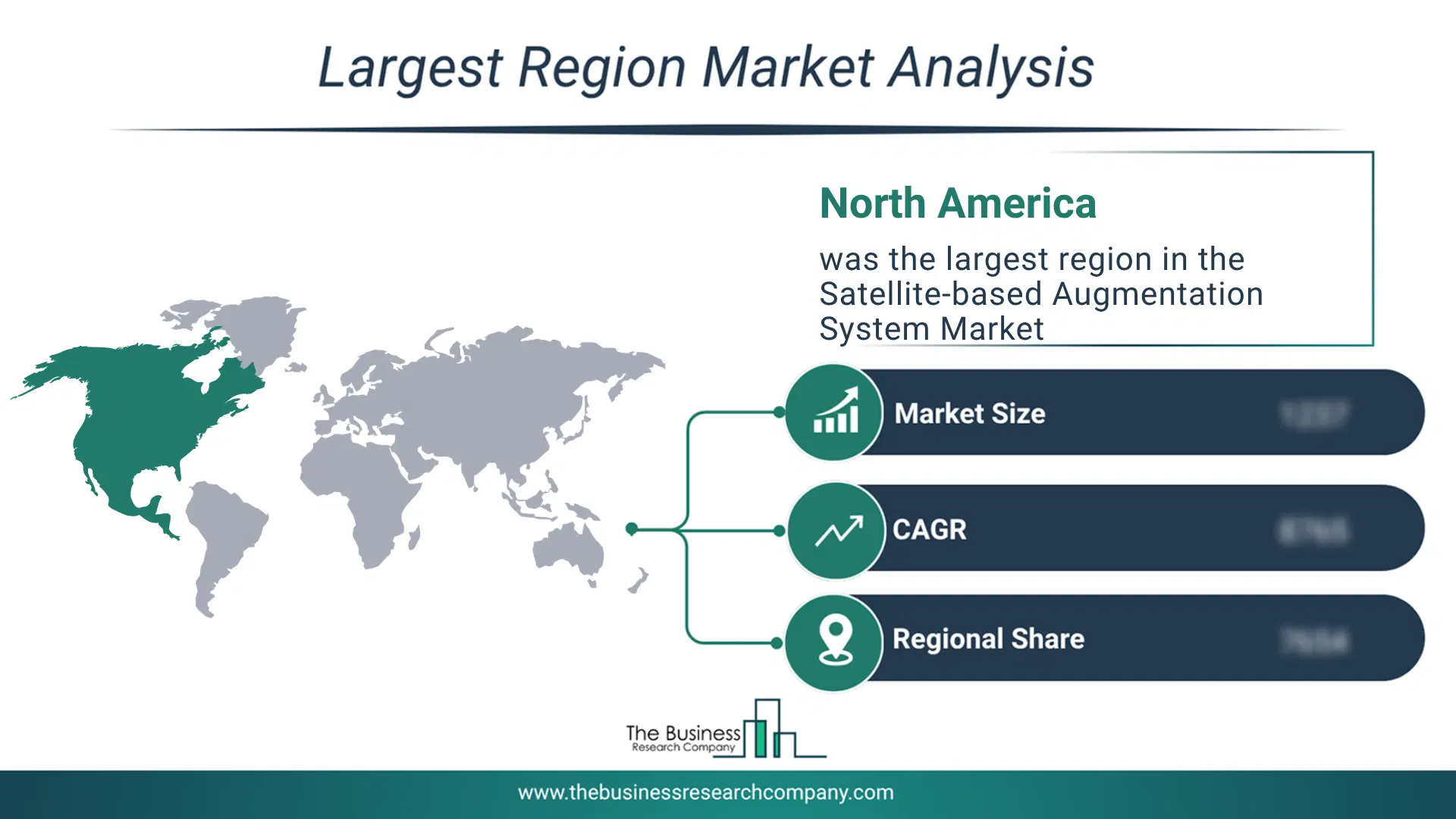
Regional Insights
North America was the largest region in the satellite-based augmentation system market in 2025. Asia-Pacific is expected to be the significant growing region in the forecast period. The regions covered in the satellite-based augmentation system market report are Asia-Pacific, South East Asia, Western Europe, Eastern Europe, North America, South America, Middle East, Africa. The countries covered in the satellite-based augmentation system market report are Australia, Brazil, China, France, Germany, India, Indonesia, Japan, Taiwan, Russia, South Korea, UK, USA, Canada, Italy, SpainWhat Defines the Satellite-based Augmentation System Market?
The satellite-based augmentation system market includes of revenues earned by entities by providing services such as soil condition monitoring, geo-traceability, ionospheric corrections, and system monitoring and maintenance. The market value includes the value of related goods sold by the service provider or included within the service offering. Only goods and services traded between entities or sold to end consumers are included.How is Market Value Defined and Measured?
The market value is defined as the revenues that enterprises gain from the sale of goods and/or services within the specified market and geography through sales, grants, or donations in terms of the currency (in USD unless otherwise specified). The revenues for a specified geography are consumption values that are revenues generated by organizations in the specified geography within the market, irrespective of where they are produced. It does not include revenues from resales along the supply chain, either further along the supply chain or as part of other products.
This chart presents market attractiveness based on a quantitative evaluation of growth, competition, strategic alignment, and risk, offering a clear view of opportunity areas for decision-making. This chart is for illustrative purposes; the full report contains the complete analysis.

This chart highlights the Total Addressable Market (TAM) by estimating the maximum revenue opportunity using an assumption-driven approach, supporting strategic planning and opportunity sizing across markets. The chart is illustrative; the full report provides a more comprehensive analysis.
What Key Data and Analysis Are Included in the Satellite-based Augmentation System Market Report 2026?
The satellite-based augmentation system market research report is one of a series of new reports from The Business Research Company that provides market statistics, including industry global market size, regional shares, competitors with the market share, detailed market segments, market trends and opportunities, and any further data you may need to thrive in the satellite-based augmentation system industry. The market research report delivers a complete perspective of everything you need, with an in-depth analysis of the current and future state of the industry.Satellite-based Augmentation System Market Report Forecast Analysis
| Report Attribute | Details |
|---|---|
| Market Size Value In 2026 | $1.65 billion |
| Revenue Forecast In 2030 | $2.22 billion |
| Growth Rate | CAGR of 7.7% from 2026 to 2030 |
| Base Year For Estimation | 2025 |
| Actual Estimates/Historical Data | 2020-2025 |
| Forecast Period | 2026 - 2030 |
| Market Representation | Revenue in USD Billion and CAGR from 2026 to 2030 |
| Segments Covered | Type, Component, Application |
| Regional Scope | Asia-Pacific, Western Europe, Eastern Europe, North America, South America, Middle East, Africa |
| Country Scope | The countries covered in the satellite-based augmentation system market report are Australia, Brazil, China, France, Germany, India, Indonesia, Japan, Taiwan, Russia, South Korea, UK, USA, Canada, Italy, Spain |
| Key Companies Profiled | RTX Corporation (Raytheon Technologies Corporation), Lockheed Martin Corporation, Airbus SE, Northrop Grumman Corporation, Honeywell International Inc., Broadcom Corporation, Safran Group, Federal Aviation Administration (FAA), Thales Group, L3Harris Technologies Inc., STMicroelectronics N.V., Elbit Systems Ltd., Rockwell Collins Inc., Garmin Ltd., Trimble Inc., Collins Aerospace, Topcon Corporation, Inmarsat Global Limited, u-Blox Holding AG, Spirent Communications Plc, GMV Innovating Solutions S.L., NovAtel Inc., Universal Avionics Systems Corporation, Accord Software & Systems Pvt. Ltd., Swift Navigation Inc., Hemisphere GNSS, Grintex India Limited, Septentrio NV, Locosys Technology Inc., NexNav Inc., NavatechGPS |
| Customization Scope | Request for Customization |
| Pricing And Purchase Options | Explore Purchase Options |