
Satellite-To-Cell Phone Service Market Report 2026
Global Outlook – By Service Type (Direct-To-Device, Relay Services, Emergency Services, Other Service Types), By Frequency Band (L-Band, S-Band, Ku-Band, Ka-Band, Other Frequency Bands), By End-User (Consumer, Government And Defense, Maritime, Aviation, Energy And Utilities, Transportation And Logistics, Other End-Users) – Market Size, Trends, Strategies, and Forecast to 2030
Satellite-To-Cell Phone Service Market Overview
• Satellite-To-Cell Phone Service market size has reached to $3.87 billion in 2025 • Expected to grow to $8.1 billion in 2030 at a compound annual growth rate (CAGR) of 15.9% • Growth Driver: Rising Demand For Reliable Communication Driving The Growth Of The Market Due To The Need For Seamless Connectivity Everywhere • Market Trend: Advancements In Hybrid Satellite-Cellular Communication Enhancing Connectivity In Remote Areas • North America was the largest region in 2025 and Asia-Pacific is the fastest growing region.What Is Covered Under Satellite-To-Cell Phone Service Market?
Satellite-to-cell phone service refers to a communication system that connects satellite networks directly to standard cell phones, enabling coverage in remote or underserved areas. This technology bridges the gap between satellites and terrestrial mobile networks, providing seamless voice and data connectivity where traditional cellular towers are unavailable. The main types of satellite-to-cell phone services include direct-to-device, relay services, emergency services, and others. Direct-to-device service enables satellite signals to connect directly with mobile devices without needing an intermediary network. It offers various frequency bands, including L-band, S-band, Ku-band, Ka-band, and others, and is used by several end-users, including consumers, government and defense, maritime, aviation, energy and utilities, transportation and logistics, and others.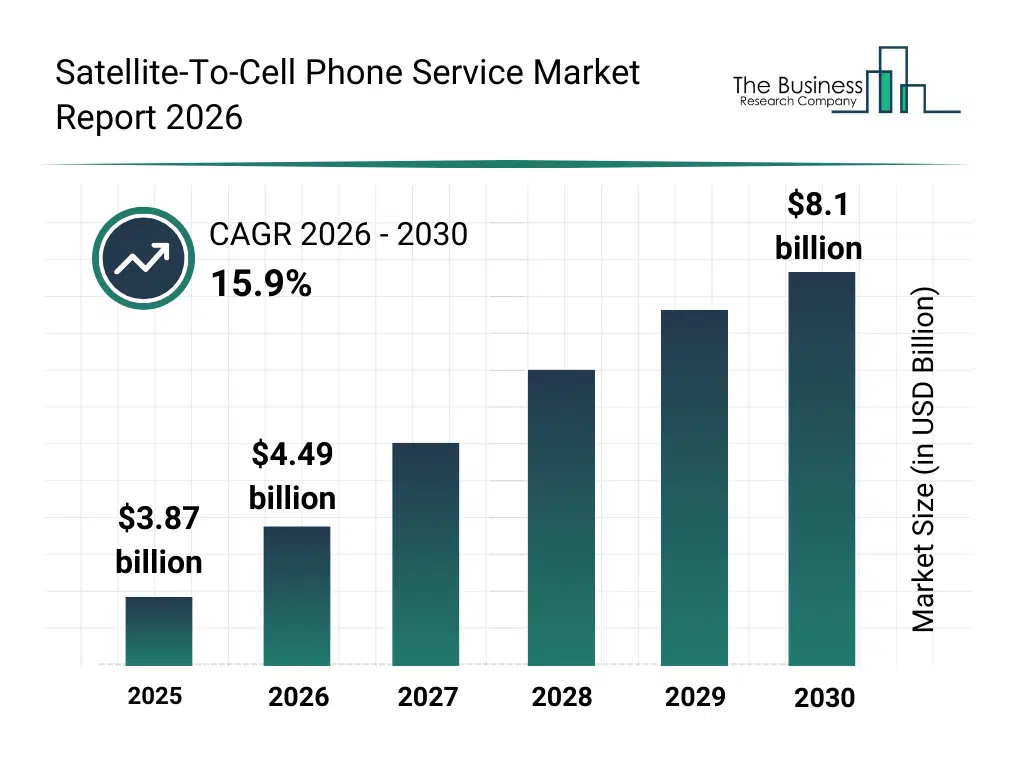
What Is The Satellite-To-Cell Phone Service Market Size and Share 2026?
The satellite-to-cell phone service market size has grown rapidly in recent years. It will grow from $3.87 billion in 2025 to $4.49 billion in 2026 at a compound annual growth rate (CAGR) of 16.2%. The growth in the historic period can be attributed to introduction of direct satellite-to-cellphone communication devices, early deployment for emergency messaging and disaster recovery, adoption in aviation satellite services, increasing sales of satellite phones and boosters, rising government contracts for remote communication.What Is The Satellite-To-Cell Phone Service Market Growth Forecast?
The satellite-to-cell phone service market size is expected to see rapid growth in the next few years. It will grow to $8.1 billion in 2030 at a compound annual growth rate (CAGR) of 15.9%. The growth in the forecast period can be attributed to expansion to underserved and remote regions, development of low-latency satellite communication networks, integration with terrestrial mobile operators, enhancement of emergency and aviation satellite services, increased adoption in consumer and commercial sectors. Major trends in the forecast period include integration of satellite-to-cell capabilities into mainstream smartphones and chipsets, expansion of hybrid satellite–cellular service bundles by mobile network operators, growing focus on emergency and disaster-resilience connectivity offerings, increasing deployment of low-earth-orbit (leo) constellations for global handheld coverage, rising regulatory harmonization and spectrum allocation for non-terrestrial mobile networks.
Global Satellite-To-Cell Phone Service Market Segmentation
1) By Service Type: Direct-To-Device, Relay Services, Emergency Services, Other Service Types 2) By Frequency Band: L-Band, S-Band, Ku-Band, Ka-Band, Other Frequency Bands 3) By End-User: Consumer, Government And Defense, Maritime, Aviation, Energy And Utilities, Transportation And Logistics, Other End-Users Subsegments: 1) By Direct-To-Device: Voice Services, Messaging Services, Data Connectivity, Multimedia Services 2) By Relay Services: Satellite Backhaul, Inter-Satellite Relay, Ground Station Relay, Hybrid Satellite-Cellular Relay 3) By Emergency Services: Disaster Response Communication, Maritime And Aviation Emergency Connectivity, Remote Search And Rescue Support, Public Safety Networks 4) By Other Service Types: IoT And M2M Communication, Defense And Government Applications, Enterprise Connectivity, Navigation And Tracking ServicesWhat Is Driver Of The Satellite-To-Cell Phone Service Market?
The increasing demand for seamless connectivity is expected to propel the growth of the satellite-to-cell phone service market going forward. Seamless connectivity means staying connected without any interruptions or breaks, no matter where you are. The rise in seamless connectivity is driven by increasing demand for reliable communication everywhere, as it allows people to stay connected without interruptions, improving convenience and safety in daily life. Satellite-to-cell phone service supports seamless connectivity by enabling mobile devices to connect directly to satellites when traditional cellular networks are unavailable, ensuring uninterrupted communication even in remote or hard-to-reach areas. For instance, in February 2024, according to the GSMA, a UK-based organization, over 65% of global mobile users expected uninterrupted network access during travel or outdoor activities, up from 50% in 2022. Therefore, the increasing demand for seamless connectivity is driving the growth of the satellite-to-cell phone service industry.Key Players In The Global Satellite-To-Cell Phone Service Market
Major companies operating in the satellite-to-cell phone service market are Apple Inc., Samsung Electronics Co., T-Mobile US Inc., Vodafone Group, Telefonica S.A., Qualcomm Incorporated, Ericsson Inc., EchoStar Mobile Limited, MediaTek Inc., SpaceX Corp., SES S.A., Iridium Communications, Inmarsat Global Ltd., OneWeb, Eutelsat Communications SA, Globalstar Inc., Thuraya Telecommunications Company, Rakuten Mobile Inc., Lynk Global Inc., AST SpaceMobile Inc.
This chart is for illustrative purposes; the full report includes a detailed competitor analysis and comprehensive overview of the top 10 companies in the market.
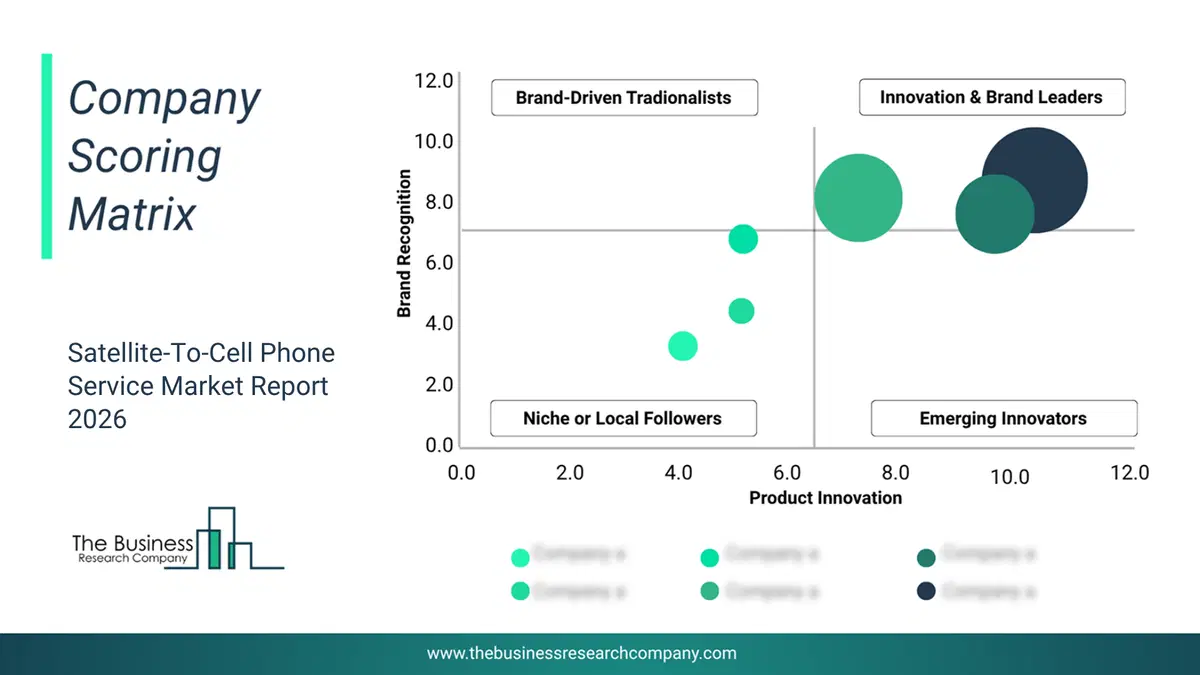
This chart maps companies by product innovation and brand strength, with bubble size indicating relative revenue, helping identify market leaders, challengers, and niche players. This is an illustrative chart; the full report provides a complete and accurate competitive analysis.
Global Satellite-To-Cell Phone Service Market Trends and Insights
Major companies operating in the satellite-to-cell phone service market are focusing on developing advanced approaches, such as hybrid satellite-cellular communication, to enhance seamless connectivity and coverage in remote areas. Hybrid satellite-cellular communication integrates satellite signals with existing cellular networks to provide reliable service where traditional coverage is weak or absent. For instance, in March 2025, Verizon, a US-based telecommunications company, launched its free satellite texting service for select smartphones. Verizon's free satellite texting service allows users to send messages even in areas without cellular coverage, ensuring connectivity in remote locations. It enhances safety by enabling communication during emergencies where traditional networks fail. The service is easy to use on select smartphones without additional hardware. This innovation expands reliable communication options for travelers, outdoor enthusiasts, and disaster response situations.What Are Latest Mergers And Acquisitions In The Satellite-To-Cell Phone Service Market? Telstra Partners With Starlink To Boost Remote Connectivity In Australia
In January 2025, Telstra, an Australia-based telecommunications company, partnered with Starlink to leverage Starlink's satellite technology to provide direct-to-device communication services that enhance mobile coverage and connectivity in remote and underserved areas across Australia, ensuring reliable access to messaging and emergency communication where traditional networks are limited. Starlink is a US-based satellite internet service provider company specializing in broadband connectivity through a constellation of low Earth orbit (LEO) satellites.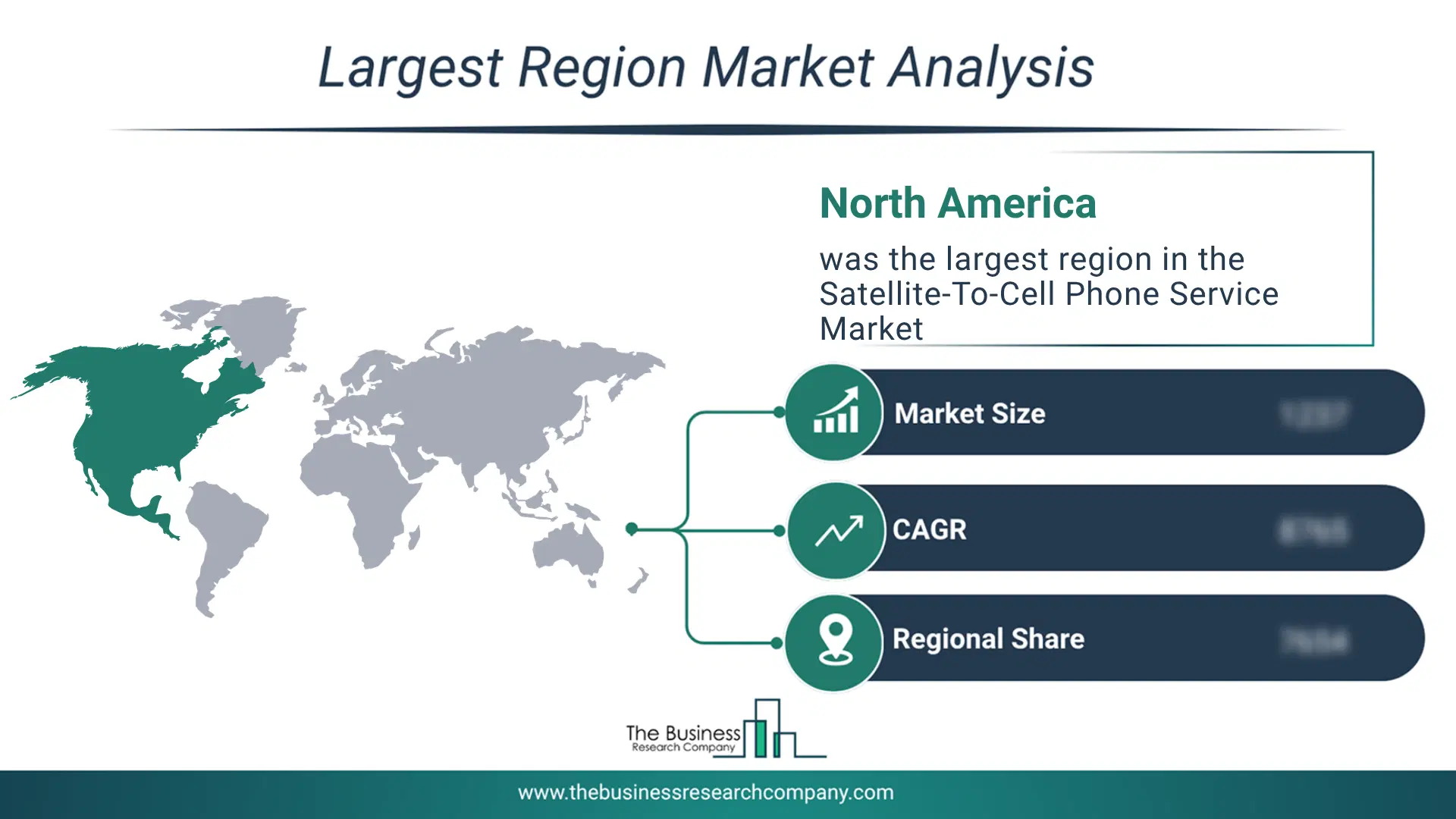
Regional Insights
North America was the largest region in the satellite-to-cell phone service market in 2025. Asia-Pacific is expected to be the fastest-growing region in the forecast period. The regions covered in this market report are Asia-Pacific, South East Asia, Western Europe, Eastern Europe, North America, South America, Middle East, Africa. The countries covered in this market report are Australia, Brazil, China, France, Germany, India, Indonesia, Japan, Taiwan, Russia, South Korea, UK, USA, Canada, Italy, SpainWhat Defines the Satellite-To-Cell Phone Service Market?
The satellite-to-cell phone service market consists of revenues earned by entities by providing services such as emergency messaging services, disaster recovery communication, satellite data services, and aviation satellite services. The market value includes the value of related goods sold by the service provider or included within the service offering. The satellite-to-cell phone service market also includes sales of satellite phones, satellite signal boosters, satellite antennas, and satellite phone docks. Values in this market are 'factory gate' values, that is the value of goods sold by the manufacturers or creators of the goods, whether to other entities (including downstream manufacturers, wholesalers, distributors and retailers) or directly to end customers. The value of goods in this market includes related services sold by the creators of the goods.How is Market Value Defined and Measured?
The market value is defined as the revenues that enterprises gain from the sale of goods and/or services within the specified market and geography through sales, grants, or donations in terms of the currency (in USD unless otherwise specified). The revenues for a specified geography are consumption values that are revenues generated by organizations in the specified geography within the market, irrespective of where they are produced. It does not include revenues from resales along the supply chain, either further along the supply chain or as part of other products.
This chart presents market attractiveness based on a quantitative evaluation of growth, competition, strategic alignment, and risk, offering a clear view of opportunity areas for decision-making. This chart is for illustrative purposes; the full report contains the complete analysis.

This chart highlights the Total Addressable Market (TAM) by estimating the maximum revenue opportunity using an assumption-driven approach, supporting strategic planning and opportunity sizing across markets. The chart is illustrative; the full report provides a more comprehensive analysis.
What Key Data and Analysis Are Included in the Satellite-To-Cell Phone Service Market Report 2026?
The satellite-to-cell phone service market research report is one of a series of new reports from The Business Research Company that provides market statistics, including industry global market size, regional shares, competitors with the market share, detailed market segments, market trends and opportunities, and any further data you may need to thrive in the satellite-to-cell phone service industry. The market research report delivers a complete perspective of everything you need, with an in-depth analysis of the current and future state of the industry.Satellite-To-Cell Phone Service Market Report Forecast Analysis
| Report Attribute | Details |
|---|---|
| Market Size Value In 2026 | $4.49 billion |
| Revenue Forecast In 2030 | $8.1 billion |
| Growth Rate | CAGR of 15.9% from 2026 to 2030 |
| Base Year For Estimation | 2025 |
| Actual Estimates/Historical Data | 2020-2025 |
| Forecast Period | 2026 - 2030 |
| Market Representation | Revenue in USD Billion and CAGR from 2026 to 2030 |
| Segments Covered | Service Type, Frequency Band, End-User |
| Regional Scope | Asia-Pacific, Western Europe, Eastern Europe, North America, South America, Middle East, Africa |
| Country Scope | The countries covered in the satellite-to-cell phone service market report are Australia, Brazil, China, France, Germany, India, Indonesia, Japan, Taiwan, Russia, South Korea, UK, USA, Canada, Italy, Spain |
| Key Companies Profiled | Apple Inc., Samsung Electronics Co., T-Mobile US Inc., Vodafone Group, Telefonica S.A., Qualcomm Incorporated, Ericsson Inc., EchoStar Mobile Limited, MediaTek Inc., SpaceX Corp., SES S.A., Iridium Communications, Inmarsat Global Ltd., OneWeb, Eutelsat Communications SA, Globalstar Inc., Thuraya Telecommunications Company, Rakuten Mobile Inc., Lynk Global Inc., AST SpaceMobile Inc. |
| Customization Scope | Request for Customization |
| Pricing And Purchase Options | Explore Purchase Options |