
Seasonal Setpoint Optimization Services Market Report 2026
Global Outlook – By Service Type (Consulting, Implementation, Maintenance Support), By Deployment Mode (On-Premises, Cloud-Based), By Enterprise Size (Large Enterprises, Small And Medium Enterprises), By Application (Commercial Buildings, Industrial Facilities, Residential Buildings, Other Applications), By End-User (Energy And Utilities, Healthcare, Education, Retail, Hospitality, Other End-Users) – Market Size, Trends, Strategies, and Forecast to 2035
Seasonal Setpoint Optimization Services Market Overview
• Seasonal Setpoint Optimization Services market size has reached to $1.34 billion in 2025 • Expected to grow to $2.4 billion in 2030 at a compound annual growth rate (CAGR) of 12.4% • Growth Driver: Surge In Rising Demand For Energy Efficiency Fueling The Growth Of The Market Due To Increasing Hvac Energy Savings Potential • North America was the largest region in 2025 and Asia-Pacific is the fastest growing region.What Is Covered Under Seasonal Setpoint Optimization Services Market?
Seasonal setpoint optimization services refer to advanced energy management services that dynamically adjust HVAC system temperature and operational setpoints based on seasonal variations, occupancy patterns, and environmental conditions to maximize efficiency. The primary purpose is to reduce energy consumption and operational costs while maintaining optimal indoor comfort and system performance across different seasons. The main service types of seasonal setpoint optimization services include consulting, implementation, and maintenance support. Consulting refers to professional services focused on analyzing and recommending optimal seasonal temperature and energy setpoints to improve efficiency and reduce operational costs in building systems. These services are categorized by deployment mode including on-premises and cloud-based and are designed for enterprise sizes such as large enterprises and small and medium enterprises. The various applications involved are commercial buildings, industrial facilities, residential buildings, and others, and they are used by several end users such as energy and utilities, healthcare, education, retail, hospitality, and others.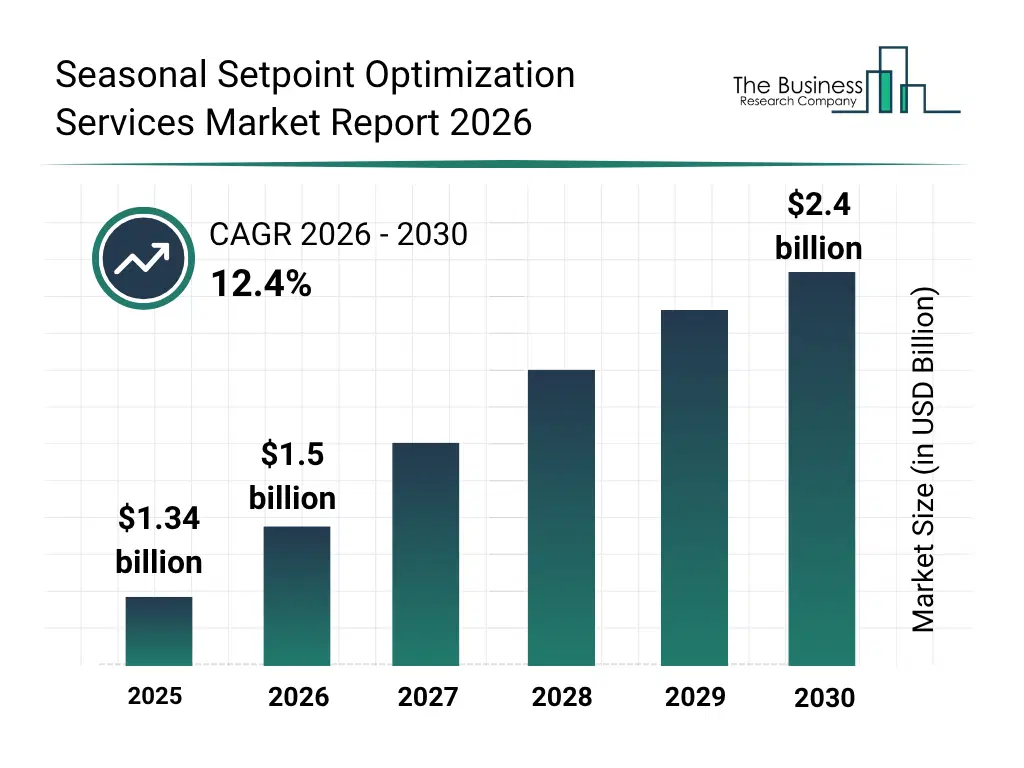
What Is The Seasonal Setpoint Optimization Services Market Size and Share 2026?
The seasonal setpoint optimization services market size has grown rapidly in recent years. It will grow from $1.34 billion in 2025 to $1.5 billion in 2026 at a compound annual growth rate (CAGR) of 12.1%. The growth in the historic period can be attributed to manual thermostat adjustment practices, static hvac scheduling without seasonal variation, high energy consumption in commercial buildings, limited adoption of automated building controls, lack of occupancy based temperature regulation.What Is The Seasonal Setpoint Optimization Services Market Growth Forecast?
The seasonal setpoint optimization services market size is expected to see rapid growth in the next few years. It will grow to $2.4 billion in 2030 at a compound annual growth rate (CAGR) of 12.4%. The growth in the forecast period can be attributed to increasing demand for adaptive hvac optimization services, expansion of centralized building energy management systems, growth in seasonal energy efficiency planning services, rising focus on operational cost reduction in facility management, increasing adoption of comfort driven building performance optimization. Major trends in the forecast period include occupancy based hvac setpoint scheduling, seasonal thermal comfort recalibration practices, dynamic hvac load balancing across building zones, energy cost driven temperature scheduling optimization, preventive hvac calibration and seasonal tune up services.
Global Seasonal Setpoint Optimization Services Market Segmentation
1) By Service Type: Consulting, Implementation, Maintenance Support 2) By Deployment Mode: On-Premises, Cloud-Based 3) By Enterprise Size: Large Enterprises, Small And Medium Enterprises 4) By Application: Commercial Buildings, Industrial Facilities, Residential Buildings, Other Applications 5) By End-User: Energy And Utilities, Healthcare, Education, Retail, Hospitality, Other End-Users Subsegments: 1) By Consulting: Energy Audit And Baseline Assessment, Building Performance Benchmarking, Heating Ventilation And Air Conditioning System Assessment, Seasonal Setpoint Strategy Design, Occupancy Pattern Analysis, Energy Cost Optimization Advisory, Regulatory Compliance Advisory, Sustainability And Carbon Reduction Planning 2) By Implementation: System Configuration And Integration, Building Management System Setup, Sensor And Control Device Installation, Seasonal Scheduling Setup, Automation Rule Deployment, Data Integration And Connectivity Setup, User Interface And Dashboard Configuration, Testing And Commissioning 3) By Maintenance Support: System Monitoring And Performance Tracking, Preventive Maintenance Services, Seasonal Adjustment Updates, Fault Detection And Troubleshooting, Software Updates And Patch Management, Remote Technical Assistance, On Site Technical Support, Performance Optimization And Fine TuningWhat Are The Drivers Of The Seasonal Setpoint Optimization Services Market?
The rising demand for energy efficiency is expected to propel the growth of the seasonal setpoint optimization services market going forward. Energy efficiency refers to the use of advanced technologies and strategies to reduce energy consumption while maintaining or improving system performance and comfort levels. The increasing demand for energy efficiency is driven by rising energy costs, stringent government regulations, and growing awareness of environmental sustainability across commercial and industrial sectors. Seasonal setpoint optimization services support energy efficiency initiatives by dynamically adjusting HVAC system setpoints based on seasonal variations, occupancy patterns, and external weather conditions, thereby minimizing energy wastage and enhancing operational performance. For instance, in November 2025, according to the Australian Bureau of Statistics, an Australia-based intergovernmental organization, Australia’s energy consumption rose by 0.5% in 2023–24, reaching 5,977 PJ. Total net energy use increased by 1.6% in 2023–24 to 23,693 PJ. Therefore, the rising demand for energy efficiency is driving the growth of the seasonal setpoint optimization services industry. The rising integration of IoT and connected sensors is expected to propel the growth of the seasonal setpoint optimization services market going forward. IoT and connected sensors refer to networks of physical devices embedded with sensors, software, and communication technologies that collect and exchange real-time data for monitoring and automation purposes. The rise in integration of IoT in building energy management is driven by the need for improved energy efficiency, real-time system monitoring, and optimized HVAC performance across residential, commercial, and industrial infrastructures. Seasonal setpoint optimization services leverage IoT-enabled sensors to continuously adjust heating, ventilation, and cooling setpoints based on occupancy patterns, weather conditions, and seasonal variations, thereby reducing energy consumption and improving operational efficiency compared to traditional fixed-control systems. For instance, in November 2025, according to the Office of Communications, a UK-based government agency, the UK had approximately 24.9 million active IoT devices in 2023, increasing to 26.5 million in 2024. Therefore, the rising integration of IoT and connected sensors is driving the growth of the seasonal setpoint optimization services industry. The increasing construction of smart cities is expected to propel the growth of the seasonal setpoint optimization services market going forward. A smart city is a city that integrates advanced technology and connected systems to efficiently manage resources, services, and infrastructure. The rise in smart city construction is driven by rapid urbanization and the need for energy-efficient and sustainable urban infrastructure, as governments focus on reducing resource consumption and improving building performance. Seasonal setpoint optimization services help smart cities by dynamically adjusting heating, ventilation, and cooling system temperature setpoints based on seasonal weather patterns, occupancy behavior, and real-time energy demand, thereby reducing energy consumption and improving operational efficiency of smart buildings. For instance, in March 2024, according to the Department of Transportation, a US-based government agency, over FY23 and FY24, SMART Grants funded 68 smart city projects in total (34 each year). Therefore, the increasing construction of smart cities is driving the growth of the seasonal setpoint optimization services industry.Key Players In The Global Seasonal Setpoint Optimization Services Market
Major companies operating in the seasonal setpoint optimization services market are Trane Technologies (TT), Johnson Controls, Carrier Global, Honeywell International, Siemens AG, Schneider Electric, Asea Brown Boveri, Emerson Electric Co., ENGIE SA, GridPoint Inc., Verdigris Technologies, Daikin Industries Ltd., BELIMO Holding AG, Clockworks Analytics, Parity Inc., BuildingIQ, BrainBox AI, KGS Buildings, Optimum Energy, Encycle Corporation, 75FRegional Outlook/Insights
North America was the largest region in the seasonal setpoint optimization services market in 2025. Asia-Pacific is expected to be the fastest-growing region in the forecast period. The regions covered in this market report are Asia-Pacific, South East Asia, Western Europe, Eastern Europe, North America, South America, Middle East, Africa. The countries covered in this market report are Australia, Brazil, China, France, Germany, India, Indonesia, Japan, Taiwan, Russia, South Korea, UK, USA, Canada, Italy, Spain.What Defines the Seasonal Setpoint Optimization Services Market?
The seasonal setpoint optimization services market includes revenues earned by entities by providing services such as HVAC seasonal setpoint adjustment, energy consumption monitoring & optimization, building management system optimization, demand response & load shifting, predictive energy analytics & AI-based optimization. The market value includes the value of related goods sold by the service provider or included within the service offering. Only goods and services traded between entities or sold to end consumers are included.How is Market Value Defined and Measured?
The market value is defined as the revenues that enterprises gain from the sale of goods and/or services within the specified market and geography through sales, grants, or donations in terms of the currency (in USD unless otherwise specified). The revenues for a specified geography are consumption values that are revenues generated by organizations in the specified geography within the market, irrespective of where they are produced. It does not include revenues from resales along the supply chain, either further along the supply chain or as part of other products.What Key Data and Analysis Are Included in the Seasonal Setpoint Optimization Services Market Report 2026?
The seasonal setpoint optimization services market research report is one of a series of new reports from The Business Research Company that provides market statistics, including industry global market size, regional shares, competitors with the market share, detailed market segments, market trends and opportunities, and any further data you may need to thrive in the seasonal setpoint optimization services industry. The market research report delivers a complete perspective of everything you need, with an in-depth analysis of the current and future state of the industry.Seasonal Setpoint Optimization Services Market Report Forecast Analysis
| Report Attribute | Details |
|---|---|
| Market Size Value In 2026 | $1.5 billion |
| Revenue Forecast In 2035 | $2.4 billion |
| Growth Rate | CAGR of 12.4% from 2026 to 2035 |
| Base Year For Estimation | 2025 |
| Actual Estimates/Historical Data | 2020-2025 |
| Forecast Period | 2026 - 2030 - 2035 |
| Market Representation | Revenue in USD Billion and CAGR from 2026 to 2035 |
| Segments Covered | Service Type, Deployment Mode, Enterprise Size, Application, End-User |
| Regional Scope | Asia-Pacific, Western Europe, Eastern Europe, North America, South America, Middle East, Africa |
| Country Scope | The countries covered in the report are Australia, Brazil, China, France, Germany, India, Indonesia, Japan, Taiwan, Russia, South Korea, UK, USA, Canada, Italy, Spain. |
| Key Companies Profiled | Trane Technologies (TT), Johnson Controls, Carrier Global, Honeywell International, Siemens AG, Schneider Electric, Asea Brown Boveri, Emerson Electric Co., ENGIE SA, GridPoint Inc., Verdigris Technologies, Daikin Industries Ltd., BELIMO Holding AG, Clockworks Analytics, Parity Inc., BuildingIQ, BrainBox AI, KGS Buildings, Optimum Energy, Encycle Corporation, 75F |
| Customization Scope | Request for Customization |
| Pricing And Purchase Options | Explore Purchase Options |