
AI-Driven Retail Heat Map Market Report 2026
Global Outlook – By Component (Software, Hardware, Services), By Deployment Mode (On-Premises, Cloud), By Application (In-Store Analytics, Customer Behavior Analysis, Queue Management, Store Layout Optimization, Other Applications), By End-User (Supermarkets Or Hypermarkets, Specialty Stores, Department Stores, Convenience Stores, Other End-Users) – Market Size, Trends, Strategies, and Forecast to 2030
AI-Driven Retail Heat Map Market Overview
• AI-Driven Retail Heat Map market size has reached to $1.59 billion in 2025 • Expected to grow to $4.45 billion in 2030 at a compound annual growth rate (CAGR) of 22.8% • Growth Driver: The Expansion Of The E-Commerce Industry Is Driving The Market Due To Increased Mobile Commerce Adoption • Market Trend: AI-Powered Retail Heat Maps Transform Shopper Insights And Store Optimization • North America was the largest region in 2025 and Asia-Pacific is the fastest growing region.What Is Covered Under AI-Driven Retail Heat Map Market?
An artificial intelligence (AI)-driven retail heat map is a visual tool that uses artificial intelligence to show how customers move and behave in a store. It collects data from cameras, sensors, or other devices to track where shoppers go, what they look at, and how long they stay in certain areas. The map uses colors to highlight busy or quiet spots, helping retailers optimize store layouts, product placement, and customer experiences. The main components of an AI-driven retail heat map are software, hardware, and services. AI-driven retail heat map software is a platform that analyzes in-store shopper behavior using artificial intelligence to generate visual heat maps, optimize product placement, and enhance merchandising strategies in real time. These are deployed on-premises and in cloud mode, which are used in applications such as in-store analytics, customer behavior analysis, queue management, store layout optimization, and others, in end-users including supermarkets or hypermarkets, specialty stores, department stores, convenience stores, and others.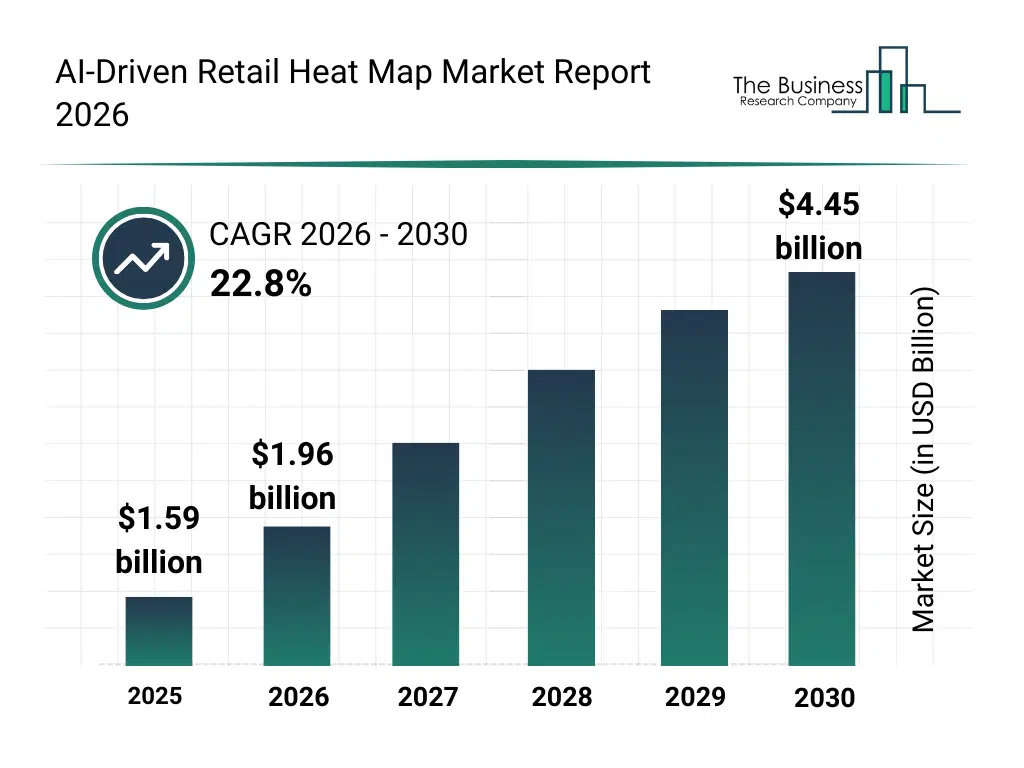
What Is The AI-Driven Retail Heat Map Market Size and Share 2026?
The AI-driven retail heat map market size has grown exponentially in recent years. It will grow from $1.59 billion in 2025 to $1.96 billion in 2026 at a compound annual growth rate (CAGR) of 23.3%. The growth in the historic period can be attributed to growing adoption of digital in-store solutions, increased investment in retail analytics, rising demand for enhanced customer experience, expansion of physical retail stores, early integration of IoT devices in retail.What Is The AI-Driven Retail Heat Map Market Growth Forecast?
The AI-driven retail heat map market size is expected to see exponential growth in the next few years. It will grow to $4.45 billion in 2030 at a compound annual growth rate (CAGR) of 22.8%. The growth in the forecast period can be attributed to surge in AI-powered analytics adoption, expansion of smart sensors and camera technologies, demand for personalized in-store experiences, integration with omni-channel retail strategies, increasing focus on store efficiency and optimization. Major trends in the forecast period include real-time customer tracking, predictive store layout optimization, footfall heat mapping, personalized shopping experience, queue and dwell time analysis.
Global AI-Driven Retail Heat Map Market Segmentation
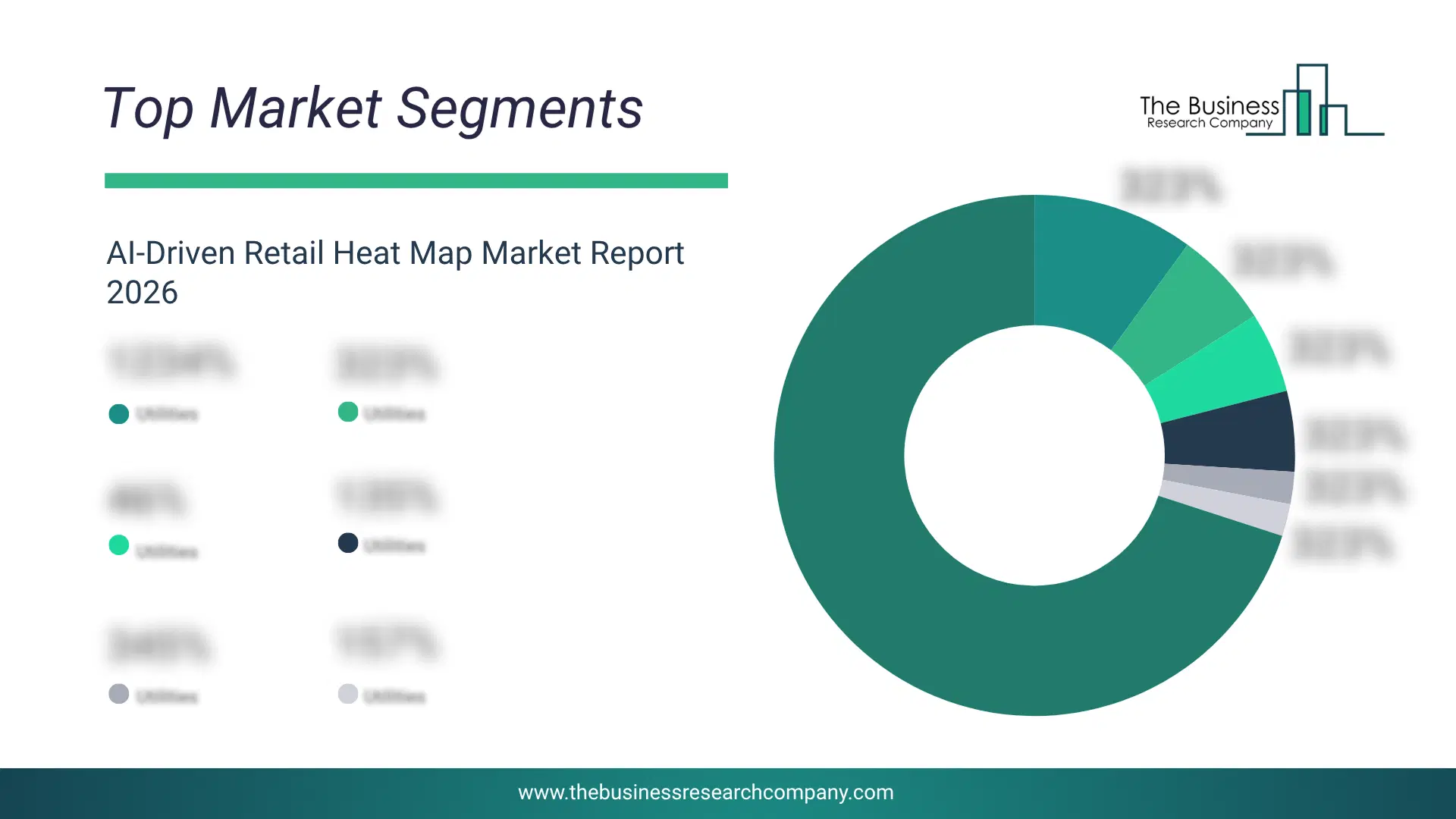
1) By Component: Software, Hardware, Services 2) By Deployment Mode: On-Premises, Cloud 3) By Application: In-Store Analytics, Customer Behavior Analysis, Queue Management, Store Layout Optimization, Other Applications 4) By End-User: Supermarkets Or Hypermarkets, Specialty Stores, Department Stores, Convenience Stores, Other End-Users Subsegments: 1) By Software: Predictive Analytics, Inventory Management, Personalization Engines, Recommendation Systems 2) By Hardware: Sensors, Cameras, Beacons, Point Of Sale Terminals 3) By Services: Consulting, Implementation, Support And Maintenance, TrainingWhat Is The Driver Of The AI-Driven Retail Heat Map Market?
The expansion of the e-commerce industry is expected to propel the growth of the AI-driven retail heat map market going forward. The e-commerce industry refers to the sector encompassing the buying and selling of goods and services over electronic platforms, primarily through websites and mobile applications, facilitating seamless transactions between businesses and consumers without the constraints of physical locations. A key factor driving the expansion of the e-commerce industry is the widespread adoption of mobile commerce, as the increasing reliance on smartphones enables consumers to access online marketplaces conveniently, enhancing user engagement and fostering continuous growth in digital transactions. AI-driven retail heat maps help to analyze consumer behavior and traffic patterns, thereby allowing e-commerce enterprises to optimize product placement, marketing strategies, and inventory management, ultimately accelerating market expansion. For instance, in August 2025, according to the United States Census Bureau, a US-based federal government agency, US retail e-commerce sales reached $292.9 billion in the second quarter of 2025, marking a 6.2 percent increase from the previous quarter and a 5.3 percent rise compared to Q2 2024, while total retail sales grew 3.8 percent, with e-commerce accounting for 15.5 percent of overall retail sales. Therefore, the expansion of the e-commerce industry is driving the AI-driven retail heat map industry.Key Players In The Global AI-Driven Retail Heat Map Market
Major companies operating in the AI-driven retail heat map market are Stratacache, Placer.ai, RetailNext, OP Retail, Aislelabs, V‑Count, Kepler Analytics, FootfallCam, Exposure Analytics, Mapsted, Pathr.ai, Prism Skylabs, Retail Sensing, Zenus Inc., Prodco Analytics Inc., Dor Technologies, Scanalytics Inc, Xovis, Springboard, Countwise, TangoEye, Palexy, Aura Vision, Deep North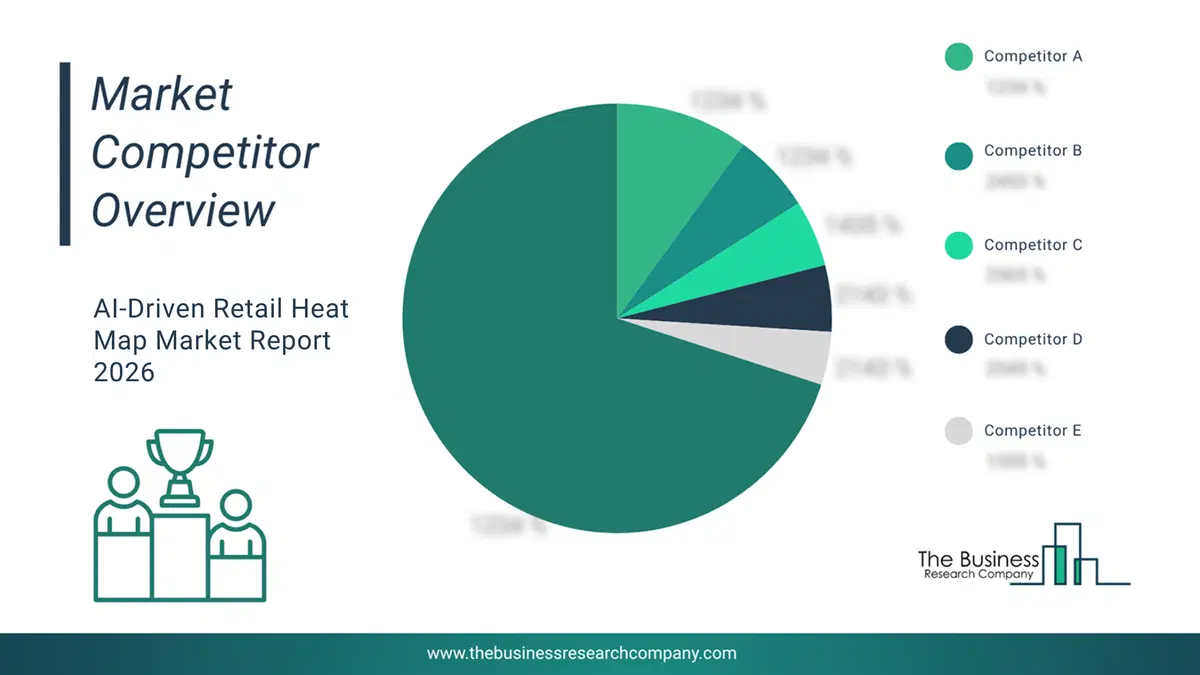
This chart is for illustrative purposes; the full report includes a detailed competitor analysis and comprehensive overview of the top 10 companies in the market.
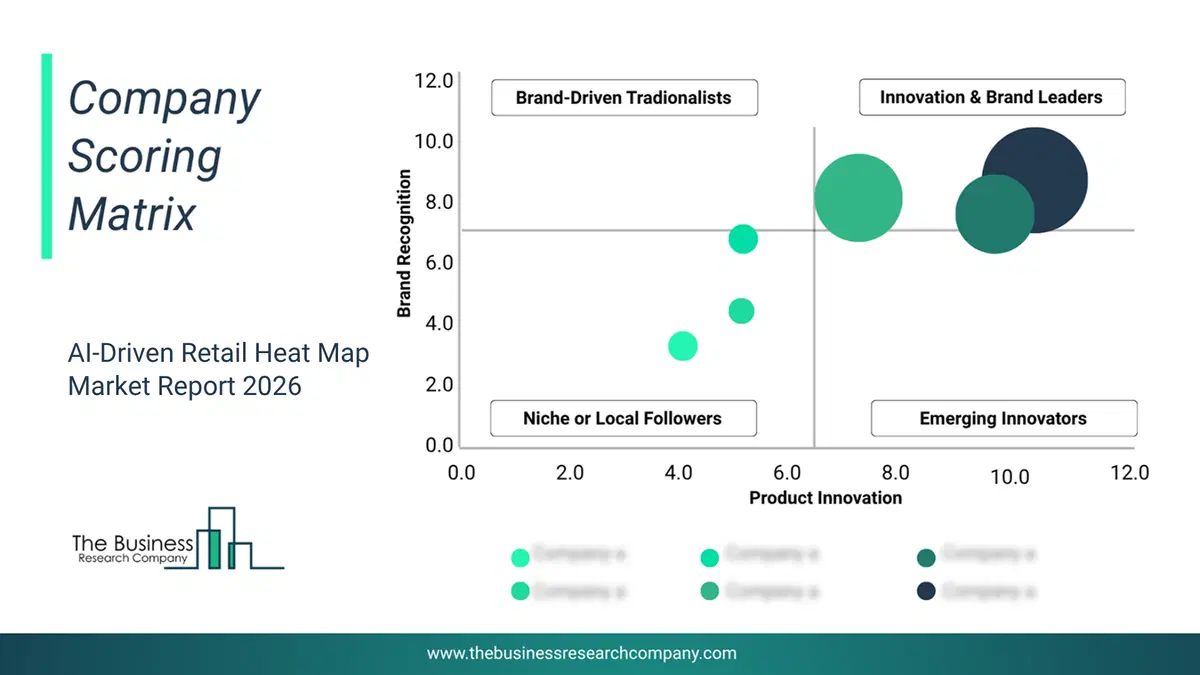
This chart maps companies by product innovation and brand strength, with bubble size indicating relative revenue, helping identify market leaders, challengers, and niche players. This is an illustrative chart; the full report provides a complete and accurate competitive analysis.
Global AI-Driven Retail Heat Map Market Trends and Insights
Major companies operating in the artificial intelligence (AI)-driven retail heat map market are focusing on the integration of real-time heatmap visualization with AI-powered predictive modeling to enhance accuracy, insight depth, and operational agility. Real-time heatmap visualization with AI-powered predictive modeling is a capability that simultaneously displays how users interact on a digital interface while leveraging artificial intelligence to forecast future engagement patterns, enabling businesses to gain instant insights and proactively optimize user experiences. For instance, in July 2024, Sprig, a US-based customer insights platform, launched Sprig Heatmaps, an AI-powered product designed to capture and analyze user engagement behavior at scale, enabling data-driven optimizations for adoption, retention, and satisfaction. Sprig Heatmaps features real-time heat map visualization, predictive engagement pattern modelling, and integration with analytics platforms to support proactive customer experience management and maximize business outcomes.What Are Latest Mergers And Acquisitions In The AI-Driven Retail Heat Map Market?
In October 2023, RetailNext, a US-based retail analytics company, partnered with MarketDial to elevate in-store analytics by combining shopper behavior data with physical retail experimentation. With this collaboration, RetailNext and MarketDial aim to integrate AI-powered traffic measurement and heat map analytics with controlled in-store testing to improve retail performance, enhance shopper experience through data-driven store layout and merchandising decisions, and deliver scalable and cost-effective optimization strategies for retailers. MarketDial is a US-based retail experimentation and analytics company that specializes in designing and executing large-scale A B tests in physical retail environments to measure the impact of operational and merchandising changes.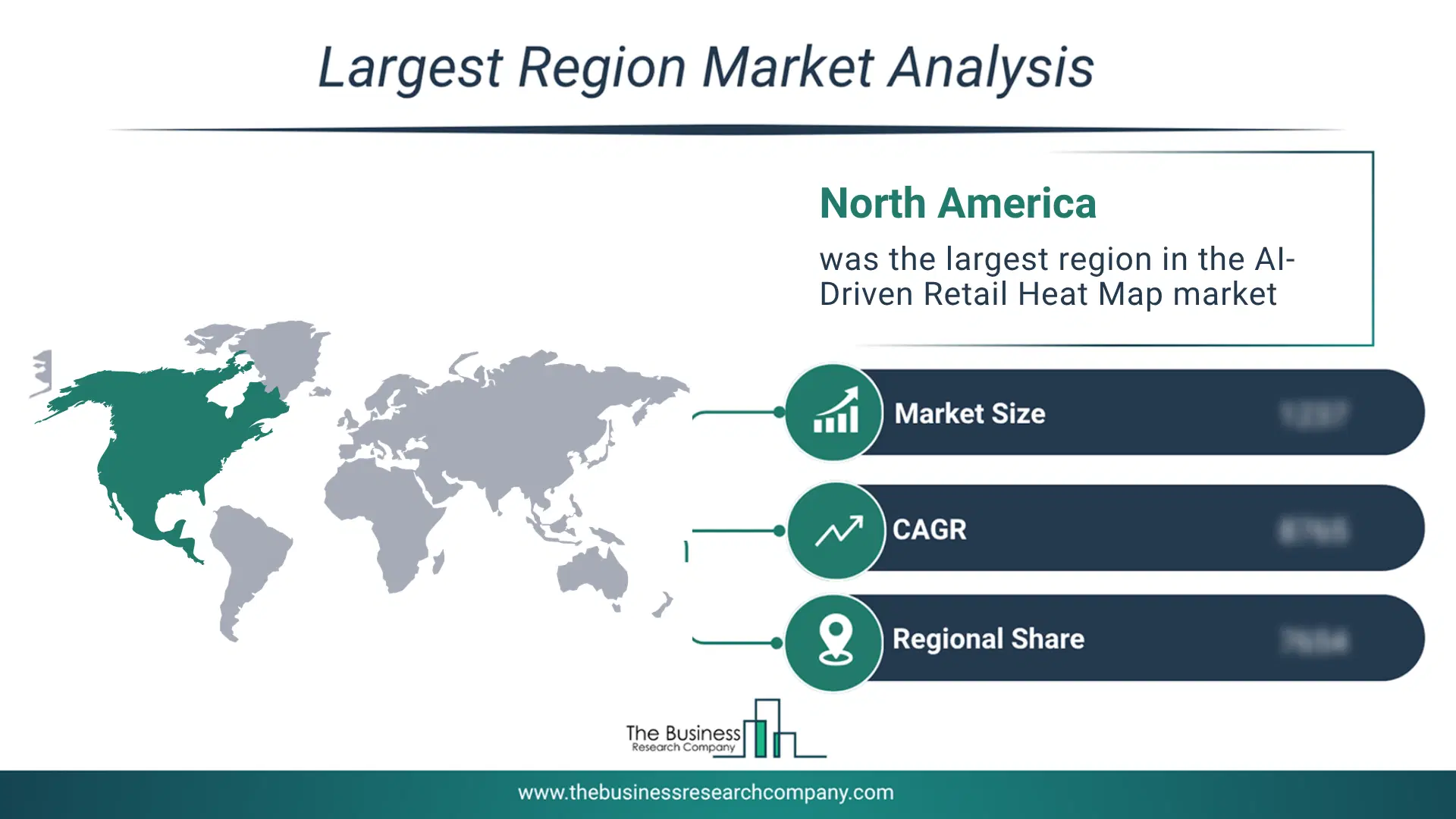
Regional Outlook
North America was the largest region in the AI-driven retail heat map market in 2025. Asia-Pacific is expected to be the fastest-growing region in the forecast period. The regions covered in this market report are Asia-Pacific, South East Asia, Western Europe, Eastern Europe, North America, South America, Middle East and Africa. The countries covered in this market report are Australia; Brazil; China; France; Germany; India; Indonesia; Japan; Taiwan; Russia; South Korea; UK; USA; Canada; Italy; Spain.What Defines the AI-Driven Retail Heat Map Market?
The AI-driven retail heat map market consists of revenues earned by entities by providing services such as real-time monitoring, data analysis, staff training, maintenance, and consulting. The market value includes the value of related goods sold by the service provider or included within the service offering. The AI-driven retail heat map market also includes sales of products such as thermal imaging cameras, Wi-Fi tracking devices, people counting systems, and digital signage systems. Values in this market are ‘factory gate’ values, that is, the value of goods sold by the manufacturers or creators of the goods, whether to other entities (including downstream manufacturers, wholesalers, distributors, and retailers) or directly to end customers. The value of goods in this market includes related services sold by the creators of the goods.How is Market Value Defined and Measured?
The market value is defined as the revenues that enterprises gain from the sale of goods and/or services within the specified market and geography through sales, grants, or donations in terms of the currency (in USD unless otherwise specified). The revenues for a specified geography are consumption values that are revenues generated by organizations in the specified geography within the market, irrespective of where they are produced. It does not include revenues from resales along the supply chain, either further along the supply chain or as part of other products.
This chart presents market attractiveness based on a quantitative evaluation of growth, competition, strategic alignment, and risk, offering a clear view of opportunity areas for decision-making. This chart is for illustrative purposes; the full report contains the complete analysis.

This chart highlights the Total Addressable Market (TAM) by estimating the maximum revenue opportunity using an assumption-driven approach, supporting strategic planning and opportunity sizing across markets. The chart is illustrative; the full report provides a more comprehensive analysis.
What Key Data and Analysis Are Included in the AI-Driven Retail Heat Map Market Report 2026?
The ai-driven retail heat map market research report is one of a series of new reports from The Business Research Company that provides market statistics, including industry global market size, regional shares, competitors with the market share, detailed market segments, market trends and opportunities, and any further data you may need to thrive in the ai-driven retail heat map industry. The market research report delivers a complete perspective of everything you need, with an in-depth analysis of the current and future state of the industry.AI-Driven Retail Heat Map Market Report Forecast Analysis
| Report Attribute | Details |
|---|---|
| Market Size Value In 2026 | $989.62 billion |
| Revenue Forecast In 2030 | $1274.33 billion |
| Growth Rate | CAGR of 5.9% from 2026 to 2030 |
| Base Year For Estimation | 2025 |
| Actual Estimates/Historical Data | 2020-2025 |
| Forecast Period | 2026 - 2030 |
| Market Representation | Revenue in USD Billion and CAGR from 2026 to 2030 |
| Segments Covered | Component, Deployment Mode, Application, End-User |
| Regional Scope | Asia-Pacific, Western Europe, Eastern Europe, North America, South America, Middle East, Africa |
| Country Scope | The countries covered in the report are Australia, Brazil, China, France, Germany, India, Indonesia, Japan, Taiwan, Russia, South Korea, UK, USA, Canada, Italy, Spain. |
| Key Companies Profiled | Stratacache, Placer.ai, RetailNext, OP Retail, Aislelabs, V‑Count, Kepler Analytics, FootfallCam, Exposure Analytics, Mapsted, Pathr.ai, Prism Skylabs, Retail Sensing, Zenus Inc., Prodco Analytics Inc., Dor Technologies, Scanalytics Inc, Xovis, Springboard, Countwise, TangoEye, Palexy, Aura Vision, Deep North |
| Customization Scope | Request for Customization |
| Pricing And Purchase Options | Explore Purchase Options |