
Retail Intelligence Software Market Report 2026
Global Outlook – By Type (Cloud-Based, On-Premises), By Application (Large Enterprises, Small And Medium-Sized Enterprises), By End User (Grocery Stores, Convenience Stores, Apparel And Footwear, Mass Merchant, Specialty Retailers, E-Commerce, Other End Users) – Market Size, Trends, Strategies, and Forecast to 2030
Retail Intelligence Software Market Overview
• Retail Intelligence Software market size has reached to $9.77 billion in 2025 • Expected to grow to $19.65 billion in 2030 at a compound annual growth rate (CAGR) of 14.5% • Growth Driver: Surging Activities Of E-Commerce Fuels Growth In The Retail Intelligence Software Market • Market Trend: Advancement In Technology For Addressing Demand For In-Store IoT Solutions • North America was the largest region in 2025 and Asia-Pacific is the fastest growing region.What Is Covered Under Retail Intelligence Software Market?
Retail intelligence software refers to a group of specialized tools for collecting, analyzing, and interpreting data on retail operations, consumer behavior, and market trends. This software is used by retailers to gain insights into their business performance, optimize operations, and make data-driven decisions to enhance the customer experience and increase profitability. The main types of retail intelligence software include cloud-based and on-premises. Cloud-based retail intelligence software is hosted on remote servers and accessed via the Internet, offering flexibility and scalability. It is sold through online and offline sales channels. It is used for various applications in both large enterprises and small and medium-sized enterprises of various end-users, including grocery stores, convenience stores, apparel and footwear, mass merchants, specialty retailers, e-commerce, and others.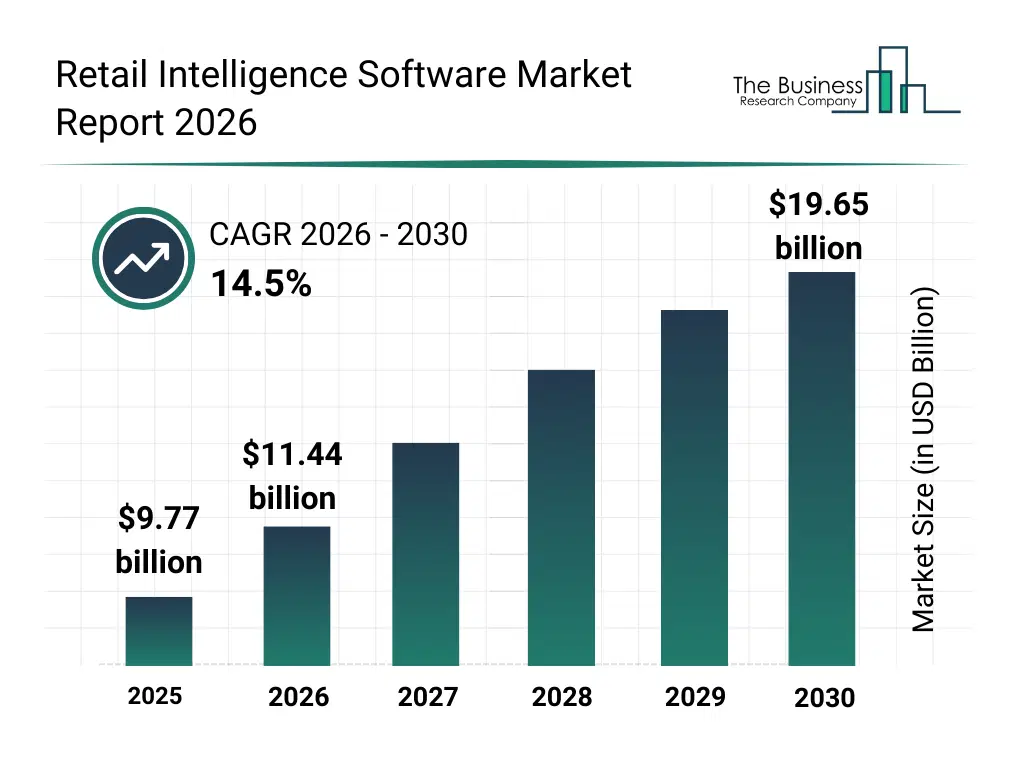
What Is The Retail Intelligence Software Market Size and Share 2026?
The retail intelligence software market size has grown rapidly in recent years. It will grow from $9.77 billion in 2025 to $11.44 billion in 2026 at a compound annual growth rate (CAGR) of 17.2%. The growth in the historic period can be attributed to increasing digitization of retail operations, growing availability of consumer transaction data, rising adoption of data-driven decision making, expansion of organized retail formats, increased focus on customer experience optimization.What Is The Retail Intelligence Software Market Growth Forecast?
The retail intelligence software market size is expected to see rapid growth in the next few years. It will grow to $19.65 billion in 2030 at a compound annual growth rate (CAGR) of 14.5%. The growth in the forecast period can be attributed to increasing deployment of AI-driven retail analytics, rising demand for real-time consumer insights, expansion of cloud-based intelligence platforms, growing focus on hyper-personalized retail strategies, increasing integration of physical and digital retail data. Major trends in the forecast period include increasing adoption of advanced consumer analytics platforms, rising use of predictive demand forecasting tools, growing integration of omnichannel data insights, expansion of real-time store performance monitoring, enhanced focus on personalized customer intelligence.
Global Retail Intelligence Software Market Segmentation
1) By Type: Cloud-Based, On-Premises 2) By Application: Large Enterprises, Small And Medium-Sized Enterprises 3) By End User: Grocery Stores, Convenience Stores, Apparel And Footwear, Mass Merchant, Specialty Retailers, E-Commerce, Other End Users Subsegments: 1) By Cloud-Based: Public Cloud, Private Cloud, Hybrid Cloud 2) By On-Premises: Managed Services, Self-HostedWhat Is The Driver Of The Retail Intelligence Software Market?
The increasing e-commerce activity is expected to propel the growth of the retail intelligence software market going forward. E-commerce refers to the buying and selling of goods and services over the Internet or other electronic networks. E-commerce adoption is on the rise due to several factors, including increasing internet penetration, shifting consumer preferences towards online shopping, convenience, and advancements in logistics and payment systems. Retail intelligence software enhances e-commerce activity by gathering, analyzing, and interpreting data related to customer behavior, sales performance, inventory management, pricing strategies, and market trends. For instance, in February 2024, according to the United States Census Bureau, a US-based government agency, total U.S. retail e-commerce sales reached $1,831.4 billion in the fourth quarter of 2023, reflecting a 0.4% increase compared to the third quarter of 2023. Therefore, the increasing e-commerce activity is driving the growth of the retail intelligence software industry.Key Players In The Global Retail Intelligence Software Market
Major companies operating in the retail intelligence software market are Supplypike LLC, Rakuten Group, SPS Commerce Inc., Numerator, Quotient Technology Inc., Trax Retail LTD, AFS Technologies Inc., ThoughtSpot Inc., Sensormatic Solutions, Wiser Solutions Inc., Retail Solutions Inc., Mi9 Retail, DataWeave, Upstream Commerce, ShopperTrak, Premise Data Corporation, TC Group Solutions, Dor Technologies, Intelligence Node, Springboard, Glew.io, Stackline, Omnilytics, Streetspotr GmbH
This chart is for illustrative purposes; the full report includes a detailed competitor analysis and comprehensive overview of the top 10 companies in the market.
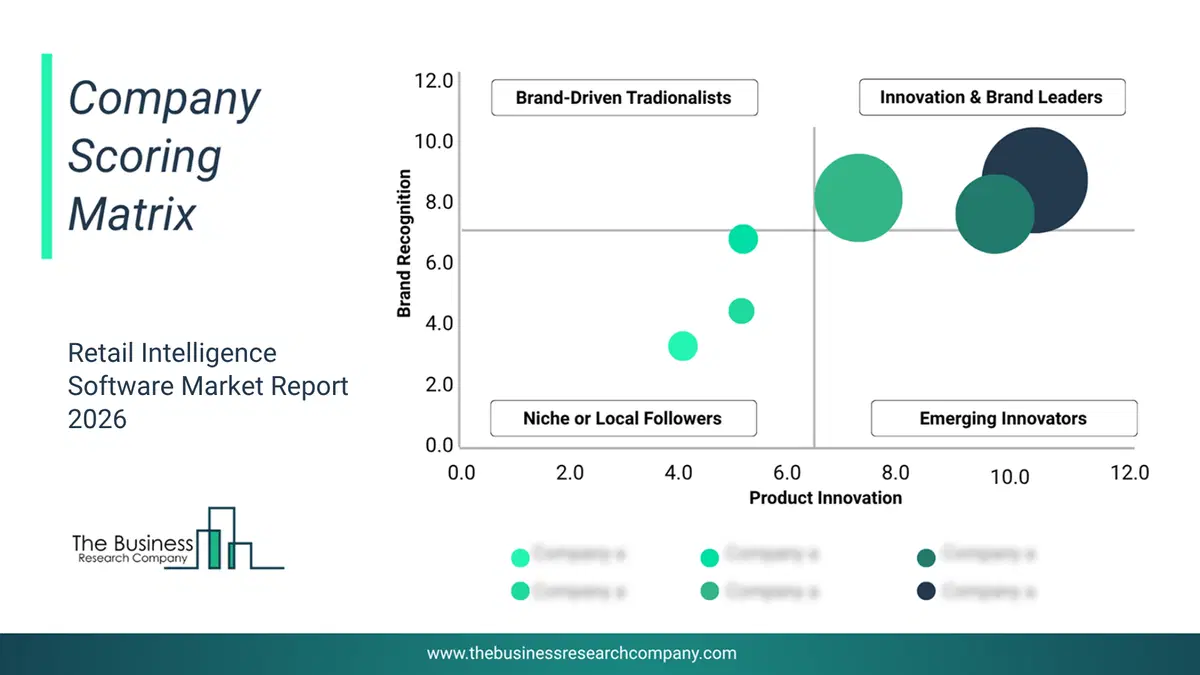
This chart maps companies by product innovation and brand strength, with bubble size indicating relative revenue, helping identify market leaders, challengers, and niche players. This is an illustrative chart; the full report provides a complete and accurate competitive analysis.
Global Retail Intelligence Software Market Trends and Insights
Major companies operating in the retail intelligence software market are providing advanced solutions that utilize IoT technologies such as Bluetooth-LE (BLE)-based retail IoT protocols, to gain a competitive edge in the market. The Bluetooth-LE-based retail IoT protocol refers to a standardized communication framework specifically designed for IoT devices used in retail settings. For instance, in December 2023, VusionGroup, a France-based retail technology company, launched VusionOX, a revolutionary Bluetooth-LE-based protocol designed to accelerate the digitalization of physical commerce. This cutting-edge connectivity solution seamlessly connects retail IoT devices with products and people, creating a unified retail environment. VusionOX, combined with VusionCloud, enables precise geolocation, personalized in-store navigation, guided fulfillment, and contextual shopper interactions. Additionally, it offers continuous over-the-air feature deployment and battery optimization, contributing to sustainability efforts.What Are Latest Mergers And Acquisitions In The Retail Intelligence Software Market?
In June 2024, Nuqleous, a US-based retail analytics and space-planning solutions provider, acquired Shiloh Technologies for an undisclosed amount. Through this acquisition, Nuqleous aims to enhance its retail intelligence software capabilities by integrating Shiloh’s AI-powered analytics platform, ShilohNEXT, and expanding its ability to serve category, sales, and brokerage teams across major retail ecosystems. Shiloh Technologies is a US-based company specializing in advanced analytics solutions designed to help retailers and suppliers make data-driven business decisions.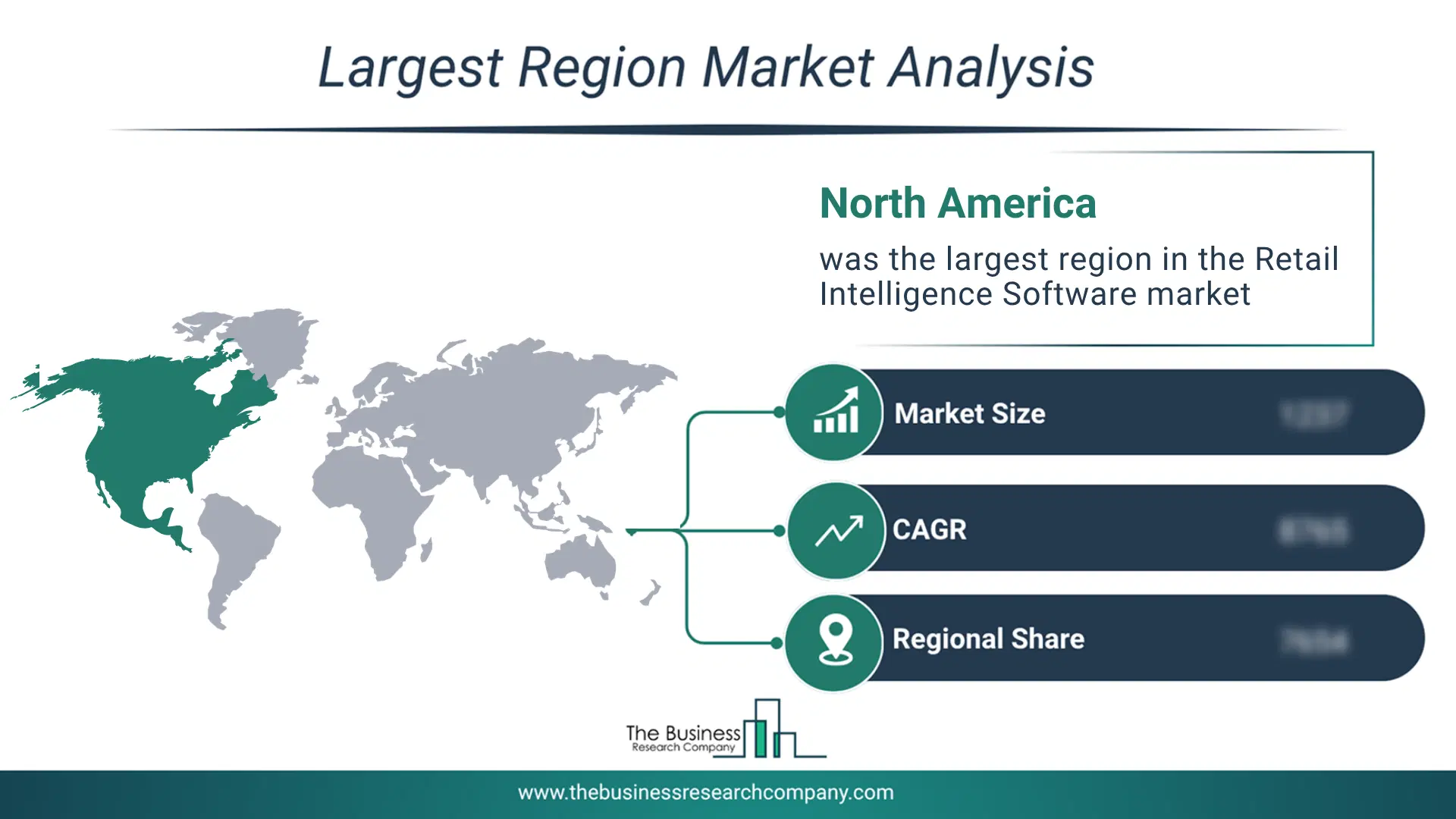
Regional Insights
North America was the largest region in the retail intelligence software market in 2025. Asia-Pacific is expected to be the fastest-growing region in the forecast period. The regions covered in this market report are Asia-Pacific, South East Asia, Western Europe, Eastern Europe, North America, South America, Middle East, Africa. The countries covered in this market report are Australia, Brazil, China, France, Germany, India, Indonesia, Japan, Taiwan, Russia, South Korea, UK, USA, Canada, Italy, Spain.What Defines the Retail Intelligence Software Market?
The retail intelligence software market includes revenues earned by entities providing services such as inventory management, sales performance tracking, and data analytics. The market value includes the value of related goods sold by the service provider or included within the service offering. Only goods and services traded between entities or sold to end consumers are included.How is Market Value Defined and Measured?
The market value is defined as the revenues that enterprises gain from the sale of goods and/or services within the specified market and geography through sales, grants, or donations in terms of the currency (in USD unless otherwise specified). The revenues for a specified geography are consumption values that are revenues generated by organizations in the specified geography within the market, irrespective of where they are produced. It does not include revenues from resales along the supply chain, either further along the supply chain or as part of other products.
This chart presents market attractiveness based on a quantitative evaluation of growth, competition, strategic alignment, and risk, offering a clear view of opportunity areas for decision-making. This chart is for illustrative purposes; the full report contains the complete analysis.

This chart highlights the Total Addressable Market (TAM) by estimating the maximum revenue opportunity using an assumption-driven approach, supporting strategic planning and opportunity sizing across markets. The chart is illustrative; the full report provides a more comprehensive analysis.
What Key Data and Analysis Are Included in the Retail Intelligence Software Market Report 2026?
The retail intelligence software market research report is one of a series of new reports from The Business Research Company that provides market statistics, including industry global market size, regional shares, competitors with the market share, detailed market segments, market trends and opportunities, and any further data you may need to thrive in the retail intelligence software industry. The market research report delivers a complete perspective of everything you need, with an in-depth analysis of the current and future state of the industry.Retail Intelligence Software Market Report Forecast Analysis
| Report Attribute | Details |
|---|---|
| Market Size Value In 2026 | $11.44 billion |
| Revenue Forecast In 2030 | $19.65 billion |
| Growth Rate | CAGR of 14.5% from 2026 to 2030 |
| Base Year For Estimation | 2025 |
| Actual Estimates/Historical Data | 2020-2025 |
| Forecast Period | 2026 - 2030 |
| Market Representation | Revenue in USD Billion and CAGR from 2026 to 2030 |
| Segments Covered | Type, Application, End User |
| Regional Scope | Asia-Pacific, Western Europe, Eastern Europe, North America, South America, Middle East, Africa |
| Country Scope | The Countries Covered In This Market Report Are Australia, Brazil, China, France, Germany, India, Indonesia, Japan, Taiwan, Russia, South Korea, Uk, Usa, Canada, Italy, Spain. |
| Key Companies Profiled | Supplypike LLC, Rakuten Group, SPS Commerce Inc., Numerator, Quotient Technology Inc., Trax Retail LTD, AFS Technologies Inc., ThoughtSpot Inc., Sensormatic Solutions, Wiser Solutions Inc., Retail Solutions Inc., Mi9 Retail, DataWeave, Upstream Commerce, ShopperTrak, Premise Data Corporation, TC Group Solutions, Dor Technologies, Intelligence Node, Springboard, Glew.io, Stackline, Omnilytics, Streetspotr GmbH |
| Customization Scope | Request for Customization |
| Pricing And Purchase Options | Explore Purchase Options |