
Security Software As A Service Market Report 2026
Global Outlook – By Component (Solution, Services), By Deployment Mode (Public Cloud, Private Cloud, Hybrid Cloud), By Organization Size (Small And Medium Enterprises, Large Enterprises), By Application (Network Security, Endpoint Security, Application Security, Cloud Security, Other Applications), By End-User Industry (Banking, Financial Services, And Insurance, Healthcare, IT And Telecommunications, Retail, Government, Other End-Users) – Market Size, Trends, Strategies, and Forecast to 2030
Security Software As A Service Market Overview
• Security Software As A Service market size has reached to $17.43 billion in 2025 • Expected to grow to $33.77 billion in 2030 at a compound annual growth rate (CAGR) of 14.1% • Growth Driver: Rising Cybersecurity Threats Driving The Growth Of The Market Due To The Need For Real-Time Threat Detection And Automated Protection • Market Trend: AI-Enhanced SaaS Security Strengthens Enterprise Risk Management • North America was the largest region in 2025 and Asia-Pacific is the fastest growing region.Market Gains By 2030 – Top Opportunities By Segment
Market Gain identifies the most promising market opportunities by highlighting the segments or products expected to generate the highest incremental revenue growth over the next five years.
What Is Covered Under Security Software As A Service Market?
Security software as a service is a cloud-based delivery model that provides organizations with access to security applications over the internet without the need for on-premise installation. It enables continuous monitoring, threat detection, and protection against cyberattacks through scalable and subscription-based software solutions. This service ensures that updates, patches, and security enhancements are managed centrally, reducing operational complexity and improving overall cybersecurity posture. The main component of security software as a service include solutions and services. Solution refers to cloud-delivered security software platforms and tools that provide comprehensive protection against cyber threats by enabling real-time threat detection, prevention, monitoring, and response across digital environments. The deployment modes include public cloud, private cloud, and hybrid cloud solutions. The organization sizes served include small and medium enterprises and large enterprises. The applications include network security, endpoint security, application security, cloud security, and others and the key end-user industries include banking, financial services, and insurance, healthcare, information technology and telecommunications, retail, government, and others.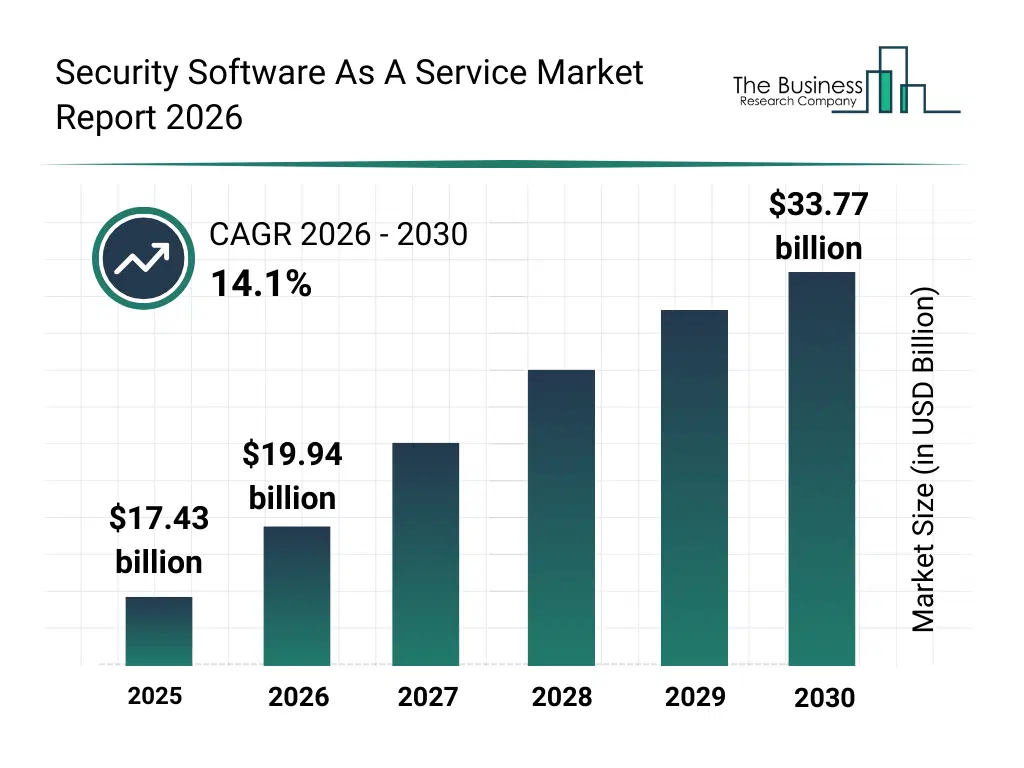
What Is The Security Software As A Service Market Size and Share 2026?
The security software as a service market size has grown rapidly in recent years. It will grow from $17.43 billion in 2025 to $19.94 billion in 2026 at a compound annual growth rate (CAGR) of 14.4%. The growth in the historic period can be attributed to increasing adoption of cloud computing, growing need for centralized security management, rising cyber threats across enterprises, expansion of remote work infrastructure, and increasing demand for cost-effective security solutions.What Is The Security Software As A Service Market Growth Forecast?
The security software as a service market size is expected to see rapid growth in the next few years. It will grow to $33.77 billion in 2030 at a compound annual growth rate (CAGR) of 14.1%. The growth in the forecast period can be attributed to increasing investment in AI-driven cybersecurity, growing integration of IoT and connected devices, rising demand for managed security services, expansion of multi-cloud deployments, and increasing focus on regulatory compliance automation. Major trends in the forecast period include the advancement of artificial intelligence for threat detection, innovation in zero-trust security models, development of automated endpoint detection and response, investment in multi-cloud security solutions, and advancement of real-time analytics and visualization dashboards.
Global Security Software As A Service Market Segmentation
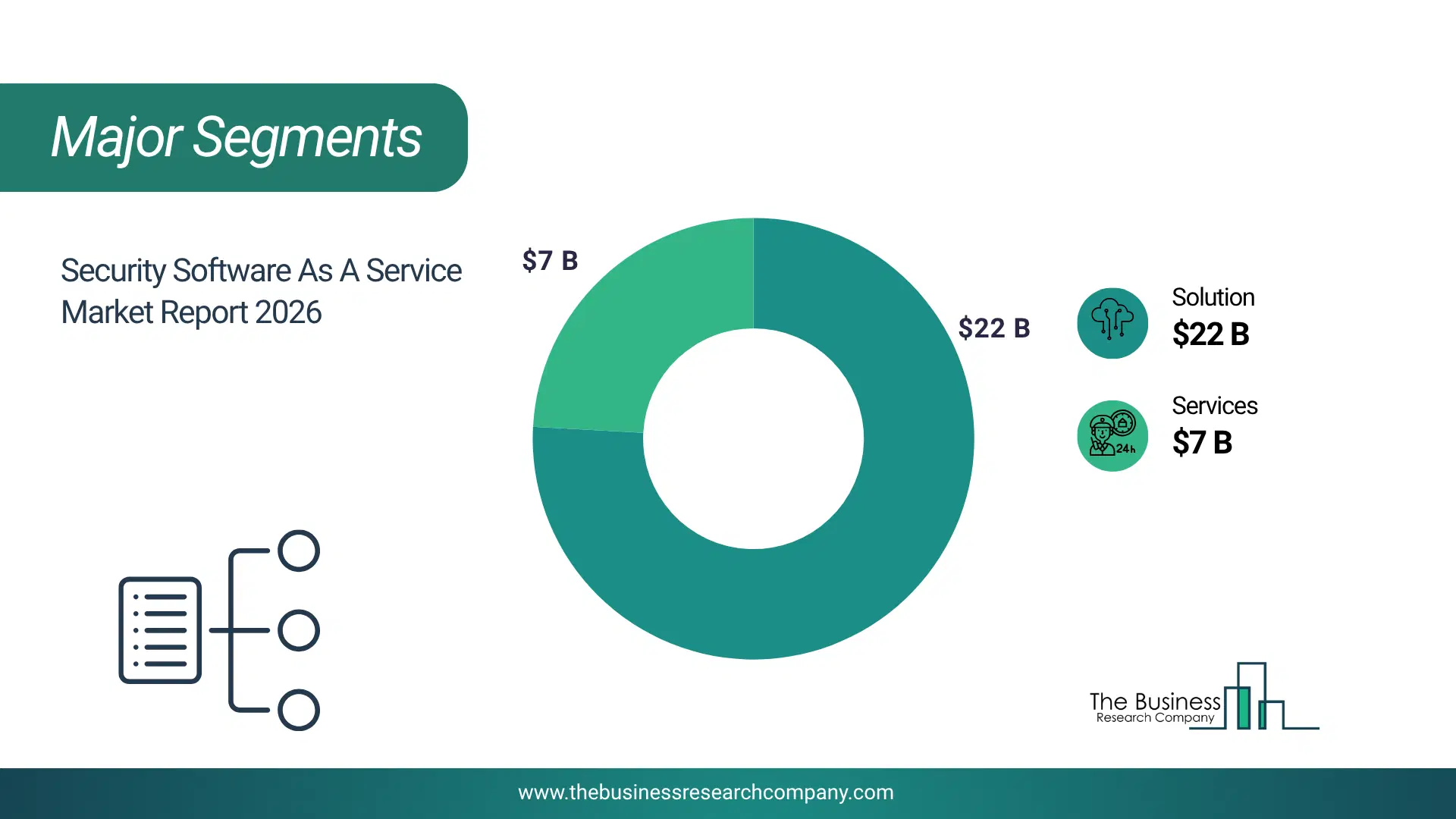
1) By Component: Solution, Services 2) By Deployment Mode: Public Cloud, Private Cloud, Hybrid Cloud 3) By Organization Size: Small And Medium Enterprises, Large Enterprises 4) By Application: Network Security, Endpoint Security, Application Security, Cloud Security, Other Applications 5) By End-User Industry: Banking, Financial Services, And Insurance, Healthcare, IT And Telecommunications, Retail, Government, Other End-Users Subsegments: 1) By Solution: Threat Management, Identity And Access Management, Data Protection, Email Security, Network Protection, Cloud Security, Compliance Management 2) By Services: Managed Services, Professional Services, Consulting Services, Support And Maintenance Services, Integration And Deployment Services The top segments in the security software as a service market will be: • Solution will reach $22.1 Billion by 2030. • Services will reach $7.47 Billion by 2030.What Is The Driver Of The Security Software As A Service Market?
The rise in cybersecurity threats is expected to propel the growth of the security software as a service market going forward. Cybersecurity threats refer to malicious attempts to access, damage, or disrupt computer systems, networks, or data. The rise in cybersecurity threats is due to the growing centralization of digital asset storage, as it creates single points of failure that are highly attractive to hackers. Security software as a service helps address cybersecurity threats by providing cloud-based protection solutions, making them ideal for organizations seeking scalable and up-to-date defense. It detects, prevents, and responds to attacks in real time, improving overall network security and reducing risk exposure. For instance, in July 2024, according to Check Point Software Technologies Ltd., an Israel-based cybersecurity company, cyberattacks on corporate networks are rising, with a 30% increase in weekly attacks in the second quarter of 2024 compared to the same period in 2023 and a 25% rise from the first quarter of 2024. Therefore, the rise in cybersecurity threats is driving the growth of the security software as a service industry.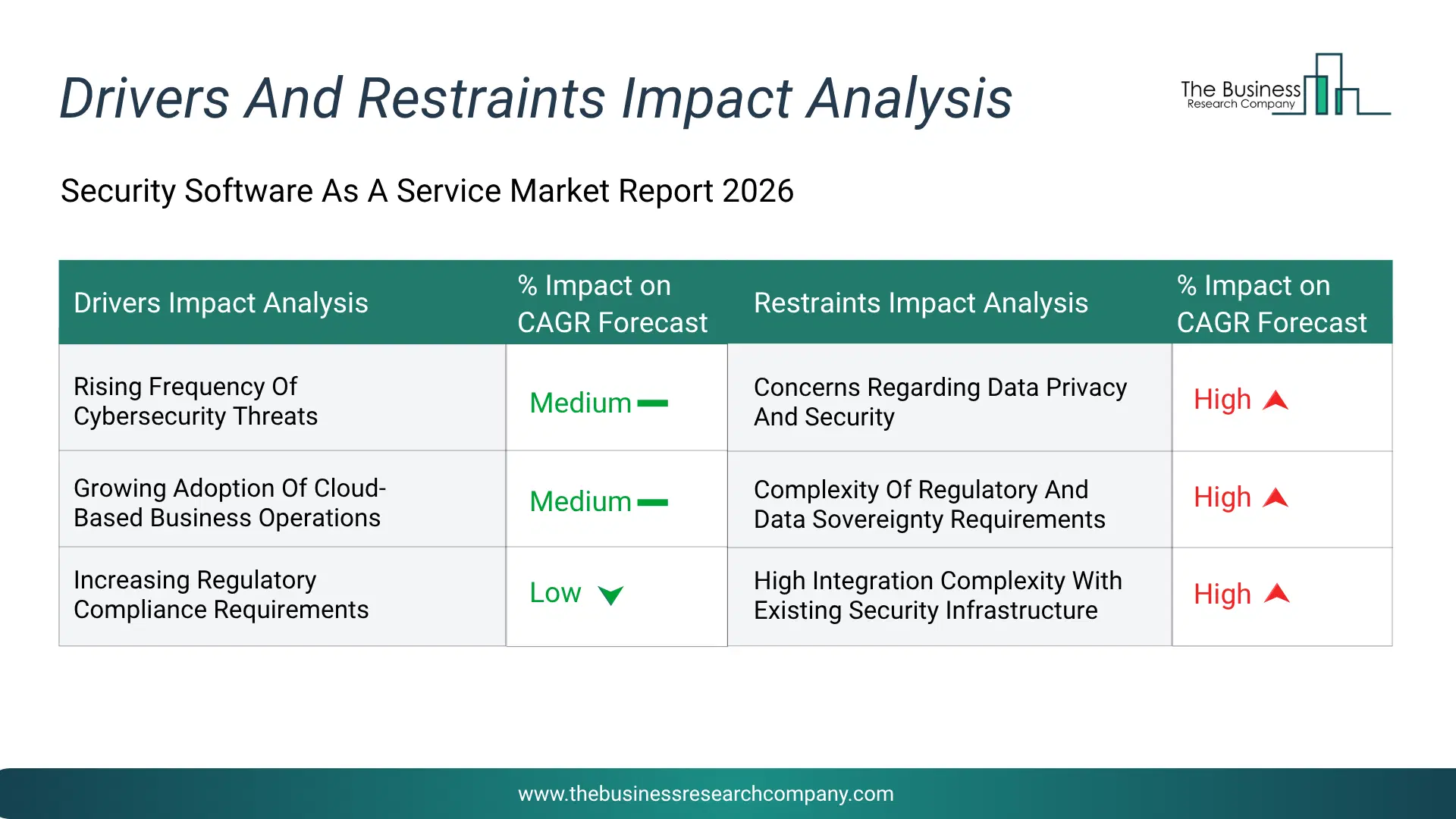
Infographic Chart Showing Key Market Drivers Analysis And Restraints For Security Software As A Service Market
The chart presents an impact analysis of key drivers and restraints, quantifying their relative influence on the market's growth rate and helping assess the balance between growth enablers and limiting factors. This chart offers a high-level perspective; the full report contains more detailed insights.
How Will The Drivers Impact Growth In The Global Security Software As A Service Market?
• Rising Frequency Of Cybersecurity Threats (Medium) – During the forecast period, the rising frequency of cybersecurity threats is expected to become a key growth driver for the security software as a service market by 2030. Organizations across industries are facing increasingly sophisticated cyberattacks targeting cloud workloads, digital identities, connected devices, and enterprise applications. Businesses are strengthening cyber resilience by adopting cloud-delivered security platforms that provide continuous visibility, rapid threat detection, and automated response capabilities. The ability to update security controls in real time and protect geographically distributed IT environments is further supporting adoption. This growing focus on proactive cyber defense is reinforcing sustained market expansion. • Growing Adoption Of Cloud-Based Business Operations (Medium) – During the forecast period, the growing adoption of cloud-based business operations is expected to emerge as a major factor driving the expansion of the security software as a service market by 2030. Enterprises are increasingly modernizing their IT infrastructure through software-as-a-service applications, cloud-native platforms, and hybrid cloud strategies, creating greater demand for cloud-centric security solutions. Security software as a service enables organizations to secure users, applications, and workloads through unified policy management and scalable protection across dynamic environments. The flexibility and operational efficiency offered by cloud-based security platforms are encouraging widespread enterprise adoption. • Increasing Regulatory Compliance Requirements (Low) – During the forecast period, the increasing regulatory compliance requirements are expected to act as a key growth catalyst for the security software as a service market by 2030. Organizations are implementing advanced security platforms to simplify governance processes, strengthen audit readiness, and improve compliance with evolving industry standards and data protection frameworks. Cloud-based security solutions help enterprises maintain centralized policy enforcement, generate compliance reports, and reduce operational complexity across distributed environments. The growing need to demonstrate regulatory accountability while minimizing compliance risks is further accelerating market adoption.How Will The Restraints Impact Growth In The Global Security Software As A Service Market?
• Concerns Regarding Data Privacy And Security (Medium) – During the forecast period, the concerns regarding data privacy and security are limiting market adoption as organizations remain cautious about storing sensitive information and security operations within third-party cloud environments. Enterprises handling confidential or regulated data often require extensive assurance regarding data protection practices. Perceived risks related to unauthorized access, data leakage, and service vulnerabilities may delay purchasing decisions. Some organizations prefer maintaining direct control over critical security functions. These concerns can slow the transition from traditional security deployments to service-based models. • Complexity Of Regulatory And Data Sovereignty Requirements (Medium) – During the forecast period, the complexity of regulatory and data sovereignty requirements is restraining market growth as organizations operating across multiple jurisdictions face varying legal and compliance obligations. Businesses must ensure that security services align with regional data storage, processing, and reporting requirements. Differences in national regulations can complicate deployment strategies and vendor selection processes. Compliance assessments and governance reviews often increase implementation timelines and operational costs. These challenges may discourage adoption among organizations with complex regulatory responsibilities. • High Integration Complexity With Existing Security Infrastructure (Low) – During the forecast period, the high integration complexity with existing security infrastructure is expected to restrain the growth of the security as a service (SECaaS) market. Organizations often operate with a combination of legacy security systems, on-premise infrastructure, hybrid cloud environments, and multiple third-party security solutions, making the integration of security as a service platforms technically challenging. Ensuring seamless interoperability between cloud-based security services and existing firewalls, identity and access management systems, endpoint protection platforms, security information and event management (SIEM) solutions, and other cybersecurity tools frequently requires extensive customization and specialized expertise. Integration challenges can increase deployment timelines, operational complexity, and implementation costs while creating temporary disruptions to existing security operations. In addition, maintaining consistent security policies and visibility across distributed IT environments further complicates service deployment and management. These technical barriers may discourage organizations from transitioning to service-based security models, particularly those with complex enterprise infrastructures. Consequently, high integration complexity with existing security infrastructure remains a significant restraint on the growth of the security as a service (SECaaS) market.Key Players In The Global Security Software As A Service Market
Major companies operating in the security software as a service market are Google LLC, Microsoft Corporation, Palo Alto Networks Inc., Fortinet Inc., CrowdStrike Holdings Inc., F5 Inc., Check Point Software Technologies Ltd., Okta Inc., Proofpoint Inc., Trellix Inc., Zscaler Inc., Trend Micro Incorporated, Cloudflare Inc., Sophos Ltd., McAfee LLC, Tenable Holdings Inc., Rapid7 Inc., CyberArk Software Ltd., SentinelOne Inc., Qualys Inc., Darktrace plc, Netskope Inc., Barracuda Networks Inc., Wiz Inc., Lacework Inc.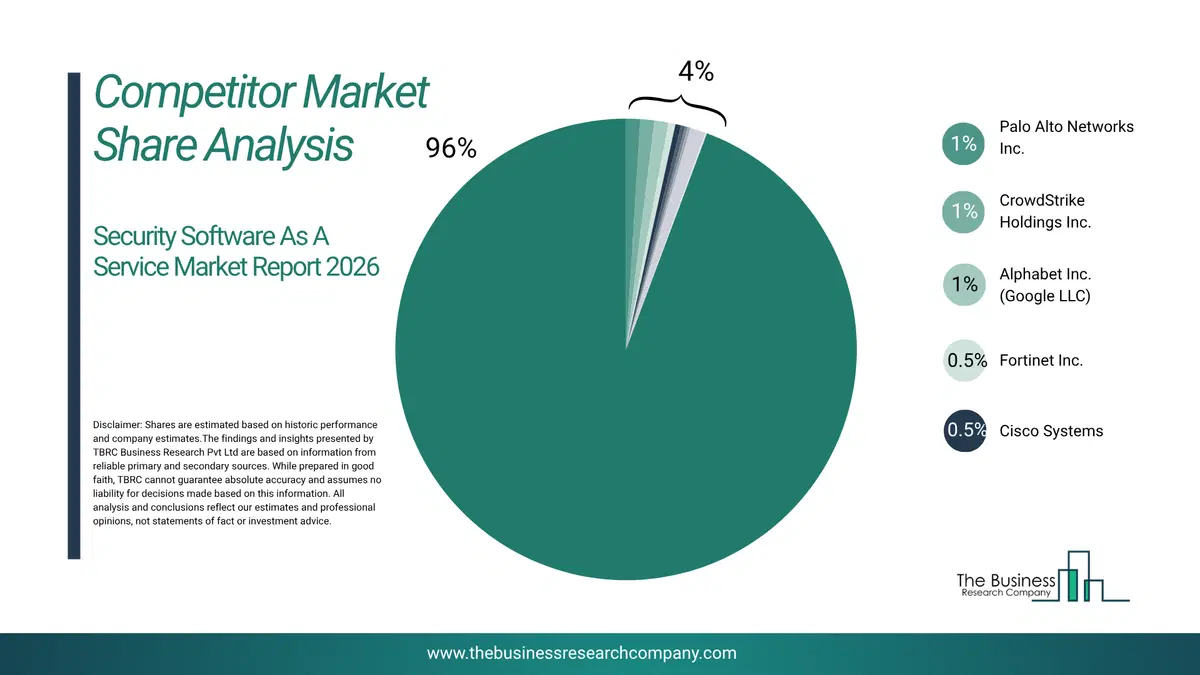
This chart is for illustrative purposes; the full report includes a detailed competitor analysis and comprehensive overview of the top 10 companies in the market.
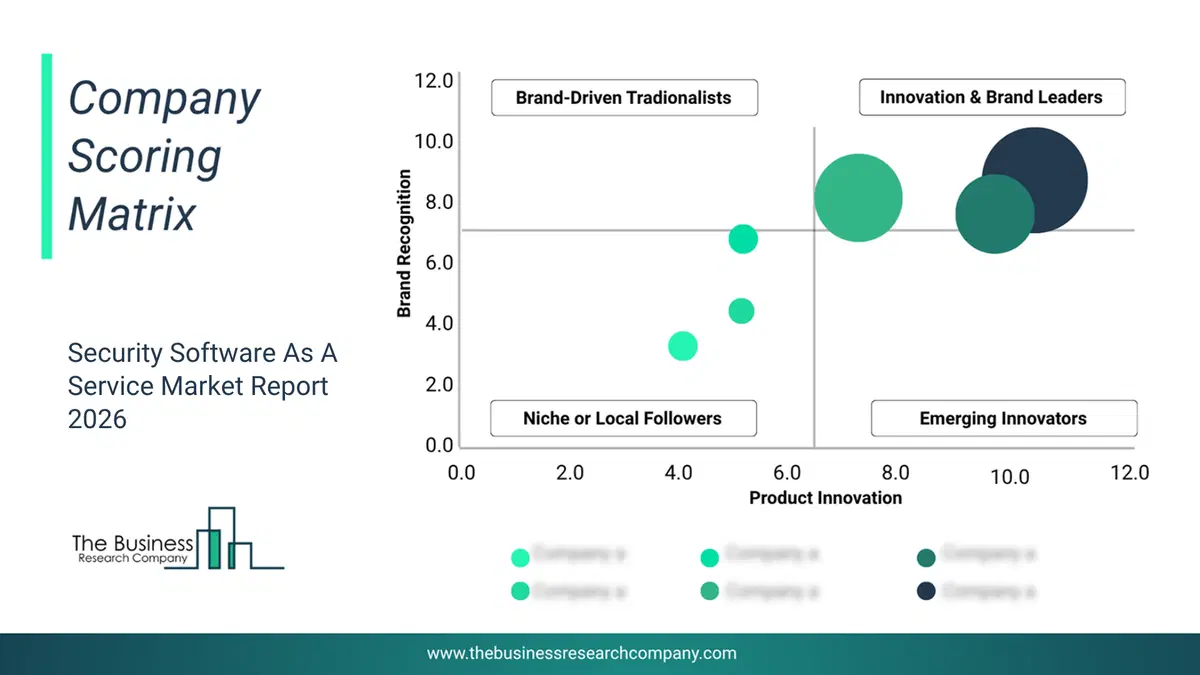
This chart maps companies by product innovation and brand strength, with bubble size indicating relative revenue, helping identify market leaders, challengers, and niche players. This is an illustrative chart; the full report provides a complete and accurate competitive analysis.
Global Security Software As A Service Market Trends and Insights
Major companies operating in the security software as a service market are focusing on developing technologically advanced solutions, such as integrated AI and SaaS security packages, to identify risks, secure applications, and enhance threat detection across increasingly complex enterprise environments. AI and SaaS security packages refer to pre-bundled SaaS security solutions designed to help organizations protect their cloud applications and AI-enabled tools from risks and threats. For instance, in August 2025, AppOmni Inc., a US-based SaaS security posture management (SSPM) company, launched new AI security capabilities and three curated product packages designed to meet enterprises at every stage of SaaS security maturity. These packages are specifically curated to meet enterprises at every stage of their SaaS security maturity journey and include a promotional 90-day free trial of the AppOmni Foundations starter package. This package provides capabilities for Shadow AI and SaaS Discovery, identity security, threat detection, and includes an AI SaaS security copilot. The platform also features enhanced real-time threat detection and broadened support for 30 new AI and SaaS applications, including AI-native tools such as Anthropic, ChatGPT Enterprise, and Claude, helping organizations safely embrace innovation.What Are Latest Mergers And Acquisitions In The Security Software As A Service Market?
In March 2025, Google LLC, a US-based technology company, acquired Wiz Inc. for $32 billion. Through this acquisition, Google aims to accelerate its cloud security offerings by integrating Wiz’s cloud-native security SaaS platform into Google Cloud, strengthening multicloud protection capabilities and serving enterprise and government customers across hybrid and multi-cloud environments. Wiz Inc. is a US-based cybersecurity company that provides security software-as-a-service (SaaS) solutions focused on cloud security and risk management.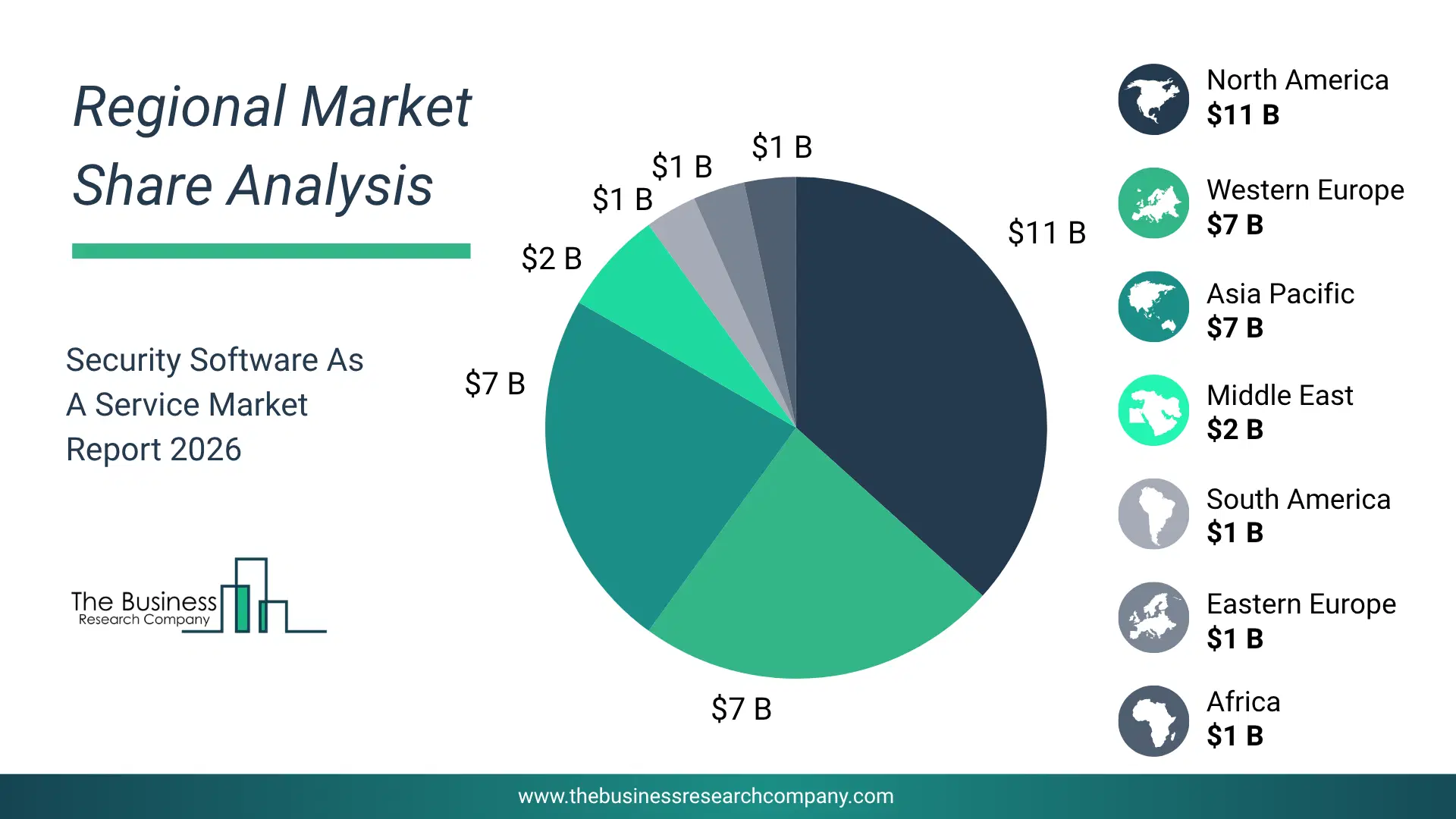
Regional Insights
North America was the largest region in the security software as a service market in 2025. Asia-Pacific is expected to be the fastest-growing region in the forecast period. The regions covered in this market report are Asia-Pacific, South East Asia, Western Europe, Eastern Europe, North America, South America, Middle East, Africa. The countries covered in this market report are Australia, Brazil, China, France, Germany, India, Indonesia, Japan, Taiwan, Russia, South Korea, UK, USA, Canada, Italy, Spain.What Defines the Security Software As A Service Market?
The security software as a service market includes revenues earned by entities through threat detection and prevention, antivirus and anti-malware protection, firewall management, intrusion detection and response, identity and access management, data encryption, vulnerability management, compliance monitoring, and security consulting. The market value includes the value of related goods sold by the service provider or included within the service offering. Only goods and services traded between entities or sold to end consumers are included.How is Market Value Defined and Measured?
The market value is defined as the revenues that enterprises gain from the sale of goods and/or services within the specified market and geography through sales, grants, or donations in terms of the currency (in USD unless otherwise specified). The revenues for a specified geography are consumption values that are revenues generated by organizations in the specified geography within the market, irrespective of where they are produced. It does not include revenues from resales along the supply chain, either further along the supply chain or as part of other products.
This chart presents market attractiveness based on a quantitative evaluation of growth, competition, strategic alignment, and risk, offering a clear view of opportunity areas for decision-making. This chart is for illustrative purposes; the full report contains the complete analysis.

This chart highlights the Total Addressable Market (TAM) by estimating the maximum revenue opportunity using an assumption-driven approach, supporting strategic planning and opportunity sizing across markets. The chart is illustrative; the full report provides a more comprehensive analysis.
What Key Data and Analysis Are Included in the Security Software As A Service Market Report 2026?
The security software as a service market research report is one of a series of new reports from The Business Research Company that provides market statistics, including industry global market size, regional shares, competitors with the market share, detailed market segments, market trends and opportunities, and any further data you may need to thrive in the security software as a service industry. The market research report delivers a complete perspective of everything you need, with an in-depth analysis of the current and future state of the industry.Security Software As A Service Market Report Forecast Analysis
| Report Attribute | Details |
|---|---|
| Market Size Value In 2026 | $19.94 billion |
| Revenue Forecast In 2030 | $33.77 billion |
| Growth Rate | CAGR of 14.4% from 2026 to 2030 |
| Base Year For Estimation | 2025 |
| Actual Estimates/Historical Data | 2020-2025 |
| Forecast Period | 2026 - 2030 |
| Market Representation | Revenue in USD Billion and CAGR from 2026 to 2030 |
| Segments Covered | Component, Deployment Mode, Organization Size, Application, End-User Industry |
| Regional Scope | Asia-Pacific, Western Europe, Eastern Europe, North America, South America, Middle East, Africa |
| Country Scope | The countries covered in the report are Australia, Brazil, China, France, Germany, India, Indonesia, Japan, Taiwan, Russia, South Korea, UK, USA, Canada, Italy, Spain. |
| Key Companies Profiled | Google LLC, Microsoft Corporation, Palo Alto Networks Inc., Fortinet Inc., CrowdStrike Holdings Inc., F5 Inc., Check Point Software Technologies Ltd., Okta Inc., Proofpoint Inc., Trellix Inc., Zscaler Inc., Trend Micro Incorporated, Cloudflare Inc., Sophos Ltd., McAfee LLC, Tenable Holdings Inc., Rapid7 Inc., CyberArk Software Ltd., SentinelOne Inc., Qualys Inc., Darktrace plc, Netskope Inc., Barracuda Networks Inc., Wiz Inc., Lacework Inc. |
| Customization Scope | Request for Customization |
| Pricing And Purchase Options | Explore Purchase Options |