
Selenide Ceramic Target Market Report 2026
Global Outlook – By Type (Bismuth Selenide Sputtering Target, Cadmium Selenide Sputtering Target, Gallium Selenide Sputtering Target, Indium Selenide Sputtering Target, Lead Selenide Sputtering Target, Niobium Selenide Sputtering Target, Tantalum Selenide Sputtering Target, Tungsten Selenide Sputtering Target, Zinc Selenide Sputtering Target), By Application (Semiconductor, Optical Coatings, Photovoltaics, Other Applications), By End-User (Semiconductor Manufacturing, Optoelectronics, Photovoltaics, Display Panels, Research Institutions) – Market Size, Trends, Strategies, and Forecast to 2030
Selenide Ceramic Target Market Overview
• Selenide Ceramic Target market size has reached to $1.34 billion in 2025 • Expected to grow to $2.06 billion in 2030 at a compound annual growth rate (CAGR) of 8.9% • Growth Driver: Rising Adoption Of Consumer Electronics Drives Market Growth Due To Increasing Demand For Smart And Efficient Devices • Asia-Pacific was the largest region in 2025.What Is Covered Under Selenide Ceramic Target Market?
A selenide ceramic target is a specialized material composed of selenide-based ceramic compounds, used in thin-film deposition techniques such as sputtering. These targets serve as source materials for coating applications in semiconductor, optical, and photovoltaic industries. They offer high purity, thermal stability, and uniform film deposition properties. The main types of selenide ceramic targets are bismuth selenide sputtering targets, cadmium selenide sputtering targets, gallium selenide sputtering targets, indium selenide sputtering targets, lead selenide sputtering targets, niobium selenide sputtering targets, tantalum selenide sputtering targets, tungsten selenide sputtering targets, and zinc selenide sputtering targets. This finds application in semiconductors, communications, and others and is used by building and construction, medical, automotive, aerospace, electrical and electronics, and others.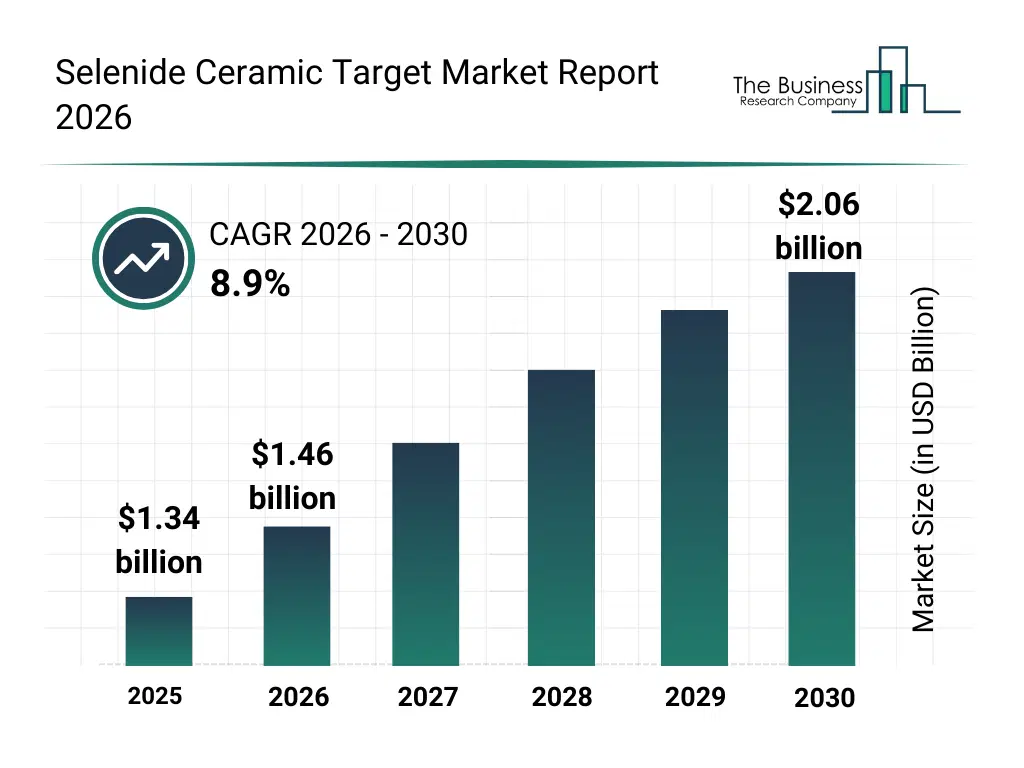
What Is The Selenide Ceramic Target Market Size and Share 2026?
The selenide ceramic target market size has grown strongly in recent years. It will grow from $1.34 billion in 2025 to $1.46 billion in 2026 at a compound annual growth rate (CAGR) of 9.1%. The growth in the historic period can be attributed to growth of semiconductor manufacturing, expansion of sputtering technology, demand for optical coatings, early adoption in electronics, availability of high purity ceramics.What Is The Selenide Ceramic Target Market Growth Forecast?
The selenide ceramic target market size is expected to see strong growth in the next few years. It will grow to $2.06 billion in 2030 at a compound annual growth rate (CAGR) of 8.9%. The growth in the forecast period can be attributed to solar energy capacity expansion, advanced chip fabrication growth, demand for miniaturized electronics, innovation in coating technologies, investment in display technologies. Major trends in the forecast period include growing demand for thin film semiconductor coatings, rising use in photovoltaic cell manufacturing, increased adoption in optical coating applications, expansion of high purity sputtering targets, focus on uniform and defect free film deposition.
Global Selenide Ceramic Target Market Segmentation
1) By Type: Bismuth Selenide Sputtering Target, Cadmium Selenide Sputtering Target, Gallium Selenide Sputtering Target, Indium Selenide Sputtering Target, Lead Selenide Sputtering Target, Niobium Selenide Sputtering Target, Tantalum Selenide Sputtering Target, Tungsten Selenide Sputtering Target, Zinc Selenide Sputtering Target 2) By Application: Semiconductor, Optical Coatings, Photovoltaics, Other Applications 3) By End-User: Semiconductor Manufacturing, Optoelectronics, Photovoltaics, Display Panels, Research Institutions Subsegments: 1) By Bismuth Selenide Sputtering Target: High-Purity Bismuth Selenide, Low-Purity Bismuth Selenide 2) By Cadmium Selenide Sputtering Target: High-Purity Cadmium Selenide, Low-Purity Cadmium Selenide 3) By Gallium Selenide Sputtering Target: High-Purity Gallium Selenide, Low-Purity Gallium Selenide 4) By Indium Selenide Sputtering Target: High-Purity Indium Selenide, Low-Purity Indium Selenide 5) By Lead Selenide Sputtering Target: High-Purity Lead Selenide, Low-Purity Lead Selenide 6) By Niobium Selenide Sputtering Target: High-Purity Niobium Selenide, Low-Purity Niobium Selenide 7) By Tantalum Selenide Sputtering Target: High-Purity Tantalum Selenide, Low-Purity Tantalum Selenide 8) By Tungsten Selenide Sputtering Target: High-Purity Tungsten Selenide, Low-Purity Tungsten Selenide 9) By Zinc Selenide Sputtering Target: High-Purity Zinc Selenide, Low-Purity Zinc SelenideWhat Are The Drivers Of The Selenide Ceramic Target Market?
The rising adoption of consumer electronics is expected to propel the growth of the selenide ceramic target market going forward. Consumer electronics refer to electronic devices designed for everyday personal or household use, including smartphones, laptops, TVs, and smart home gadgets. The rising adoption of consumer electronics is increasing as more people seek smart, connected, and energy-efficient devices that enhance convenience, productivity, and entertainment. Selenide ceramic targets enhance the adoption of consumer electronics by enabling high-performance semiconductor components, making them essential for advanced devices. They improve efficiency and durability, supporting innovations in smartphones, laptops, and smart home technology. For instance, in February 2024, according to a report published by Uswitch Limited, a UK-based online and telephone comparison, in 2022, the UK had 71.8 million mobile connections, and by 2025, 95% (approximately 65 million people) are expected to be smartphone users. Therefore, the rising adoption of consumer electronics is driving the growth of the selenide ceramic target industry. The rising demand for semiconductors is expected to propel the growth of the selenide ceramic target market going forward. Semiconductors are materials with electrical conductivity between that of a conductor and an insulator, essential for making electronic components like transistors, diodes, and integrated circuits. The rising demand for semiconductors is increasing as most industries prefer advanced chips that enhance performance, improve energy efficiency, and enable smart functionalities in electronic devices. Selenide ceramic targets enhance demand for semiconductors by enabling high-quality thin-film deposition, making them essential for advanced chip manufacturing. They improve performance and durability in semiconductor components, supporting innovations in consumer electronics, automotive, and telecommunications. For instance, in February 2025, according to a report published by the Semiconductor Industry Association, a US-based trade association, global semiconductor sales reached $627.6 billion in 2024, marking a 19.1% increase from $526.8 billion in 2023, with fourth-quarter 2024 sales rising 17.1% compared to the same quarter in 2023, which totaled $145.9 billion. Therefore, the rising demand for semiconductors is driving the growth of the selenide ceramic target industry. The rising investment in renewable energy technologies is expected to propel the growth of the selenide ceramic target market going forward. Renewable energy technologies are systems and methods used to generate power from natural, sustainable sources such as sunlight, wind, water, and geothermal heat, which are replenished naturally. The rising investment in renewable energy technologies is increasing as governments, businesses, and individuals seek sustainable energy solutions to reduce carbon emissions, lower energy costs, and meet environmental goals. Selenide ceramic targets are used in renewable energy for thin-film solar cells, enhancing efficiency and stability in photovoltaic applications. Their high-purity composition improves light absorption and energy conversion. For instance, in July 2024, according to the article published by Gov.UK, a UK-based government agency, the renewable energy auction budget for the year increased by $640 million, surpassing $1.92 billion. This record funding aims to support the development of new green infrastructure, reinforcing the commitment to achieving clean power by 2030. Therefore, the rising investment in renewable energy technologies is driving the growth of the selenide ceramic target industry.Key Players In The Global Selenide Ceramic Target Market
Major companies operating in the selenide ceramic target market are Tosoh Corporation, Materion Corporation, ULVAC, Inc., Plansee SE, Umicore, JX Advanced Metals Corporation, Hitachi Metals Ltd., Sumitomo Chemical Co., Ltd., Nippon Mining & Metals Corporation, Mitsui Mining & Smelting Co., Ltd., Linde plc, Heraeus Holding GmbH, Advanced Engineering Materials Limited, Beijing Zhongnuo Advanced Material Technology Co., Ltd., Konfoong Materials International Co., Ltd., Luoyang Sifon Electronic Materials Co., Ltd., Angstrom Sciences, Inc., Furaya Metals Co., Ltd., Ningbo Jiangfeng Electronic Materials Co., Ltd., Vital Materials Co., Limited
This chart is for illustrative purposes; the full report includes a detailed competitor analysis and comprehensive overview of the top 10 companies in the market.
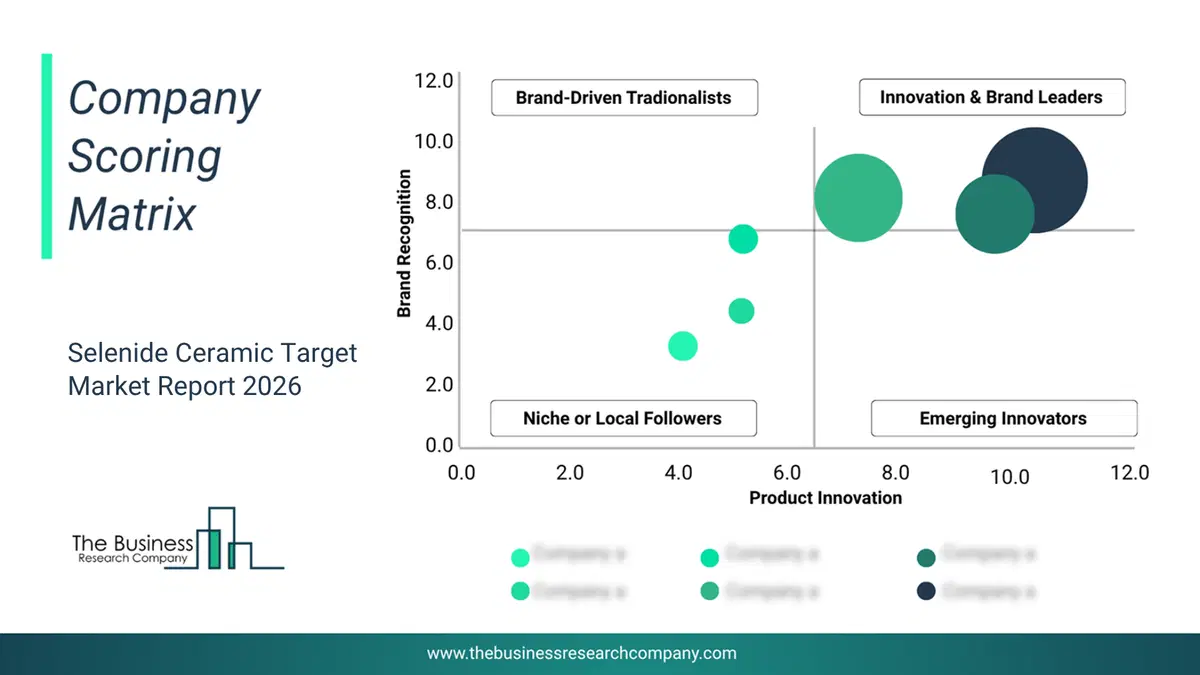
This chart maps companies by product innovation and brand strength, with bubble size indicating relative revenue, helping identify market leaders, challengers, and niche players. This is an illustrative chart; the full report provides a complete and accurate competitive analysis.
Regional Insights
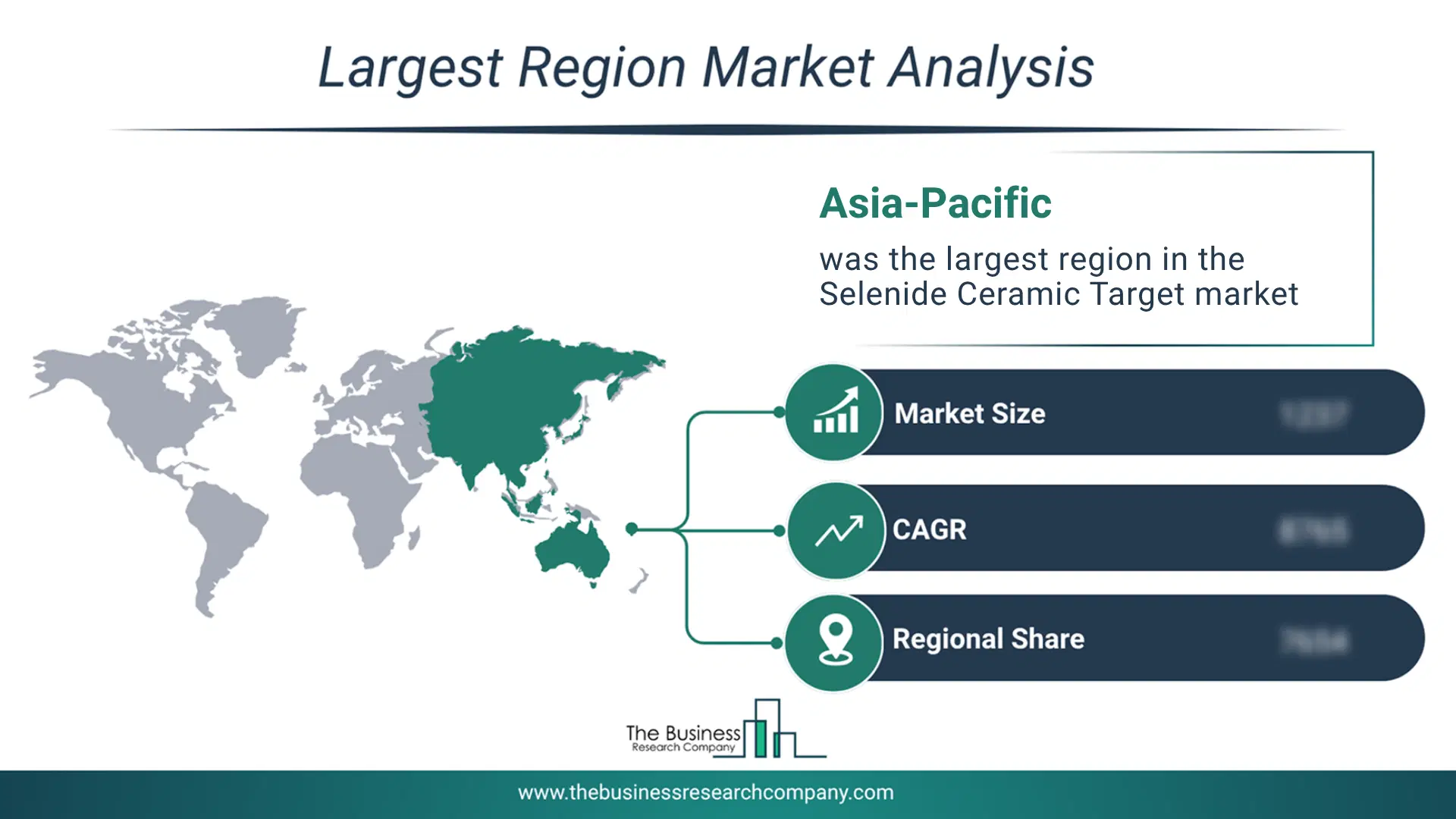
Asia-Pacific was the largest region in the selenide ceramic target market in 2025. The regions covered in this market report are Asia-Pacific, South East Asia, Western Europe, Eastern Europe, North America, South America, Middle East, Africa The countries covered in this market report are Australia, Brazil, China, France, Germany, India, Indonesia, Japan, Taiwan, Russia, South Korea, UK, USA, Canada, Italy, SpainWhat Defines the Selenide Ceramic Target Market?
The selenide ceramic target market consists of sales of high-performance selenide ceramic targets, selenium alloy targets, selenide ceramic targets for optical coatings, and selenium-based sputtering targets for photovoltaic applications. Values in this market are ‘factory gate’ values, that is, the value of goods sold by the manufacturers or creators of the goods, whether to other entities (including downstream manufacturers, wholesalers, distributors, and retailers) or directly to end customers. The value of goods in this market includes related services sold by the creators of the goods.How is Market Value Defined and Measured?
The market value is defined as the revenues that enterprises gain from the sale of goods and/or services within the specified market and geography through sales, grants, or donations in terms of the currency (in USD unless otherwise specified). The revenues for a specified geography are consumption values that are revenues generated by organizations in the specified geography within the market, irrespective of where they are produced. It does not include revenues from resales along the supply chain, either further along the supply chain or as part of other products.
This chart presents market attractiveness based on a quantitative evaluation of growth, competition, strategic alignment, and risk, offering a clear view of opportunity areas for decision-making. This chart is for illustrative purposes; the full report contains the complete analysis.

This chart highlights the Total Addressable Market (TAM) by estimating the maximum revenue opportunity using an assumption-driven approach, supporting strategic planning and opportunity sizing across markets. The chart is illustrative; the full report provides a more comprehensive analysis.
What Key Data and Analysis Are Included in the Selenide Ceramic Target Market Report 2026?
The selenide ceramic target market research report is one of a series of new reports from The Business Research Company that provides market statistics, including industry global market size, regional shares, competitors with the market share, detailed market segments, market trends and opportunities, and any further data you may need to thrive in the selenide ceramic target industry. The market research report delivers a complete perspective of everything you need, with an in-depth analysis of the current and future state of the industry.Selenide Ceramic Target Market Report Forecast Analysis
| Report Attribute | Details |
|---|---|
| Market Size Value In 2026 | $1.46 billion |
| Revenue Forecast In 2030 | $2.06 billion |
| Growth Rate | CAGR of 9.1% from 2026 to 2030 |
| Base Year For Estimation | 2025 |
| Actual Estimates/Historical Data | 2020-2025 |
| Forecast Period | 2026 - 2030 |
| Market Representation | Revenue in USD Billion and CAGR from 2026 to 2030 |
| Segments Covered | Type, Application, End-User |
| Regional Scope | Asia-Pacific, Western Europe, Eastern Europe, North America, South America, Middle East, Africa |
| Country Scope | The countries covered in this market report are Australia, Brazil, China, France, Germany, India, Indonesia, Japan, Taiwan, Russia, South Korea, UK, USA, Canada, Italy, Spain |
| Key Companies Profiled | Tosoh Corporation, Materion Corporation, ULVAC, Inc., Plansee SE, Umicore, JX Advanced Metals Corporation, Hitachi Metals Ltd., Sumitomo Chemical Co., Ltd., Nippon Mining & Metals Corporation, Mitsui Mining & Smelting Co., Ltd., Linde plc, Heraeus Holding GmbH, Advanced Engineering Materials Limited, Beijing Zhongnuo Advanced Material Technology Co., Ltd., Konfoong Materials International Co., Ltd., Luoyang Sifon Electronic Materials Co., Ltd., Angstrom Sciences, Inc., Furaya Metals Co., Ltd., Ningbo Jiangfeng Electronic Materials Co., Ltd., Vital Materials Co., Limited |
| Customization Scope | Request for Customization |
| Pricing And Purchase Options | Explore Purchase Options |