
Self-Cleaning Coatings Market Report 2026
Global Outlook – By Type (Hydrophobic, Hydrophilic), By Material (Titanium Dioxide, Silicon Dioxide, Zinc Oxide, Graphene-Based Coatings, Other Materials), By End User (Construction, Automotive, Textile And Apparel, Other End Users) – Market Size, Trends, Strategies, and Forecast to 2030
Self-Cleaning Coatings Market Overview
• Self-Cleaning Coatings market size has reached to $4.56 billion in 2025 • Expected to grow to $6.43 billion in 2030 at a compound annual growth rate (CAGR) of 7.1% • Growth Driver: The Rise In Construction Investment Drives The Growth Of The Market Due To Increasing Demand For Durable And Low-Maintenance Materials • Market Trend: Innovation Accelerates In Next-Generation Hydrophobic Surface Solutions • North America was the largest region in 2025 and Asia-Pacific is the fastest growing region.What Is Covered Under Self-Cleaning Coatings Market?
Self-cleaning coatings are specialized surface treatments designed to automatically remove dirt, dust, and contaminants through natural processes such as rainwater (hydrophilic) or sunlight (photocatalytic). These coatings help maintain cleanliness and visibility on surfaces such as glass, ceramics, and metals without frequent manual cleaning. The main types of self-cleaning coatings are hydrophobic and hydrophilic. Hydrophobic self-cleaning coatings repel water by creating a high contact angle that causes droplets to roll off, effectively removing dirt and keeping surfaces clean with minimal maintenance. These coatings are typically made from materials such as titanium dioxide, silicon dioxide, zinc oxide, graphene-based substances, and other materials. They are widely used across various end-user industries, including construction, automotive, textiles, and others.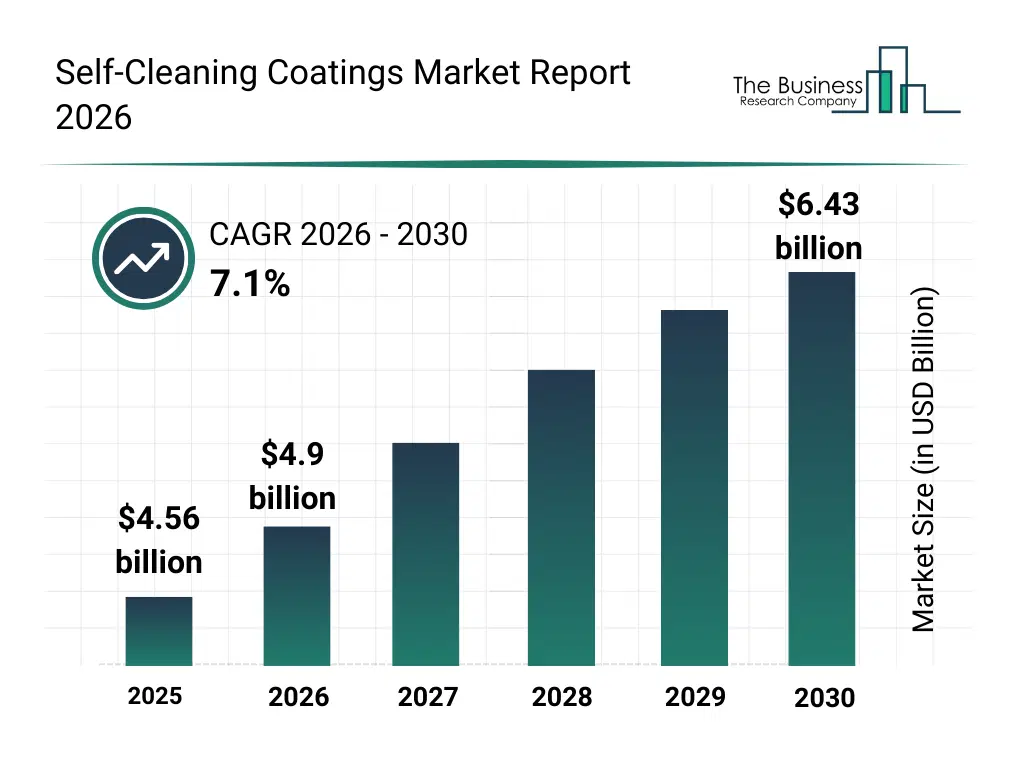
What Is The Self-Cleaning Coatings Market Size and Share 2026?
The self-cleaning coatings market size has grown strongly in recent years. It will grow from $4.56 billion in 2025 to $4.9 billion in 2026 at a compound annual growth rate (CAGR) of 7.3%. The growth in the historic period can be attributed to urban pollution challenges, architectural innovation, glass facade adoption, coating technology advancement, demand for reduced cleaning costs.What Is The Self-Cleaning Coatings Market Growth Forecast?
The self-cleaning coatings market size is expected to see strong growth in the next few years. It will grow to $6.43 billion in 2030 at a compound annual growth rate (CAGR) of 7.1%. The growth in the forecast period can be attributed to smart building construction, sustainable infrastructure growth, nanotechnology advancements, automotive exterior protection demand, expansion of green cities. Major trends in the forecast period include growing demand for low maintenance surfaces, expansion in architectural glass applications, rising use in automotive exteriors, increased adoption of photocatalytic coatings, focus on anti pollution surface technologies.
Global Self-Cleaning Coatings Market Segmentation
1) By Type: Hydrophobic, Hydrophilic 2) By Material: Titanium Dioxide, Silicon Dioxide, Zinc Oxide, Graphene-Based Coatings, Other Materials 3) By End User: Construction, Automotive, Textile And Apparel, Other End Users Subsegments: 1) By Hydrophobic: Fluoropolymer-Based Coatings, Silicon-Based Coatings, Nano-Structured Coatings, Graphene-Based Coatings 2) By Hydrophilic: Photocatalytic Coatings, Anti-Fog Coatings, Doped Metal Oxide CoatingsWhat Are The Drivers Of The Self-Cleaning Coatings Market?
The rising investment in construction projects is expected to propel the growth of the self-cleaning coatings market going forward. Construction projects refer to organized efforts to build, renovate, or develop structures such as buildings, roads, or infrastructure, typically involving planning, design, labor, and materials. The rising investment in construction projects is primarily due to rapid urbanization, as growing urban populations increase the demand for housing, infrastructure, and public facilities. Investment in construction projects increases the demand for self-cleaning coatings due to the need for durable and low-maintenance building materials. For instance, in July 2024, according to the Office for National Statistics (ONS), a UK-based government department, in 2023, total investment in the infrastructure sector reached $17.3 billion (£13.8 billion) at constant prices, representing a 3.9% increase from 2022. Therefore, the rising investment in construction projects drives the growth of the self-cleaning coatings industry. The increasing green building certifications are expected to propel the growth of the self-cleaning coatings market going forward. Green building certifications refer to formal sustainability ratings, such as LEED or BREEAM, that evaluate buildings on energy efficiency, water conservation, material performance, and long-term environmental impact. The rise in green building certifications occurs because governments and investors now prioritize measurable sustainability standards to qualify for incentives and reduce operating costs. Rising green building certifications are driving greater demand for self-cleaning coatings by encouraging the adoption of low-maintenance, energy-efficient, and environmentally responsible surface technologies that reduce water usage, minimize chemical cleaning needs, and contribute to longer-lasting, sustainable building performance. For instance, in February 2024, according to the U.S. Green Building Council, a US-based non-profit organization, there were more than 6,000 LEED-certified commercial projects worldwide in 2023, marking a significant increase in certified green building space compared to previous years. Therefore, the increasing green building certifications are driving the growth of the self-cleaning coatings industry.Key Players In The Global Self-Cleaning Coatings Market
Major companies operating in the self-cleaning coatings market are Minnesota Mining and Manufacturing Company, PPG Industries Inc., The Sherwin-Williams Company, Akzo Nobel N.V., Arkema S.A., Hempel A/S, Jotun A/S, Saint-Gobain Glass S.A., Asahi India Glass Limited, Nippon Sheet Glass Co. Ltd., Guardian Industries Corp., Pilkington Group Limited, AGC Inc., Corning Incorporated, Nanogate SE, NEI Corporation, Nanovere Technologies LLC, Nanopool GmbH, Advanced Nanotech Lab Co. Ltd., Nanova Care Coat Pvt. Ltd.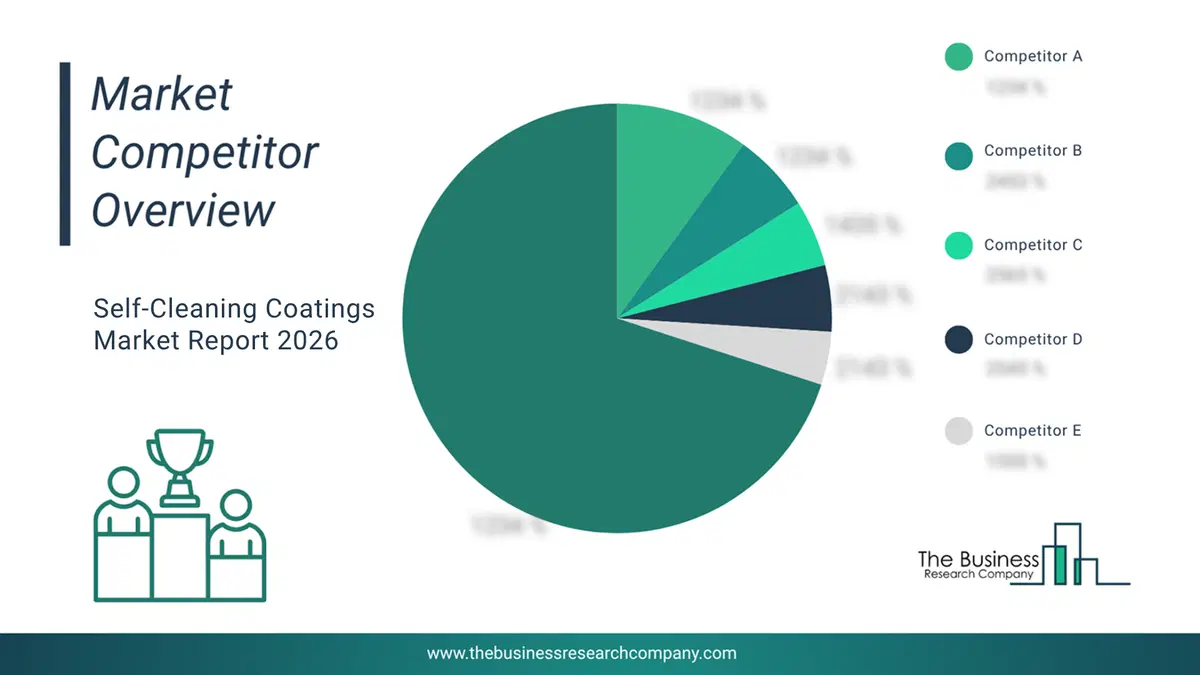
This chart is for illustrative purposes; the full report includes a detailed competitor analysis and comprehensive overview of the top 10 companies in the market.
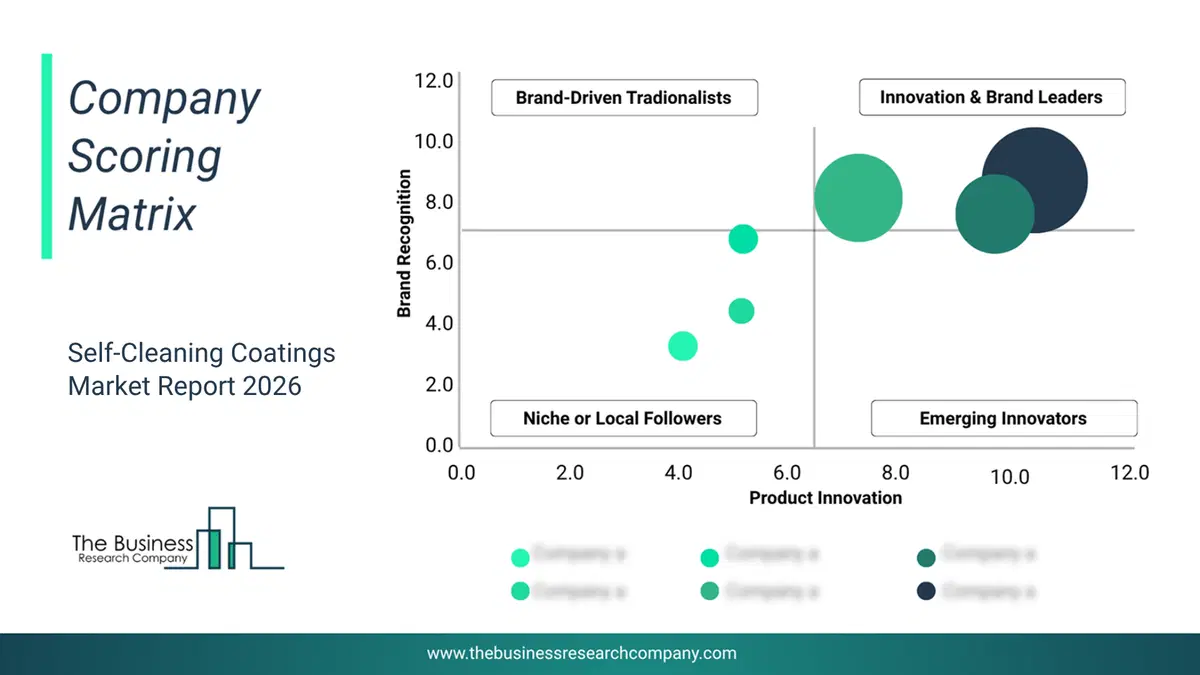
This chart maps companies by product innovation and brand strength, with bubble size indicating relative revenue, helping identify market leaders, challengers, and niche players. This is an illustrative chart; the full report provides a complete and accurate competitive analysis.
Global Self-Cleaning Coatings Market Trends and Insights
Major companies operating in the self-cleaning coatings market are focusing on developing innovative products such as advanced superhydrophobic solutions to enhance long-term surface performance while reducing maintenance needs across industrial, commercial, and infrastructure applications. Advanced superhydrophobic solutions are highly water-repellent coatings engineered to cause water droplets to bead up and roll off surfaces, which helps remove dirt, dust, and contaminants automatically and improves durability, reduces maintenance, and keeps surfaces cleaner for longer. For instance, in September 2025, NTT Advanced Technology Corporation, a Japan-based technology solutions provider, launched HIREC-RAS, a new super-hydrophobic, self-cleaning aerosol coating that comes in a convenient spray-can format. It is an aerosolized version of HIREC-R, offering easier application and improved spray uniformity compared to earlier products like HIREC1100. HIREC-RAS maintains a high water-repellent contact angle of over 150 degrees and can preserve performance for around three years. The product targets small-scale or partial repairs of hydrophobic coatings used on outdoor infrastructure such as antennas, steel towers, bridges, power plants, and buildings.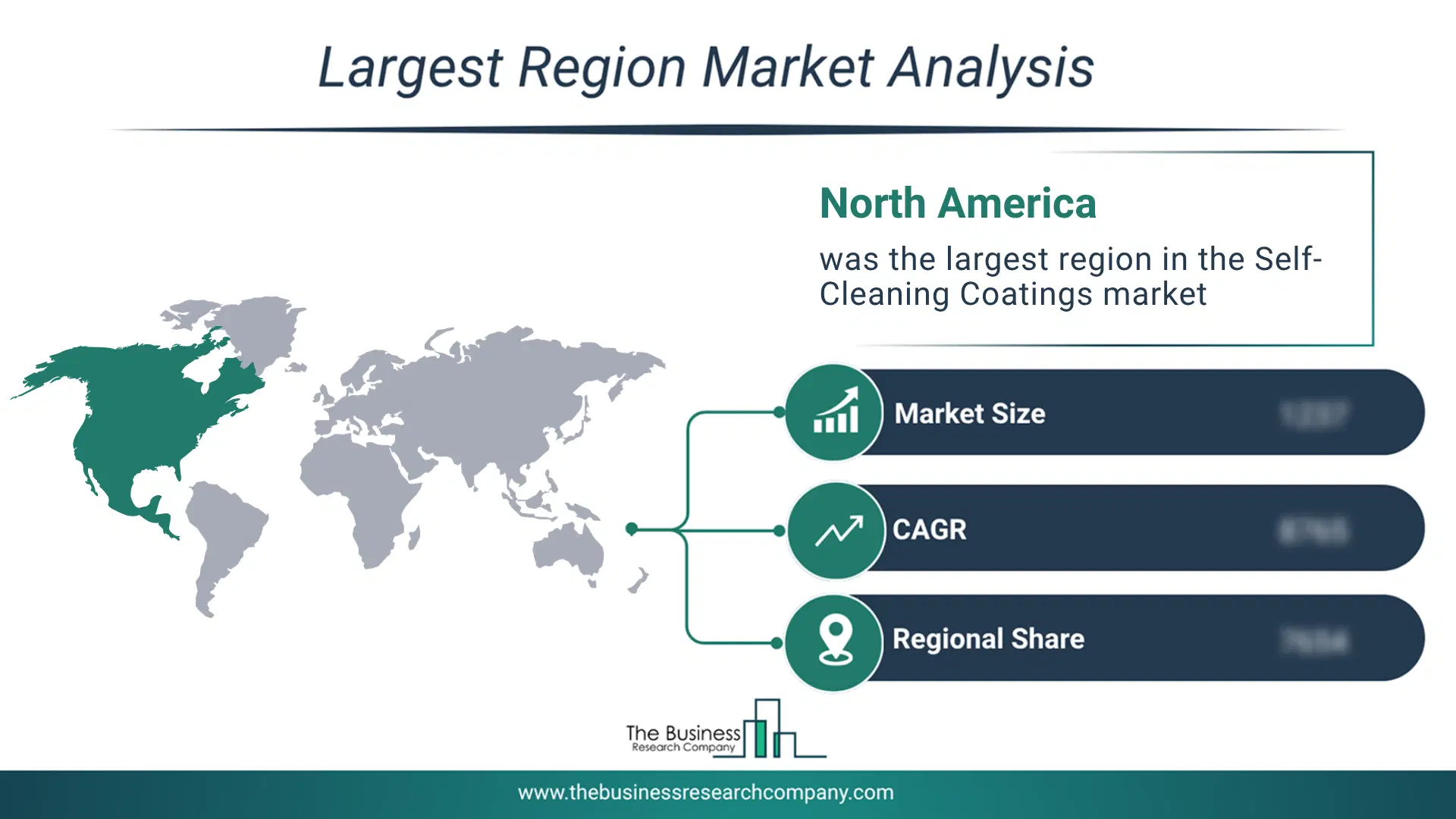
Regional Insights
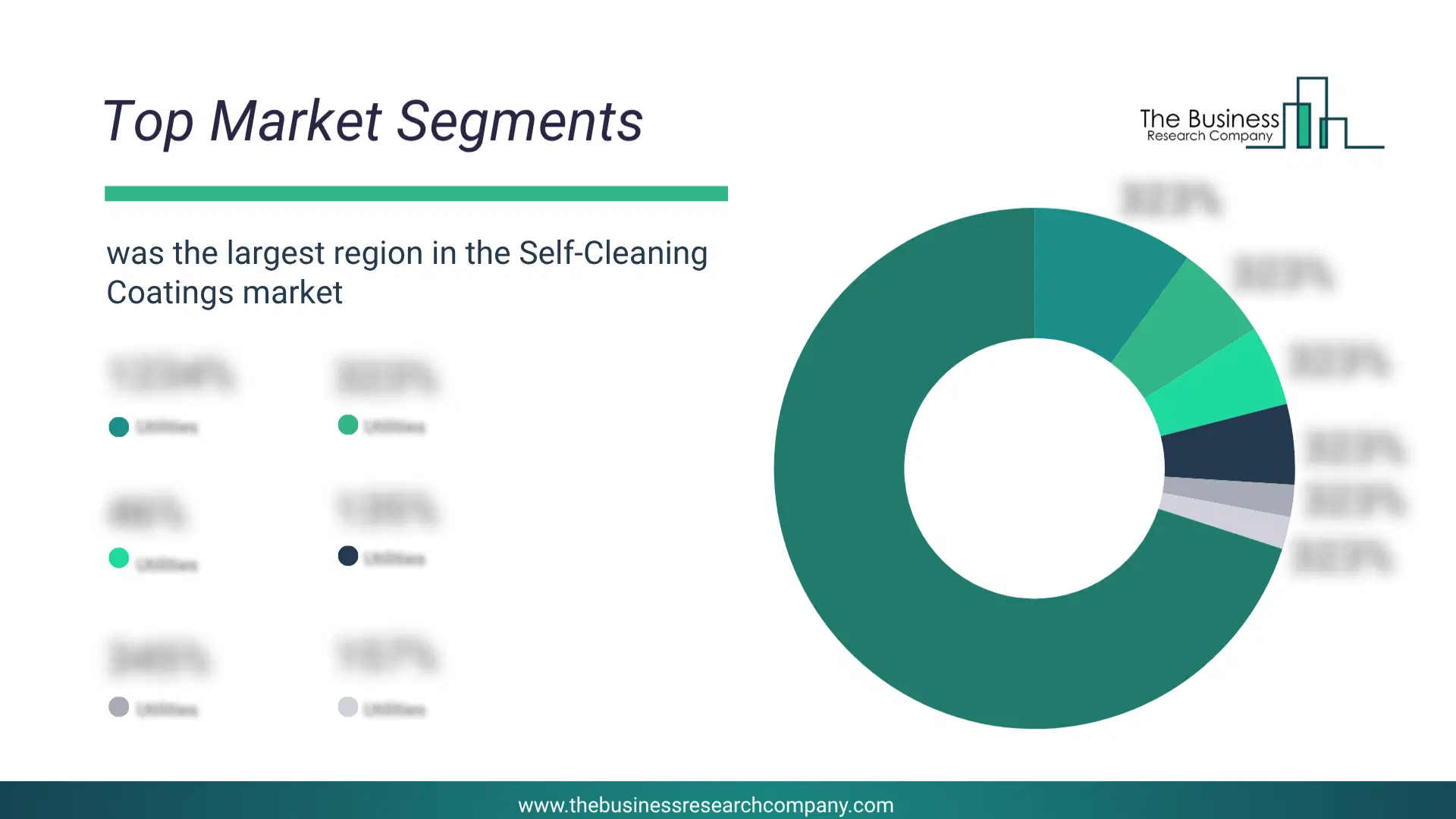
North America was the largest region in the self-cleaning coatings market in 2025. Asia-Pacific is expected to be the fastest-growing region in the forecast period. The regions covered in this market report are Asia-Pacific, South East Asia, Western Europe, Eastern Europe, North America, South America, Middle East, Africa The countries covered in this market report are Australia, Brazil, China, France, Germany, India, Indonesia, Japan, Taiwan, Russia, South Korea, UK, USA, Canada, Italy, SpainWhat Defines the Self-Cleaning Coatings Market?
The self-cleaning coatings market consists of sales of photocatalytic coatings, anti-fog coatings, oleophobic coatings, anti-microbial coatings, and self-cleaning paints. Values in this market are ‘factory gate’ values, that is, the value of goods sold by the manufacturers or creators of the goods, whether to other entities (including downstream manufacturers, wholesalers, distributors, and retailers) or directly to end customers. The value of goods in this market includes related services sold by the creators of the goods.How is Market Value Defined and Measured?
The market value is defined as the revenues that enterprises gain from the sale of goods and/or services within the specified market and geography through sales, grants, or donations in terms of the currency (in USD unless otherwise specified). The revenues for a specified geography are consumption values that are revenues generated by organizations in the specified geography within the market, irrespective of where they are produced. It does not include revenues from resales along the supply chain, either further along the supply chain or as part of other products.
This chart presents market attractiveness based on a quantitative evaluation of growth, competition, strategic alignment, and risk, offering a clear view of opportunity areas for decision-making. This chart is for illustrative purposes; the full report contains the complete analysis.

This chart highlights the Total Addressable Market (TAM) by estimating the maximum revenue opportunity using an assumption-driven approach, supporting strategic planning and opportunity sizing across markets. The chart is illustrative; the full report provides a more comprehensive analysis.
What Key Data and Analysis Are Included in the Self-Cleaning Coatings Market Report 2026?
The self-cleaning coatings market research report is one of a series of new reports from The Business Research Company that provides market statistics, including industry global market size, regional shares, competitors with the market share, detailed market segments, market trends and opportunities, and any further data you may need to thrive in the self-cleaning coatings industry. The market research report delivers a complete perspective of everything you need, with an in-depth analysis of the current and future state of the industry.Self Cleaning Coatings Market Report Forecast Analysis
| Report Attribute | Details |
|---|---|
| Market Size Value In 2026 | $4.9 billion |
| Revenue Forecast In 2030 | $6.43 billion |
| Growth Rate | CAGR of 7.3% from 2026 to 2030 |
| Base Year For Estimation | 2025 |
| Actual Estimates/Historical Data | 2020-2025 |
| Forecast Period | 2026 - 2030 |
| Market Representation | Revenue in USD Billion and CAGR from 2026 to 2030 |
| Segments Covered | Type, Material, End User |
| Regional Scope | Asia-Pacific, Western Europe, Eastern Europe, North America, South America, Middle East, Africa |
| Country Scope | The countries covered in this market report are Australia, Brazil, China, France, Germany, India, Indonesia, Japan, Taiwan, Russia, South Korea, UK, USA, Canada, Italy, Spain |
| Key Companies Profiled | Minnesota Mining and Manufacturing Company, PPG Industries Inc., The Sherwin-Williams Company, Akzo Nobel N.V., Arkema S.A., Hempel A/S, Jotun A/S, Saint-Gobain Glass S.A., Asahi India Glass Limited, Nippon Sheet Glass Co. Ltd., Guardian Industries Corp., Pilkington Group Limited, AGC Inc., Corning Incorporated, Nanogate SE, NEI Corporation, Nanovere Technologies LLC, Nanopool GmbH, Advanced Nanotech Lab Co. Ltd., Nanova Care Coat Pvt. Ltd. |
| Customization Scope | Request for Customization |
| Pricing And Purchase Options | Explore Purchase Options |