
Self-Healing Materials Market Report 2026
Global Outlook – By Product (Polymer, Concrete, Metal, Coating, Ceramic, Asphalt, Fiber-Reinforced Composites), By Form (Intrinsic, Extrinsic), By End Use Industry (Transportation, Consumer Goods, Building And Construction, Energy Generation, Healthcare, Other End Use Industries) – Market Size, Trends, Strategies, and Forecast to 2030
Self-Healing Materials Market Overview
• Self-Healing Materials market size has reached to $3.95 billion in 2025 • Expected to grow to $12.54 billion in 2030 at a compound annual growth rate (CAGR) of 25.9% • Growth Driver: Demand For Renewable Energy Projects Propels Market Growth Attributable To Enhanced Durability And Efficiency Needs • Market Trend: Advancements In Self-Healing Materials With Biodegradable Self-Healing Plastics • Asia-Pacific was the largest region and fastest growing region.What Is Covered Under Self-Healing Materials Market?
Self-healing materials are advanced materials that can automatically repair damage without external intervention. These materials mimic biological healing processes and can restore their original properties after scratching, cracking, or otherwise damaging. The healing process can be intrinsic, relying on the material's inherent properties, such as reversible chemical bonds, or extrinsic, involving embedded capsules, microvascular networks, or external stimuli to deliver healing agents. The main products in self-healing materials are polymer, concrete, metal, coating, ceramic, asphalt, and fiber-reinforced composites. A polymer is a type of synthetic or natural polymer designed to autonomously repair its structural damage, restoring its functionality and enhancing longevity by using inherent or embedded healing mechanisms. These are having intrinsic and extrinsic forms that are used in end user industries such as transportation, consumer goods, building and construction, energy generation, healthcare, and others.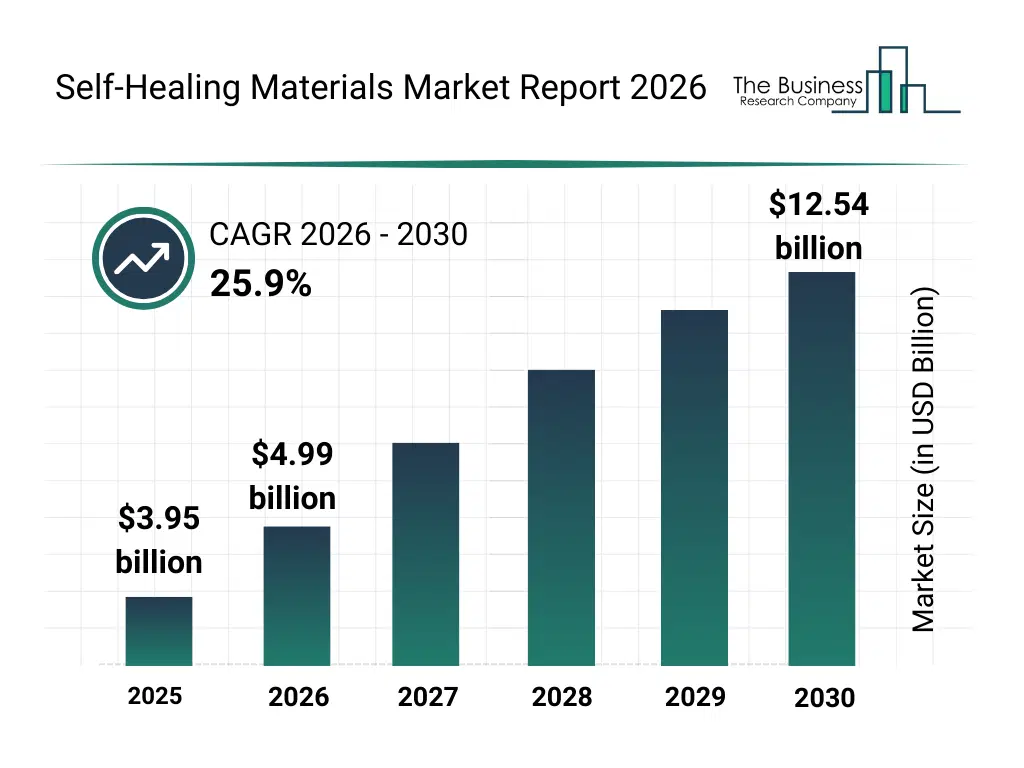
What Is The Self-Healing Materials Market Size and Share 2026?
The self-healing materials market size has grown exponentially in recent years. It will grow from $3.95 billion in 2025 to $4.99 billion in 2026 at a compound annual growth rate (CAGR) of 26.3%. The growth in the historic period can be attributed to increasing research into advanced material behavior, early adoption of composite materials in aerospace, growth in high-performance coating applications, rising need for durable infrastructure materials, development of smart chemical formulations.What Is The Self-Healing Materials Market Growth Forecast?
The self-healing materials market size is expected to see exponential growth in the next few years. It will grow to $12.54 billion in 2030 at a compound annual growth rate (CAGR) of 25.9%. The growth in the forecast period can be attributed to expansion of self-healing composite usage, development of bio-inspired healing mechanisms, growth in AI-driven materials engineering, increasing integration of healing systems in commercial products, development of low-cost scalable healing materials. Major trends in the forecast period include increasing adoption of smart material formulations, growth in automated damage detection, rising use of high-performance composite materials, expansion of multi-functional structural materials, increasing development of bio-based self-healing technologies.
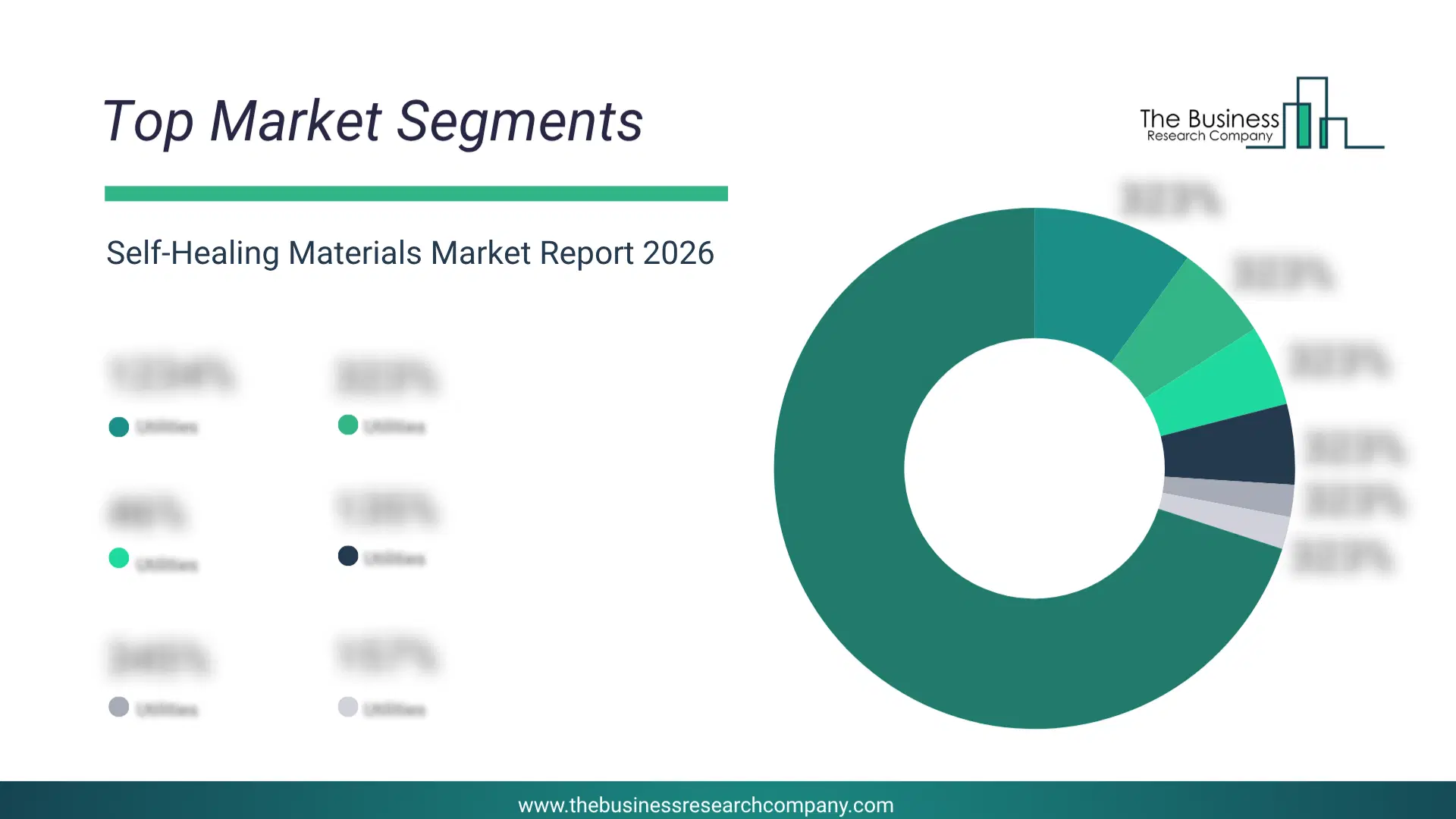
Global Self-Healing Materials Market Segmentation
1) By Product: Polymer, Concrete, Metal, Coating, Ceramic, Asphalt, Fiber-Reinforced Composites 2) By Form: Intrinsic, Extrinsic 3) By End Use Industry: Transportation, Consumer Goods, Building And Construction, Energy Generation, Healthcare, Other End Use Industries Subsegments: 1) By Polymer: Microencapsulated Polymers, Vascular Polymers, Intrinsic Polymers 2) By Concrete: Bacterial Concrete, Microcapsule-Based Concrete, Autogenous Concrete 3) By Metal: Shape Memory Alloys, Coated Metal Alloys, Self-Healing Thin Films 4) By Coating: Self-Healing Polymeric Coatings, Nanocoatings, Anti-Corrosion Coatings 5) By Ceramic: Oxide-Based Self-Healing Ceramics, Non-Oxide Self-Healing Ceramics, Composite Ceramics 6) By Asphalt: Induction-Based Self-Healing Asphalt, Capsule-Based Self-Healing Asphalt, Bio-Based Self-Healing Asphalt 7) By Fiber-Reinforced Composites: Polymer Matrix Composites (PMC), Ceramic Matrix Composites (CMC), Metal Matrix Composites (MMC)What Is The Driver Of The Self-Healing Materials Market?
The demand for renewable energy projects is expected to propel the growth of the self-healing materials market going forward. Renewable energy projects are initiatives focused on generating energy from sustainable sources such as solar, wind, hydro, geothermal, and biomass to reduce environmental impact and dependency on fossil fuels. The increase in renewable energy projects is due to factors such as decarbonization, rising energy demand, advancements in renewable technologies, falling costs of solar and wind power, government policies promoting green energy, and growing awareness of sustainable energy's environmental and economic benefits. Self-healing materials are used in renewable energy projects to enhance durability, reduce maintenance costs, and improve efficiency. It is used in solar panels to repair microcracks in photovoltaic cells, maintaining efficiency and extending lifespan. In wind turbines, they help fix minor damages in blades and coatings, reducing maintenance costs and downtime. For instance, in July 2024, according to the US Energy Information Administration (EIA), a US-based agency of the US Federal Statistical System, renewable energy consumption in the United States increased 2% from 2022 to a record 8.2 quads in 2023. Therefore, the growth of renewable energy projects drives the self-healing materials industry.Key Players In The Global Self-Healing Materials Market
Major companies operating in the self-healing materials market are BASF SE, The Dow Chemical Company, SABIC, 3M Company, Evonik Industries Corporation, Covestro AG, PPG Industries Inc., Solvay, Arkema SA, Acciona S.A., Akzo Nobel N.V., Momentive Performance Materials, Tnemec Company Inc., MacDermid Autotype Ltd., High Impact Technology LLC, Applied Thin Films Inc., Autonomic Materials Inc., Avecom N.V., Sensor Coating Systems Ltd, NEI Corporation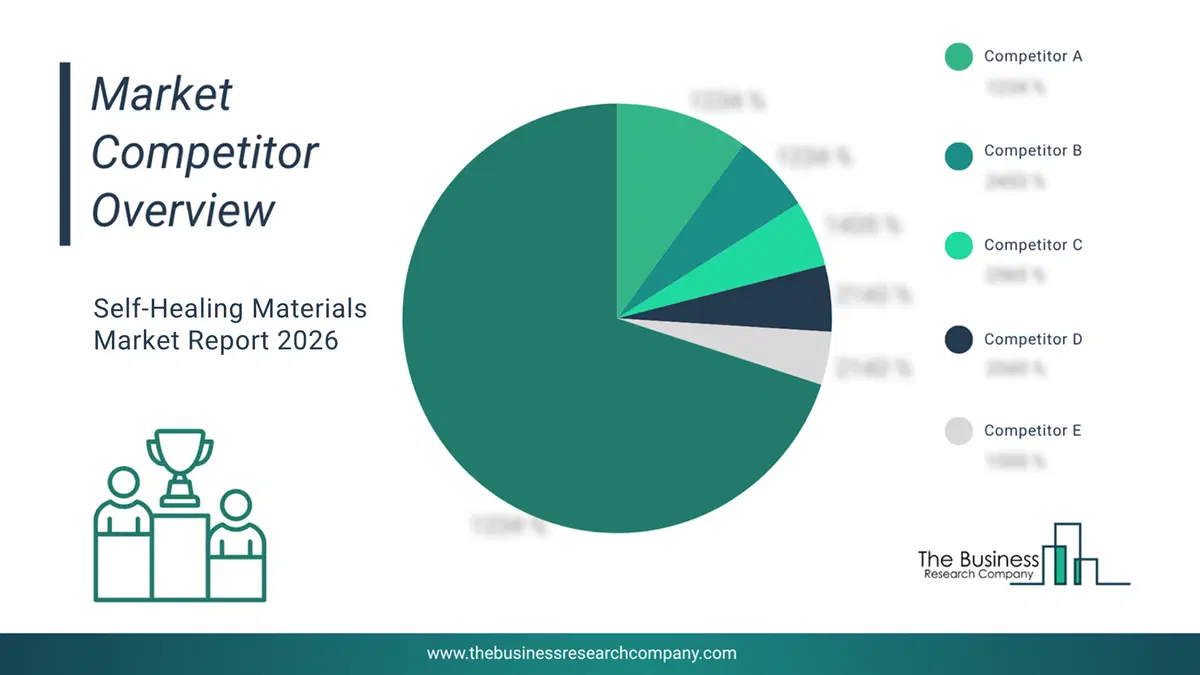
This chart is for illustrative purposes; the full report includes a detailed competitor analysis and comprehensive overview of the top 10 companies in the market.
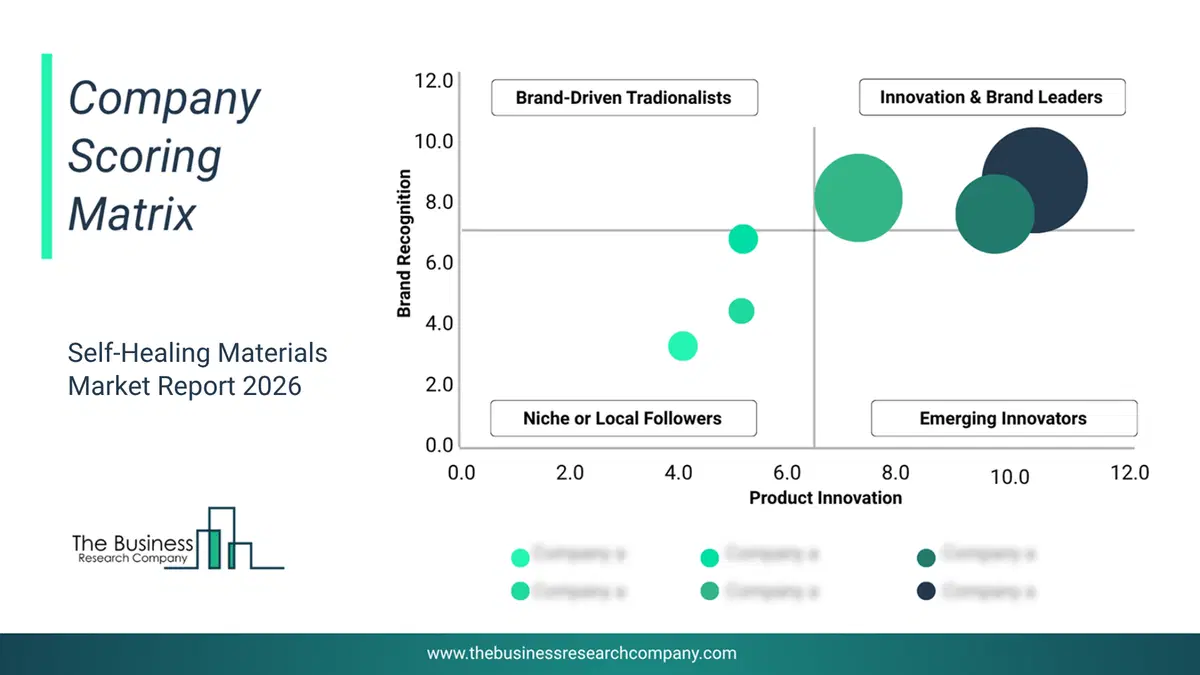
This chart maps companies by product innovation and brand strength, with bubble size indicating relative revenue, helping identify market leaders, challengers, and niche players. This is an illustrative chart; the full report provides a complete and accurate competitive analysis.
Global Self-Healing Materials Market Trends and Insights
Major companies operating in the self-healing materials market are focusing on developing innovative products such as biodegradable, self-healing plastic to address environmental challenges by creating a more durable, recyclable, and eco-friendly alternative to traditional plastics. Biodegradable self-healing plastic is an eco-friendly material capable of autonomously repairing damage while decomposing naturally in the environment. For instance, in November 2023, the University of Tokyo, a Japan-based public research organization, unveiled a novel plastic material named VPR (Vitrimer Incorporated with Polyrotaxane), which possesses a remarkable capacity to self-repair when subjected to heat, retains its original form, and exhibits partial biodegradability. VPR can mend itself much faster, recover its original shape more swiftly, and undergo chemical recycling at an accelerated rate, outperforming typical vitrimers.What Are Latest Mergers And Acquisitions In The Self-Healing Materials Market?
In October 2023, United States Steel Corporation, a US-based manufacturing company, partnered with DuPont to develop COASTALUME, a solution engineered and warrantied for coastal environments. With this partnership, COASTALUME combined the strength and self-healing characteristics of U.S. Steel’s GALVALUME solution with DuPont’s Tedlar polyvinyl fluoride film barrier that helps resist saltwater corrosion, UV damage, cracking, and impact. DuPont is a US-based synthetic materials and polymers company that is involved in developing self-healing materials.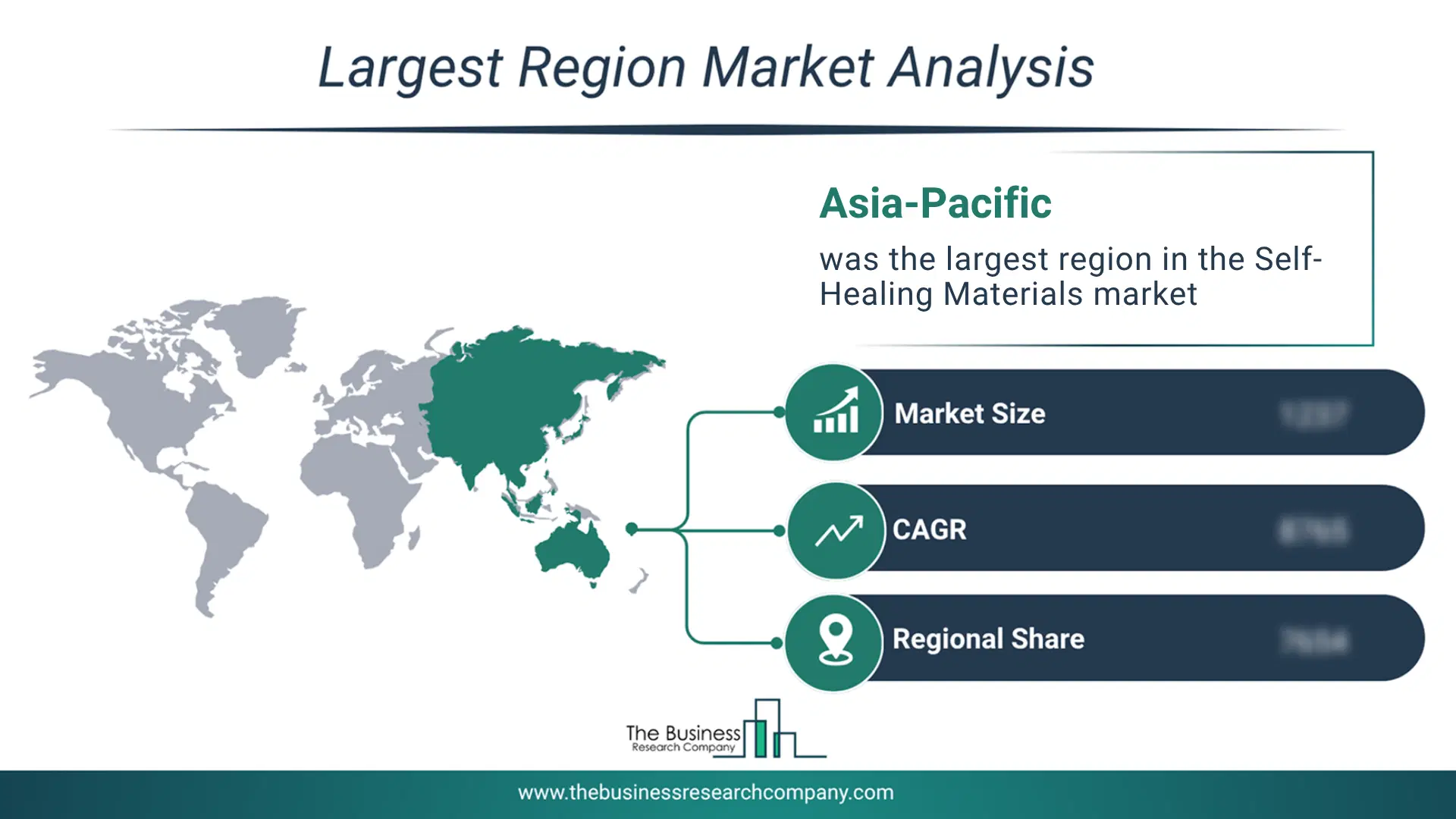
Regional Insights
Asia-Pacific was the largest region in the self-healing materials market in 2025. North America is expected to be the fastest-growing region in the forecast period. The regions covered in this market report are Asia-Pacific, South East Asia, Western Europe, Eastern Europe, North America, South America, Middle East, Africa. The countries covered in this market report are Australia, Brazil, China, France, Germany, India, Indonesia, Japan, Taiwan, Russia, South Korea, UK, USA, Canada, Italy, Spain.What Defines the Self-Healing Materials Market?
The self-healing materials market consists of sales of microencapsulated healing agents, shape memory alloys, biological self-healing materials, and thermoplastic elastomers. Values in this market are ‘factory gate’ values, that is the value of goods sold by the manufacturers or creators of the goods, whether to other entities (including downstream manufacturers, wholesalers, distributors, and retailers) or directly to end customers. The value of goods in this market includes related services sold by the creators of the goods.How is Market Value Defined and Measured?
The market value is defined as the revenues that enterprises gain from the sale of goods and/or services within the specified market and geography through sales, grants, or donations in terms of the currency (in USD unless otherwise specified). The revenues for a specified geography are consumption values that are revenues generated by organizations in the specified geography within the market, irrespective of where they are produced. It does not include revenues from resales along the supply chain, either further along the supply chain or as part of other products.
This chart presents market attractiveness based on a quantitative evaluation of growth, competition, strategic alignment, and risk, offering a clear view of opportunity areas for decision-making. This chart is for illustrative purposes; the full report contains the complete analysis.

This chart highlights the Total Addressable Market (TAM) by estimating the maximum revenue opportunity using an assumption-driven approach, supporting strategic planning and opportunity sizing across markets. The chart is illustrative; the full report provides a more comprehensive analysis.
What Key Data and Analysis Are Included in theSelf-Healing Materials Market Report 2026?
The self-healing materials market research report is one of a series of new reports from The Business Research Company that provides market statistics, including industry global market size, regional shares, competitors with the market share, detailed market segments, market trends and opportunities, and any further data you may need to thrive in the self-healing materials industry. The market research report delivers a complete perspective of everything you need, with an in-depth analysis of the current and future state of the industry.Self-Healing Materials Market Report Forecast Analysis
| Report Attribute | Details |
|---|---|
| Market Size Value In 2026 | $4.99 billion |
| Revenue Forecast In 2030 | $12.54 billion |
| Growth Rate | CAGR of 26.3% from 2026 to 2030 |
| Base Year For Estimation | 2025 |
| Actual Estimates/Historical Data | 2020-2025 |
| Forecast Period | 2026 - 2030 |
| Market Representation | Revenue in USD Billion and CAGR from 2026 to 2030 |
| Segments Covered | Product, Form, End Use Industry |
| Regional Scope | Asia-Pacific, Western Europe, Eastern Europe, North America, South America, Middle East, Africa |
| Country Scope | The countries covered in this market report are Australia, Brazil, China, France, Germany, India, Indonesia, Japan, Taiwan, Russia, South Korea, UK, USA, Canada, Italy, Spain |
| Key Companies Profiled | BASF SE, The Dow Chemical Company, SABIC, 3M Company, Evonik Industries Corporation, Covestro AG, PPG Industries Inc., Solvay, Arkema SA, Acciona S.A., Akzo Nobel N.V., Momentive Performance Materials, Tnemec Company Inc., MacDermid Autotype Ltd., High Impact Technology LLC, Applied Thin Films Inc., Autonomic Materials Inc., Avecom N.V., Sensor Coating Systems Ltd, NEI Corporation |
| Customization Scope | Request for Customization |
| Pricing And Purchase Options | Explore Purchase Options |