
Shopping Centers Market Report 2026
Global Outlook – By Category (Regional Malls, Neighborhood Centers, Outlet Malls, Lifestyle Centers, Mixed Use Development), By Product (Apparel And Accessories, Fast Moving Consumer Goods (FMCG), Hardline And Softline, Diversified), By Tenant (Retail Stores, Restaurants, Entertainment Venues, Other Tenants) – Market Size, Trends, Strategies, and Forecast to 2030
Shopping Centers Market Overview
• Shopping Centers market size has reached to $6224.46 billion in 2025 • Expected to grow to $8639.12 billion in 2030 at a compound annual growth rate (CAGR) of 6.8% • Growth Driver: Fashionable Apparel Expenditure Boosts Retail Sector Growth • Market Trend: Technological Advancements In The Shopping Centers Market • North America was the largest region and fastest growing region.Market Gains By 2030 – Top Opportunities By Segment
Market Gain identifies the most promising market opportunities by highlighting the segments or products expected to generate the highest incremental revenue growth over the next five years.
What Is Covered Under Shopping Centers Market?
Shopping centers are large complexes that house multiple retail stores and other commercial establishments within a single area. They are designed to provide consumers with various goods and services in a convenient and often aesthetically pleasing environment. The main types of shopping centers are regional malls, neighborhood centers, outlet malls, lifestyle centers, and mixed-use developments. Regional malls are large shopping centers that serve a broad area and typically feature a wide range of stores, including department stores, specialty shops, and entertainment options. They often have a strong mix of both national and international brands. The various products include apparel and accessories, fast-moving consumer goods (FMCG), hardline and softline, and diversified, and the various tenants involved are retail stores, restaurants, entertainment venues, and others.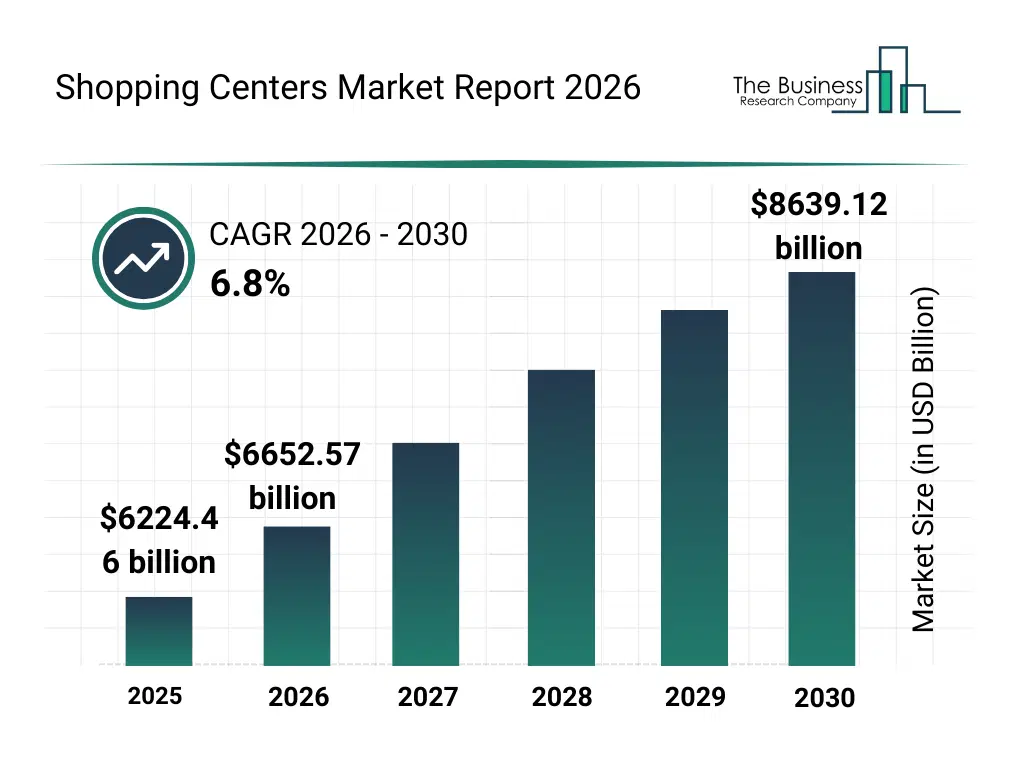
What Is The Shopping Centers Market Size and Share 2026?
The shopping centers market size has grown strongly in recent years. It will grow from $6224.46 billion in 2025 to $6652.57 billion in 2026 at a compound annual growth rate (CAGR) of 6.9%. The growth in the historic period can be attributed to increasing construction of large commercial hubs, rising popularity of organized retail environments, growth in leisure-integrated shopping spaces, expansion of retail leasing platforms, early use of digital mall directories.What Is The Shopping Centers Market Growth Forecast?
The shopping centers market size is expected to see strong growth in the next few years. It will grow to $8639.12 billion in 2030 at a compound annual growth rate (CAGR) of 6.8%. The growth in the forecast period can be attributed to growing adoption of smart Retail Analytics, increasing integration of automation in malls, rising development of mixed-use commercial spaces, expansion of sustainable retail infrastructure, growing implementation of immersive retail technologies. Major trends in the forecast period include growing adoption of automated retail experiences, rising integration of smart mall infrastructure, increasing focus on energy-efficient retail operations, expansion of customer engagement technologies, growth in mixed-use retail developments.
Global Shopping Centers Market Segmentation
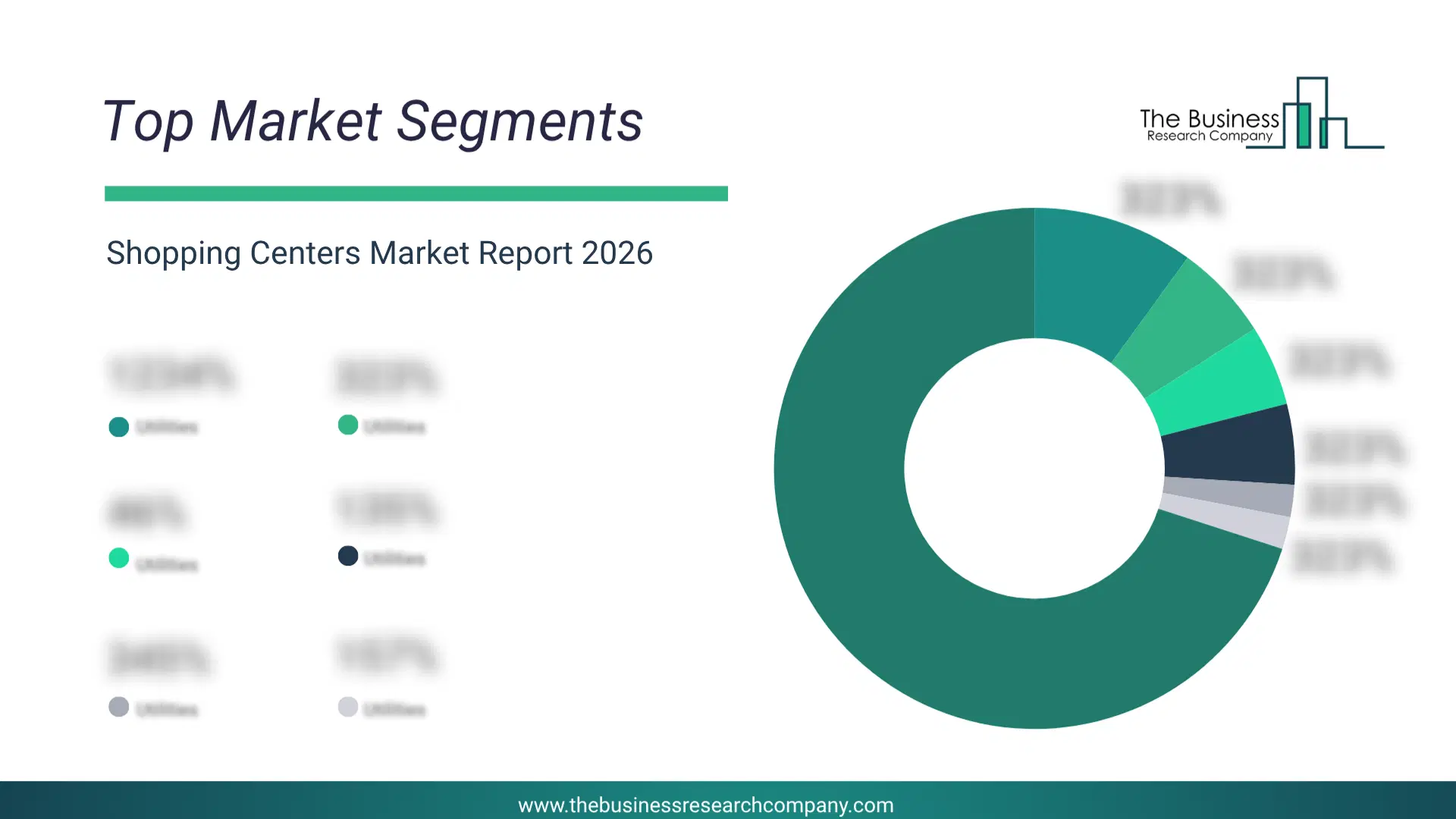
1) By Category: Regional Malls, Neighborhood Centers, Outlet Malls, Lifestyle Centers, Mixed Use Development 2) By Product: Apparel And Accessories, Fast Moving Consumer Goods (FMCG), Hardline And Softline, Diversified 3) By Tenant: Retail Stores, Restaurants, Entertainment Venues, Other Tenants Subsegments: 1) By Regional Malls: Super-Regional Malls, Community Malls 2) By Neighborhood Centers: Convenience Centers, Strip Malls 3) By Outlet Malls: Factory Outlet Malls, Designer Outlet Malls 4) By Lifestyle Centers: Open-Air Lifestyle Centers, Urban Lifestyle Centers 5) By Mixed-Use Development: Retail And Residential Mixed-Use, Retail And Office Mixed-Use, Retail And Entertainment Mixed-Use The top segments in the shopping centers market will be: • Regional Malls will reach $2376.13 Billion by 2030. • Neighborhood Centers will reach $1845.32 Billion by 2030. • Mixed Use Development will reach $1711.63 Billion by 2030. • Lifestyle Centers will reach $1356.51 Billion by 2030. • Outlet Malls will reach $1299.87 Billion by 2030.What Is The Driver Of The Shopping Centers Market?
The increasing spending on fashionable apparel is expected to propel the growth of the shopping centers market going forward. Fashionable apparel refers to clothing and accessories that are trendy, stylish, and in line with the latest fashion trends. The increasing spending on fashionable apparel is due to rising disposable incomes, social media influence, celebrity endorsements, fast fashion availability, and evolving consumer preferences. Shopping centers are centralized hubs for fashionable apparel where diverse fashion retailers, ranging from high-end boutiques to mainstream brands, showcase and retail a wide array of trendy clothing, accessories, and footwear. For instance, in February 2025, according to the U.S. Bureau of Labor Statistics, a federal statistical agency, household spending on women's apparel averaged $655 in 2023 compared with $406 for men's apparel. Therefore, the increasing spending on fashionable apparel is driving the growth of the shopping center industry.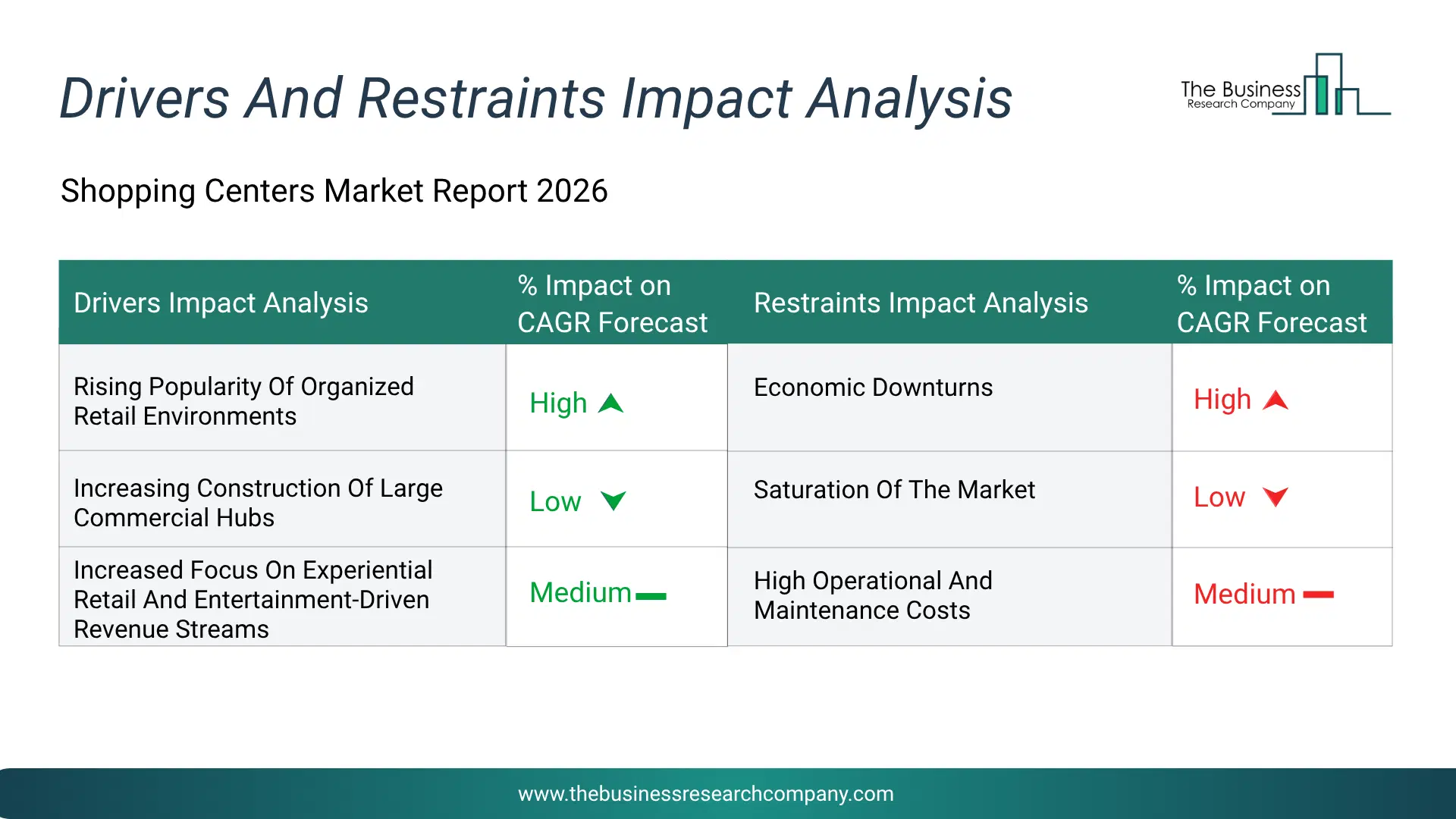
Infographic Chart Showing Key Market Drivers Analysis And Restraints For Shopping Centers Market
The chart presents an impact analysis of key drivers and restraints, quantifying their relative influence on the market's growth rate and helping assess the balance between growth enablers and limiting factors. This chart offers a high-level perspective; the full report contains more detailed insights.
How Will The Drivers Impact Growth In The Global Shopping Centers Market?
• Rising Popularity Of Organized Retail Environments (High) – During the forecast period, the rising popularity of organized retail environments is expected to become a key growth driver for the shopping centers market by 2030. The rising popularity of organized retail environments is significantly driving the shopping centers market as consumers increasingly prefer structured and well-managed shopping spaces over unorganized retail. These environments offer standardized pricing, better product quality, and enhanced customer service, which improves overall shopping experiences. The presence of multiple brands under one roof increases convenience and reduces search time for consumers. Additionally, organized retail ensures better infrastructure, including parking, security, and hygiene, attracting higher footfall. Retailers also benefit from better visibility and streamlined operations within such centers. With growing urbanization and rising disposable incomes, consumers are shifting toward modern retail formats. This transition continues to boost demand for shopping centers globally. • Increasing Construction Of Large Commercial Hubs (Low) – During the forecast period, the increasing construction of large commercial hubs is expected to emerge as a major factor driving the expansion of the shopping centers market by 2030. The increasing construction of large commercial hubs is a major driver for the shopping centers market as developers invest in expansive, multi-purpose retail spaces. These hubs are designed to accommodate a wide range of retail stores, entertainment zones, offices, and dining options, creating a one-stop destination for consumers. Such developments attract both national and international brands, enhancing the market's overall appeal. Governments and private investors are supporting infrastructure expansion, further accelerating development activities. Large commercial hubs also contribute to economic growth by generating employment and boosting local businesses. Their strategic locations in urban and semi-urban areas increase accessibility and foot traffic. This continuous expansion is fueling the growth of shopping centers worldwide. • Increased Focus On Experiential Retail And Entertainment-Driven Revenue Streams (Medium) – During the forecast period, the increased focus on experiential retail and entertainment-driven revenue streams is expected to act as a key growth catalyst for the shopping centers market by 2030. The increased focus on experiential retail and entertainment-driven revenue streams is transforming the shopping centers market by shifting emphasis from traditional shopping to immersive experiences. Consumers now seek entertainment, dining, and social engagement alongside retail purchases. Shopping centers are integrating cinemas, gaming zones, live events, and themed attractions to enhance visitor engagement. This approach increases dwell time, leading to higher spending per visit. Retailers and mall operators are leveraging these experiences to differentiate themselves from e-commerce platforms. The inclusion of entertainment options also attracts diverse consumer segments, including families and younger audiences. As a result, experiential retail is becoming a key factor in sustaining long-term growth and competitiveness in the market.How Will The Restraints Impact Growth In The Global Shopping Centers Market?
• Economic Downturns (High) – During the forecast period, the Economic Downturns act as a major restraint on the shopping centers market because reduced consumer spending power directly impacts retail sales and footfall within malls and commercial hubs. During periods of economic slowdown, consumers prioritize essential goods over discretionary purchases, leading to lower revenue for retailers. This decline in spending reduces rental income for mall operators and increases vacancy rates as smaller retailers struggle to sustain operations. Investors also become cautious, delaying or cancelling new development projects due to financial uncertainty. Additionally, tenant demand weakens, affecting occupancy levels in existing shopping centers. Overall, economic instability slows expansion and reduces profitability across the market. • Saturation Of The Market (Low) – During the forecast period, the Saturation Of The Market acts as a major restraint on the shopping centers market because the high concentration of malls and retail spaces in urban regions leads to intense competition among existing players. With limited growth in consumer base, multiple shopping centers compete for the same tenants and foot traffic, resulting in reduced profitability. This oversupply of retail space often leads to lower rental rates and declining occupancy levels, particularly in older or less strategically located malls. Developers face challenges in differentiating new projects in already crowded markets. In many cases, underperforming centers are forced to close or undergo costly redevelopment. Overall, saturation limits new expansion opportunities and slows market growth. • High Operational And Maintenance Costs (Medium) – During the forecast period, the High Operational And Maintenance Costs act as a major restraint on the shopping centers market because maintaining large commercial complexes requires continuous and expensive expenditure. Costs such as electricity, security, cleaning, facility management, and staffing significantly increase the financial burden on operators. Rising energy prices and labor costs further add to overall operational expenses. In addition, modernization efforts such as upgrading infrastructure, implementing digital systems, and improving customer experience require substantial capital investment. These high recurring costs reduce profit margins for mall owners and make operations less sustainable in low-revenue conditions. As a result, many operators face financial pressure, limiting expansion and long-term profitability in the market.Key Players In The Global Shopping Centers Market
Major companies operating in the shopping centers market are Brookfield Property Partners L.P., Simon Property Group Inc., Unibail-Rodamco-Westfield SE, Taubman Centers Inc., Kimco Realty Corporation, Klépierre S.A., Macerich, CBL & Associates Properties Inc., Pennsylvania Real Estate Investment Trust, Mercialys SA, ECE Group GmbH & Co. KG, Hammerson plc, Ivanhoé Cambridge Inc., Sunshine Shopping Center Co. Ltd., Terreno Realty Corporation, Regency Centers Corporation, Federal Realty Investment Trust, Washington Prime Group Inc., Urban Edge Properties, Brixmor Property Group.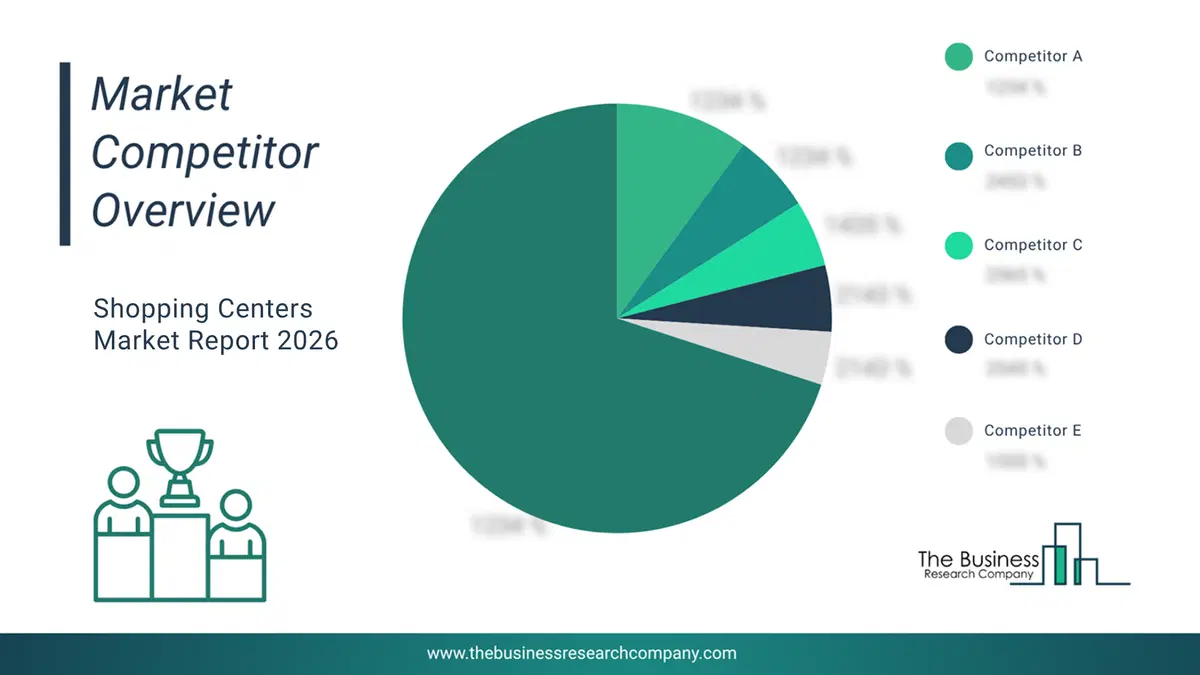
This chart is for illustrative purposes; the full report includes a detailed competitor analysis and comprehensive overview of the top 10 companies in the market.
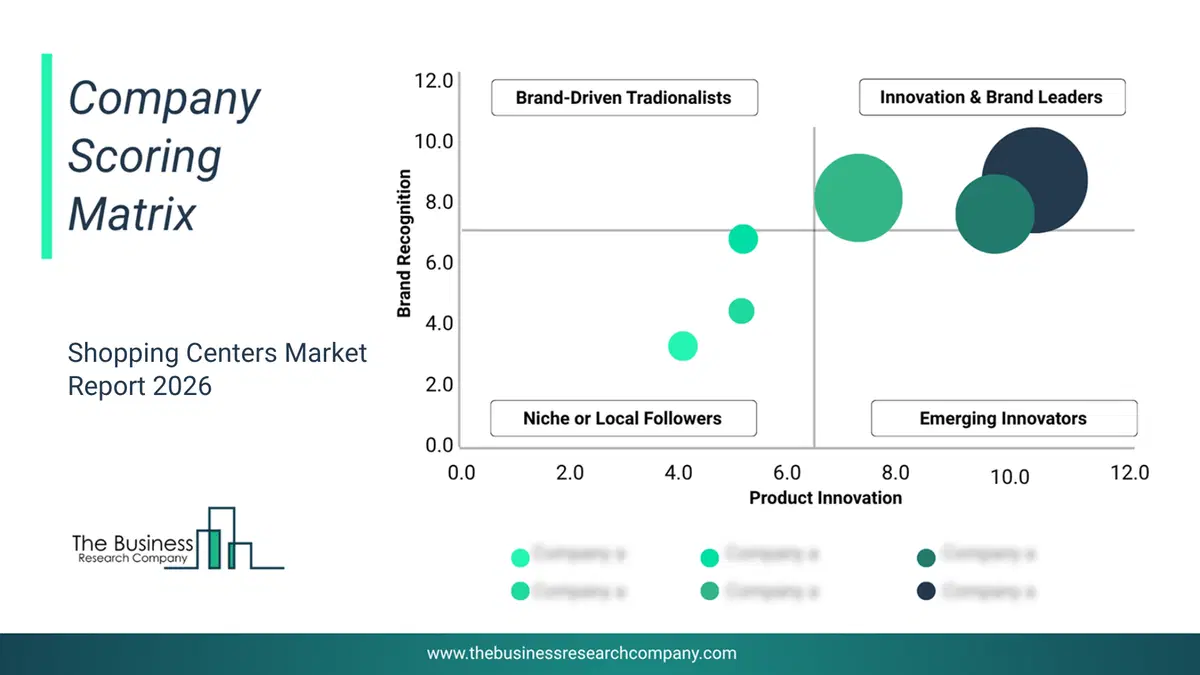
This chart maps companies by product innovation and brand strength, with bubble size indicating relative revenue, helping identify market leaders, challengers, and niche players. This is an illustrative chart; the full report provides a complete and accurate competitive analysis.
Global Shopping Centers Market Trends and Insights
Major companies operating in the shopping centers market are focused on developing innovative technologies, such as advanced computer vision technology, to enable a checkout-free shopping experience. Advanced computer vision technology refers to the use of artificial intelligence and machine learning algorithms to enable computers to interpret and understand visual information from the world, including images and videos, facilitating tasks like object detection, facial recognition, and scene understanding. For instance, in July 2024, REWE Group, a Germany-based company that operates supermarkets, hypermarkets, discount stores, drugstores, and more, launched Europe's largest autonomous supermarket, named Pick&Go, in Hamburg, covering 1,200 square meters and offering around 20,000 items. This innovative store utilizes advanced computer vision technology to enable a checkout-free shopping experience, allowing customers to select items and leave without traditional checkout lines. Shoppers can choose from four payment methods: traditional checkout, self-scanning, cashless via the Pick&Go app, or using computer-vision-enabled terminals. Unlike similar systems, REWE emphasizes minimal data collection, ensuring customer privacy.What Are Latest Mergers And Acquisitions In The Shopping Centers Market?
In February 2024, Whitestone REIT, a US-based real estate agency, acquired Garden Oaks Shopping Center for an undisclosed amount. With this acquisition, Whitestone REIT aims to expand its portfolio of retail properties, enhance its market presence in the Houston area, and capitalize on the center's strategic location and potential growth opportunities. Garden Oaks Shopping Center is a US-based commercial property owner specializing in retail spaces catering to local communities.Regional Insights
North America was the largest region in the shopping centers market in 2025. Asia-Pacific is expected to be the fastest-growing region in the forecast period. The regions covered in this market report are Asia-Pacific, South East Asia, Western Europe, Eastern Europe, North America, South America, Middle East, Africa. The countries covered in this market report are Australia, Brazil, China, France, Germany, India, Indonesia, Japan, Taiwan, Russia, South Korea, UK, USA, Canada, Italy, Spain.What Defines the Shopping Centers Market?
The shopping centers market includes revenues earned by entities by providing retail space leasing, concierge services, community center, superregional center, specialty center, and festival center. The market value includes the value of related goods sold by the service provider or included within the service offering. Only goods and services traded between entities or sold to end consumers are included.How is Market Value Defined and Measured?
The market value is defined as the revenues that enterprises gain from the sale of goods and/or services within the specified market and geography through sales, grants, or donations in terms of the currency (in USD unless otherwise specified). The revenues for a specified geography are consumption values that are revenues generated by organizations in the specified geography within the market, irrespective of where they are produced. It does not include revenues from resales along the supply chain, either further along the supply chain or as part of other products.
This chart presents market attractiveness based on a quantitative evaluation of growth, competition, strategic alignment, and risk, offering a clear view of opportunity areas for decision-making. This chart is for illustrative purposes; the full report contains the complete analysis.

This chart highlights the Total Addressable Market (TAM) by estimating the maximum revenue opportunity using an assumption-driven approach, supporting strategic planning and opportunity sizing across markets. The chart is illustrative; the full report provides a more comprehensive analysis.
What Key Data and Analysis Are Included in theShopping Centers Market Report 2026?
The shopping centers market research report is one of a series of new reports from The Business Research Company that provides market statistics, including industry global market size, regional shares, competitors with the market share, detailed market segments, market trends and opportunities, and any further data you may need to thrive in the shopping centers industry. The market research report delivers a complete perspective of everything you need, with an in-depth analysis of the current and future state of the industry.Shopping Centers Market Report Forecast Analysis
| Report Attribute | Details |
|---|---|
| Market Size Value In 2026 | $6652.57 billion |
| Revenue Forecast In 2030 | $8639.12 billion |
| Growth Rate | CAGR of 6.9% from 2026 to 2030 |
| Base Year For Estimation | 2025 |
| Actual Estimates/Historical Data | 2020-2025 |
| Forecast Period | 2026 - 2030 |
| Market Representation | Revenue in USD Billion and CAGR from 2026 to 2030 |
| Segments Covered | Category, Product, Tenant |
| Regional Scope | Asia-Pacific, Western Europe, Eastern Europe, North America, South America, Middle East, Africa |
| Country Scope | The countries covered in the report are Australia, Brazil, China, France, Germany, India, Indonesia, Japan, Taiwan, Russia, South Korea, UK, USA, Canada, Italy, Spain. |
| Key Companies Profiled | Brookfield Property Partners L.P., Simon Property Group Inc., Unibail-Rodamco-Westfield SE, Taubman Centers Inc., Kimco Realty Corporation, Klépierre S.A., Macerich, CBL & Associates Properties Inc., Pennsylvania Real Estate Investment Trust, Mercialys SA, ECE Group GmbH & Co. KG, Hammerson plc, Ivanhoé Cambridge Inc., Sunshine Shopping Center Co. Ltd., Terreno Realty Corporation, Regency Centers Corporation, Federal Realty Investment Trust, Washington Prime Group Inc., Urban Edge Properties, Brixmor Property Group. |
| Customization Scope | Request for Customization |
| Pricing And Purchase Options | Explore Purchase Options |