
Smart Adaptive Street Furniture Market Report 2026
Global Outlook – By Product Type (Benches, Lighting, Waste Bins, Information Kiosks, Charging Stations, Other Product Types), By Technology (Internet of Things-Enabled, Sensor-Based, Solar-Powered, Other Technologies), By Application (Urban Areas, Parks, Transportation Hubs, Commercial Spaces, Other Applications) – Market Size, Trends, Strategies, and Forecast to 2030
Smart Adaptive Street Furniture Market Overview
• Smart Adaptive Street Furniture market size has reached to $4.72 billion in 2025 • Expected to grow to $9.7 billion in 2030 at a compound annual growth rate (CAGR) of 15.5% • Growth Driver: Escalating Demand For Smart City Solutions Fueling The Growth Of The Market Due To Rapid Urbanization, Sustainability Goals, And Enhanced Public Services • Market Trend: Technological Innovations Enhancing Reliability And Efficiency In Smart Street Infrastructure • Europe was the largest region and fastest growing region.What Is Covered Under Smart Adaptive Street Furniture Market?
Smart adaptive street furniture refers to technologically enhanced urban infrastructure elements that integrate sensors, connectivity, and adaptive systems to respond dynamically to environmental conditions and user needs. These solutions often incorporate features that improve functionality and sustainability in public spaces. By combining design, technology, and interactivity, smart adaptive street furniture enhances urban living, promotes community well-being, and supports smarter city ecosystems. The main product types of smart adaptive street furniture are benches, lighting, waste bins, information kiosks, charging stations, and others. Benches are long seats, typically made of wood, metal, or stone, designed to accommodate multiple people for sitting in public or private spaces. The multiple technologies are internet of things (IoT)-enabled, sensor-based, solar-powered, and others, and they are used by several applications such as urban areas, parks, transportation hubs, commercial spaces, and others.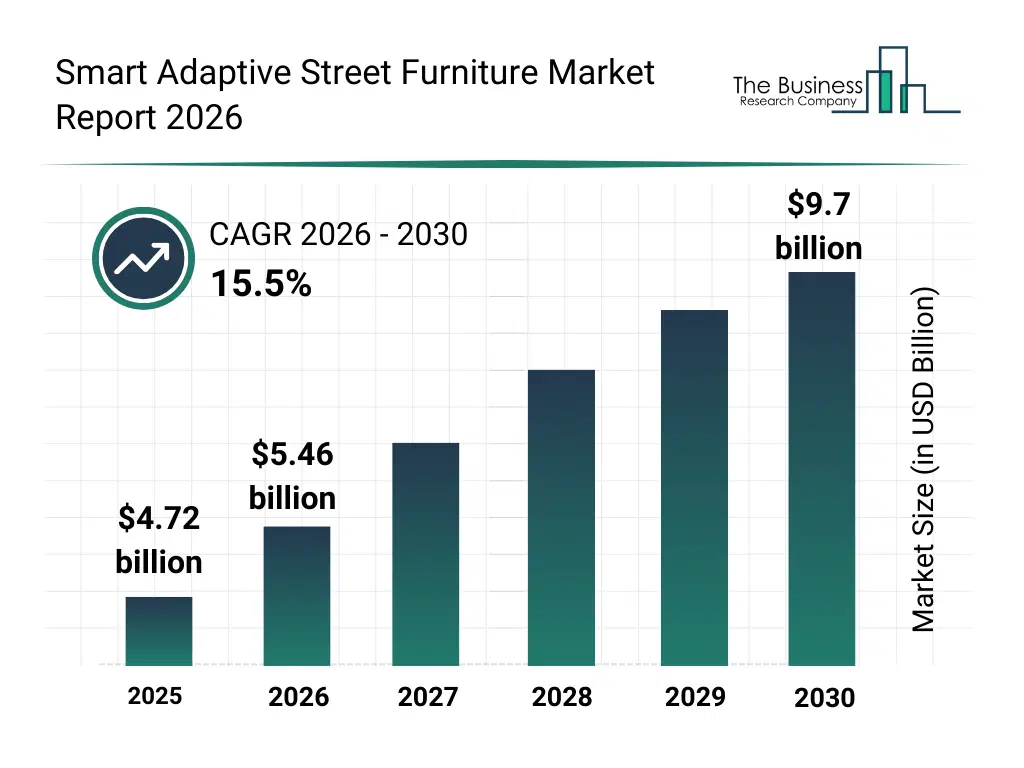
What Is The Smart Adaptive Street Furniture Market Size and Share 2026?
The smart adaptive street furniture market size has grown rapidly in recent years. It will grow from $4.72 billion in 2025 to $5.46 billion in 2026 at a compound annual growth rate (CAGR) of 15.7%. The growth in the historic period can be attributed to rising adoption of smart urban infrastructure, increased use of sensor-enabled public furniture, growth in IoT integration for street amenities, expansion of solar-powered street furniture, deployment of interactive signage in public spaces.What Is The Smart Adaptive Street Furniture Market Growth Forecast?
The smart adaptive street furniture market size is expected to see rapid growth in the next few years. It will grow to $9.7 billion in 2030 at a compound annual growth rate (CAGR) of 15.5%. The growth in the forecast period can be attributed to increasing implementation of connected street furniture, adoption of adaptive and modular urban infrastructure, expansion of intelligent monitoring systems, development of sustainable and energy-efficient urban installations, integration with smart city platforms. Major trends in the forecast period include integration of AI-enabled adaptive street furniture, deployment of sensor-based smart benches and lighting, adoption of IOT-connected public seating pods and planters, expansion of interactive digital signage platforms, development of smart bus shelter monitoring systems.
Global Smart Adaptive Street Furniture Market Segmentation
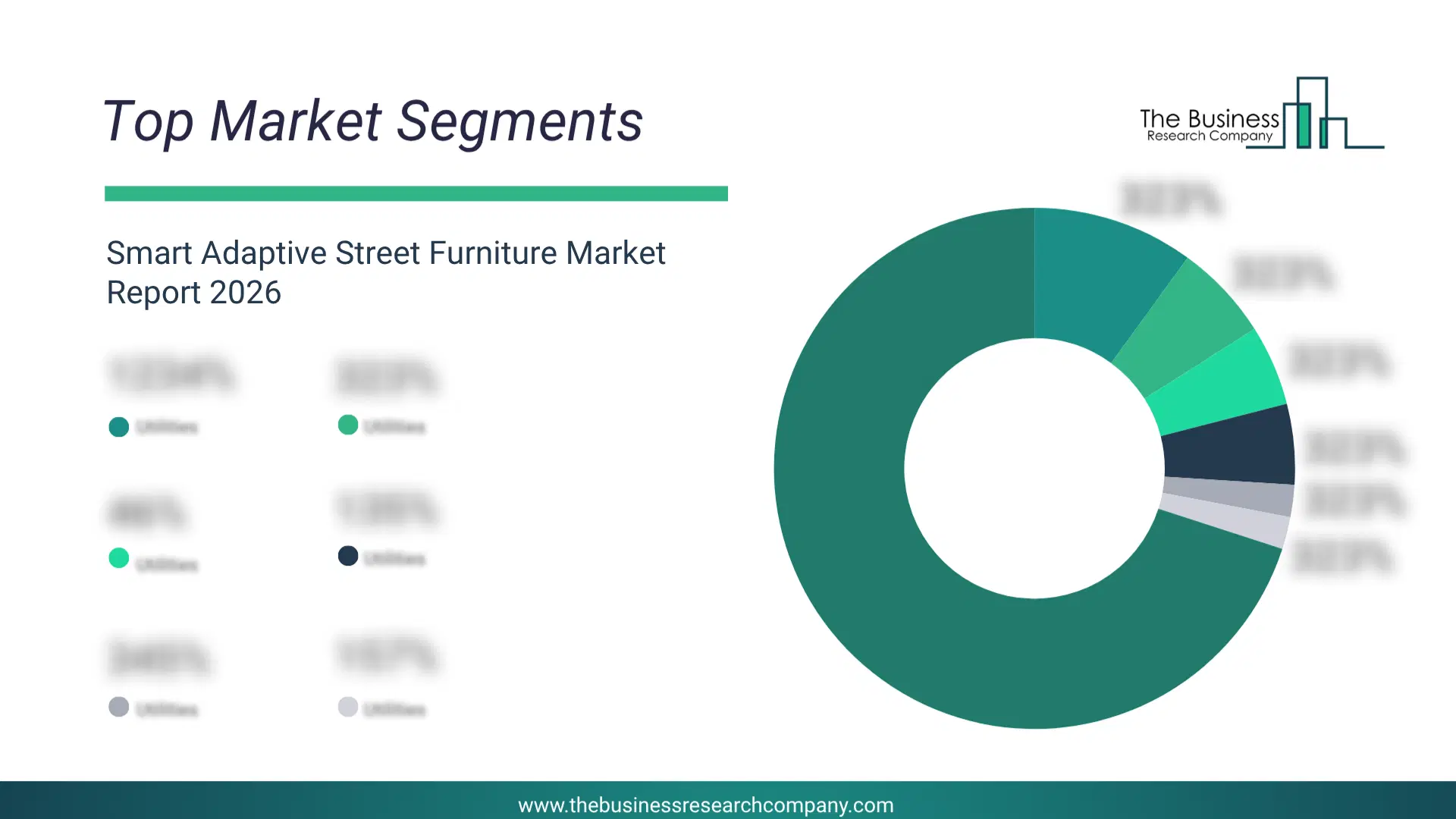
1) By Product Type: Benches, Lighting, Waste Bins, Information Kiosks, Charging Stations, Other Product Types 2) By Technology: Internet of Things-Enabled, Sensor-Based, Solar-Powered, Other Technologies 3) By Application: Urban Areas, Parks, Transportation Hubs, Commercial Spaces, Other Applications Subsegments: 1) By Benches: Smart Benches, Modular Benches, Solar-Powered Benches, Interactive Benches 2) By Lighting: Smart Streetlights, Solar-Powered Lighting, Motion-Sensor Lighting, Decorative Lighting 3) By Waste Bins: Smart Waste Bins, Solar-Powered Waste Bins, Recycling Waste Bins, Self-Compacting Waste Bins 4) By Information Kiosks: Digital Information Kiosks, Interactive Information Kiosks, Touchscreen Information Kiosks, Wayfinding Information Kiosks 5) By Charging Stations: Electric Vehicle Charging Stations, Solar-Powered Charging Stations, Wireless Charging Stations, Public Device Charging Stations 6) By Other Product Types: Smart Bicycle Stands, Smart Shelters, Air Quality Monitoring Units, Digital SignageWhat Is The Driver Of The Smart Adaptive Street Furniture Market?
The escalating demand for smart city solutions is expected to propel the growth of the smart adaptive street furniture market going forward. Smart city solutions refer to integrated technologies and data-driven systems designed to enhance the efficiency, sustainability, and livability of urban areas by optimizing resources and improving public services. Escalating demand for smart city solutions is due to rapid urbanization, increasing need for efficient resource management, growing focus on sustainability, and rising public safety concerns. Smart adaptive street furniture supports smart city solutions by providing connected, multifunctional, and responsive urban infrastructure that enhances public services and citizen engagement. For instance, in July 2025, according to HiveMQ GmbH, a Germany-based software company, artificial intelligence (AI) optimization reduced peak grid pressure by 31%, increased the usage of renewable energy by 42%, and increased transportation on-time performance from 72% to 94% between 2022 and 2023. Therefore, escalating demand for smart city solutions is driving the smart adaptive street furniture industry.Key Players In The Global Smart Adaptive Street Furniture Market
Major companies operating in the smart adaptive street furniture market are Delta Electronics Inc., Signify N.V., Valmont Industries Inc., JCDecaux SA, Daktronics Inc., Schréder Group, Landscape Forms Inc., Lappset Group Oy, Soofa Inc., Ekin Smart City Solutions, Iysert Energy Research & Development Pvt. Ltd., Bigbelly Solar LLC, Strawberry Energy Ltd., SEEDiA Sp. z o.o., EnGoPlanet Energy Solutions LLC, Sunbolt LLC, Cartelmatic SAS, ZANO Street Furniture Ltd., City Gecko d.o.o., Polymobyl SA.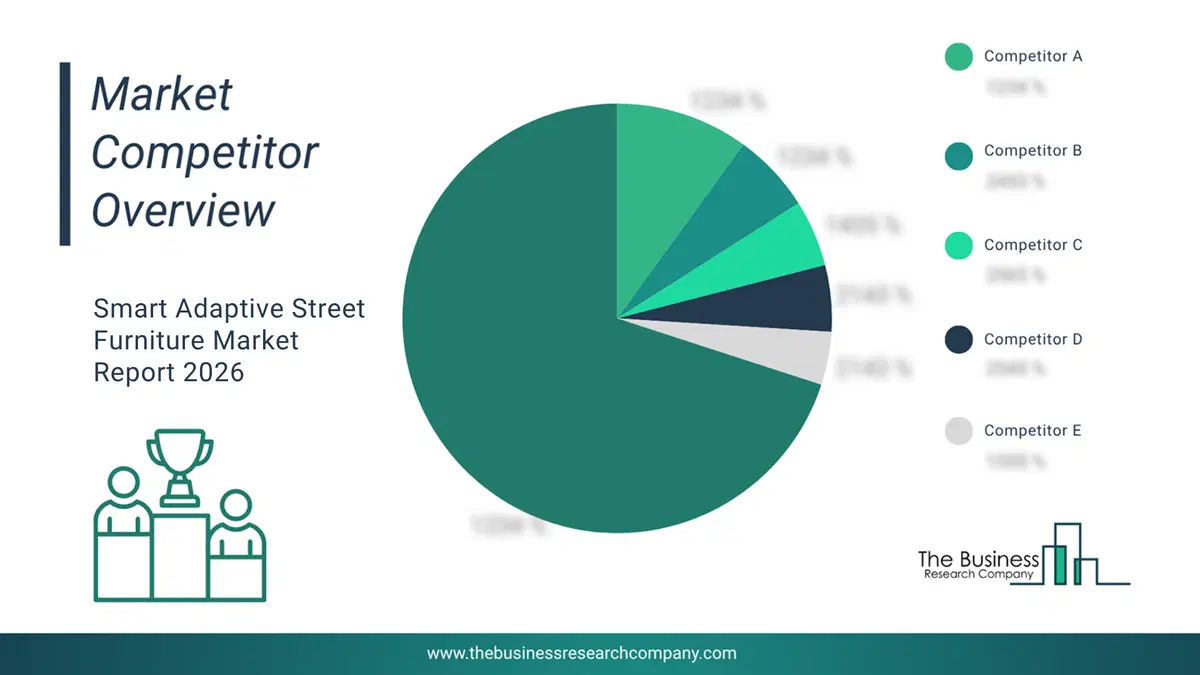
This chart is for illustrative purposes; the full report includes a detailed competitor analysis and comprehensive overview of the top 10 companies in the market.
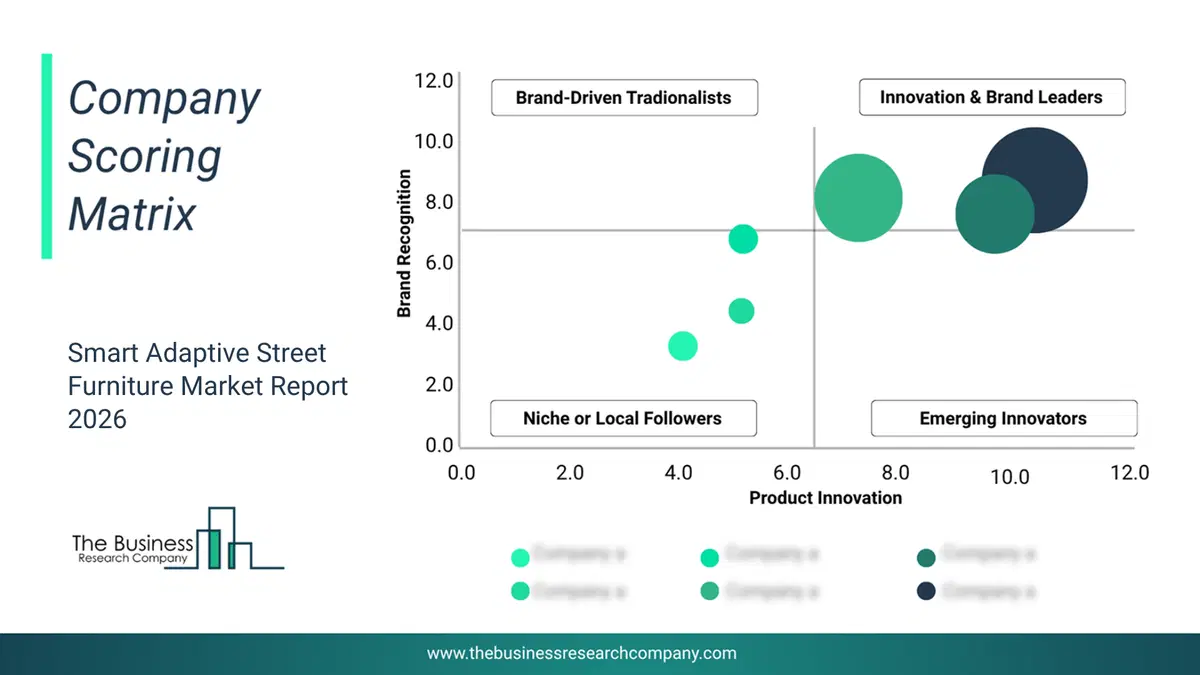
This chart maps companies by product innovation and brand strength, with bubble size indicating relative revenue, helping identify market leaders, challengers, and niche players. This is an illustrative chart; the full report provides a complete and accurate competitive analysis.
Global Smart Adaptive Street Furniture Market Trends and Insights
Major companies operating in the smart adaptive street furniture market are focusing on technological innovations, such as utility-grade performance, to enhance reliability, reduce operational costs, and improve urban infrastructure efficiency. Utility-grade performance refers to a high standard of reliability, durability, and safety designed to meet the rigorous requirements of utility and critical infrastructure operations. For instance, in November 2024, Ubicquia Inc., a US-based technology company, launched its next-generation UbiCell utility-grade universal lighting controller (UGU). The new controller is compatible with cobra head and decorative streetlights, offering utility-grade performance with robust surge protection and advanced electrical diagnostics. Powered by Ubicquia’s UbiVu cloud-based artificial intelligence (AI) platform, it delivers real-time monitoring of 32 data points per hour, enabling proactive maintenance, improved energy efficiency, and reduced operational costs.What Are Latest Mergers And Acquisitions In The Smart Adaptive Street Furniture Market?
In December 2024, Creators of the Outside World (CROWD), a Netherlands-based provider of outdoor public-space infrastructure including street furniture, public shelters, and cycling infrastructure, acquired Armada Mobility B.V. for an undisclosed amount. Through this acquisition, CROWD Group aims to strengthen its position in the smart adaptive street furniture market by integrating Armada Mobility’s multifunctional shelters, bike-parking systems, and smart-city furniture solutions into its portfolio. Armada Mobility B.V. is a Netherlands-based company that provides travel-information systems, multifunctional shelters, bicycle-parking solutions, and smart-city furniture for public transport and urban-mobility environments.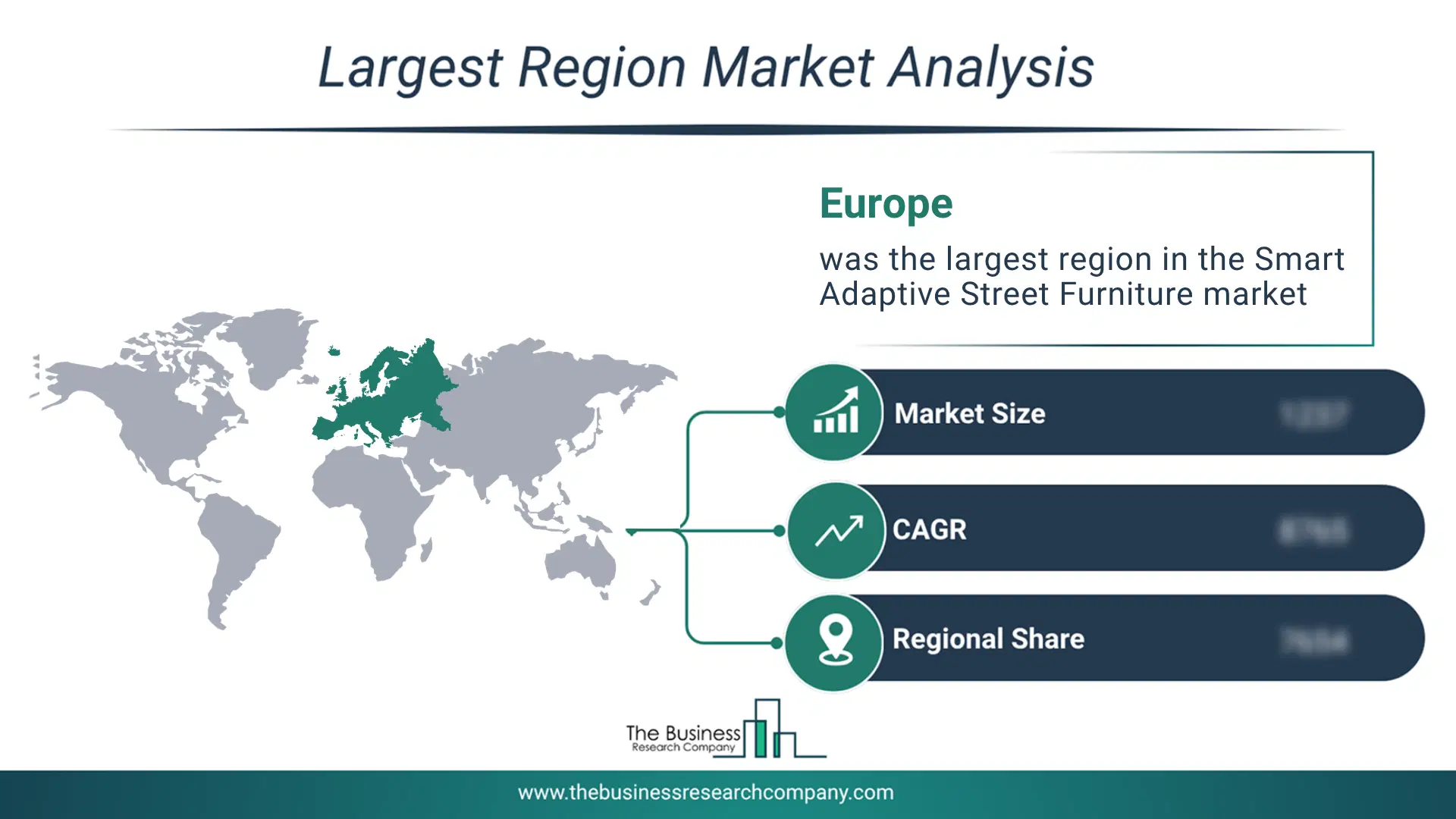
Regional Insights
Europe was the largest region in the smart adaptive street furniture market in 2025. Asia-Pacific is expected to be the fastest-growing region in the forecast period. The regions covered in this market report are Asia-Pacific, South East Asia, Western Europe, Eastern Europe, North America, South America, Middle East, Africa. The countries covered in this market report are Australia, Brazil, China, France, Germany, India, Indonesia, Japan, Taiwan, Russia, South Korea, UK, USA, Canada, Italy, Spain.What Defines the Smart Adaptive Street Furniture Market?
The smart adaptive street furniture market consists of sales of bike racks, public seating pods, interactive digital signage, smart bus shelters, and planters. Values in this market are ‘factory gate’ values, that is the value of goods sold by the manufacturers or creators of the goods, whether to other entities (including downstream manufacturers, wholesalers, distributors and retailers) or directly to end customers. The value of goods in this market includes related services sold by the creators of the goods.How is Market Value Defined and Measured?
The market value is defined as the revenues that enterprises gain from the sale of goods and/or services within the specified market and geography through sales, grants, or donations in terms of the currency (in USD unless otherwise specified). The revenues for a specified geography are consumption values that are revenues generated by organizations in the specified geography within the market, irrespective of where they are produced. It does not include revenues from resales along the supply chain, either further along the supply chain or as part of other products.
This chart presents market attractiveness based on a quantitative evaluation of growth, competition, strategic alignment, and risk, offering a clear view of opportunity areas for decision-making. This chart is for illustrative purposes; the full report contains the complete analysis.

This chart highlights the Total Addressable Market (TAM) by estimating the maximum revenue opportunity using an assumption-driven approach, supporting strategic planning and opportunity sizing across markets. The chart is illustrative; the full report provides a more comprehensive analysis.
What Key Data and Analysis Are Included in theSmart Adaptive Street Furniture Market Report 2026?
The smart adaptive street furniture market research report is one of a series of new reports from The Business Research Company that provides market statistics, including industry global market size, regional shares, competitors with the market share, detailed market segments, market trends and opportunities, and any further data you may need to thrive in the smart adaptive street furniture industry. The market research report delivers a complete perspective of everything you need, with an in-depth analysis of the current and future state of the industry.Smart Adaptive Street Furniture Market Report Forecast Analysis
| Report Attribute | Details |
|---|---|
| Market Size Value In 2026 | $5.46 billion |
| Revenue Forecast In 2030 | $9.7 billion |
| Growth Rate | CAGR of 15.7% from 2026 to 2030 |
| Base Year For Estimation | 2025 |
| Actual Estimates/Historical Data | 2020-2025 |
| Forecast Period | 2026 - 2030 |
| Market Representation | Revenue in USD Billion and CAGR from 2026 to 2030 |
| Segments Covered | Product Type, Technology, Application |
| Regional Scope | Asia-Pacific, Western Europe, Eastern Europe, North America, South America, Middle East, Africa |
| Country Scope | The countries covered in this market report are Australia, Brazil, China, France, Germany, India, Indonesia, Japan, Taiwan, Russia, South Korea, UK, USA, Canada, Italy, Spain |
| Key Companies Profiled | Delta Electronics Inc., Signify N.V., Valmont Industries Inc., JCDecaux SA, Daktronics Inc., Schréder Group, Landscape Forms Inc., Lappset Group Oy, Soofa Inc., Ekin Smart City Solutions, Iysert Energy Research & Development Pvt. Ltd., Bigbelly Solar LLC, Strawberry Energy Ltd., SEEDiA Sp. z o.o., EnGoPlanet Energy Solutions LLC, Sunbolt LLC, Cartelmatic SAS, ZANO Street Furniture Ltd., City Gecko d.o.o., Polymobyl SA. |
| Customization Scope | Request for Customization |
| Pricing And Purchase Options | Explore Purchase Options |