
Smart Court Market Report 2026
Global Outlook – By Type (External Network Deployment, Intranet Deployment), By Hardware (Courtroom Technology, Video Conferencing Solutions, Digital Evidence Management, Document Management Systems), By Services (Consulting Services, Support And Maintenance Services, Training Services, Integration Services, Data Migration Services), By Purpose Of Use (Dispute Resolution, Real-Time Evidence Sharing, Remote Hearings), By End-User Type (Court Systems, Law Firms, Government Agencies) – Market Size, Trends, Strategies, and Forecast to 2030
Smart Court Market Overview
• Smart Court market size has reached to $1.47 billion in 2025 • Expected to grow to $3.02 billion in 2030 at a compound annual growth rate (CAGR) of 15.5% • Growth Driver: Increasing Court Backlogs Fueling The Growth Of The Market Due To Infrastructure Gaps And Delayed Legal Proceedings • Market Trend: New Solution Enhances Digital Evidence Management Efficiency • North America was the largest region in 2025 and Asia-Pacific is the fastest growing region.What Is Covered Under Smart Court Market?
A smart court is a technology-enabled judicial system that integrates digital tools such as artificial intelligence (AI), big data, cloud computing, and blockchain to streamline legal processes. It allows for online case filing, virtual hearings, automated document handling, and real-time data analysis. The main purpose of a smart court is to enhance the efficiency, transparency, and accessibility of the justice system. The main types of smart courts are external network deployment and intranet deployment. External network deployment enables smart court systems to operate via cloud-based networks, allowing remote access to legal services such as hearings, evidence sharing, and AI-driven case management. It includes various hardware, such as courtroom technology, video conferencing solutions, digital evidence management, document management systems, and display solutions, with several services, including consulting services, support and maintenance services, training services, integration services, and data migration services. It is used for various purposes, such as dispute resolution, real-time evidence sharing, remote hearings, and client consultations, serving end-user including court systems, law firms, government agencies, and private corporations.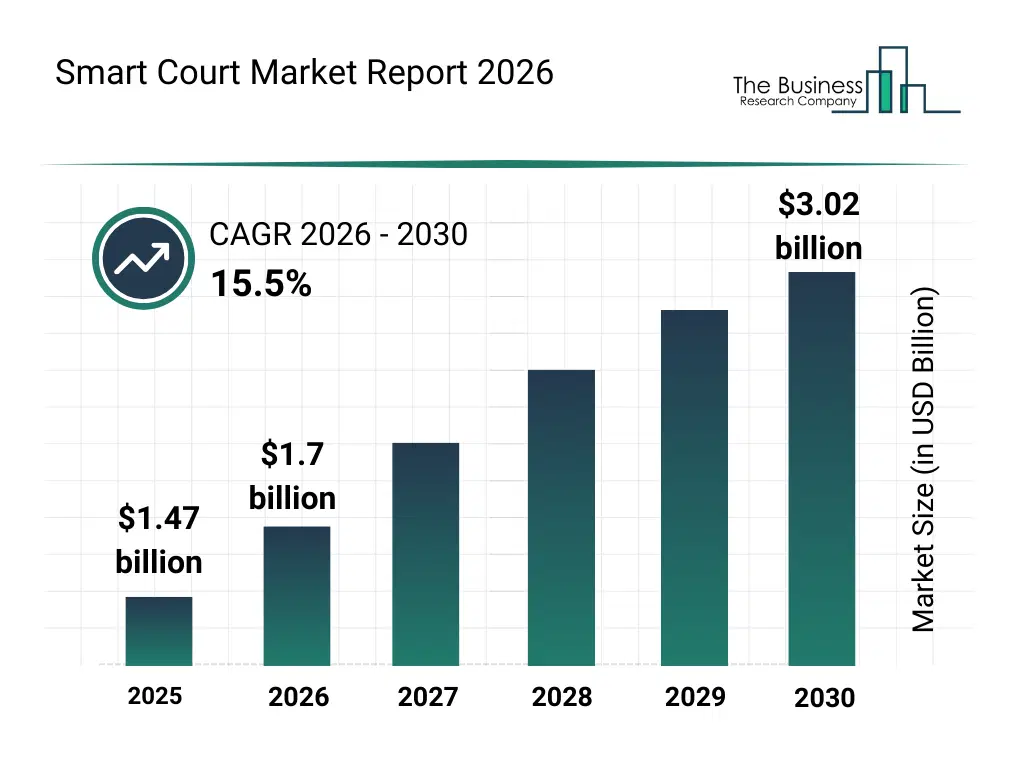
What Is The Smart Court Market Size and Share 2026?
The smart court market size has grown rapidly in recent years. It will grow from $1.47 billion in 2025 to $1.7 billion in 2026 at a compound annual growth rate (CAGR) of 15.8%. The growth in the historic period can be attributed to government-led judicial digitization initiatives, rising case volumes in courts, adoption of electronic filing systems, expansion of video conferencing in legal proceedings, early implementation of e-justice platforms.What Is The Smart Court Market Growth Forecast?
The smart court market size is expected to see rapid growth in the next few years. It will grow to $3.02 billion in 2030 at a compound annual growth rate (CAGR) of 15.5%. The growth in the forecast period can be attributed to increasing investments in smart governance infrastructure, rising demand for remote legal access, expansion of blockchain-based evidence systems, growing focus on data-driven judicial decision-making, increasing integration of cybersecurity in court systems. Major trends in the forecast period include increasing adoption of ai-enabled case management systems, rising use of virtual hearings and remote proceedings, growing integration of secure digital evidence platforms, expansion of cloud-based judicial infrastructure, enhanced focus on transparency and process automation.
Global Smart Court Market Segmentation
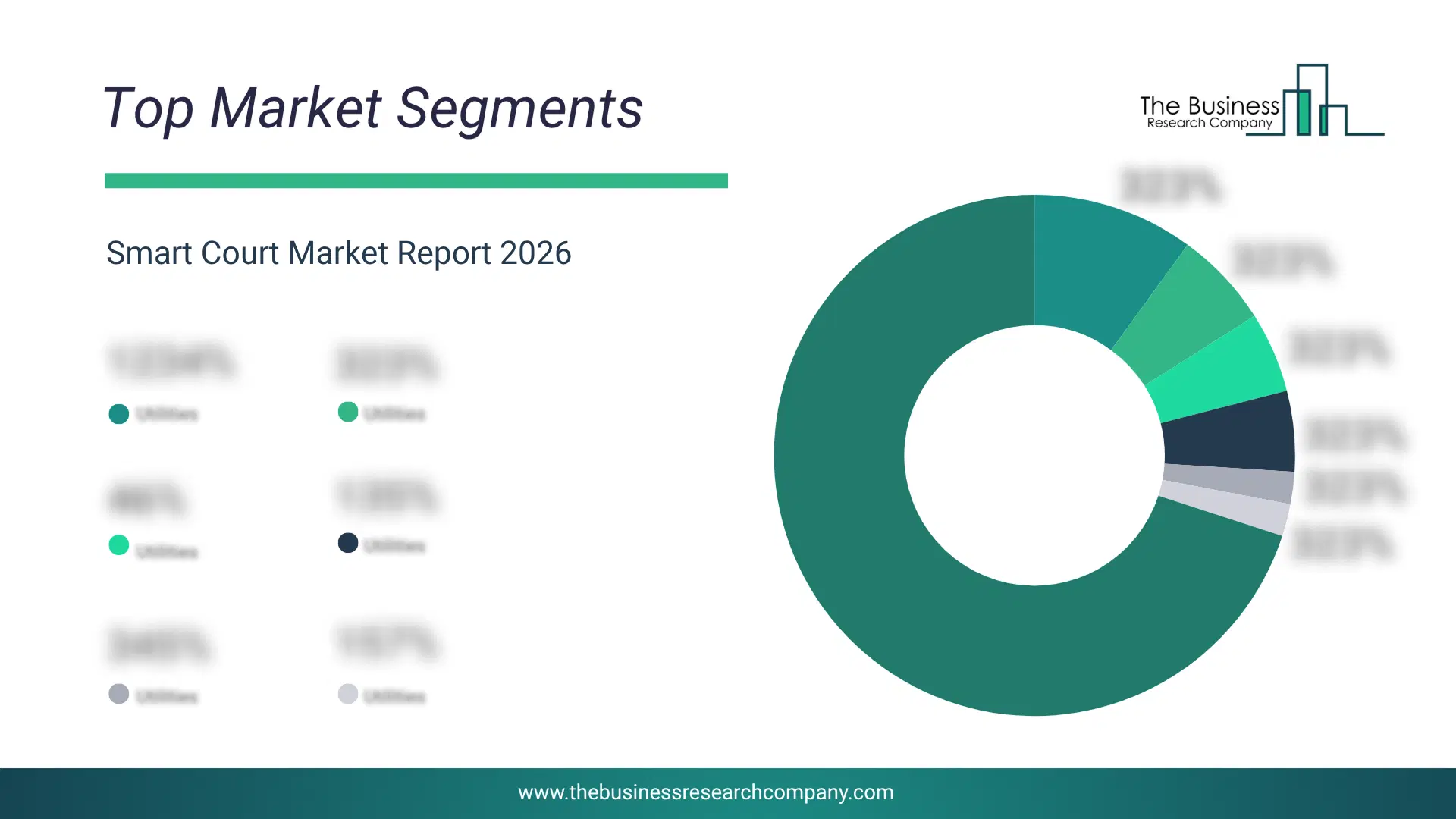
1) By Type: External Network Deployment, Intranet Deployment 2) By Hardware: Courtroom Technology, Video Conferencing Solutions, Digital Evidence Management, Document Management Systems 3) By Services: Consulting Services, Support And Maintenance Services, Training Services, Integration Services, Data Migration Services 4) By Purpose Of Use: Dispute Resolution, Real-Time Evidence Sharing, Remote Hearings 5) By End-User Type: Court Systems, Law Firms, Government Agencies Subsegments: 1) By External Network Deployment: Cloud-Based Case Management, Online Dispute Resolution Platforms, Public Access Portals, Remote Video Conferencing Solutions 2) By Intranet Deployment: Local Court Management Systems, Document Management Systems, Internal Judicial Analytics Tools, Secure Evidence Storage And Retrieval SystemsWhat Is The Driver Of The Smart Court Market?
The increasing court backlogs are expected to propel the growth of the smart court market going forward. Court backlogs refer to the accumulation of unresolved legal cases that remain pending in judicial systems over a long period. The rise in court backlogs is primarily due to insufficient judicial infrastructure, as many courts lack the necessary number of judges, courtrooms, and digital systems to efficiently handle the growing volume of cases, leading to prolonged delays in legal proceedings. Smart court helps reduce court backlogs by streamlining judicial processes through digital technologies. It minimizes delays with tools like e-filing, automated case management, and virtual hearings, enhancing overall efficiency and access to justice. For instance, in March 2025, according to the UK Parliament, a UK-based government administration, the backlogs in the Crown Court had reached 73,105 cases in September 2024, an increase from 67,573 cases in December 2023. Therefore, the increasing court backlogs are driving the growth of the smart court industry.Key Players In The Global Smart Court Market
Major companies operating in the smart court market are Microsoft Corporation, Huawei Technologies Co. Ltd., Tencent Holdings Limited, Cisco Systems Inc., Capgemini SE, Thomson Reuters Corporation, Tyler Technologies Inc., Relativity ODA LLC, iManage LLC, i3 Verticals Inc., Onit Inc., InfoTrack Pty Ltd, Equivant Inc., ZyLAB Technologies B.V., Synergy International Systems Inc., eFORCE Software Inc., Lawcus Inc., Relational Semantics Inc., UniCourt Inc., Beijing Internet Court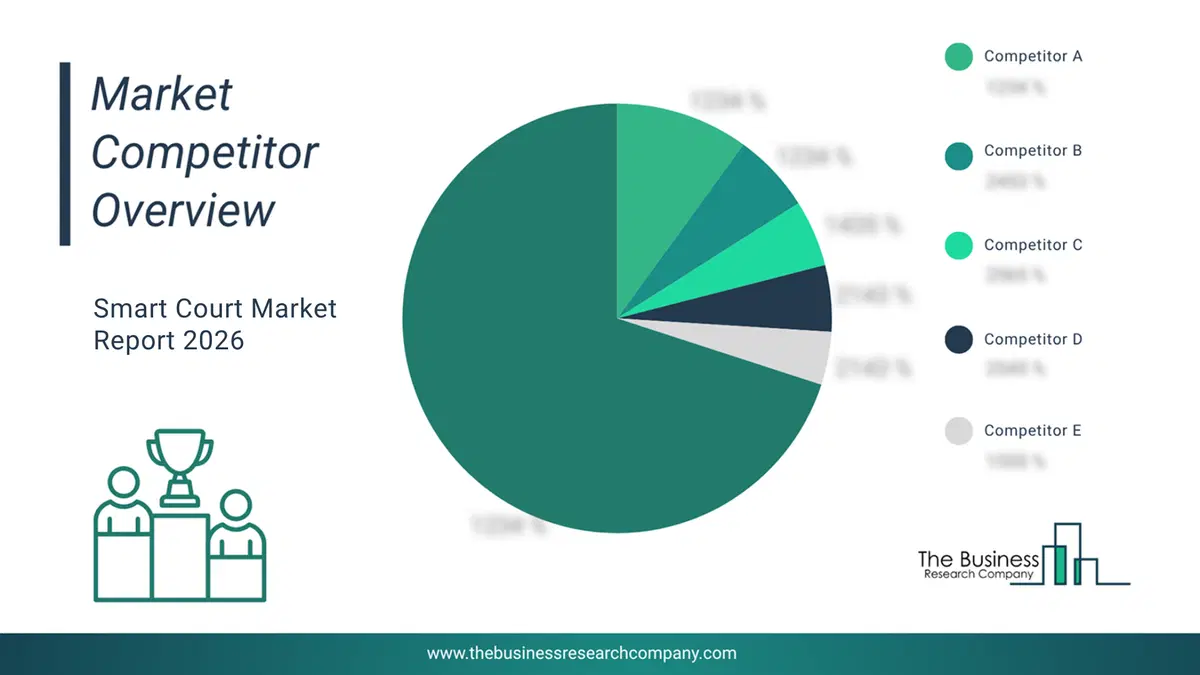
This chart is for illustrative purposes; the full report includes a detailed competitor analysis and comprehensive overview of the top 10 companies in the market.
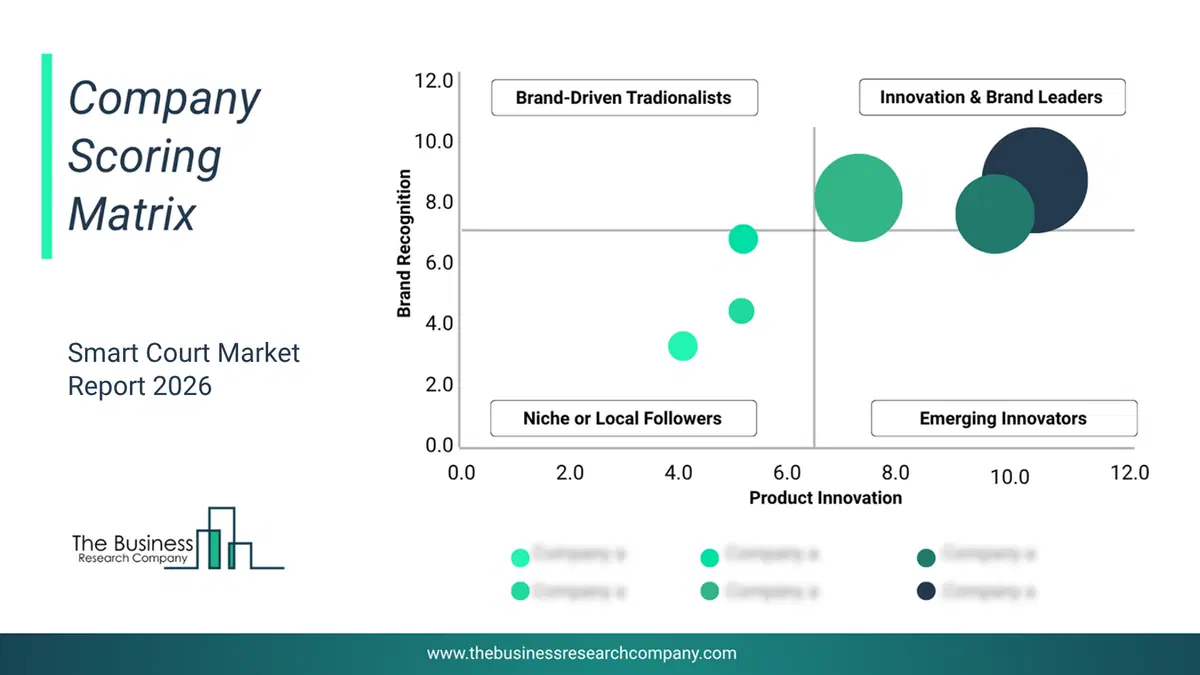
This chart maps companies by product innovation and brand strength, with bubble size indicating relative revenue, helping identify market leaders, challengers, and niche players. This is an illustrative chart; the full report provides a complete and accurate competitive analysis.
Global Smart Court Market Trends and Insights
Major companies operating in the smart court market are focusing on developing advanced solutions, such as digital evidence management systems, to support faster and more transparent judicial proceedings. A digital evidence management system is a secure solution that captures, organizes, and manages digital evidence while ensuring chain-of-custody integrity and streamlined court access. For instance, in June 2025, Milestone Systems, a Denmark-based provider of data-driven video technology, launched XProtect Evidence Manager, a new digital evidence management extension for its XProtect video management software. This solution is designed to be cost-effective, open, and built for choice, tackling the high costs and inflexibility of traditional proprietary systems by enabling organizations to efficiently manage, share, and store digital evidence on their terms. It offers workflow efficiency, license-free sharing, and storage flexibility, giving users freedom from vendor lock-in and reducing the total cost of ownership.What Are Latest Mergers And Acquisitions In The Smart Court Market?
In August 2023, Tyler Technologies Inc., a US-based govtech company, acquired Computing System Innovations Inc. (CSI) for an undisclosed amount. With this acquisition, Tyler enhanced its court automation capabilities by integrating CSI’s AI-driven document redaction and classification tools into its justice solutions portfolio, enabling smarter, faster, and more secure digital court processes. Computing System Innovations Inc. is a US-based AI-driven smart court provider.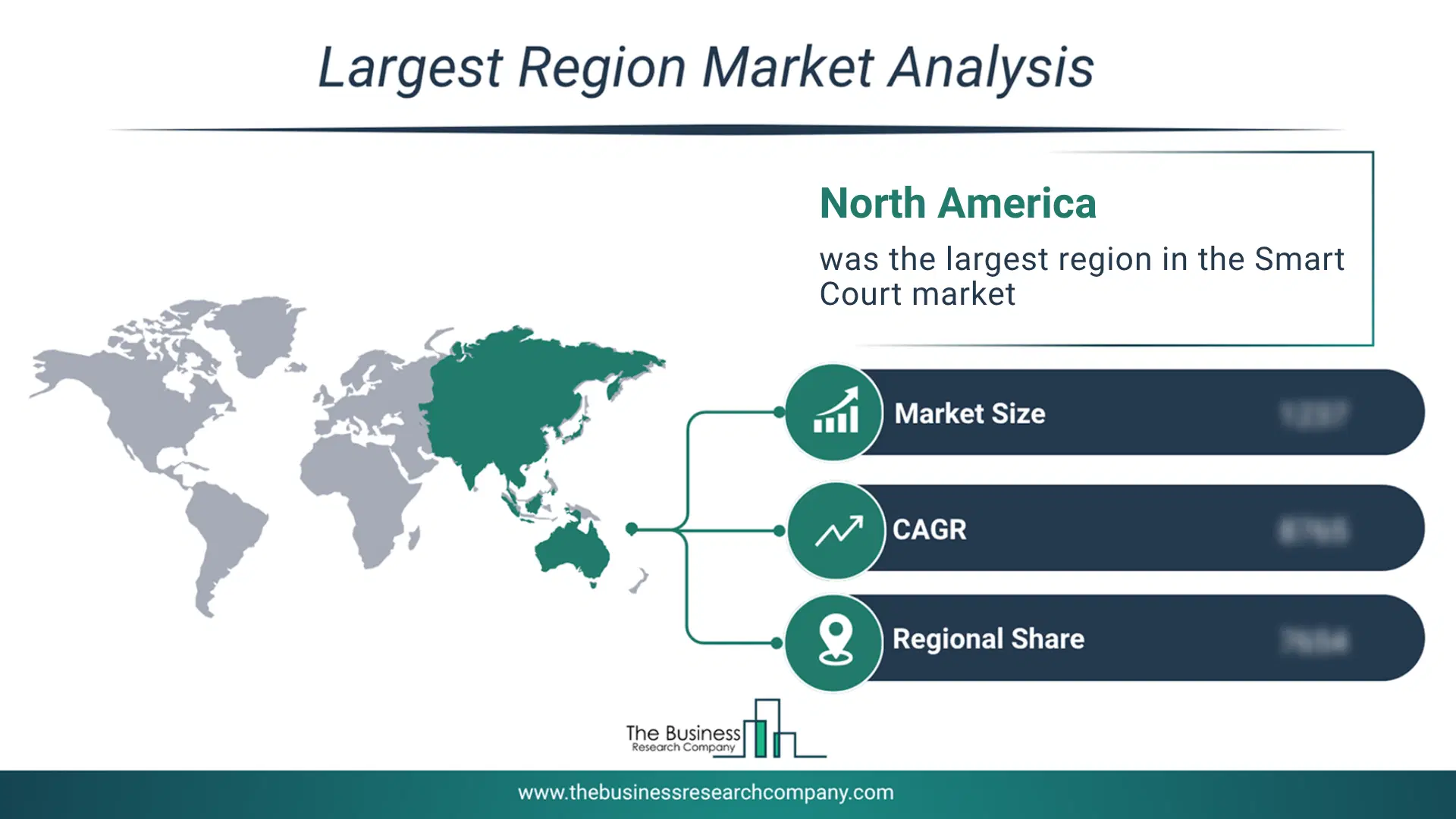
Regional Outlook
North America was the largest region in the smart court market in 2025. Asia-Pacific is expected to be the fastest-growing region in the forecast period. The regions covered in this market report are Asia-Pacific, South East Asia, Western Europe, Eastern Europe, North America, South America, Middle East, Africa The countries covered in this market report are Australia, Brazil, China, France, Germany, India, Indonesia, Japan, Taiwan, Russia, South Korea, UK, USA, Canada, Italy, Spain.What Defines the Smart Court Market?
The smart court market consists of revenues earned by entities by providing services such as virtual hearings, digital evidence submission, document digitization, and multilingual support. The market value includes the value of related goods sold by the service provider or included within the service offering. The smart court market also includes sales of smart cameras, surveillance systems, electronic voting systems, interactive touchscreen kiosks, and digital signature pads. Values in this market are ‘factory gate’ values; that is, the value of goods sold by the manufacturers or creators of the goods, whether to other entities (including downstream manufacturers, wholesalers, distributors, and retailers) or directly to end customers. The value of goods in this market includes related services sold by the creators of the goods.How is Market Value Defined and Measured?
The market value is defined as the revenues that enterprises gain from the sale of goods and/or services within the specified market and geography through sales, grants, or donations in terms of the currency (in USD unless otherwise specified). The revenues for a specified geography are consumption values that are revenues generated by organizations in the specified geography within the market, irrespective of where they are produced. It does not include revenues from resales along the supply chain, either further along the supply chain or as part of other products.
This chart presents market attractiveness based on a quantitative evaluation of growth, competition, strategic alignment, and risk, offering a clear view of opportunity areas for decision-making. This chart is for illustrative purposes; the full report contains the complete analysis.

This chart highlights the Total Addressable Market (TAM) by estimating the maximum revenue opportunity using an assumption-driven approach, supporting strategic planning and opportunity sizing across markets. The chart is illustrative; the full report provides a more comprehensive analysis.
What Key Data and Analysis Are Included in the Smart Court Market Report 2026?
The smart court market research report is one of a series of new reports from The Business Research Company that provides market statistics, including Market Report 2026?global market size, regional shares, competitors with the market share, detailed market segments, market trends and opportunities, and any further data you may need to thrive in the smart court Market Report 2026? The market research report delivers a complete perspective of everything you need, with an in-depth analysis of the current and future state of the Market Report 2026?Smart Court Market Report Forecast Analysis
| Report Attribute | Details |
|---|---|
| Market Size Value In 2026 | $1.7 billion |
| Revenue Forecast In 2030 | $3.02 billion |
| Growth Rate | CAGR of 15.8% from 2026 to 2030 |
| Base Year For Estimation | 2025 |
| Actual Estimates/Historical Data | 2020-2025 |
| Forecast Period | 2026 - 2030 |
| Market Representation | Revenue in USD Billion and CAGR from 2026 to 2030 |
| Segments Covered | Type, Hardware, Services, Purpose Of Use, End-User Type |
| Regional Scope | Asia-Pacific, Western Europe, Eastern Europe, North America, South America, Middle East, Africa |
| Country Scope | The countries covered in the report are Australia, Brazil, China, France, Germany, India, Indonesia, Japan, Taiwan, Russia, South Korea, UK, USA, Canada, Italy, Spain. |
| Key Companies Profiled | Microsoft Corporation, Huawei Technologies Co. Ltd., Tencent Holdings Limited, Cisco Systems Inc., Capgemini SE, Thomson Reuters Corporation, Tyler Technologies Inc., Relativity ODA LLC, iManage LLC, i3 Verticals Inc., Onit Inc., InfoTrack Pty Ltd, Equivant Inc., ZyLAB Technologies B.V., Synergy International Systems Inc., eFORCE Software Inc., Lawcus Inc., Relational Semantics Inc., UniCourt Inc., Beijing Internet Court |
| Customization Scope | Request for Customization |
| Pricing And Purchase Options | Explore Purchase Options |