
Smart Hospital Wayfinding Robot Market Report 2026
Global Outlook – By Component (Hardware, Software, Services), By Technology (Artificial Intelligence-Based, Sensor-Based, Radio Frequency Identification, Other Technologies), By Application (Patient Navigation, Visitor Assistance, Asset Tracking, Emergency Response, Other Applications), By End-User (Hospitals, Clinics, Specialty Centers, Other End-Users) - Market Size, Trends, Strategies, and Forecast to 2030
Smart Hospital Wayfinding Robot Market Overview
• Smart Hospital Wayfinding Robot market size has reached to $1 billion in 2025 • Expected to grow to $2.17 billion in 2030 at a compound annual growth rate (CAGR) of 16.6% • Growth Driver: Growing Emphasis On Patient-Centered Treatment Driving The Growth Of The Market Due To Rising Focus On Enhancing Patient Experience And Navigational Ease In Healthcare Facilities • Market Trend: Hospitals Adopt Robotics To Enhance Efficiency And Patient Care • North America was the largest region in 2025 and Asia-Pacific is the fastest growing region.What Is Covered Under Smart Hospital Wayfinding Robot Market?
A smart hospital wayfinding robot is an autonomous mobile system designed to assist patients and visitors in navigating complex hospital environments using interactive maps, voice guidance, and real-time location data. Its purpose is to improve hospital efficiency and patient experience by reducing confusion, saving staff time, and ensuring timely arrivals at appointments or departments. The main components of smart hospital wayfinding robots are hardware, software, and services. Hardware refers to the physical elements such as sensors, cameras, and robotic platforms, that enable autonomous navigation and interaction within hospital environments. These robots operate using technologies such as artificial intelligence-based systems, sensor-based systems, radio frequency identification, and others. Key applications include patient navigation, visitor assistance, asset tracking, emergency response, and others, with primary end users being hospitals, clinics, specialty centers, and others.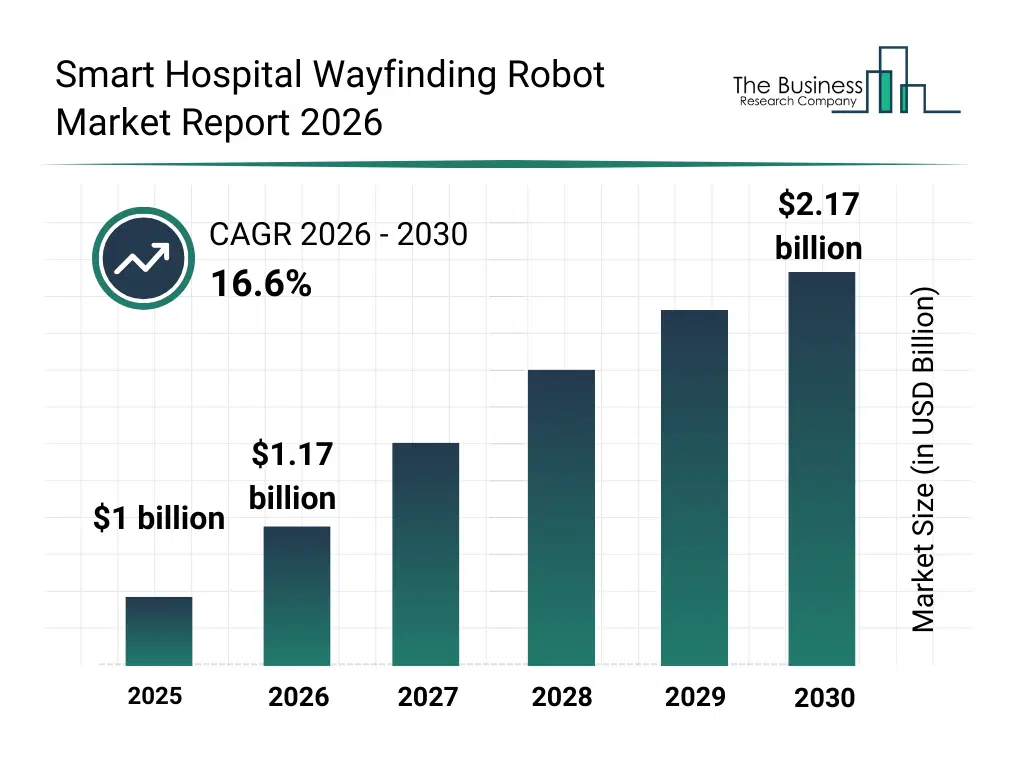
What Is The Smart Hospital Wayfinding Robot Market Size and Share 2026?
The smart hospital wayfinding robot market size has grown rapidly in recent years. It will grow from $1 billion in 2025 to $1.17 billion in 2026 at a compound annual growth rate (CAGR) of 16.9%. The growth in the historic period can be attributed to increasing complexity of hospital layouts, rising patient footfall in large healthcare facilities, adoption of service robots in hospitals, growing demand for operational efficiency, improvements in indoor navigation technologies.What Is The Smart Hospital Wayfinding Robot Market Growth Forecast?
The smart hospital wayfinding robot market size is expected to see rapid growth in the next few years. It will grow to $2.17 billion in 2030 at a compound annual growth rate (CAGR) of 16.6%. The growth in the forecast period can be attributed to increasing investments in smart hospital infrastructure, rising demand for contactless patient services, expansion of digital patient engagement tools, growing use of robotics in healthcare operations, advancements in indoor positioning technologies. Major trends in the forecast period include increasing deployment of autonomous navigation robots, rising adoption of AI-driven wayfinding systems, growing integration with hospital information systems, expansion of voice-enabled patient assistance, enhanced focus on patient experience optimization.
Global Smart Hospital Wayfinding Robot Market Segmentation
1) By Component: Hardware, Software, Services 2) By Technology: Artificial Intelligence-Based, Sensor-Based, Radio Frequency Identification, Other Technologies 3) By Application: Patient Navigation, Visitor Assistance, Asset Tracking, Emergency Response, Other Applications 4) By End-User: Hospitals, Clinics, Specialty Centers, Other End-Users Subsegments: 1) By Hardware: Display Screens, Sensors, Wheels And Motors, Cameras, Battery Systems 2) By Software: Navigation Management, Voice Recognition, Mapping And Localization, User Interface, Data Analytics 3) By Services: Installation Services, Maintenance Services, Training Services, Technical Support, Software UpdatesWhat Is The Driver Of The Smart Hospital Wayfinding Robot Market?
The increasing emphasis on patient-centered treatment is expected to propel the growth of the smart hospital wayfinding robot market going forward. Patient-centered treatment refers to a healthcare approach that prioritizes the individual needs, preferences, and values of patients throughout the care process. The rise in patient-centered treatment is driven by increased patient empowerment, as better access to information allows individuals to actively participate in decisions about their care. Smart hospital wayfinding robots help patient-centered treatment by reducing stress and confusion in navigating complex hospital environments, allowing patients to focus more on their care and well-being. For instance, in July 2023, according to the survey conducted by the National Health Service, a UK-based government department, 90.3% of patients felt involved in decisions about their care, up from 89.9% in 2022, while 93.0% expressed confidence and trust in their healthcare professional, consistent with the previous year. Therefore, the increasing emphasis on patient-centered treatment is driving the growth of the smart hospital wayfinding robot industry.Key Players In The Global Smart Hospital Wayfinding Robot Market
Major companies operating in the smart hospital wayfinding robot market are LG Electronics Inc., Panasonic Corporation, Singapore Technologies Engineering Ltd., Keenon Robotics Co. Ltd., Changi General Hospital Pte Ltd., UBTech Robotics Corp., SoftBank Robotics Group Corp., CenTrak Inc., Yujin Robot Co. Ltd., Pudu Robotics Co. Ltd., OrionStar Technology Co. Ltd., Pointr Ltd., Ateago Technology Co. Ltd., Bivocom Co. Ltd., PAL Robotics S.L., Robotlab Ltd., Botzee Inc., RIFE TECHNOLOGIES, PredictML Inc., iHub Robotics.
This chart is for illustrative purposes; the full report includes a detailed competitor analysis and comprehensive overview of the top 10 companies in the market.
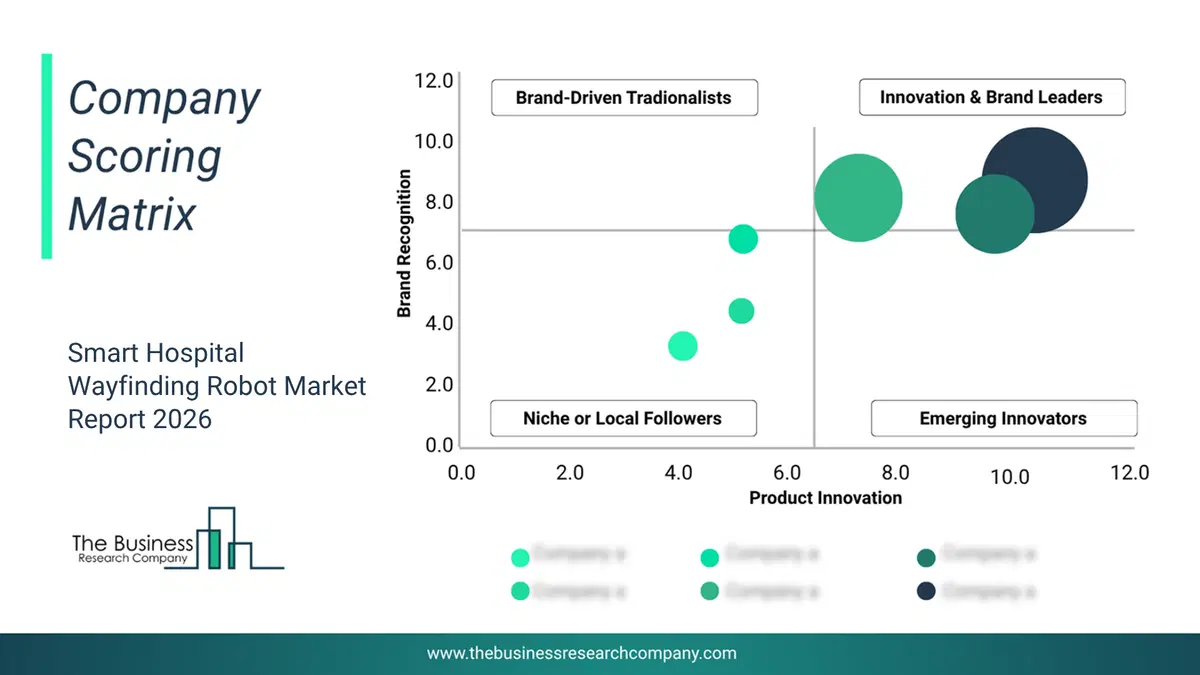
This chart maps companies by product innovation and brand strength, with bubble size indicating relative revenue, helping identify market leaders, challengers, and niche players. This is an illustrative chart; the full report provides a complete and accurate competitive analysis.
Global Smart Hospital Wayfinding Robot Market Trends and Insights
Major companies operating in the smart hospital wayfinding robot market are focusing on advanced innovations such as medicine delivery robots to enhance operational efficiency, reduce staff workload, improve patient care, and streamline medication distribution within healthcare facilities. Medicine delivery robots are autonomous robots that transport medications within hospitals, improving efficiency, reducing staff workload, and ensuring timely delivery to patient care areas. For instance, in July 2023, Changi General Hospital Pte Ltd, a Singapore-based medical institution, introduced three robots, including Edi the Robotic Navigator for patient wayfinding, MEDi the ‘Smart’ Medicine-Delivery-on-Wheels for efficient medication transport, and BLANKi the Blanket Delivery Robot to enhance patient comfort and reduce staff workload in the Emergency Department. These robots collectively aim to improve efficiency, streamline operations, and provide a better overall experience for patients and visitors. The hospital plans to expand its deployment across other areas of the campus to further optimize healthcare services. Early feedback from staff and patients has been positive, demonstrating the ability of robotics to transform patient care.What Are Latest Mergers And Acquisitions In The Smart Hospital Wayfinding Robot Market?
In May 2025, Ubitus K.K., a Japan-based company specializing in cloud computing, artificial intelligence, and interactive streaming technologies, collaborated with MacKay Memorial Hospital to co-develop and deploy AI-powered service robots within the hospital. Through this collaboration, Ubitus integrated its advanced AI and NVIDIA ACE virtual assistant technologies to create robots capable of providing patient registration assistance, companionship, and smart hospital wayfinding. This initiative enhanced the hospital’s operational efficiency and patient experience by enabling real-time navigation support and interactive communication between patients and hospital systems. MacKay Memorial Hospital, a Taiwan-based medical organization known for adopting innovative healthcare solutions.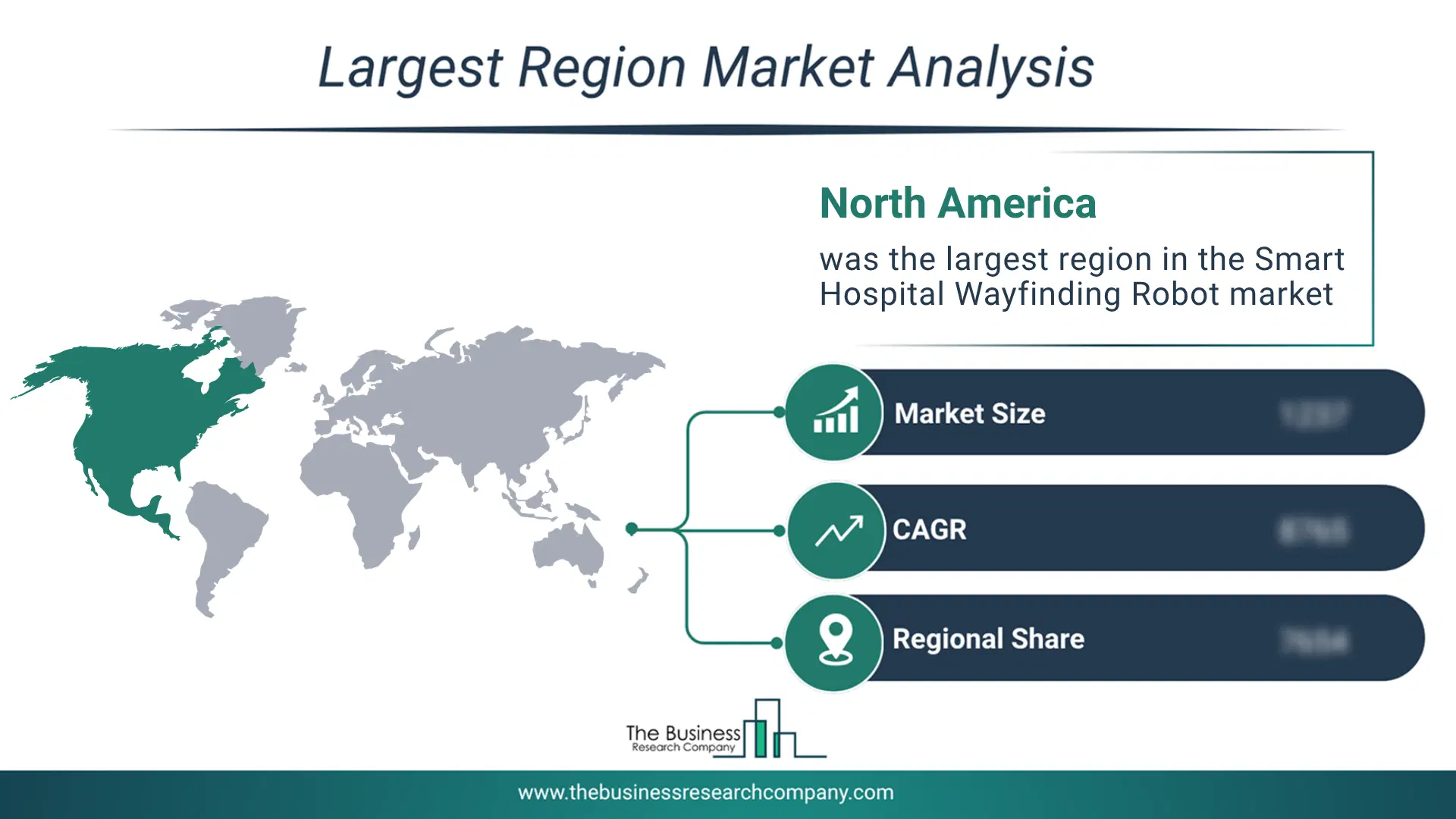
Regional Outlook
North America was the largest region in the smart hospital wayfinding robot market in 2025. Asia-Pacific is expected to be the fastest-growing region in the forecast period. The regions covered in this market report are Asia-Pacific, South East Asia, Western Europe, Eastern Europe, North America, South America, Middle East, Africa. The countries covered in this market report are Australia, Brazil, China, France, Germany, India, Indonesia, Japan, Taiwan, Russia, South Korea, UK, USA, Canada, Italy, Spain.What Defines the Smart Hospital Wayfinding Robot Market?
The smart hospital wayfinding robot market consists of revenues earned by entities by providing services such as real-time patient guidance, visitor assistance, automated hospital navigation, voice-enabled instructions, and integration with hospital databases. The market value includes the value of related goods sold by the service provider or included within the service offering. The smart hospital wayfinding robot market consists of sales of autonomous navigation robots, AI-powered guide robots, sensor-equipped escort robots, interactive information robots, and intelligent delivery and wayfinding robots. Values in this market are ‘factory gate’ values, that is, the value of goods sold by the manufacturers or creators of the goods, whether to other entities (including downstream manufacturers, wholesalers, distributors, and retailers) or directly to end customers. The value of goods in this market includes related services sold by the creators of the goods.How is Market Value Defined and Measured?
The market value is defined as the revenues that enterprises gain from the sale of goods and/or services within the specified market and geography through sales, grants, or donations in terms of the currency (in USD unless otherwise specified). The revenues for a specified geography are consumption values that are revenues generated by organizations in the specified geography within the market, irrespective of where they are produced. It does not include revenues from resales along the supply chain, either further along the supply chain or as part of other products.
This chart presents market attractiveness based on a quantitative evaluation of growth, competition, strategic alignment, and risk, offering a clear view of opportunity areas for decision-making. This chart is for illustrative purposes; the full report contains the complete analysis.

This chart highlights the Total Addressable Market (TAM) by estimating the maximum revenue opportunity using an assumption-driven approach, supporting strategic planning and opportunity sizing across markets. The chart is illustrative; the full report provides a more comprehensive analysis.
What Key Data and Analysis Are Included in the Smart Hospital Wayfinding Robot Market Report 2026?
The smart hospital wayfinding robot market research report is one of a series of new reports from The Business Research Company that provides market statistics, including industry global market size, regional shares, competitors with the market share, detailed market segments, market trends and opportunities, and any further data you may need to thrive in the smart hospital wayfinding robot industry. The market research report delivers a complete perspective of everything you need, with an in-depth analysis of the current and future state of the industry.Smart Hospital Wayfinding Robot Market Report Forecast Analysis
| Report Attribute | Details |
|---|---|
| Market Size Value In 2026 | $1.17 billion |
| Revenue Forecast In 2030 | $2.17 billion |
| Growth Rate | CAGR of 16.6% from 2026 to 2030 |
| Base Year For Estimation | 2025 |
| Actual Estimates/Historical Data | 2020-2025 |
| Forecast Period | 2026 - 2030 |
| Market Representation | Revenue in USD Billion and CAGR from 2026 to 2030 |
| Segments Covered | Component, Technology, Application, End-User |
| Regional Scope | Asia-Pacific, Western Europe, Eastern Europe, North America, South America, Middle East, Africa |
| Country Scope | The countries covered in the report are Australia, Brazil, China, France, Germany, India, Indonesia, Japan, Taiwan, Russia, South Korea, UK, USA, Canada, Italy, Spain |
| Key Companies Profiled | LG Electronics Inc., Panasonic Corporation, Singapore Technologies Engineering Ltd., Keenon Robotics Co. Ltd., Changi General Hospital Pte Ltd., UBTech Robotics Corp., SoftBank Robotics Group Corp., CenTrak Inc., Yujin Robot Co. Ltd., Pudu Robotics Co. Ltd., OrionStar Technology Co. Ltd., Pointr Ltd., Ateago Technology Co. Ltd., Bivocom Co. Ltd., PAL Robotics S.L., Robotlab Ltd., Botzee Inc., RIFE TECHNOLOGIES, PredictML Inc., iHub Robotics. |
| Customization Scope | Request for Customization |
| Pricing And Purchase Options | Explore Purchase Options |